How to Design an Onboarding Process? HR Onboarding Automation Guide | Recommended Onboarding Management System

From labor insurance enrollment deadlines to probation tracking, this article fully dissects the seven key steps, legal obligations, and common errors in the onboarding process for new employees in Taiwanese companies, and explains how to replace paper processes with an onboarding management system.
The onboarding process is a standard procedure for companies to complete a series of administrative tasks required by law before and after an employee officially starts work, including labor insurance enrollment, signing of employment contracts, account activation, and training arrangements. A well-designed onboarding process not only enables new employees to quickly get started on their first day but also reduces HR firefighting costs, avoids regulatory penalties, and establishes a positive first impression of the company. According to the Labor Standards Act, the Labor Insurance Act, and the National Health Insurance Act, employers are required to handle labor insurance, prepare employment contracts, and establish personnel data from the employee's first day of work. Failure to process these in a timely manner may result in fines. This article completely dissects how to establish a onboarding system that complies with Taiwanese regulations and reduces administrative burdens, covering legal obligations, process design, common bottlenecks, and digital tools.
Legal Preparations Before Onboarding
Before the new employee steps into the company, HR must complete several legally required tasks with deadlines. These deadlines are not recommendations but legal requirements, and failure to comply may lead to penalties from the authorities.
Table: Legal Enrollment Deadlines for New Employees
| Item | Legal Deadline | Regulatory Authority | Penalty for Delay |
|---|---|---|---|
| Labor Insurance (including Employment Insurance) | On the day of onboarding | Labor Department, Labor Insurance Agency | Monthly fines |
| Occupational Accident Insurance | On the day of onboarding | Labor Department, Labor Insurance Agency | Monthly fines |
| National Health Insurance | Within 3 days of obtaining eligibility | Ministry of Health and Welfare, National Health Insurance Administration | Retroactive payment and interest |
| Labor Retirement Fund Contribution | Notify within 7 days of onboarding | Labor Department, Labor Insurance Agency | Monthly fines |
According to announcements from the Labor Department, employers should enroll employees in labor insurance and employment insurance on their first day of work; if the onboarding day coincides with a holiday or public holiday, the Labor Insurance Agency's electronic system allows for supplementing enrollment through a "subsequent declaration" method. For national health insurance, the insurance agency mandates that employers must declare enrollment within 3 days of the employee obtaining insured status.
In addition to the enrollment obligations, employers must also prepare written employment contracts. While Article 2 of the Labor Standards Act does not require a written form, it is recommended to set it in writing, covering items such as job content, salary, hours of work, and probation period agreements, with each party retaining a copy.
In Brief
Labor insurance and occupational accident insurance must be processed on the day of onboarding, national health insurance within 3 days, and retirement fund contributions within 7 days; the three deadlines are different.
The Seven Steps of Standard Onboarding Process
A complete onboarding process encompasses not only HR's administrative tasks but also the entire chain of inter-departmental cooperation.
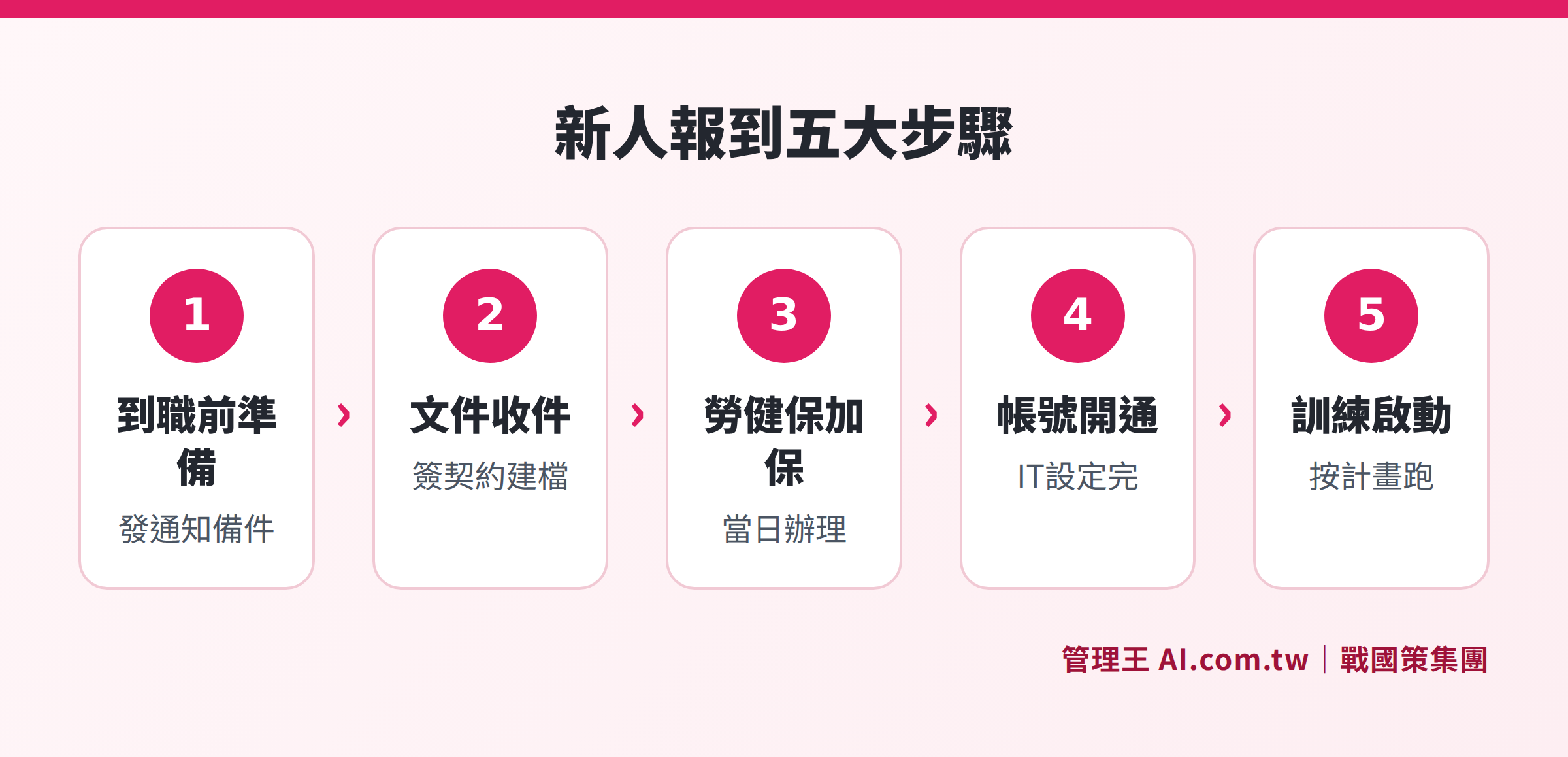
The seven standard steps from acceptance confirmation to probation completion assessment
- Acceptance Confirmation and Pre-boarding Notification: Send a notification letter after acceptance, detailing the start date, location, list of documents to bring (such as ID card, bank book, diploma, health check report), and parking or transportation information.
- Receipt of Onboarding Documents and Record Creation: On the day of onboarding, collect basic information, fill out employee information forms, sign the employment contract, NDA or confidentiality agreement, and IP agreement, and establish the personnel master file.
- Enrollment in Labor Insurance and Retirement Fund: On the day of onboarding, handle labor insurance, employment insurance, and occupational accident insurance with the Labor Insurance Agency; complete health insurance enrollment declaration within 3 days; set the retirement fund contribution rate within 7 days.
- IT Account and Equipment Activation: Grant system access rights (e.g., ERP, email, collaboration tools) based on job position, distribute computer, ID card, access card, and confirm that the necessary hardware and software are ready.
- Introduction to Company Environment and Policies: Familiarize the new employee with the work environment, key colleagues, and company regulations (such as work rules, leave policies, travel expense requirements), and explain emergency contact procedures.
- Training Course Arrangements and Assignments: Plan training programs for new employees based on their job roles, including occupational safety training, product knowledge, system operation, and assign a "partner" or "mentor."
- Probation Tracking and Assessment: Set 30/60/90 day milestones, conduct regular check-ins, gather feedback on new employee satisfaction, and conduct formal evaluation interviews upon the end of the probation period.
Common Bottlenecks in Onboarding and Solutions
Many small and medium-sized enterprises operate their onboarding processes through verbal explanations or paper forms, leading to vulnerabilities in the following areas:
Table: Common Issues in Onboarding Process and Corresponding Solutions
| Common Issues | Causes | Recommended Solutions |
|---|---|---|
| Forgetting to Enroll in Labor Insurance on the Onboarding Day | HR lacks a reminder mechanism | The system automatically triggers an enrollment reminder after creating the new employee's master record |
| Computers and Accounts Not Ready on the First Day | The IT department did not receive prior notification | Automatically assign onboarding checklist tasks to the IT department |
| Forgetting to Have the New Employee Sign the Contract | Paper processes are prone to omissions | Automatically send the electronic contract prior to onboarding for online signing |
| Documents Filed All Over the Place | Mixing Excel and paper usage | Consolidate personnel master files for centralized storage, supporting PDF uploads |
| No Follow-Up on New Employee Training Progress | Training lacks system tracking | The new employee training system automatically assigns courses and tracks completion rates |
| Forgetting to Evaluate When Probation Ends | No automatic notifications | The system automatically reminds supervisors to fill out evaluations 7 days before the end of the probation period |
Among these, labor insurance enrollment is the most easily overlooked item with the clearest penalties. According to the Labor Department's explanation, even for one day of employment, the employer has an obligation to enroll on the same day; failure to do so may result in monthly penalties per person, and back payment of insurance premiums is required.
Checklist of Onboarding Documents: Essential Data Collection Items for HR
The documents needed for onboarding can be categorized into two types: regulatory necessities and management recommendations:
Regulatory Necessities (Based on Article 7 of the Labor Standards Act, a work record must be established)
- Copy of ID card (front and back)
- Employment contract (two originals; one for the company and one for the employee)
- Labor insurance enrollment declaration information
- National health insurance enrollment application
- Confirmation of retirement fund contribution rate
Management Recommended Documents
- Employee basic information form (emergency contact, address, education background)
- Bank account for salary transfer
- Copy of diploma or related qualifications
- Company confidentiality agreement (NDA)
- Intellectual property-related agreements
- Health check report (specific roles may require a pre-employment health check under the Labor Health Protection Regulations)
It is recommended to save all documents electronically, upload scanned paper versions to the HR system for easy reference and audits later on. Regarding document retention periods, salary-related data should be kept for at least seven years according to tax regulations; personal data should be deleted or anonymized after the purpose of retention ceases or the retention period expires according to the Personal Data Protection Act; employment contracts should be retained throughout the labor relationship and then calculated for retention years after termination.
Common Legal Risks in the Onboarding Process and Prevention
Even well-structured companies may encounter legal pitfalls in the details. Here are the most frequently observed risk points in practice:
Improper Probation Agreement: Reducing salary or not granting days off in employment contracts by claiming that "probation periods are not subject to labor laws" is considered an invalid agreement. Probation employees are still protected under the Labor Standards Act, and attendance, salary, and insurance regulations apply.
Oral Agreements Not Documented: Verbal agreements on salary adjustments or benefit promises, if not written into the contract, can lead to disputes in the future. It is recommended to confirm all verbal commitments in writing in the offer letter or as an attachment to the employment contract.
Failure to Process Enrollment by Required Deadlines: As mentioned, enrollment is required on the day for labor insurance, within 3 days for health insurance, and within 7 days for retirement fund contributions; the most commonly missed deadline is for health insurance due to the complexity of the application paperwork. It is advisable to establish an SOP with systems that remind these deadlines.
Failure to Timely Unenroll Departing Employees from Insurance: After an employee's departure, the employer must handle the unenrollment from labor and health insurance on the day of departure. If unenrollment is delayed, the employer may incur unnecessary insurance premiums and may affect the departing employee’s new insurance enrollment timeline.
Improper Handling of Personal Data: Collecting employee personal data (such as ID card details, bank account numbers, health check information) falls under the scope of the Personal Data Protection Act. Employers must inform employees of the purpose of data collection and usage and establish relevant security measures to prevent data breaches.
Establishing a standardized onboarding process combined with automatic reminders from a system is the most effective way to prevent the above-mentioned risks. The smaller the business, the more it relies on individual memory, and systematic tools can effectively fill the gaps in personnel resources. Especially when HR wears multiple hats (e.g., also handling payroll, training, recruiting), standardized processes allow under-resourced companies to maintain compliance levels and prevent delays in onboarding tasks when an employee leaves or is on leave.
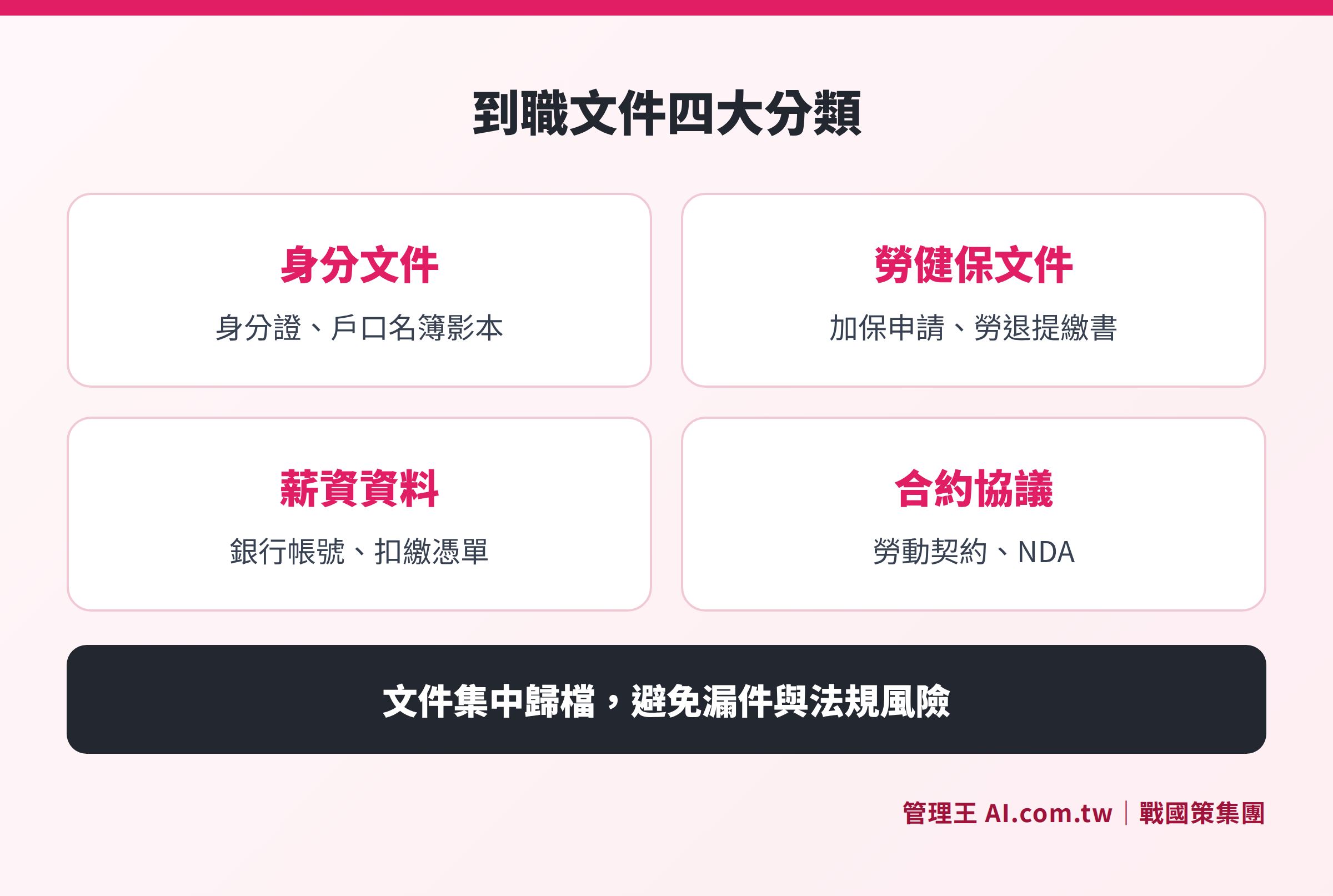
Checklist of documents required by law and management recommendations
Probation Period Management and Key to Retaining New Employees
The probation period is the most vulnerable time for retaining new employees and is also the stage where HR easily overlooks follow-ups. The onboarding experience in the first 90 days has a direct impact on whether new employees decide to stay long-term; if supervisors and HR do not systematically track progress, they often only realize the issue when the new employee resigns.
30-Day Milestone: Confirm that the new employee understands job responsibilities, is familiar with systems/tools, and knows key colleagues; direct supervisors conduct the first check-in to assess job adaptation status and identify any unresolved resource gaps.
60-Day Milestone: New employees should be able to independently complete core job responsibilities; confirm that essential training course completion rates and quarterly or monthly KPI goals are set; proactively gather initial feedback from new employees regarding the work environment, team atmosphere, and tool support.
90-Day Milestone (Probation Evaluation): Supervisors and HR jointly fill out the probation evaluation form, covering aspects such as work quality, attendance, learning speed, and cultural adaptation; formally inform the evaluation results and confirm whether to transition the employee to formal status or extend the probation period as agreed. If they decide not to transition, legal notice or severance pay must be given.
Without systematic tracking, relying on supervisors' memory can cause these three milestones to be postponed by other urgent matters, leading to new employees feeling neglected and leaving the company, forcing the company to reinvest in recruitment and onboarding costs.
Onboarding Challenges for Multiple Locations and Remote Employees
For companies with multiple branches, offices in various locations, or using remote working models, the difficulty of the onboarding process increases exponentially:
Common Issues for Multiple Branches
- Each branch supervisor handles onboarding on their own, leading to inconsistent processes and difficult audits
- Labor and health insurance enrollment is handled uniformly by headquarters HR, but branch supervisors do not promptly report onboarding dates, causing delays in enrollment
- Paper contracts require back-and-forth shipping between headquarters and branches, wasting time and effort
- Computer equipment and ID cards must be logistics-ready in advance; otherwise, new employees have no equipment on their first day
Special Considerations for Remote Employee Onboarding
- It is advisable to handle employment contracts and NDAs with electronic signatures to save on shipping time; according to the Electronic Signature Act, compliant electronic signatures have the same legal effect as paper signatures
- Logistics for equipment must be arranged in advance to ensure that necessary hardware for remote work is delivered before the employee starts
- Welcome meetings should be conducted online, and it is suggested to record them for future reference in the new employee training database
- For remote employees, the recommended clocking method is GPS positioning or WiFi identification to ensure attendance records are complete
The advantage of using an onboarding management system is that regardless of where the new employee is onboarding, HR can see the completion status of everyone's onboarding checklist from the same backend, branch supervisors have their own dashboards, and headquarters HR has a global perspective, eliminating information scattered in various LINE groups.
How to Automate Onboarding with 管理王
The 管理王 AI.com.tw onboarding automation system transforms the seven steps mentioned above into an auto-enabled workflow. Once HR establishes a new employee's master file and inputs the start date in the system, the system automatically generates 20-30 tasks based on the role and department, precisely assigning them to corresponding responsible parties—IT opens accounts, HR prepares contracts, administration provides computers, supervisors prepare workstations—each task has a designated person and a deadline, ensuring nothing is missed.
Main features include:
- Automatically Generated Onboarding Checklist: Create a to-do list based on job position templates, allowing supervisors to see in real-time which task is stuck on the dashboard
- Electronic Contracts Automatically Sent: The electronic contract system automatically sends the employment contract, NDA, and IP agreements for online signing prior to onboarding and archives them automatically after signing
- IT Account Activation Reminders: Integrate with systems such as Microsoft 365 and Google Workspace, triggering activation requests automatically based on job position
- Welcome Message and Training Assignments: Automatically trigger a welcome message on the first day and assign necessary courses through the new employee training system
- Automatic Probation Tracking: Automatically send check-in reminders at 30/60/90 days and prompt supervisors to fill out evaluations 7 days before the end of the probation period
The HR system is responsible for centralized management of employee master files, natively integrated with the payroll calculation system, the attendance clock-in system, and the performance management system, eliminating the need for API integration, allowing data to flow within the same system.
A free plan can be used indefinitely, allowing companies with fewer than 10 employees to experience the full onboarding automation features; if advanced AI features and more member counts are required, consider evaluating the pricing plan for the suitable subscription option.
Let Our Consultants Assist in Establishing Onboarding SOP
Free consultation on how to upgrade the onboarding process from paper to automated systems, suitable for companies with 10 to 200 employees.
Free Consultation Hotline: 0800-003-191
LINE Official Account: @119m
Official Website: app.AI.com.tw
Free Trial: Apply for 管理王 Now
Frequently Asked Questions
Do I need to enroll in labor insurance on the same day as onboarding?
Yes. According to announcements from the Labor Department, employers must handle labor insurance (including employment insurance) and occupational accident insurance enrollment on the same day as the employee's onboarding. If the onboarding day coincides with a holiday or public holiday, it can be processed through the Labor Insurance Agency's e-system by means of subsequent declaration; the insurance coverage counts from the day of employment. Failure to comply may result in penalties from the regulatory authority.
Is a written employment contract necessary?
While the Labor Standards Act does not strictly require employment contracts to be in writing, oral contracts also have legal effect. However, written contracts can help avoid disputes in the future, and a written contract is typically required when applying for work permits for foreign employees. It is advisable for employers to adopt written forms, with both parties retaining signed originals that clearly outline important terms (salary, position, hours of work, probation period).
What is the maximum duration for a probation period?
The Labor Standards Act does not explicitly stipulate a maximum limit for probation periods, but commonly, three months is standard practice and generally does not exceed six months. Employees are still protected under the Labor Standards Act during the probation period, and employers cannot dismiss them arbitrarily; if it is necessary to terminate the contract, severance pay must be provided according to the law (unless there is a reasonable agreement for termination before three months, which may still be contentious; consulting the labor bureau is recommended).
How long does the onboarding process take to complete?
From receiving the offer notice to completing all legal and administrative tasks, it typically takes one to two weeks. Legal insurance enrollments (labor and health insurance, retirement) need to be completed on the onboarding day or within 7 days; IT accounts usually must be applied for 3 to 5 working days in advance; complete new employee training plans are typically progressively completed within 30 to 90 days. Using automation tools can significantly reduce manual tracking costs.
How long should HR retain personnel data after an employee leaves?
According to Article 30 of the Labor Standards Act and relevant tax regulations, salary data should be retained for at least seven years; performance and attendance records are recommended to be kept for three to five years; personal data should be deleted or anonymized after the purpose of retention has ceased or the retention period has expired, as stipulated by the Personal Data Protection Act. The 管理王 system defaults to retaining data for seven years but can adjust retention periods for different fields as needed.
Data Sources
- Labor Department - Employers Should Enroll Employees in Labor Insurance on Their First Day
- Labor Department Labor Insurance Bureau - Common Questions on Insurance Coverage
- Ministry of Health and Welfare National Health Insurance Administration - Enrollment Declaration for Insured Persons
- National Regulations Database - Labor Standards Act
- National Regulations Database - Labor Retirement Fund Act
This article is for informational purposes only and does not constitute legal or labor advice. Actual references should follow the latest announcements from the responsible authorities.