How to Conduct Onboarding Training? A Complete Guide from Day One to Probation Period | Recommended Onboarding Training Systems

Onboarding training is more than just handing out a manual. This article provides a comprehensive breakdown of how companies can establish systematic onboarding training to improve retention rates and the quality of the probation period, from the 30/60/90-day plan framework, statutory obligations, to common reasons for failure.
Onboarding training is a systematic process for companies to transform new employees from "strangers" into "assets," encompassing job orientation, skills training, cultural integration, and probation tracking. Effective onboarding is not just about issuing an employee handbook; it's about a structured 30/60/90-day learning map that informs newcomers on their first day about what they need to learn and the standards to meet over the next three months. Research shows that decisions on long-term retention are made during the first 90 days of employment; companies lacking systematic training have turnover rates much higher within six months than those with complete onboarding processes. For SMEs, the direct costs of re-recruiting and training an employee can be significant—from posting job vacancies to probationary salaries, this represents real losses. Establishing a replicable, trackable, and continuously optimized onboarding system is one of the most leveraged investments to improve retention rates.
What is Onboarding Training? Definition and Core Objectives
Onboarding Training is a systematic learning and integration program designed by companies for new employees, aiming to equip them with the knowledge, skills, and behavioral norms needed to perform their jobs effectively in the shortest time possible while fostering a sense of organizational culture identity.
Onboarding training typically includes three levels:
- Administrative Check-in: Signing labor contracts, enrolling in health insurance, activating accounts, equipment handover, personal data declaration, etc.
- Skills Training: Professional knowledge, operational processes, SOPs, and tool usage directly related to the job.
- Cultural Integration: Company values, communication styles, team collaboration habits, mentor pairing (Mentoring).
All three levels are essential. If only administrative check-in is done, newcomers won’t know how to perform tasks; if only skills training occurs, newcomers won’t know the reason behind their work; neglecting cultural integration leads newcomers to feel out of place and leave quickly.
In a nutshell
Onboarding training is not just a welcoming activity; it is a systematic process that transforms new hires from "strangers" to "insiders" from their first day of employment until the end of the probation period.
What Are the Legal Obligations for Onboarding Training in Taiwanese Enterprises?
According to the "Occupational Safety and Health Education and Training Regulations" (established by the Ministry of Labor), employers must provide general safety and health education and training for newly hired workers or workers changing jobs, with a minimum statutory hour requirement of 3 hours for general positions.
Table: Minimum Statutory Safety and Health Training Hours (According to Occupational Safety and Health Education and Training Regulations)
| Target Audience | Minimum Hours |
|---|---|
| General workers (including administrative staff) | 3 hours |
| Special operations involving production machinery, welding, chemicals, etc. | 3 + 3 hours (including basic training) |
| All levels of supervisory personnel | 3 + 6 hours (including management courses) |
| Existing employees (every 3 years) | At least 3 hours |
In addition, according to the "Labor Standards Act" and related interpretations, employers must pay wages during the pre-employment training period (wages cannot be deducted under the pretext of unpaid training). Labor Standards Act protections apply during training periods, including hour calculations and minimum wage regulations.
Furthermore, under Article 32 of the "Occupational Safety and Health Act," employers who fail to provide safety and health education and training according to regulations may be fined between 30,000 and 150,000 New Taiwan Dollars (based on the latest announcements from the supervising authority).
This article provides general information and does not constitute legal or tax advice; actual provisions should be based on the latest announcements from the supervising authority.
The Golden Framework for Onboarding Training: 30/60/90 Day Plan
The "30/60/90 Day Training Plan" is currently the most widely adopted framework for onboarding training, allowing training objectives to be broken down into verifiable milestone stages.
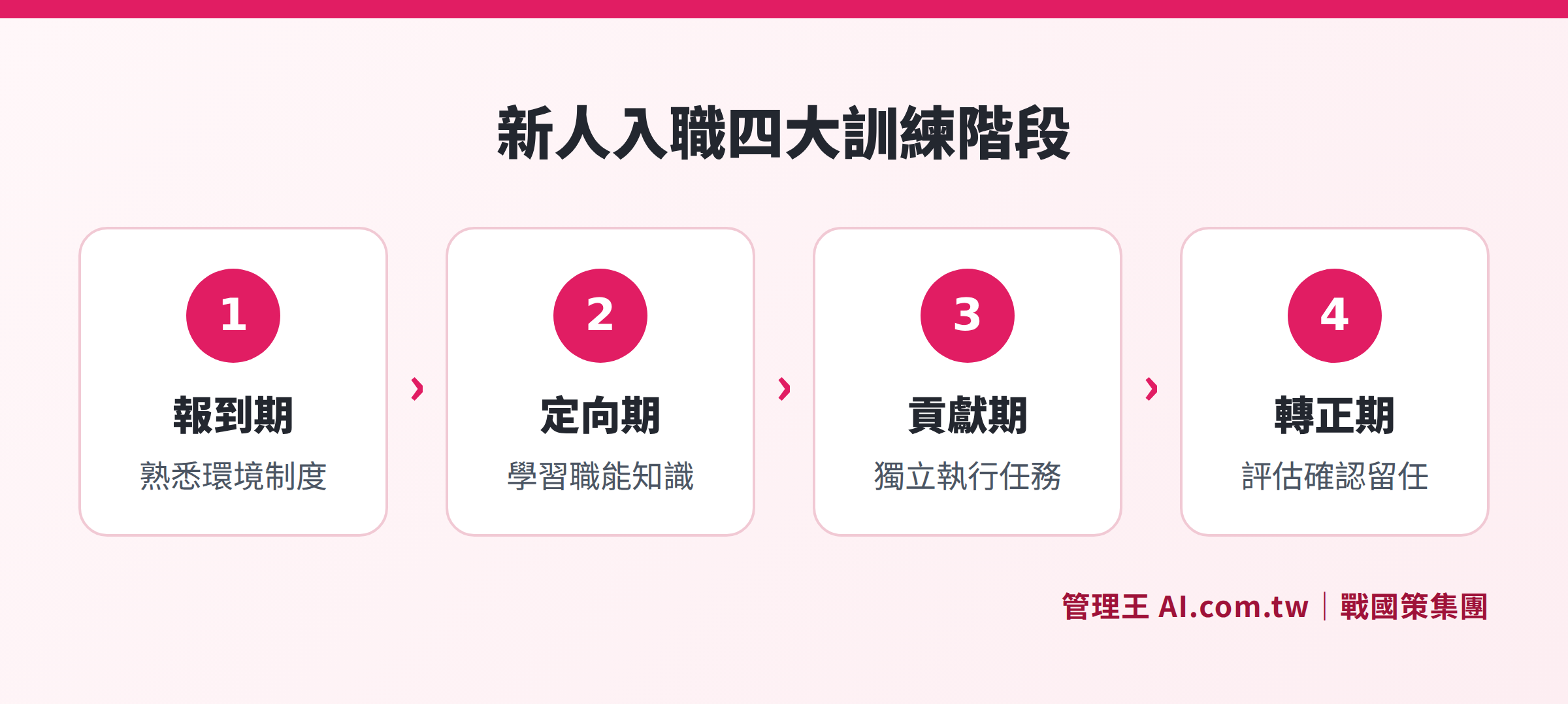
Training objectives broken down into three stages: Orientation in the first 30 days, Hands-on execution from days 31 to 60, Independent contribution from days 61 to 90.
Table: Key Points of the 30/60/90 Day Training Plan
| Stage | Core Objective | Main Activities |
|---|---|---|
| First 30 Days (Orientation Phase) | Establish a sense of security, understand the organization | Administrative check-in, company introduction, mentor pairing, D7/D14/D30 surveys |
| Days 31–60 (Hands-on Phase) | Master core work skills | SOP practice, departmental cross-training, understanding customers/products, phase assessments |
| Days 61–90 (Contribution Phase) | Independently contribute, confirm retention willingness | Independent task execution, performance goal setting, probation evaluation interviews |
First 30 Days: Orientation Phase (Establishing Security)
The most vulnerable time for new hires is the first two weeks post-hire. During this period, priority should be given to:
- Pre-Onboarding Preparation Checklist: Computer, accounts, access, workstations, colleague introductions—everything should be ready on the first day.
- Comprehensive Company Introduction: Company history, mission, organizational structure, responsibilities of each department.
- Mentor Pairing: Assign a senior colleague to guide one-on-one and answer daily questions.
- D7 / D14 / D30 Cultural Adaptation Surveys: Proactively ask for newcomers’ feelings to detect any adaptation issues early.
Days 31–60: Hands-on Phase (Establishing Competence)
This stage focuses on transitioning newcomers from "observers" to "executors":
- Observe actual workflows alongside senior colleagues.
- Independently attempt to complete standard tasks with immediate feedback from their mentors.
- Departmental cross-training (sales for the first two weeks followed by customer service, warehousing, rapidly building interdepartmental networks).
- Weekly 1-on-1 interviews to track progress.
Days 61–90: Contribution Phase (Establishing a Sense of Achievement)
The final stage of probation focuses on confirming retention willingness and setting performance goals:
- Set individual goals linked to departmental KPIs.
- Conduct formal probation evaluation interviews (two-way).
- Confirm the criteria for regularization or extension of the probation period.
Differences in Onboarding Training Focus for Different Positions
The onboarding training content should differ by position and should not all apply the same material.
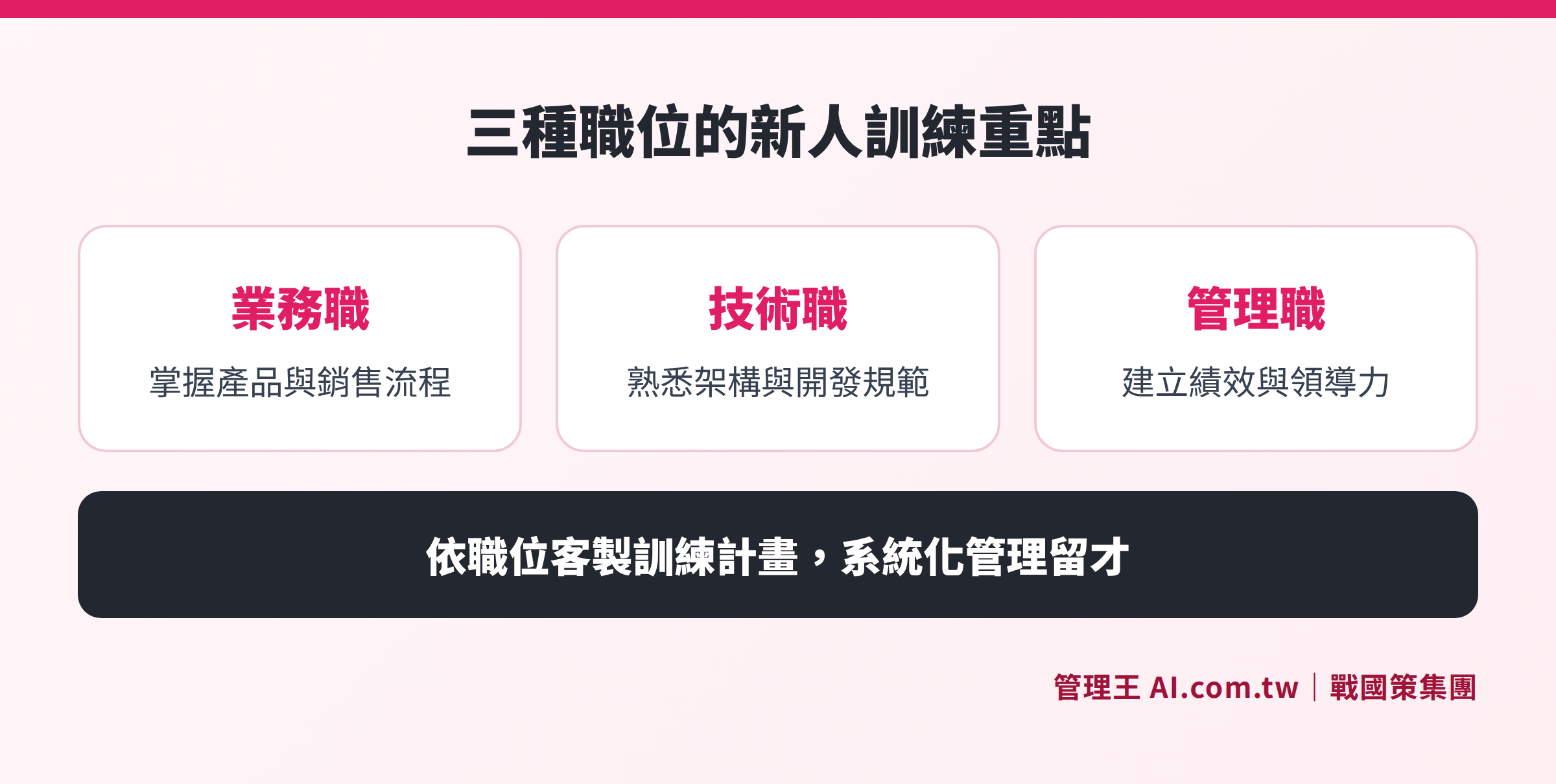
Comparing the core differences of onboarding for sales, technical, and managerial positions.
Sales Positions
New sales hires need to quickly grasp product knowledge and the sales process. Key training focuses include:
- Core selling points of products or services and common customer questions.
- CRM system operation and customer data maintenance rules.
- Standard visit procedures, pricing standards, and contract signing processes.
Technical Positions (Engineers, Designers)
New hires in technical roles need to understand development specifications and collaboration tools. Key training focuses include:
- Code standards, version control processes (Git flow).
- Understanding existing system architecture and reading technical documents.
- Setting up development environments, deployment processes, and emergency procedures.
Management Positions (New Supervisors)
For supervisors promoted from individual contributors or externally recruited, training focuses on team leadership:
- Company performance management systems and how to set KPIs.
- Understanding the boundaries of a culture of empowerment and accountability.
- Completing legally mandated safety and health supervisor training (at least 9 hours).
Common Reasons for Onboarding Training Failures and Solutions
Many companies "conduct onboarding training, but it’s ineffective." The reasons usually center on several key points:
Failure Reason 1: Relying entirely on verbal transfer from bosses or seasoned staff, without standardization.
Verbal training varies from person to person, making quality inconsistent. Solution: Establish SOP documents, record critical knowledge in videos or put it in a knowledge base, ensuring every newcomer receives training of the same quality.
Failure Reason 2: Only a briefing on the first day, with no follow-up.
Information overload occurs in the first two weeks for newcomers, making it easy to become overwhelmed. Solution: Establish regular check-in mechanisms at D7, D14, and D30 to actively monitor progress.
Failure Reason 3: No assessment mechanisms to determine if newcomers have learned.
Without tests or evaluations, supervisors can’t know how much newcomers have absorbed. Solution: Design small quizzes for each learning module that newcomers must pass before moving to the next stage (gamified training).
Failure Reason 4: Mentors lack time to guide new hires.
Senior employees are often busy and see mentoring as an "extra burden." Solution: Include mentoring as part of performance assessments for senior employees and provide clear guiding instructions and tools for mentoring.
Failure Reason 5: Training is disconnected from actual work.
Training courses that differ vastly from real work scenarios result in newcomers learning but not applying. Solution: Design training around "real work tasks," allowing newcomers to engage in actual work under supervision as soon as possible.
How to Evaluate the Effectiveness of Onboarding Training?
Effective onboarding training should be "quantifiable" and not rely solely on subjective feelings from supervisors. The purpose of evaluation is not to assign scores but to identify "which part of the training is causing stagnation in newcomer learning," allowing for targeted improvements.
Evaluation of training effectiveness usually occurs across two dimensions: Process Indicators (whether training was effectively executed) and Outcome Indicators (whether the desired results were achieved after execution). Focusing only on process indicators (e.g., 100% course completion rates) while neglecting outcome indicators (e.g., new hires’ output remaining below expectations after 60 days) often creates the illusion that there was training, but the effectiveness was poor.
Common evaluation indicators include:
- Probation Completion Rate: What proportion of newcomers successfully pass probation and become regular employees.
- 90-Day Retention Rate: The percentage of employees still employed after 90 days (high-quality companies typically aim for over 85%).
- Training Completion Rate: The actual completion rate of assigned learning tasks.
- Knowledge Test Scores: The pass rates for assessments at each stage.
- Newcomer Satisfaction Surveys: Adaptation survey scores at D30 / D60 / D90.
- Time to Productivity: The average number of days from onboarding to independent contribution for newcomers.
- Mentor Ratings: Mentors' scores on newcomers’ learning attitudes and progress, reflecting how smoothly the mentoring process is proceeding.
Regularly tracking these indicators (recommended quarterly) is essential for identifying gaps in the training process and continuously improving, allowing the onboarding system to optimize alongside the company’s growth.
Building an Onboarding System from Scratch: Implementation Steps for SMEs
Many SME owners report, "We know onboarding is important, but we don’t know where to start." Here is a set of implementation steps suitable for companies with 10 to 50 employees, to complete basic setup within a month:
Step 1: Inventory Existing Knowledge and Identify Key Processes
Gather senior employees from each department and spend half a day listing the "10 essential things every position must know." These do not need to be written into complete training materials; a simple bullet-point list will suffice. This list will serve as a source for subsequent SOP and training materials.
Step 2: Create Training Templates by Position
Organize the list from step one into a "Position Training Map," marking each knowledge point with corresponding weeks for learning and assessment methods (testing, practice, supervisor confirmation). A first draft training template for a position can usually be completed in two working days, with quarterly adjustments thereafter.
Step 3: Assign Mentors and Clarify Mentoring Rules
Designate a mentor for each new hire, providing clear mentoring guidelines (e.g., "Weekly 30-minute 1-on-1 meetings, guided by this list of questions") and incorporating mentoring responsibilities into performance evaluations, instead of relying solely on verbal assignments.
Step 4: Design Milestone Assessment Points
Set up one assessment point for each of D7, D30, D60, and D90. Confirm basic environment adaptation at D7, core knowledge mastery at D30, ability to execute independently at D60, and conduct formal probation review interviews at D90. Each point should have specific standards and documentation forms.
Step 5: Gather Feedback and Continuously Optimize
After every new hire completes their probation, arrange a 30-minute "Training Experience Review"—ask newcomers which training was most useful, which fell short, and any knowledge that was significant but not mentioned during onboarding. This feedback provides direct material for optimizing the training system. Document the entire process and incorporate it into the HR system for centralized management, ensuring that the same quality training can be executed for each recruitment, irrespective of the mentors involved.
You can also refer to the 管理王 blog for further reading: What is an Education Training System? (explaining LMS platform functions) and What is a Knowledge Management System? (explaining how to establish an enterprise knowledge base), both complementing the onboarding training system.
How to Establish Systematic Onboarding Training with 管理王
管理王 AI.com.tw Onboarding Training System digitizes the above training framework entirely, allowing SMEs to avoid piecing together Excel + Line groups + Google Drive solutions.
Core Function Operations Process:
- 30/60/90 Day Learning Map Setup: HR or supervisors can pre-set training plan templates by position, which will be automatically applied when newcomers join, allowing them to see their entire growth path from day one.
- Diverse Materials Assignment and Tracking: Assign videos, documents, training courses, and SOPs to newcomers, with the system showing in real-time who has viewed or not viewed each.
- Gamified Testing: Each learning module will automatically trigger a test upon completion, allowing progression only when passed, ensuring genuine absorption of knowledge.
- Mentor Pairing and 1-on-1 Records: The system assigns mentors and tracks regular meetings, alongside automatically sending D7/D14/D30/D60/D90 cultural adaptation surveys.
- Onboarding Automation: Automatically generates computer requests, account activations, and equipment handover lists, ensuring zero administrative process omissions.
- AI Onboarding Assistant: New hires can ask common questions directly to AI, with questions only directed to supervisors if unanswered, significantly reducing the time cost of repeated answers from supervisors.
管理王 offers a free plan for permanent use, including basic onboarding training functions, with no credit card needed for immediate trial. After implementation, it's recommended to connect with the performance management system to set probation goals, link to the payroll system to ensure compliance with probation salary, and use the electronic contract system for electronic signing of labor agreements—completing the entire onboarding process on one platform without switching between multiple systems.
Want to establish a systematic onboarding training system?
管理王 consultants provide free assistance in planning a 30/60/90 day training plan, with probation tracking and assessments all completed in one stop, free trial no credit card required in 30 seconds.
Free consultation hotline: 0800-003-191
LINE official account: @119m
Official website: app.AI.com.tw
Free trial: Apply for 管理王 Now
Frequently Asked Questions
Can probationary employees be unpaid or have training fees substitute wages?
No. According to Taiwanese labor laws, the probationary period establishes a formal labor relationship, and during pre-employment training, employers must pay wages based on agreements or minimum wage standards and cannot reduce wages or withhold payment under the guise of training. While there is no legal limit on the length of the probation period, it should be reasonable (typically 3 months in practice), and probationary wages should not be lower than the minimum wage. Always refer to the latest announcements from supervisory authorities.
What records need to be kept for onboarding training?
According to the "Occupational Safety and Health Education and Training Regulations," employers must keep documents related to safety and health training, including instructor qualifications, course outlines, attendance records, and attendance photos for supervising authority audits. HR training records (material assignments, assessment results, 1-on-1 records) are recommended to be kept for at least 3 to 5 years, serving as evidence for future performance evaluations or labor disputes.
What are the considerations for the mentor pairing system?
Mentors should be selected from senior employees close to the new hire’s position but not holding direct assessment authority to avoid the pressure of being evaluated while being mentored. Mentor responsibilities should be clearly defined (e.g., fixed weekly 30-minute 1-on-1 sessions) and included in performance evaluations; otherwise, they may turn into a mere formality due to busy schedules. A single mentor managing more than two new hires typically sees a noticeable decline in quality.
How to train remote or online new hires?
The core challenge of remote onboarding is "lack of informal contact" (spontaneous conversations in the office). Solutions include: more frequent video call check-ins (daily 15 minutes instead of weekly), establishing a comprehensive knowledge base for new hires to self-consult, effectively utilizing asynchronous communication tools to record work contexts, and arranging virtual lunch or coffee break times to build interpersonal connections.
How long does onboarding training take, and how to estimate the costs?
The training duration varies by job complexity. For general administrative or operational roles, 30 to 40 hours of initial training suffices for basic competency; technical or managerial positions typically require 60 to 120 hours of training. Hidden costs of self-designed training systems include supervisor time, material production, HR administration, etc., and utilizing systematic tools can greatly reduce the marginal costs of repeated training.
Sources
- Full text of Occupational Safety and Health Education and Training Regulations—National Regulatory Database (Judicial Yuan)
- Taipei City Labor Inspection Office: FAQ on Labor Education and Training Regulations—Taipei City Government Labor Bureau
- Official website of the Occupational Safety and Health Administration—Ministry of Labor
This article provides general information and does not constitute legal or labor advice; actual regulations should be based on the latest announcements from the Ministry of Labor and supervising authorities.