One-Page Website Pricing Trends: How Much for Outsourcing, Templates, and DIY | One-Page Website Recommendations

The cost of one-page websites varies by production method: outsourcing ranges from NT$10,000 to 1 million, SaaS template platforms start at NT$150 per month, and self-hosting starts at NT$3,000 per year. This article summarizes the 2026 market trends in Taiwan, hidden costs, and recommended options.
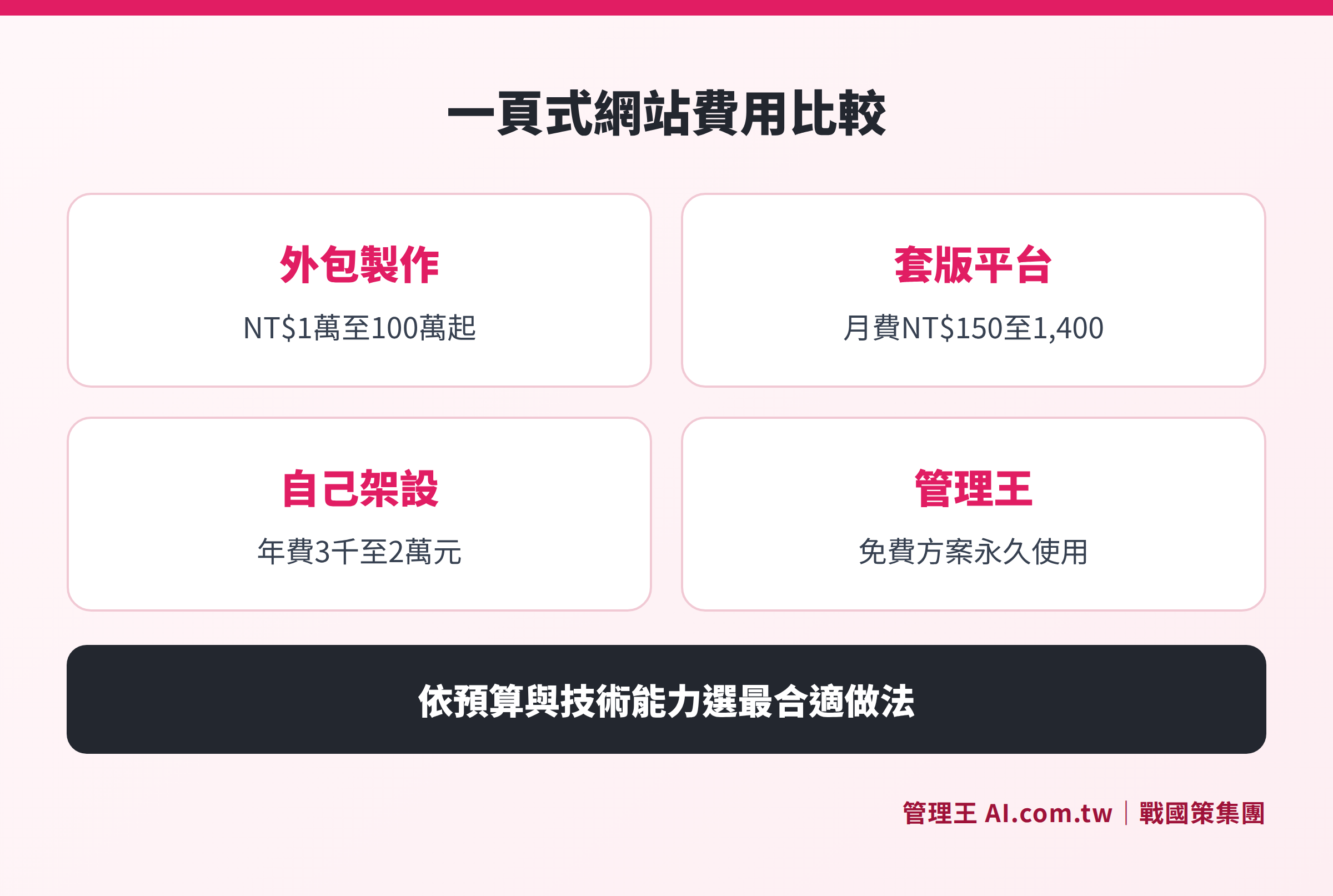
The production costs of one-page websites vary from almost zero to several hundred thousands, depending on whether they are outsourced, made with a template platform, or self-hosted. Outsourcing to a Taiwanese design company typically costs around NT$10,000 to 35,000 for a basic version, and can exceed NT$50,000 for fully customized designs that include payment processing and backend features; using SaaS template platforms (Wix, Carrd, Squarespace) can lead to annual costs ranging from NT$600 to NT$17,000; if you choose to write the code yourself, you only need to pay for domain registration (NT$300 to 1,200/year) and hosting (NT$3,000 to 20,000/year), but this has a higher technical threshold. The core reason for budget uncertainty often lies not in the page itself, but in five hidden variables: content production, functional complexity, backend integration, maintenance licensing, and the number of revisions. This article breaks down the actual market prices for these three production methods based on 2026 Taiwan data, helping you find a one-page website solution that fits your budget and needs while explaining how to quickly go online at a lower cost using the built-in Landing Page tool from 管理王 AI.com.tw.
Overview of Production Costs: Outsourcing, Templates, DIY
Choosing a method for producing a one-page website essentially involves trade-offs among four dimensions: "cost," "time," "technical threshold," and "flexibility." Here's a look at the overall market:
Table: Comparison of Three Production Methods for One-Page Websites (2026 Taiwan Market)
| Production Method | Initial Cost | Annual Ongoing Cost | Technical Threshold | Completion Time |
|---|---|---|---|---|
| Outsourced Design Company | NT$10,000 to 100,000+ | NT$6,000 to 24,000 (maintenance) | No technical skills required | 1 to 8 weeks |
| SaaS Template Platform | Almost free | NT$600 to 17,000 | Low | 1 day to 1 week |
| Self-hosted (DIY) | NT$3,300 to 21,200 | NT$3,300 to 21,200 | High | Varies |
Summary in One Sentence
The real cost of a one-page website isn’t just the initial setup cost; maintenance, hosting, and editing fees often add up to more than that initial expense over time.
Each of the three methods has its applicable scenarios: for small budgets needing to go online quickly, template platforms are ideal; for a fully customized brand image, outsourcing is the way to go; and for tech personnel, DIY is the best fit. Let’s go through each method one by one.
Outsourced Design Companies: Cost Trends and Influencing Factors
Outsourcing is the most common choice among SMEs in Taiwan. According to the 2026 market trends in the Taiwanese design industry, the outsourcing costs for one-page websites (Landing Pages) can be categorized into four levels:
Table: Outsourced One-Page Website Cost Levels (2026)
| Level | Content | Cost Range | Completion Time |
|---|---|---|---|
| Template Production | Applying existing templates and replacing copy and images | NT$5,000 to 15,000 | 3 to 7 days |
| Semi-Customized | Adjusting layout, color scheme, and forms based on templates | NT$15,000 to 50,000 | 1 to 3 weeks |
| Fully Customized | Designing from scratch, front-end slicing, payment or API integration | NT$50,000 to 150,000+ | 4 to 8 weeks |
| Advertising Landing Page | Multi-version A/B testing pages, including performance tracking setup | NT$8,000 to 30,000 | 3 to 7 days |
Five Key Factors Influencing Pricing:
- Content Production: Costs typically increase by NT$5,000 to 30,000 if copywriting, product photography, or video is provided by the design company.
- Functional Complexity: Pure display pages are the cheapest; adding forms, payment processing, booking systems, or LINE notifications incurs additional charges for features.
- Backend Integration: Integrating Google Analytics, FB Pixel, CRM, etc., can increase costs by NT$2,000 to 8,000 for each item.
- Number of Revisions: Contracts usually include 2 to 3 free revisions; additional revisions are charged hourly (about NT$1,000 to 2,000/hour).
- Copyright Ownership: Some companies use licensed templates or codes, which may get left behind when switching companies.
Outsourcing levels range from template production to fully customized, with costs escalating from below NT$10,000 to above NT$150,000 based on the degree of design customization.
Another hidden risk with outsourcing quotes is inconsistent pricing standards. Some companies quote just the "design fees," excluding hosting, domains, and ongoing maintenance; others might quote an "all-inclusive first-year" price. When comparing quotes, confirm whether hosting is included, what the second-year costs are, how revisions are billed, and who owns the original files and accounts.
SaaS Template Platforms: Monthly Fee Comparison and Practical Limitations
SaaS website building platforms allow those with no technical backgrounds to launch a one-page website in just a few hours, at a cost far lower than outsourcing. Common options include:
Carrd (focused on one-page websites): Pro Lite plan at USD 9/year (approximately NT$295), Pro Standard at USD 19/year (approximately NT$620), Pro Plus at USD 49/year (approximately NT$1,600). You can bind a custom domain and remove branding; it's the cheapest one-page specific tool available but relatively basic in functionality, lacking support for complex shopping carts or backend management.
Wix: Free plan includes ads, paid plans range from about NT$500 to 1,400 per month (when paid annually), and offers a wealth of templates and an app marketplace, suitable for display-type websites but has a closed system that complicates future migrations.
Squarespace: Monthly fees start at USD 16 (approximately NT$520), with annual prepayment discounts available; it offers high-quality designs, suitable for brand image pages, but has weaker Chinese language support and integration with Taiwanese payment systems.
Three Common Pain Points of International SaaS Platforms:
- Lack of integration with Taiwan's channels like LINE official accounts or LINE Notify.
- Incomplete Traditional Chinese interface, large time zone differences for customer support.
- Lists collected through forms need manual export, cannot automatically enter the CRM for task allocation.
Self-Hosting: Technical Threshold and Initial Costs
Technically savvy individuals can minimize costs significantly:
- Domain: NT$300 to 1,200 per year, depending on the top-level domain (.tw, .com, .io).
- Hosting: Shared hosting costs NT$3,000 to 6,000 per year; VPS costs NT$6,000 to 20,000 per year; if using static deployment on Vercel or Netlify, the free plans are typically sufficient for a standard one-page website.
- SSL Certificate: Let's Encrypt is free, and most hosts come pre-built with it.
- Development Tools: WordPress + Elementor (free version), Next.js, plain HTML/CSS, no licensing fees.
The main annual costs for DIY site building consist of the domain and hosting, and with static deployment, hosting can be reduced to near zero.
Common DIY Tools and Frameworks:
- WordPress + Elementor: The most popular globally, a rich ecosystem of plugins; the free Elementor version can fulfill most one-page needs, but compatibility issues need self-checking, and hosting fees range from NT$3,000 to 6,000 annually.
- Webflow: The choice of visual designers, capable of creating dynamic effects without coding; the Free plan has many limitations, while CMS plans start at USD 23 a month.
- Plain HTML/CSS/JS + Static Deployment: The fastest method for technical personnel, deploying on Vercel or Cloudflare Pages almost free; the drawback is that each content modification requires coding.
- Static site frameworks such as Next.js / Astro: Suitable for engineers familiar with front-end development; Vercel's free quota is usually sufficient for general traffic one-page websites.
Who is DIY Suitable For: Those with front-end development skills or those willing to learn to use low-code tools like Webflow. For pure business-oriented owners or marketers, DIY may seem cost-effective, but the time spent on development represents opportunity costs, and the learning curve may delay deployment by several weeks. Before choosing, honestly assess: "Can I finish the page in 48 hours?" If the answer is uncertain, template platforms or 管理王's free options might be a more efficient starting point.
Five Major Hidden Costs Not to Underestimate
Many people overlook ongoing costs when comparing the "one-time setup cost":
1. Hosting and Domain (Annual Charges)
Even for SaaS platforms, a custom domain usually incurs an extra annual fee of NT$300 to 800; outsourced websites require hosting rentals costing NT$3,000 to 20,000 annually.
2. Maintenance and Update Fees
The WordPress system requires regular updates for plugins and security patches. Design companies typically offer annual maintenance packages costing about 10 to 20% of the construction fees, or a fixed NT$3,000 to 12,000 per year.
3. Subsequent Modification Fees
Changing Banners for promotional activities, adjusting copy, or adding new sections may incur charges of NT$1,000 to 5,000 for each modification if the system isn’t self-controlled.
4. Material Licensing Fees
Purchasing licensed stock images (Shutterstock, Getty) costs about NT$500 to 3,000 per image; using copyright-free stock images (Unsplash, Pexels) can save on these costs.
5. Payment Processing Fees
If the one-page website includes online payments, mainstream payment processors in Taiwan (Green World, Pay2go) charge transaction fees ranging from 1.5% to 3%, which becomes significant during high transaction volumes.
Budget-Conscious Choices
Here are reasonable choices based on corresponding budgets:
- Budget NT$0 to 5,000: Use Carrd or the free version of Wix for templates, filling in your content and images to go live in as little as 1 day; the drawback is limited brand customization.
- Budget NT$5,000 to 20,000: Outsource template production, or use 管理王 Landing Page free plan for self-service (providing 50+ industry templates and a drag-and-drop editor), without needing an engineer.
- Budget NT$20,000 to 50,000: Outsource semi-customized work, or use the paid plan from 管理王 (NT$5,000/month) alongside consulting configuration (NT$1,000/hour with transparent pricing).
- Budget NT$50,000 and above: Opt for fully customized outsourcing, or choose a comprehensive marketing automation solution including advanced AI copywriting, A/B testing, and cross-channel integration.
When selecting, the most important consideration is not "who is the cheapest," but rather "what the source of traffic and conversion goals of this page are." Pages driven by ads need to be easily modifiable, include built-in Pixel and UTM tracking, and forms that go directly to CRM; pages aimed at organic SEO traffic require skills in technical SEO settings and ongoing content updating mechanisms.
How to Create a One-Page Website with 管理王
管理王's Landing Page creation tool is a drag-and-drop platform designed for Taiwanese SMEs, addressing the pain point of marketers having to quickly launch ad landing pages without design or engineering backgrounds.
Practical Steps to Operate:
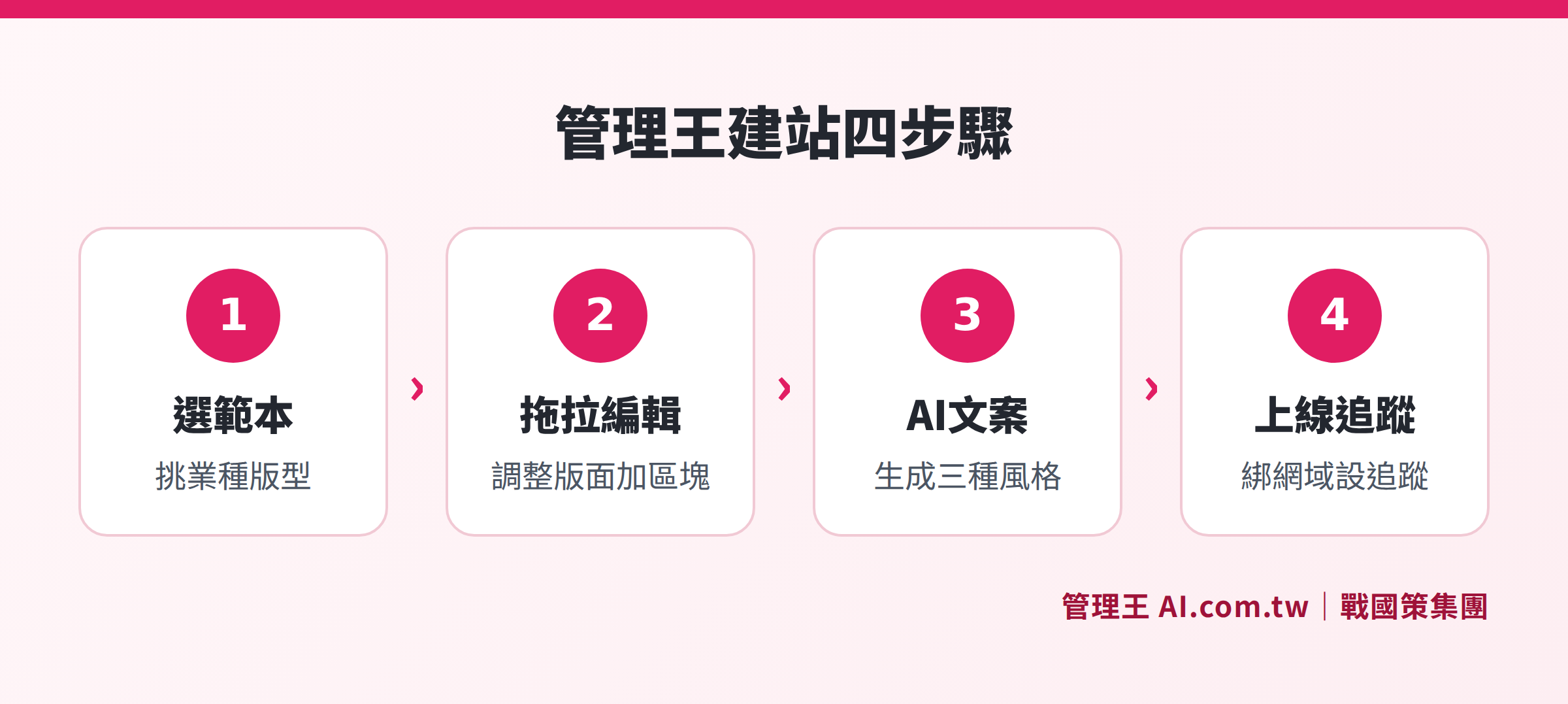
- Select the closest template from 50+ industry templates (e-commerce, courses, restaurants, consulting, medical beauty, etc.).
- Use the drag-and-drop block editor to adjust the main visuals, selling points, customer testimonials, pricing tables, FAQs, and CTA forms.
- Enable AI copywriting assistance by entering the product name and target audience, with the system generating three styles (professional/friendly/active) to choose from.
- Bind a custom domain, set SEO metadata tags, and install GA4 and FB Pixel.
- After form submission, data is automatically entered into the CRM customer management system, and sales teams receive immediate LINE notifications.
The Landing Page integrates natively with 管理王's marketing automation, AI SEO tools, and ad management without needing additional API connections, allowing form data, ad performance, and CRM statuses to communicate within the same account.
A free plan available for unlimited usage includes the drag-and-drop editor and basic templates; advanced A/B testing, AI copy points, custom domains, and other features are available in paid plans (starting at NT$5,000/month). 戰國策 has served over 30,000 enterprises, with a 100% Traditional Chinese interface, in accordance with Taiwanese business practices and regulations.
To learn about the overall structure of Landing Page strategies, refer to: What is a Landing Page? Structure and Practices for High-Converting Landing Pages. For comparing various website building tools, refer to: Recommended One-Page Websites: Comparing DIY, Platforms, and AI Generation Tools.
A list of features can be viewed in 管理王's feature directory, which details all 100+ modules.
Try the One-Page Website Tool for Free Now
30 seconds for free registration, a drag-and-drop editor without needing an engineer, and launch a high-converting one-page sales page in 30 minutes.
Free consultation hotline: 0800-003-191
LINE Official Account: @119m
Official Website: app.AI.com.tw
Free trial: Apply for 管理王 Now
Frequently Asked Questions
What is a reasonable price for outsourcing a one-page website?
According to the 2026 market trends in Taiwan, basic template production costs between NT$5,000 and 15,000, semi-customized from NT$15,000 to 50,000, and fully customized above NT$50,000. Complete quotes should include hosting, domain, and modification arrangements; if only "design fees" are quoted without maintenance, subsequent years' costs may exceed expectations. Be sure to clarify ownership of original files and hosting accounts when comparing multiple quotes.
Are SaaS website platforms or outsourcing more suitable for SMEs?
If budget is limited and quick deployment is needed, SaaS platforms (like 管理王's free plan or Carrd) are usually more cost-effective; if high brand image requirements or complex functional integrations (payment, booking, CRM) are needed, semi-customizing or fully-customizing through outsourcing is more appropriate. It's recommended to use free tools to test page conversion before considering upgrades or outsourcing based on data.
Why did I receive such varying quotes for one-page websites?
The differences in cost hinge on five variables: (1) whether you provide your own copy and images, (2) whether backend integrations are needed (payments, APIs), (3) whether the quote includes SEO settings and marketing tracking code installation, (4) the number of subsequent modifications, and (5) the scope of the maintenance contract. Clarifying these five points allows for a basis of comparison across different quotes.
Do one-page websites require additional hosting fees?
Websites built through outsourcing usually require hosting; for SaaS platforms (like Wix or 管理王), hosting fees are typically embedded in the monthly fee. If you opt for DIY static deployment (Vercel, Netlify), basic traffic is free; however, if backend services (database, form processing) are necessary, paid plans will run about NT$300 to 1,000 monthly.
Can one-page websites be revised later?
Yes, but the cost can vary greatly. Websites built on SaaS platforms and with 管理王's Landing Page tool can be modified independently without requiring an engineer; for outsourced sites, if the original files are with the design company, there will typically be costs involved for rework. It's advisable to clearly state the delivery conditions for original design files, code, hosting accounts, and domain accounts in the contract.
Data Sources
- Domino Website Design — 2026 Website Design Cost Trends: Templates Starting at 15,000, Customization Starting at 150,000 (2026 Inquiry)
- Islanders Academy — How Much Does a One-Page Website Cost? Level Trends and Pricing Logic (2026 Inquiry)
- 管理王 AI.com.tw Landing Page Features
- 管理王 AI.com.tw Plans and Pricing