Complete Guide to Online Booking Systems: Key to the Service Industry Bidding Farewell to Phone Appointments|Booking System Recommendations
Online booking systems enable service industry customers to choose time slots anytime, automatically confirm notifications, and provide appointment reminders and online deposits seamlessly, completely bidding farewell to scheduling via phone. This article explains the core features, applications in various industries, five key indicators for selection, and implementation steps.
Online booking systems allow customers to self-select service items, choose service personnel, and select time slots through a public webpage, automatically receiving notifications upon confirmation, entirely replacing the traditional process of phone inquiries, LINE exchanges, and handwritten schedules. Automatic reminders 24 hours and 1 hour before appointments effectively reduce last-minute cancellations and no-shows; the online deposit feature makes it harder for customers to break appointments once they have paid; all booking data automatically creates customer profiles, laying the foundation for subsequent marketing and repurchase tracking. For service industries where "time slots" are core, such as beauty SPAs, fitness trainers, pet grooming, psychological counseling, tutoring, and vehicle maintenance, implementing an online booking system is the most direct way to improve front desk efficiency, reduce downtime losses, and naturally gather customer data. It's the first step in digital transformation for the service sector and yields the quickest results.
What is an Online Booking System? Complete Analysis of Core Functions
An Online Appointment Booking System is a digital tool that allows customers to complete bookings independently while enabling service providers to centrally manage time slots and personnel resources. Unlike restaurant reservations or hotel bookings, the core of a service industry booking system lies in "personnel resource scheduling"—which technician, which service time slot corresponds to which customer; the intersection of these three requires high-level automation to avoid conflicts and wasted time slots.
Six Core Functions of an Online Booking System
Public Booking Page
Provides an independent URL or an embeddable booking page for the official website, where customers can select service items, choose service personnel, and time slots, and complete bookings without making phone calls or sending LINE messages, allowing for bookings at night or on holidays.
Resource and Personnel Management
Businesses can set the available time slots for each service provider each week, as well as the duration and price for each service, with the system automatically opening or closing bookings based on these settings. When employees take leave or are out, they can block those time slots with one click, eliminating the need to notify each customer by phone.
Automatic Conflict Detection
The same service provider can only be booked once in the same time slot; the system locks it automatically, completely eliminating the awkwardness of "two customers booking the same technician." This reliability cannot be guaranteed with handwritten schedules or LINE group management.
Online Deposits and Payments
Customers prepay deposits online when booking, reducing last-minute cancellations and no-shows; payment processing integrates with popular Taiwanese platforms like Green World and Neweb, allowing automatic reconciliation without manual transaction record verification.
Automatic Confirmation and Reminder Notifications
After the booking is made, a confirmation message (via SMS or LINE) is automatically sent, and reminders are sent to customers 24 hours and 1 hour before the appointment, ensuring that no available time is wasted. All reminder notifications are automated without manual tracking by front desk staff.
Data Reports and Customer Management
The system accumulates each customer's booking history, spending amounts, last visit dates, and other data, forming a complete customer profile. Employee performance rankings and customer lifetime value (LTV) analysis allow business owners to see which technicians are most popular and which customers have the highest repurchase potential.
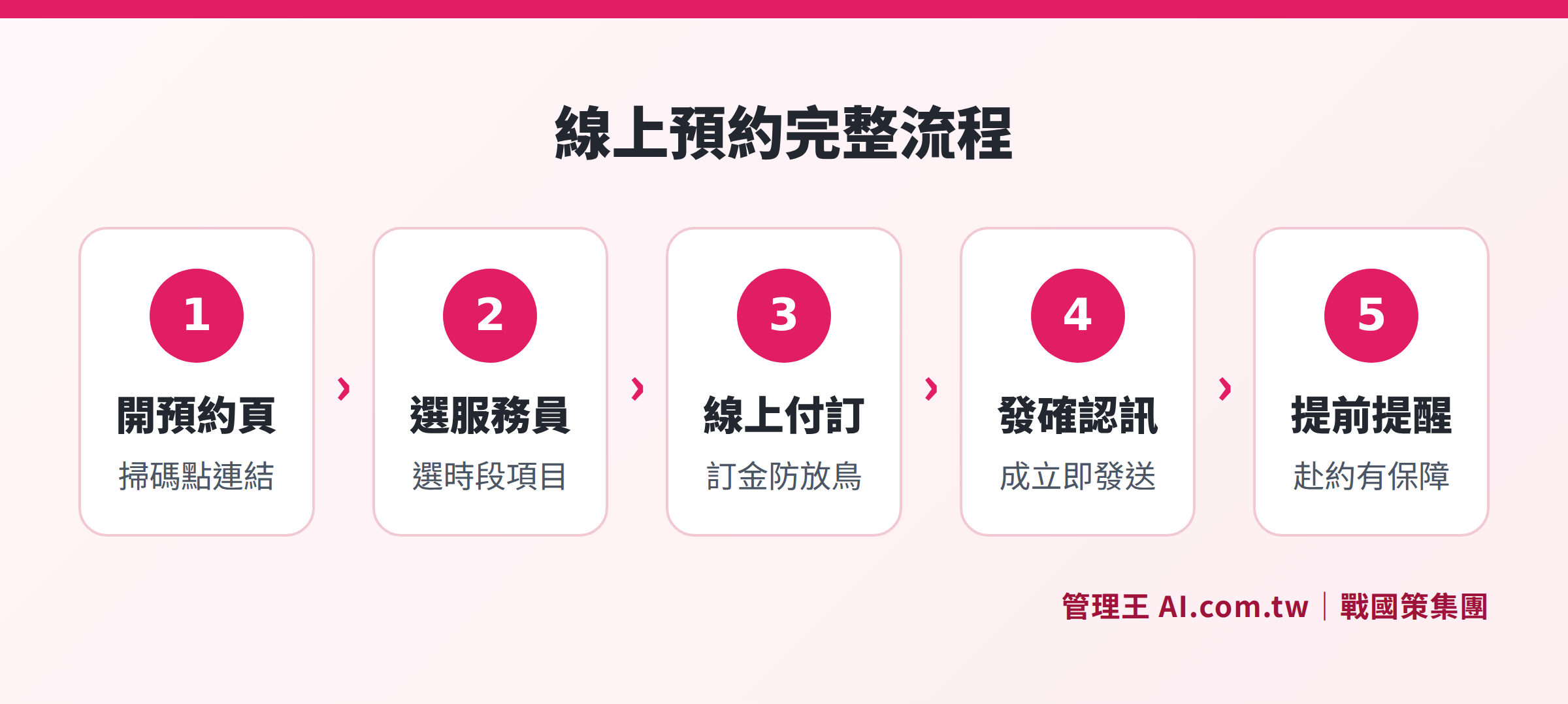
Full process automation from the customer opening the booking page to receiving an automatic follow-up reminder after service completion
Table: Comparison of Traditional Phone Reservations vs. Online Booking System Functions
| Comparison Item | Phone/LINE Reservations | Online Booking System |
|---|---|---|
| Acceptable Booking Time Slots | Limited to business hours | 24 hours a day |
| Front Desk Labor Requirements | Requires dedicated personnel to answer and record | Fully automated, no manual labor needed |
| Double Booking Risk | Handwritten or verbal confirmations are prone to errors | System automatically locks, zero double bookings |
| Customer Reminders | Requires manual follow-up | Automatic SMS or LINE notifications |
| Deposit Collection | Manual verification post-transfer | Online payment with automatic reconciliation |
| Customer Data | Scattered in messaging apps and phones | Centralized, complete customer profiles |
| Marketing and Repurchase | Difficult to integrate | Can integrate with points collection, coupons, and repurchase reminders |
In a Nutshell
The essence of an online booking system is to transform the process of "scheduling" from a manual procedure into system automation, allowing every time slot in the service industry to be accurately scheduled without wasting any time.
Is the Service Industry Still Using Phone Reservations? Five Common Pain Points
According to the Ministry of Economic Affairs statistics, the service industry accounts for approximately 61% of Taiwan's GDP, with small and medium-sized enterprises making up over 98% of all businesses, serving as the absolute main force of the service industry. However, many small service providers still handle bookings via phone and LINE, and the following five pain points are common concerns for nearly every service industry owner:
Pain Point 1: No One to Handle Inquiries After Work Hours
Customers are accustomed to inquiring and booking at night or on holidays, but service providers cannot be on duty 24/7. If messages are missed, responses the next day may have already led customers to competitors.
Pain Point 2: Schedule Dependence on Handwritten Notes, Double Booking is Left to Chance
Multiple service personnel and service items managed through LINE groups or paper schedules can lead to two customers booking the same technician due to minor oversights, causing reputational damage from on-site issues.
Pain Point 3: Customers Confirm but Still No-Show
Without systematic reminders, it often happens that customers forget to show up. Due to the proximity of appointments, these time slots often cannot be filled, resulting in a direct loss of service revenue.
Pain Point 4: Customer Data Resides in Personal Employee Phones
Designer or coach customer lists are stored on personal phones, and once an employee leaves or changes jobs, the business loses all customer relationships built over the years, starting from scratch.
Pain Point 5: Marketing and Booking Are Two Separate Processes
When issuing discount coupons or promoting points collection activities, customers need to call to inquire for redemption, creating a disconnect that significantly hampers promotional effectiveness.
Which Service Industries Are Most Suitable for Implementing Online Booking Systems?
Any industry where the core business involves "providing services by specific personnel at specific time slots" is suitable for implementing a booking system. The benefits of implementation are particularly evident in the following industries:
Beauty SPAs, Hair Salons
With multiple designers having different availability, and customer preferences for specific designers, accurate resource management is essential. VIPs will have priority for popular time slots, and regular reminders for coloring can significantly boost return rates.
Fitness Trainers, Yoga Studios
Personal and group class capacity control needs differ; a booking system can manage both one-on-one time slots and class limits simultaneously and automatically add customers to a waitlist when classes are full.
Pet Grooming, Pet Hotels
Customers typically have multiple pets with fixed grooming cycles, and the system can create individual profiles for each pet and send automatic reminders ahead of grooming or vaccination due dates, converting occasional clients into loyal regulars.
Psychological Counseling, Aesthetic Medical Clinics
High privacy requirements necessitate system support for one-on-one time slot management without displaying other booking records; fixed-period follow-up reminders can significantly reduce client loss rates.
Tutoring and Skill Classes
Students have fixed class times that require support for regular recurring bookings, leave scheduling, and comprehensive management of class schedules.
Vehicle Maintenance and Home Appliance Repairs
Based on maintenance cycles, the system can record vehicle or equipment information and automatically remind customers of the upcoming maintenance dates, turning a one-time maintenance client into a long-term regular.
Table: Core Use Cases for Implementing Booking Systems across Various Service Industries
| Industry Type | Core Booking Needs | Most Critical Function |
|---|---|---|
| Beauty SPA, Hairdressing | Specific designer, multiple service combinations | VIP reserved time slots, regular coloring reminders |
| Fitness Trainers, Yoga | Individual versus group class capacity control | Class capacity limits, waitlist management |
| Pet Grooming, Pet Hotels | Multiple pet data, fixed grooming cycles | Pet files, vaccination expiry notifications |
| Psychological Counseling, Aesthetic Clinics | Regular follow-up, high privacy | One-on-one time slots, confidential data settings |
| Tutoring and Skills | Student schedules, make-up lessons | Regular recurring bookings, schedule management |
| Vehicle Maintenance and Repairs | In-store scheduling, maintenance cycle tracking | Vehicle profiles, next maintenance reminders |
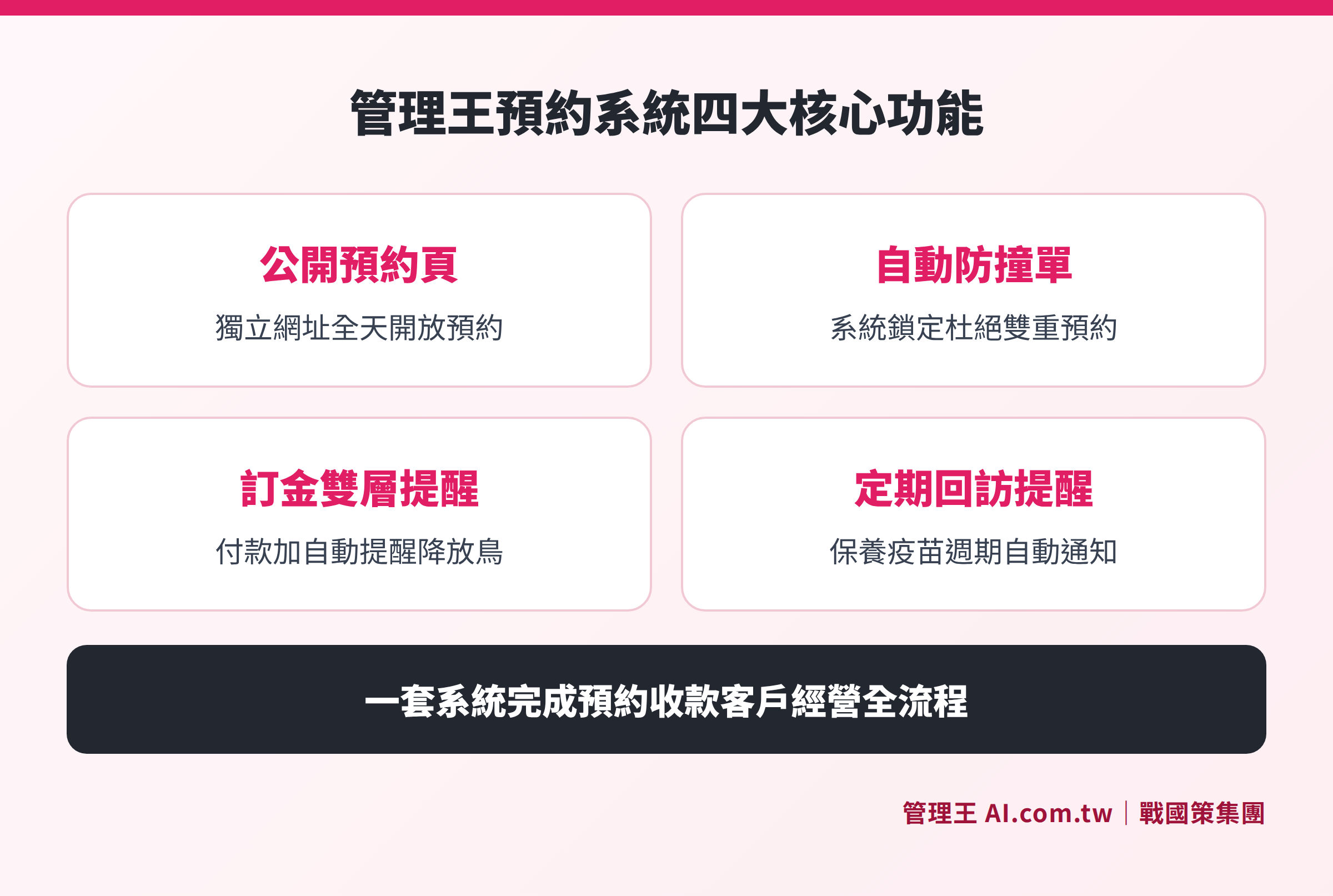
Comparison of core benefits for five key industries after implementing online booking systems
How to Choose the Right Online Booking System? Five Evaluation Indicators
The market offers a variety of booking tools, from free international SaaS options (like Calendly, Acuity Scheduling) to locally developed systems in Taiwan. The following five indicators can help Taiwanese service industry owners make suitable choices:
Indicator 1: Support for Taiwanese Payment Methods and Electronic Invoicing
Can the system integrate with mainstream Taiwanese payment platforms like Green World and Neweb and automatically issue electronic invoices as required? Imported international tools often do not support local payment methods, requiring additional integration, increasing technical complexity and costs.
Indicator 2: LINE Notification Integration
Given that Taiwanese customers heavily rely on LINE, whether notifications regarding booking confirmations and reminders can be sent via official LINE accounts is a crucial local indicator. Pure email notifications have much lower open rates in Taiwan compared to LINE messages, rendering their reminder effectiveness limited.
Indicator 3: Depth of Integration with CRM
Can customer data collected by the booking system flow directly into the CRM system? If the booking system is an isolated tool, marketing tracking, repurchase reminders, and customer segmentation will require additional manual data transfer, increasing management burdens.
Indicator 4: Flexibility in Managing Multiple Personnel Resources
Can different service items, available time slots, and prices be set for each employee? If an employee takes leave, can their booking page be temporarily suspended with one click? Flexibility in managing multiple personnel is essential for scaling operations in the service industry.
Indicator 5: Data Reporting and Marketing Connectivity
Does the system have statistics for employee project performance and customer LTV analysis? Can it integrate with the points collection system and marketing automation, allowing booking data to drive subsequent marketing actions directly?
Five Steps to Implement an Online Booking System
Many service industry owners worry that implementing a system is "too complicated"; in fact, a well-designed booking system typically takes just a few days to set up and go live:
Step 1: Inventory Service Items and Personnel Scheduling
List all service items (including duration and price) and each service provider's available time slots. This foundation data for setting up the system can usually be entered in just a few hours.
Step 2: Establish a Public Booking Page
Input the service item list and employee schedule into the system's backend, and customize the appearance and text of the public booking page. You can choose to use an independent URL (e.g., book.yourshop.com) or embed it in a specific page of your existing official website.
Step 3: Set Notification and Deposit Rules
Decide how many hours before appointments automatic reminders should be sent (recommended once at 24 hours and again at 1 hour), and whether to collect deposits and at what percentage. Online deposits can effectively improve customer attendance rates, so service providers are encouraged to activate this feature actively.
Step 4: Full Process Testing
Walk through the booking process as a customer to confirm that notifications are sent correctly, payment processing is accurate, employee calendars display correctly, and to simulate conflicts to ensure the system locks correctly.
Step 5: Guide Existing Customers to Transition to Online Booking
Publish public booking links through channels like LINE official accounts, Instagram, and Google My Business, paired with minor incentives (e.g., priority seating for online bookings) to encourage customers to develop the habit of booking online. Keep phone reservations as a buffer initially to give customers ample time to adjust.
Manage Online Appointments with 管理王 AI.com.tw
The 管理王 booking system is an integrated booking solution specifically designed for the Taiwanese service industry, completing the whole process from public booking page, online deposits, to customer repurchase tracking all within the same system, eliminating the need to integrate multiple APIs or pay additional integration fees.
Public Booking Page and Resource Management
Provides an independent URL or an embeddable public booking page for existing websites, allowing owners to set each service provider's available booked time slots, service durations, and prices. Customers can select their desired time online, freeing receptionists from waiting by the phone for confirmations.
Automatic Conflict Prevention, Flawless Scheduling
The same service provider cannot be booked in the same time slot, automatically preventing double booking. No matter how busy the store is or how packed events are, the system keeps schedules precise, leaving no gaps for human error.
Online Deposits and Dual Automatic Reminders
Supports online deposit prepayments, significantly boosting appointment rates for customers who have paid; automatic confirmation messages are sent after booking, along with reminders sent at 24 hours and 1 hour prior to the appointment, minimizing idle time.
VIP Priority Reservations and Regular Appointment Reminders
Allows VIP clients to book popular time slots first and supports regular appointment reminders—whether for pet grooming, vehicle maintenance cycles, or psychological counseling fixed periods—automatically notifying customers and transforming one-time clients into long-term returning customers.
Integrate with Google My Business “Book Now” Button
The 管理王 booking system can be integrated with Google My Business's "Book Now" button to turn search traffic directly into bookings, maximizing ROI on SEO and word-of-mouth marketing efforts.
Complete Closed Loop from Appointment to Payment to Customer Management
The 管理王 system naturally connects with the CRM system, marketing automation, customer reactivation, and loyalty points; booking data automatically creates customer profiles, supporting subsequent targeted marketing, repurchase tracking, and LTV analysis. Compared to international tools like Calendly, which do not support Taiwanese payments and are costly on a subscription basis, 管理王 can handle the entire process from booking to payment and customer management within one system.
Free Plan Available for Permanent Use, suitable for personal studios or small stores with 10 or fewer people; for those needing multi-person management, advanced analytics, and higher AI usage, subscription plans starting from NT$5,000/month can be selected. The 戰國策 Group serves over 30,000 enterprises and has 26 years of practical experience in the Taiwanese SME sector, enabling 管理王 to truly understand the daily needs of service industry owners.
Free Trial of 管理王 Booking System, Live Within a Day
Consultants assist in setting up public booking pages, integrating Taiwanese payment methods and LINE notifications, allowing your service industry to complete digital appointment transformation within a week.
Free consultation hotline: 0800-003-191
LINE official account: @119m
Official website: app.AI.com.tw
Free trial: Apply for 管理王 now
Frequently Asked Questions
Is the online booking system suitable for personal studios or one-person service businesses?
Absolutely suitable. As long as there are fixed service items and time slot needs, a one-person studio can save a significant amount of time answering phone calls and confirming messages with an online booking system. The 管理王 free plan supports up to 10 members, allowing individual studios to start using it immediately with no technical background required.
How long does it take to implement an online booking system?
Setting up a complete public booking page, service items, and notification rules generally takes around 1 to 3 working days to complete. Allowing existing customers to get used to the new booking method usually requires a transition period of 2 to 4 weeks. It is recommended to keep the phone reservation channel open initially, gradually guiding customers to transition to online booking.
How to encourage customers who are not accustomed to online booking to switch?
You can place the booking link in the automatic replies of the LINE official account so that when customers message inquiring, the bot automatically sends the booking page URL. At the end of services, staff can verbally remind customers, "Next time you can book online directly, available 24 hours a day," coupled with exclusive discounts for online bookings, allowing most returning customers to transition smoothly within 2 to 3 weeks.
What is the difference between an online booking system and event registration system?
The event registration system focuses on capacity control for single events, suitable for courses, information sessions, exhibitions, and other fixed sessions; while a booking system focuses on periodic personnel schedule management, suitable for the daily operation of service industries that require long-term and continuous bookings. Both systems have their focus, and 管理王 provides both to maximize usage efficiency based on business nature.
How is customer personal data protected in the booking system?
管理王 data is stored at the 戰國策 Group's data center in Taiwan (with dual data center backup, compliant with ISO 27001 standards), and data does not leave Taiwan. All transmissions are protected by HTTPS/TLS 1.3 encryption. All operations maintain complete audit records, complying with the Personal Data Protection Act regulations, and administrators can finely set access permissions for each employee.
Data Sources
- Ministry of Economic Affairs Small and Medium Enterprises Administration: White Paper on Small and Medium Enterprises (Number of small and medium enterprises and employment figures in Taiwan, 2023 data)
- Ministry of Economic Affairs: Service Industry Statistics (Proportion of service industry to GDP, 2022 data)
- Introduction page for 管理王 booking system features (Feature descriptions, technical specifications, query date: 2025)
- 管理王 service plans and pricing (Subscription plans and prices are subject to the latest announcements on the official website)