Complete Guide to Online Approval Systems: Digitalizing Approval Processes and Implementation Steps | Recommended Approval Systems

Online approval systems fully digitize employee applications for leave, overtime, procurement, and more, allowing managers to approve requests on their phones, maintaining audit trails and auto-updating payroll attendance modules. After the 113th amendment to Taiwan's Electronic Signature Law, electronic signatures hold the same legal validity as paper, and this article provides a complete overview of functions, regulations, implementation steps, and purchasing indicators.
An online approval system is a management tool that replaces the paper-based approval process with web or mobile solutions, allowing employees to submit requests internally while managers approve them on their phones, with every process leaving a digital trail. Compared to traditional methods using paper and Excel, online approval significantly shortens the time it takes to wait for manager signatures, eliminates the risk of lost documents, and allows management to keep track of all departments' approval statuses. After the amendment of Taiwan's Electronic Signature Law in the 113th year of the Republic (2024) in May, electronic documents and signatures now have the same legal effect as paper-based ones, providing a more solid legal foundation for enterprises promoting digitalization in approvals. This article thoroughly analyzes the different aspects of online approval systems, including definition, functions, regulations, implementation steps, and purchasing indicators, to assist Taiwan's SMEs in making informed decisions.
What is an Online Approval System? Definition and Core Concepts
An online approval system (Online Approval System) is a software tool that transforms various internal application forms — such as leave requests, overtime, business trips, procurement, expense reimbursement, and contract stamping — into digital approval processes. After the applicant fills out the electronic form, the system automatically notifies the supervisors in sequence according to a predefined approval path, recording timestamps, operators, and decision results at each step.
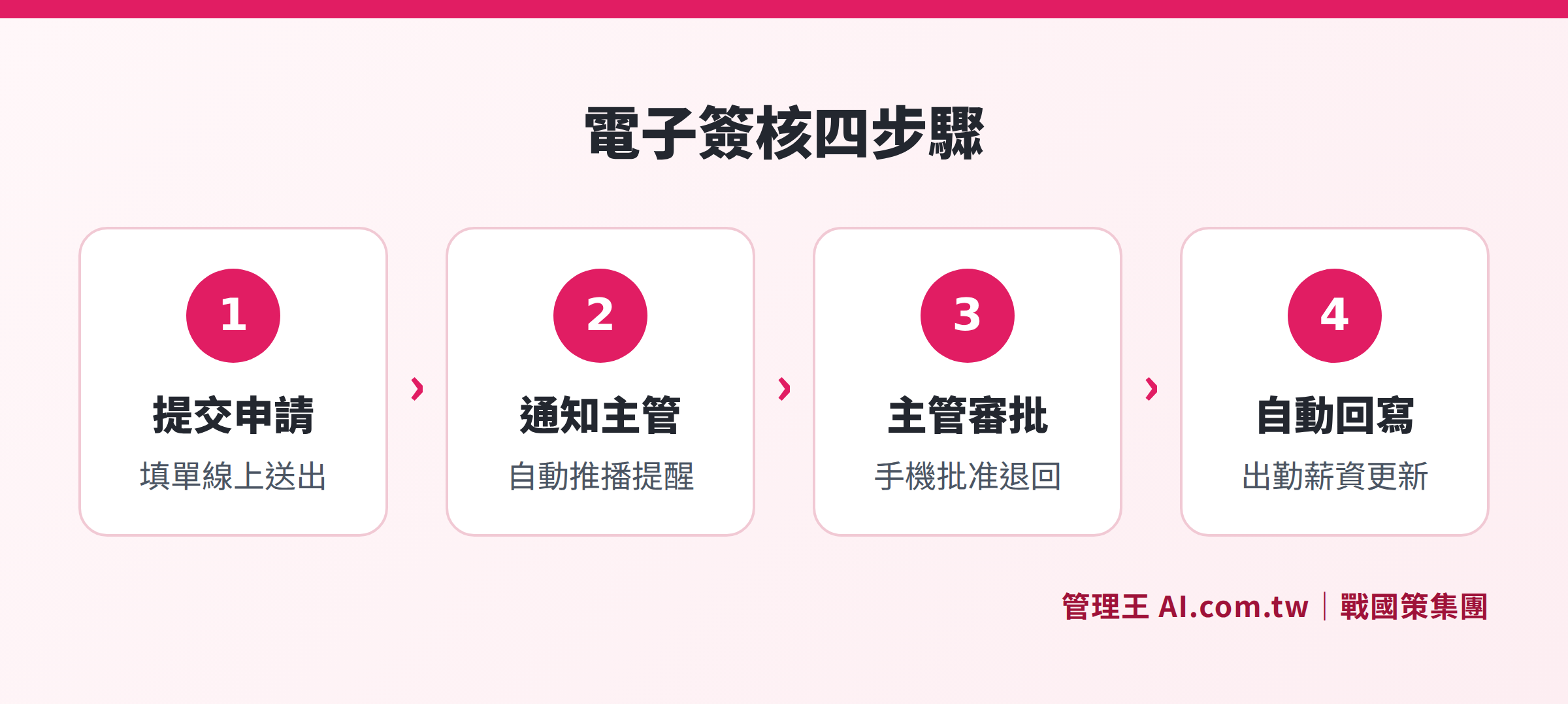
In traditional practices, a procurement application might require the signatures of three individuals: the department supervisor, finance supervisor, and general manager. The transmission across the office alone can take one to several days, not to mention that processes can completely stall when supervisors are traveling or on leave, with the added risk of lost documents. The online approval system thoroughly addresses this pain point: supervisors can receive notifications while on business trips and approve requests with a click, completing the approval process in just minutes.
In One Sentence
Online Approval System = Move all applications requiring manager approval online, and automatically complete submission, approval, and archiving in one line.
Difference Between Online Approval and Electronic Signatures
These two terms are often used interchangeably, but they refer to different levels of tools. Electronic signatures (e-Signature) are the technology that confirms "the person on the document is indeed that person," such as completing a legally binding electronic signature on a contract. Online approval systems are tools for "managing approval processes," focusing on application submission, multi-level review, notification mechanisms, and record retention throughout the workflow. The two can integrate: a complete enterprise management system provides both process approvals and electronic signature functionality, allowing internal approvals and external contract signing to be completed on the same platform.
Difference Between Electronic Forms and Regular Email Applications
Many enterprises think that sending an application via email and saving a screenshot counts as digitalization, but this method lacks structured data, cannot automatically notify the next reviewer, and cannot track where the process is stalled. The core value of the online approval system lies in "process automation": the system knows whom the application should be sent to first, who next, who to notify if it exceeds the processing time, and which data to automatically update after approval.
Paper vs. Online Approval: Efficiency Difference at a Glance
Table: Comparison of Six Key Aspects Between Paper-Based Approval and Online Approval System
| Aspect | Paper-Based Approval | Online Approval System |
|---|---|---|
| Application Method | Fill out paper forms or Excel | Fill out electronic forms on web or mobile |
| Notification Method | Phone, email, or physical delivery | System automatically pushes notifications to the next approver |
| When Supervisor is Absent | Process is stalled, waiting for their return to proceed | Can appoint a proxy or approve remotely via mobile |
| Audit Inquiry | Searching through paper archives, time-consuming and labor-intensive | System retains a complete digital record, searchable by conditions with one click |
| Data Synchronization | Manual re-entry required to relevant systems after approval | Automatically updates attendance, payroll, and other modules upon approval |
| Compliance Records | No clear timestamps, hard to provide evidence | Each step includes operator, IP, and timestamps |
A complete digital approval process from employee submission of electronic form to system automatic push, manager approval, and data updating
Core Functions of Online Approval Systems
1. Multi-level and Conditional Approval Processes
Approval rules in enterprises are often not a linear process. For example, procurement amounts above a certain threshold could require an additional approval step, or a department supervisor's leave exceeding three days requires a vice president's additional signature — these conditional rules relied on memory in the paper era but can be set directly in an online approval system, ensuring rules are enforced and not lost due to personnel changes.
- Sequential Approval: The following approver is notified only after the previous one has given approval, suitable for processes that need layered responsibility.
- Parallel Approval: Notifies multiple approvers simultaneously, suitable for situations that require co-signatures from various departments.
- Conditional Diversion: Automatically selects different approval paths based on applicant’s level, department, or application amount.
2. Proxy Approval and Timeliness Control
When supervisors are on business trips or leave, they can appoint a proxy to handle pending approvals, ensuring that the process does not get interrupted due to their absence. A good approval system will have an in-built SLA timeliness control: if it surpasses a specified time without being processed, the system automatically sends a reminder, and may escalate notifications to upper management, ensuring each application has someone responsible and a timeline.
3. Mobile Approval and Real-Time Notifications
Many Taiwanese enterprises commonly use instant messaging tools as their primary communication channels. If the online approval system can push notifications directly to managers' phones for pending approvals, allowing managers to approve requests without needing to log into another system, it can significantly enhance actual usage rates. The batch approve function lets supervisors process multiple pending requests at once, saving time on operations.
4. Complete Audit Trail and Efficiency Reports
The complete timeline for each application — when submitted, who approved or rejected it, and the IP address used — must have a digitized record. This not only facilitates post-query but also serves as an important compliance basis during labor inspection or internal disputes. Monthly efficiency reports clearly present the average approval times across different departments, helping management identify process bottlenecks.
5. AI Approval Assistant
Advanced online approval systems incorporate AI functionality, assisting managers in summarizing key points of numerous pending requests and suggesting priorities. For medium- to upper-management personnel who need to handle large volumes of approvals daily, an AI assistant can enhance decision-making efficiency.
6. Form Customization and Module Integration
Different enterprises and departments have various application needs. The system should support custom form design and require deep integration with attendance clock-in system, payroll calculation system, procurement management, and other modules — after approval, relevant data is updated automatically without manual re-entry.
Taiwan's 2024 Electronic Signature Law Amendment: Key Compliance Points for Enterprises
The amendment to Taiwan's Electronic Signature Law was passed by the Legislative Yuan on April 30, 2024, and officially took effect on May 15, 2024. This is the first major revision since the law was enacted in 2002 and has significant implications for enterprises' digital processes.
Three Major Highlights of the Amendment:
1. Legal Effect of Electronic Documents Equals Paper
Electronic documents and electronic signatures cannot have their legal effect denied solely based on their electronic form, equating them with written documents and handwritten signatures. Approval records in an enterprise with complete timestamps and operational trails hold significant legal validity.
2. Consent Mechanism Changed from Explicit to Implicit
What previously required both parties' "explicit consent" to use electronic documents is now changed to "implicit consent" (opt-out mechanism), reducing friction for enterprises implementing digital processes and promoting more widespread electronic application.
3. Presumptive Validity of Digital Signatures
Digital signatures verified by certification authorities have a stronger presumptive validity, suitable for contractual scenarios needing more robust legal protection.
Practical Implications for Enterprises:
The regulatory hurdles for enterprises promoting digital signatures have significantly reduced. As long as there are complete electronic records and identity verification in processes, courts and regulatory authorities generally cannot deny their validity simply because "there is no paper version." It should be noted that certain legal actions, such as land registration and property transfer, still require written forms, so enterprises should confirm business nature before implementation.
By integrating with electronic contracts and electronic signature functions, external contract signing can also be fully digitized, forming a complete paperless office environment in conjunction with the internal online approval system.
Five Common Corporate Approval Scenarios and Their Digitalization Practices
Table: Common Corporate Approval Processes, Pain Points, and Digital Improvements
| Type of Approval | Common Pain Points | Improvements After Digitalization |
|---|---|---|
| Leave Applications | Obtaining supervisor's signature on paper, HR manually updating attendance balances | Employees apply online, supervisors approve remotely, remaining leave is automatically deducted |
| Overtime Applications | Oral notifications followed by incomplete submissions and disputes over overtime calculations | Records established with prior applications, overtime pay automatically calculated in the payroll module |
| Procurement Requests | The same process applies regardless of the amount, leading to insufficient control details | Automatically routes based on amount thresholds, additional approval required for large procurements |
| Expense Reimbursements | Receipts are easily lost, processed only at the end of the month | Immediate photo uploads with automatic allocation to accounting categories |
| Contract Stamping | Time-consuming mailing of paper contracts back and forth with chaotic filing | Electronic signatures allow online confirmation by the opposite party, contracts are automatically archived |
Digitalization for each approval scenario requires integration with corresponding backend systems to truly realize effectiveness. Leave is linked to attendance, overtime to payroll, and procurement to inventory and accounts payable — this depth of integration is the most noteworthy differentiating point when purchasing an online approval system.

A complete implementation process from process inventory, path design, training to online optimization
Four Steps for Implementing Online Approval Systems
Implementing an online approval system does not mean simply purchasing the software to complete the task; successful implementation requires systematic planning and promotion. Here are four commonly followed implementation paths:
Step 1: Inventory Existing Approval Processes
List all types of applications requiring supervisor approval, noting each process's number of approval layers, conditional rules, and average processing times. This step also harbors opportunities to identify unnecessary steps within current processes; many enterprises discover that certain approval levels are merely remnants of history and can be simplified.
Step 2: Design the Digital Approval Path
Do not just replicate the paper process onto the system; redesign based on actual control needs. Clearly define condition diversion rules — such as "procurement amounts over Taiwan dollars 30,000 require finance supervisor's co-signature" — to make rules transparent and reduce future cognitive discrepancies.
Step 3: System Setup and Employee Training
After completing the basic system setup, arrange operational briefings for department supervisors and employees, focusing on the core actions of "how to submit applications, how supervisors receive notifications and approve." The operation process on mobile devices should be a focal training point, as most employees will use the system for the first time on their phones.
Step 4: Trial Launch and Continuous Optimization
It is recommended to first conduct a trial in one department or for one type of application and gather feedback before promoting it company-wide. After the system goes live, regularly review approval efficiency reports to identify which departments or document types have lengthy average processing times, and make targeted process adjustments or remind relevant personnel.
Five Major Assessment Indicators for Purchasing Online Approval Systems
When Taiwanese SMEs purchase online approval systems among many options, it is advisable to evaluate based on the following five aspects to avoid selecting a system that features delightful functions but is unsuitable for Taiwan's actual environment:
Indicator 1: Compliance with Taiwan's Regulations
Does the system have built-in calculations for paid leave days and overtime pay multiples (1 and 1/3 times for the first two hours of extended hours on weekdays, 1 and 2/3 times for the third hour and beyond) in accordance with Taiwan's Labor Standards Act? Are the rates for weekend overtime and national holiday attendance accurate? Systems with insufficient regulatory compliance might lead to errors in payroll calculations, which can be costly.
Indicator 2: Depth of Integration with Existing Systems
If the approval system cannot integrate with attendance, payroll, procurement, and other modules, manual re-entry will still be required after approval, resolving only the process notification issue and not the fundamental pain point of duplicated data entry. Before purchasing, confirm what native integrations the system offers and the costs and complexities of API connections.
Indicator 3: Mobile User Experience
Supervisors most often handle pending approvals on their phones. Does the system support mobile notification pushes? Is the user interface smooth and easy to use on mobile devices? This directly affects the actual usage rate after the system goes live and is one of the key factors determining whether the implementation succeeds or not.
Indicator 4: Flexibility in Customizing Forms and Processes
Each enterprise has different approval rules; does the system support customizing form fields, adjusting approval layers, and condition diversion without additional fees? Or does every adjustment require a new quote?
Indicator 5: Completeness and Searchability of Audit Trails
Does the system fully record timestamps and operators for each application, and support search by date range, department, application type, and approvers? This is the most important system capability for labor inspections and handling employee disputes.
How to Use 管理王 Approval Center
管理王 AI.com.tw Approval Center is an electronic signature tool designed for Taiwanese SMEs, with six preset forms for leave, overtime, business trips, procurement, expense reimbursements, and contract documents, while also supporting custom form design to enable applications across different departments on the same system.
Operational Procedure:
Employees open 管理王 on their phones or computers, select the application type, fill out the electronic form, and submit it; the system immediately pushes notifications to the designated approval supervisors. Supervisors can open notifications directly and approve or reject on their mobile devices without needing to install additional applications. Each record includes the IP address and operation time, automatically stored as part of the audit trail.
Supports multi-level approval settings, automatically assigning different approval paths based on application amounts, departments, or applicant positions. When procurement amounts exceed set thresholds, it automatically sends for secondary approvals; longer leave requests automatically require departmental supervisor additional sign-offs, all executed according to predefined rules.
When supervisors are away, they can appoint proxy approvers within the system to take over pending tasks, preventing workflow bottlenecks. It has built-in SLA controls to automatically send reminders if actions are not taken within specified time frames.
After approval, leave data automatically updates the attendance system, adjusting remaining leave days, and overtime data integrates directly into payroll calculations, with procurement requests linking to the procurement module, eliminating the need for manual re-entry.
The AI approval assistant feature helps supervisors summarize multiple pending requests and suggest priorities, allowing quick clearance of pending review items even during meeting gaps. The system also integrates with electronic contracts and electronic signature, allowing external contract electronic signing under the same management platform.
For enterprises requiring more complete talent management, the system can be linked to performance management systems and HR systems, ensuring the entire process from employee daily applications to performance evaluations is completed within 管理王.
Free Plans Available for Permanent Use of the basic approval features for up to 10 members, ideal for nascent small teams to become familiar with digital processes. Larger companies or those needing more AI features may upgrade to the economical plan (NT$5,000/month, capped at 30 users) or business plan (NT$10,000/month, capped at 60 users, including remote onboarding training).
The 管理王 Approval Center is a key component module of the EIP Corporate Information Portal System. You can also refer to 2026 Digital Signature Guide for Taiwanese Enterprises to understand comparison of functionalities among different systems. 戰國策 Group serves more than 30,000 enterprises, specifically designed to fit Taiwanese SMEs' business habits and regulatory environments, with servers and data located in Taiwan, meeting data sovereignty needs.
Get Started with Digitalization of Corporate Approval for Free
Consultants will assist you in planning an online approval system suitable for Taiwanese SMEs, completely digitizing from leave requests to procurement, with a free plan for permanent use.
Free consultation hotline: 0800-003-191
LINE Official Account: @119m
Official website: app.AI.com.tw
Free trial: Apply for 管理王 now
FAQs
Does the online approval system hold legal validity in Taiwan?
Yes. After the amendment of Taiwan's Electronic Signature Law on May 15, 2024, electronic documents and signatures are equal to paper forms in legal effect and cannot be denied validity solely due to their electronic nature. Electronic records generated by enterprises using an online approval system have considerable legal validity if they include complete timestamps and operational trails. However, specific legal actions such as land registration have exceptions; it is advisable to confirm with legal counsel according to business nature.
What is the cost of implementing an online approval system?
The cost varies significantly based on system scale and functionalities. 管理王 AI.com.tw offers a free plan (up to 10 users, can be used permanently) and paid plans starting from NT$5,000/month (30 users). When evaluating total costs, consider the time cost of employee training and the internal manpower needed for process redesign, not just the monthly fee itself.
What if employees are reluctant to use the new system?
The most common reason for low adoption is complexity or the need to operate a separate system. Opting for a system that supports mobile notifications directly for operational use significantly reduces resistance, allowing employees to avoid learning a new interface. Management should clearly state the policy of "all applications must be electronic, and paper forms will no longer be accepted" to avoid confusion caused by dual systems. It is suggested to start the promotion with the most frequently used leave applications, allowing employees to build habits before extending to other processes.
Can online approval records serve as evidence in labor disputes?
Complete electronic approval records (including IP address, timestamps, and operators) can be used as supporting evidence in labor disputes, specifically relating to whether overtime applications were pre-approved. Enterprises must ensure that attendance records comply with the completeness requirements stated in Article 30 of the Labor Standards Act. The formal legal effect will still be judged based on individual case circumstances; for major disputes, it is advisable to seek legal professional advice.
What is the relationship between online approval systems and ERP systems?
Online approval systems are usually one of the components of an ERP system, falling under EIP (Enterprise Information Portal). They are responsible for handling internal process approvals. A complete ERP system automatically synchronizes the approval results with financial, procurement, inventory, and other modules to avoid data silos across systems. If a standalone approval tool is purchased, additional API connections will be needed to achieve automatic data flow.
Source Materials
- Taiwan's Electronic Signature Law (Effective May 15, 2024): National Legislative Database
- Regulations for Electronic Document Exchange: National Legislative Database
- 功能頁 for 管理王 AI.com.tw Approval Center: https://app.ai.com.tw/features/approval-center