How to Choose a Food Ordering System? A Complete Guide for Restaurants to Build Their Own Online Ordering Platform|Recommended Ordering Systems

Food ordering systems help restaurants create their own online ordering platforms, saving up to 30% in commissions from delivery platforms and gaining complete control over customer data. This article covers fee comparisons, six core functions, QR Code and KIOSK ordering, implementation processes, and purchasing advice for various business types.
A food ordering system is a core tool that enables restaurants to establish their own online ordering platform, freeing the food service industry from hefty commissions of delivery platforms, allowing them to receive orders and payments directly through their website, QR Code, or self-service KIOSK. By 2026, the total number of restaurants in Taiwan has reached 181,000, making competition increasingly fierce; commissions on each order are approximately 35% for UberEats and 32%-38% for Foodpanda, while a self-built ordering system only incurs a payment processing fee (around 1.5%-3%), turning the saved difference directly into profit. This article provides a comprehensive explanation of how to choose the right ordering system, from delivery platform fee comparisons, six core functions, implementation processes, to recommendations for various types of restaurants, transforming restaurants from "renting space on delivery platforms" to "operating their own online store."
What is a Food Ordering System?
A food ordering system (Online Ordering System) is a set of software tools that allows customers to place orders, make payments, reserve seats, and track orders through the restaurant’s own webpage, mobile page, or by scanning a QR Code. The main difference from delivery platforms (like UberEats and Foodpanda) is that delivery platforms are "renting someone else's store to do business," while a food ordering system allows businesses to "create their own online store."
Fundamental Differences Between a Self-Built Ordering System and a Delivery Platform
While delivery platforms address the exposure and logistics issues for restaurants, they also come with three major costs:
- High commissions: Each order has 30%-38% taken by the platform, which means for every three meal vouchers sold, one goes to the platform.
- Customer data does not belong to you: Customer data belongs to the platform, thus making it impossible to conduct proactive marketing or accumulate a loyal membership base.
- Brand visibility is diluted: Customers remember "buying from UberEats" instead of saying "I’m your loyal customer."
With a self-built ordering system, customers order directly from the restaurant, with complete retention of customer data, and only payment processing fees need to be paid for each order, allowing all other income to remain with the restaurant.
In Brief
A food ordering system allows restaurants to transition from "renting space on delivery platforms" to "operating their own online store," with each saved commission equivalent to an increase in profit.
Updated Fee Rate Comparison for Delivery Platforms in 2026
The food delivery platform market in Taiwan is primarily dominated by UberEats and Foodpanda. After the implementation of the "Delivery Platform Management Regulations" in July 2026, various platforms adjusted their fee structures, reducing negotiation space for restaurants.
Table: Comparison of Major Delivery Platforms and Self-Built Systems (Data from July 2026, based on official website information)
| Platform | Commission per Order | Monthly Fee Overview | Ownership of Customer Data | Taiwan Mobile Payment |
|---|---|---|---|---|
| UberEats | Around 35% | Based on contract | Belongs to platform | Built-in support |
| Foodpanda | 32%-38% | Approximately NT$300 | Belongs to platform | Built-in support |
| Self-Built Ordering System | 0% (Additional payment processing fee) | Based on plan | Completely belongs to the restaurant | Requires self-integration |
Source: Ocard Blog, queried in July 2026.
Estimated Cost of Commissions
For example, let’s consider a restaurant with an average daily order revenue of NT$20,000 (for estimation purposes, actual terms depend on each platform’s contract):
- Using UberEats (around 35% commission): approximately NT$210,000 per month in platform fees.
- Switching to a self-built ordering system (payment processing fee around 2.5%): approximately NT$15,000 per month in payment processing costs.
- Monthly difference: approximately NT$195,000.
Even if the delivery platform is kept for continued exposure, by guiding return customers to the owned ordering system, the savings are substantial.
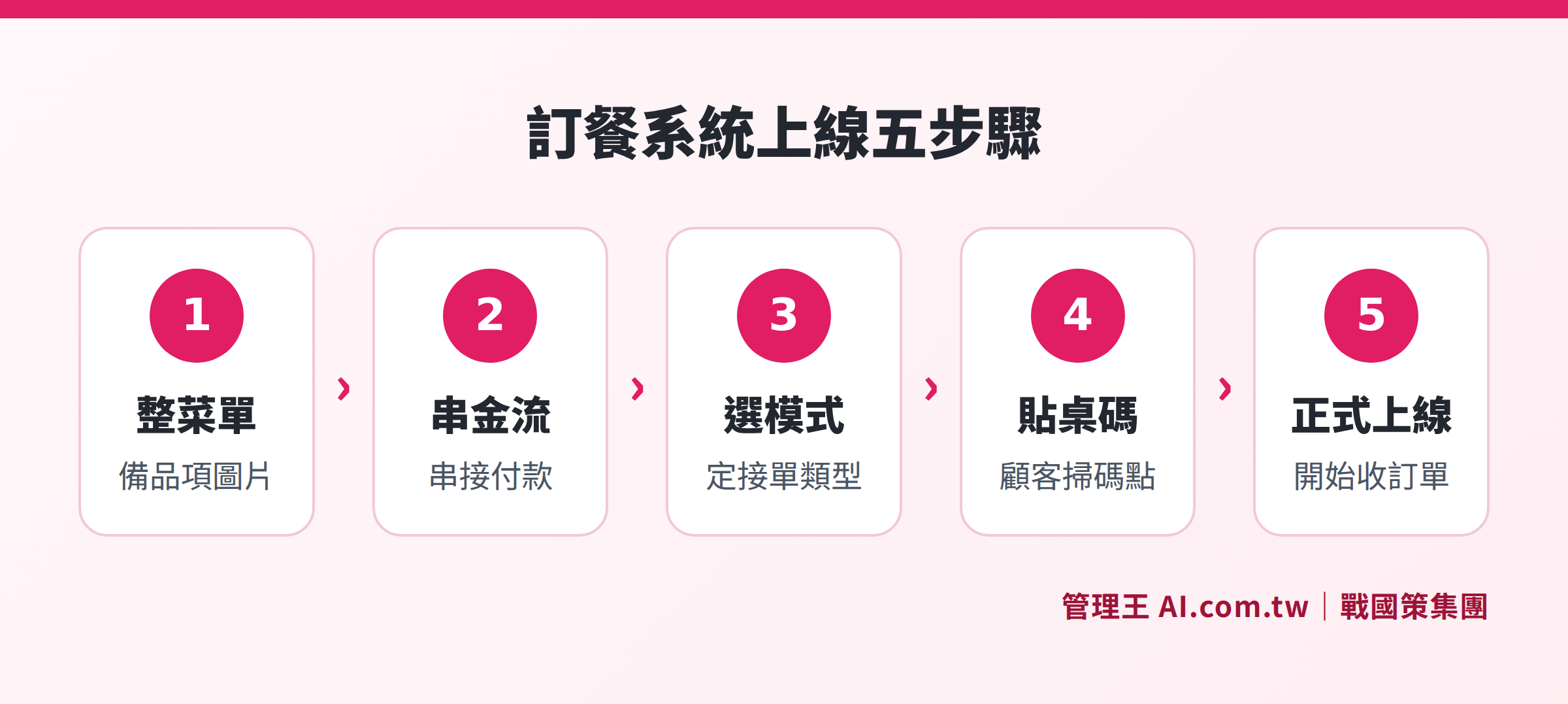
The five key steps from menu establishment to official order receipt, detailing the operation required for each step.
Six Essential Core Functions for a Food Ordering System
A complete food ordering system should have the following six core modules; missing any one could disrupt customer experience or create operational gaps.
1. Multi-Store Online Menu Management
Supports multi-store and multi-menu synchronized management, customizable product categories and options (hot/cold, sweetness levels, add-ons, meal combos) can be set freely, and can automatically switch meal menus (breakfast, lunch, dinner, or limited-time offerings) based on different time periods. For chain brands, the headquarters can uniformly manage the brand's menu while allowing local adjustments at each store; changing prices or removing items only requires a unified update in the backend without the need for modifications at each store.
2. Unified Order Reception for Dine-In, Takeaway, and Delivery
A good ordering system should not only serve takeaway but should also cover dine-in (table number ordering), takeaway (scheduled pickup times), and delivery (utilizing self or third-party delivery personnel) to allow customers to complete their orders on the same interface, preventing restaurant staff from switching between multiple platforms to take orders. During peak times, orders can be evenly distributed based on scheduled times, avoiding overwhelming the kitchen with simultaneous rushes.
3. Integration with Mainstream Payment Methods in Taiwan
Should connect with credit cards, LINE Pay, and Jkopay, the main mobile payment methods in Taiwan. After customers complete online payments, the restaurant receives payment before processing orders, thus reducing the risk of malicious order cancellations; the checkout process is streamlined to avoid customers waiting to swipe their cards during peak times.
4. Automatic Kitchen Order Dispatch and Delivery Tracking
Once an order is placed, it's automatically pushed to the kitchen printer or kitchen display screen (Kitchen Display System), allowing chefs to receive orders without manual handling of paper or verbal communication, reducing the order omission rate. In delivery scenarios, delivery personnel can be assigned, GPS tracking provided, and customizable labels used, ensuring transparency and control from meal preparation to delivery.
5. QR Code Table Ordering and KIOSK Self-Service Ordering
Customers can scan the QR Code on the table for self-service ordering without waiting for a server; KIOSK self-service ordering machines are suitable for high-traffic fast food restaurants and chain brands, especially during peak times, reducing lines, decreasing labor demands, and simultaneously driving upselling. The adoption rate of QR Code ordering among Taiwanese chain operators has already surpassed 80%, evolving from an emergency tool during the pandemic to a standard feature in daily operations.
6. Sales Analysis and Membership Integration
Instantly view best-selling item rankings, meal preparation efficiency, and average customer spending trends, and integrate with membership points and coupon centers, transforming one-time consumers into loyal repeat customers. The system automatically suggests removing unpopular items and optimizing menu structures, allowing owners to make decisions based on data rather than intuition.
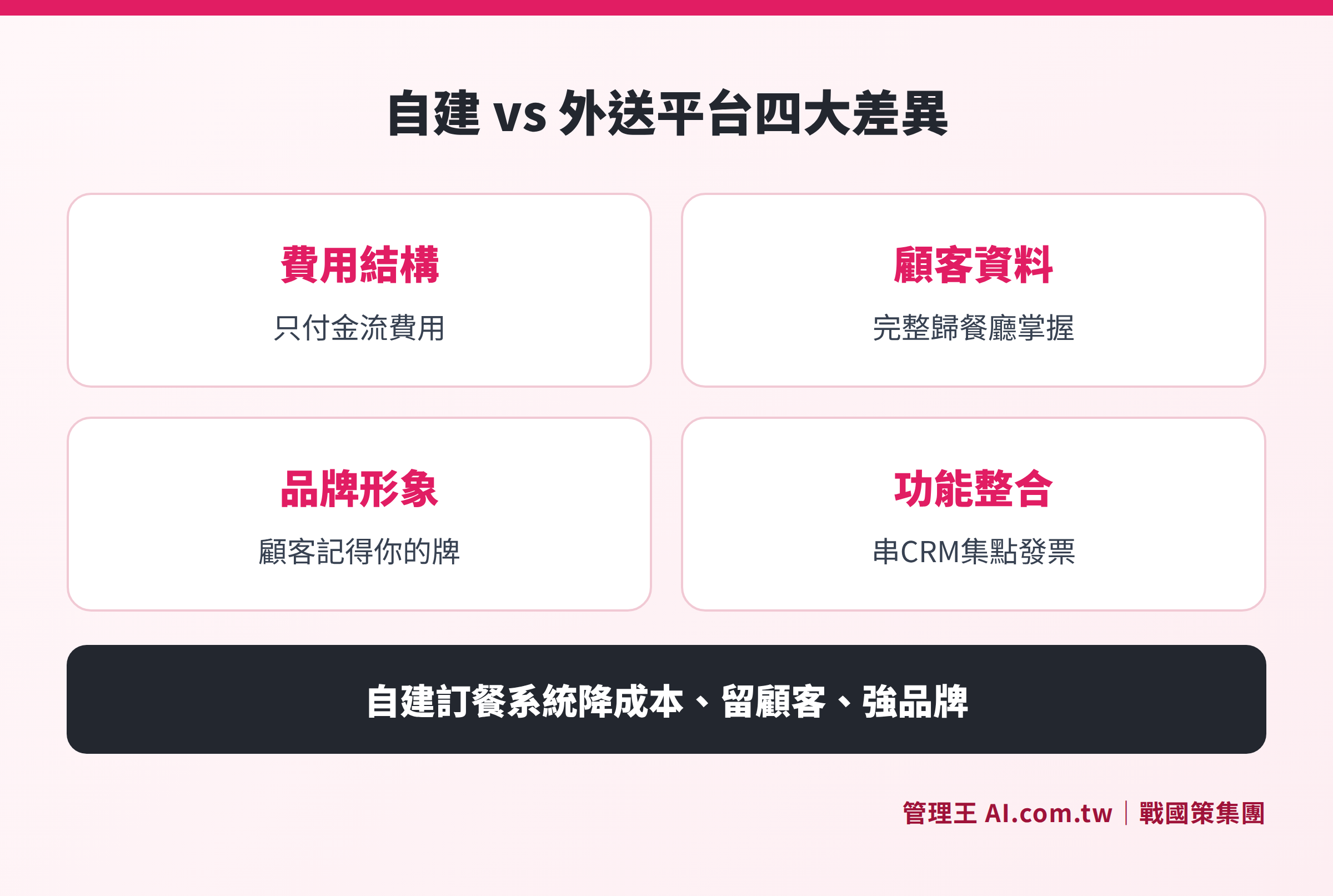
Comparison of differences from the perspectives of cost structure, customer data, brand control, and functional flexibility.
Detailed Explanation of QR Code Ordering and KIOSK Self-Service Ordering
Complete Process of QR Code Table Ordering
The QR Code ordering process is as follows:
- Customers scan the exclusive QR Code on the table after being seated.
- The mobile phone directly opens the restaurant's online menu (no app download required).
- Customers select items and complete customizations (add-ons, sweetness).
- After adding to the shopping cart, the order is submitted.
- The system automatically notifies the kitchen to prepare the order.
- Customers can pay online on their phones or settle the bill at the end of the meal.
This process eliminates the repetitive step of waitstaff taking orders and inputting them into the POS, making it especially efficient for dining scenarios with many seats, while also reducing the chances of human errors during ordering.
Applicable Scenarios for KIOSK Self-Service Ordering
KIOSK is suitable for the following scenarios:
- Fast food and bubble tea shops: Quick customer flow, fixed items, with KIOSK speeding up orders and simultaneously promoting upselling recommendations.
- Flagship stores for chain brands: Enhances brand image while reducing staffing needs.
- Aviation, shopping malls, and department store food courts: Foreign travelers can switch to multi-language interfaces, lowering language communication barriers.
Table: Comparison of Applicable Scenarios for Three Ordering Modes
| Ordering Mode | Optimal Scenario | Labor Requirement | Customer Autonomy | Upselling Probability |
|---|---|---|---|---|
| Traditional Waitstaff Ordering | Fine dining, private banquets | High | Low | Dependent on waitstaff guidance |
| QR Code Table Ordering | Medium-sized restaurants, beverage shops | Low | High | Medium |
| KIOSK Self-Service Ordering | Fast food, chain, airport | Extremely low | High | High (system recommended upselling) |
How are Payment Processing Fees Calculated for Ordering Systems?
Payment processing fees are one of the main costs of a self-built ordering system. Rates from various payment providers in Taiwan vary slightly, estimated as follows:
- Credit Card (Visa/Mastercard): Transaction amounts approximately 1.5%-2.5%, depending on the issuing bank and transaction volume.
- LINE Pay: Merchant rates may vary based on contracts, typically around 2%-2.8%.
- Jkopay: Rates vary by plan; check with Jkopay for the latest quotes.
The above rates are for reference only; actual rates depend on the latest announcements and contract terms from each payment provider. Compared with delivery platform commissions ranging from 32%-38%, even with processing fees included, the overall costs of a self-built ordering system remain significantly lower than those of delivery platforms.
Furthermore, the monthly fees for a self-built ordering system are usually fixed costs, regardless of the order quantity; delivery platforms take a commission from each order, meaning the better the performance, the higher the losses. For restaurants with established stable customer bases, the sooner they switch to a self-built ordering system, the more cost-effective it will be.
How to Choose a Food Ordering System? Five Assessment Indicators
Amidst numerous food ordering systems, restaurant owners in Taiwan should evaluate from the following five perspectives to avoid choosing an overseas SaaS system that is "not compatible with Taiwan's environment."
1. Does it Support Mainstream Payment Methods in Taiwan?
The system must natively connect with LINE Pay, Jkopay, and credit cards (Visa/Mastercard/JCB). Foreign systems often lack local payment integrations available in Taiwan; if self-integration is required, additional development costs will be incurred, and subsequent maintenance responsibilities remain unclear.
2. Does it Comply with Taiwan's Tax and Invoice Regulations?
The Taiwanese electronic invoice system is governed by the Ministry of Finance, and the restaurant industry must comply with relevant regulations when issuing electronic invoices. The ordering system should be able to automatically link with electronic invoice functions or integrate with POS systems that already connect to invoices, avoiding manual issuance of invoices later on.
3. Is Multi-Store Management Capability Comprehensive?
Operators with more than one store should confirm whether the system supports centralized management of menus and reports at the headquarters while allowing each store to independently receive orders and settle accounts separately. If each store operates independently without centralized management, the benefits of expansion will rapidly decline.
4. How Deep is the Integration with Existing POS and CRM Systems?
If the restaurant already has a POS system or member database, the new ordering system should be capable of integrating with existing systems to avoid the need for double data entry. The ideal scenario is a complete process of "order in the ordering system → settle in POS → accumulate member points in CRM" being completed automatically without manual involvement.
5. Local Customer Support in Taiwan
System issues often occur during the busiest peak periods. If customer service is overseas and does not understand traditional Chinese, restaurant owners may find it challenging to receive timely assistance during emergencies. Prioritize systems with a local customer service center in Taiwan that can resolve issues on the same day via direct phone contact.
How Should Restaurants of Different Sizes and Formats Choose?
Core needs differ for various food and beverage operators; clarifying one's scenario before purchase is advisable:
- Single-store cafes or artisanal bakeries: Core needs are takeaway reservations + scheduled pickup times; starting with a free plan is recommended.
- Beverage chain brands: Multi-store management + KIOSK fast ordering + membership points should be prioritized.
- Lunch box shops and fast food takeaway shops: Scheduling pickup times to streamline traffic is crucial to avoid chaos during lunch hour.
- Medium-sized dine-in restaurants (20 tables or more): QR Code table ordering + automatic kitchen dispatch will significantly enhance efficiency.
- Cloud kitchens: Without physical storefronts, they rely entirely on online orders; system stability and breadth of payment integration are most important.
- Headquarters of chain restaurants: Cross-store report consolidation, centralized campaign distribution, and real-time monitoring of store performance are core management needs.
When selecting a system, it's advisable to start from the "biggest pain point" currently: if it’s missed orders, focus on kitchen dispatch systems; if it’s customer attrition, target membership and coupon modules; if costs are too high, start with replacing delivery platforms with a self-built ordering solution.
Preparation Work Before Implementing the Food Ordering System
After selecting a system, it is recommended to complete the following preparations before going live:
- Organize and confirm menu data: Item names, prices, images (recommended uniform dimensions), options descriptions (sweetness levels, temperature, add-ons); prepare foreign language menus if applicable.
- Confirm Taiwanese payment processing accounts: Apply for corporate accounts for receiving payments and complete certification with payment providers; approval typically takes several business days.
- Decide on ordering modes: Confirm which order reception channels to activate (takeaway, delivery, table-side QR Code, KIOSK); not all modes need to go live at once; they can be launched in phases.
- Plan kitchen order dispatch processes: Decide whether to use a printer or a kitchen display screen, ensuring network stability.
- Inform in-house staff: Briefly explain the new order reception processes, so kitchen staff know how orders will be displayed.
Once preparations are complete, the impact of the transition on the launch day will be significantly reduced, and the adaptation period for employees will also be shorter.
How to Use 管理王 AI.com.tw's Food Ordering System
The 管理王 Ordering System is a complete online ordering solution designed for Taiwanese restaurateurs, covering multi-store menus, unified order reception for dine-in, takeaway, and delivery, mainstream payment methods in Taiwan, automatic kitchen order dispatch, QR Code table ordering, KIOSK self-service ordering, sales analysis, and more. From deciding to use it to going live can be completed in as little as one afternoon. Free plans can be used permanently, suitable for operators wanting to test the waters first.
Implementation process is recommended as follows:
- Create an online menu: Add items in the management interface, upload images, and set customizable options (hot/cold, sweetness, add-ons, meal combos). For multi-stores, headquarters can set them uniformly or grant autonomy for each store to adjust.
- Integrate Taiwanese payment systems: Select which payment methods to enable (credit cards, LINE Pay, Jkopay), and the system will guide you through the integration; orders will be automatically confirmed once customers pay online.
- Set up pickup modes: Depending on the type of restaurant, choose to activate takeaway reservations (with specified pickup times), table-side ordering, or delivery dispatch; all modes can be activated simultaneously.
- Activate table-side QR Codes: The backend generates exclusive QR Code stickers for each table, which can be printed and placed on tabletops. Customers scanning it will enter the ordering page, with orders automatically sent to the kitchen.
- Integrate CRM and membership points: The ordering system natively integrates with 管理王's CRM module, membership points, and coupon centers, turning each order into an accumulation of customer relationships and driving repeat purchases.
- Set up reservation systems (if applicable): If there’s a need for dine-in reservations, you may simultaneously activate the online reservation function, which will automatically connect reservation information with seat management, reducing the need for phone bookings.
The same account also covers POS checkout, invoice management, and accounting and reporting, avoiding the need to purchase multiple software solutions. For plan details, refer to 管理王 service plans.
The 戰國策 Group serves over 30,000 enterprises, and the 管理王 system is developed and maintained by a Taiwanese team, with data stored in Taiwan’s data centers, complying with personal data laws and local regulatory requirements. Customer support is available Monday to Friday from 9:00 to 18:00 in traditional Chinese.
Try the Ordering System for Free and Say Goodbye to High Commissions
Consultants assist in evaluating the feasibility of building an ordering platform, providing insights on how to save on delivery platform commissions and manage your customer data.
Free consultation hotline: 0800-003-191
LINE official account: @119m
Official website: app.AI.com.tw
Free trial: Apply for 管理王 now
Frequently Asked Questions
Do I have to give up delivery platforms when implementing a food ordering system?
No, it is not necessary. A self-built ordering system and delivery platforms are not mutually exclusive. The most common practice is to retain the delivery platform to attract new customers while using the self-built ordering system together with membership points to guide repeat consumers back to their own channels, letting delivery platforms be responsible for acquiring customers while owned platforms focus on retaining them, gradually reducing commission costs.
What is the approximate cost of activating the ordering system?
The costs vary depending on the system and plan. The 管理王 free plan can be used permanently for basic functions; paid plans start at NT$5,000 per month, depending on the depth of features and number of users. The initial investment is mainly the time cost involved in building the menu and setting up payment systems, usually without the need for additional hardware costs (except for kitchen printers).
Can a small shop with no IT personnel set it up by themselves?
Yes. The 管理王 ordering system interface is entirely in traditional Chinese, and the operational logic is similar to that of general e-commerce product listing processes, allowing owners or managers to complete the setup themselves without programming skills. For any custom development needs, consulting services (NT$1,000/hour transparent billing) can be purchased, with free initial assessments provided by consultants.
Does the ordering system support electronic invoices?
The 管理王 system is designed in accordance with Taiwan's business accounting laws and electronic invoice implementation regulations; for complete invoice integration settings, it is recommended to confirm with consultants during implementation to ensure compliance with tax regulations. For details, please contact customer service.
How many stores are worth introducing a self-built ordering system?
Even a single store is worth implementing. As long as there is a certain volume of daily takeaway orders, utilizing scheduled pickup times can save labor, and each order's commission savings start accumulating from day one. For chain brands, the benefits are even more pronounced, as centralized management allows headquarters to gain immediate insight into each store's performance, with headquarters marketing activities also being able to dispatch simultaneously to all stores.