Complete Guide to Online Store Setup: From Choosing a Platform, Payment Integration to First Order|Recommended Online Store Platforms

A comprehensive analysis of the five core elements of setting up an online store in Taiwan: choosing a platform, payment integration, logistics connection, marketing tools, and backend management, along with explanations of the Consumer Protection Law's seven-day appreciation period and e-invoice compliance points.
Setting up an online store is the most direct way for Taiwanese SMEs and individual entrepreneurs to enter the e-commerce world—creating an online store that operates 24/7, allowing customers to order, pay, and choose delivery options anytime, without the need to rent a physical store, serving buyers across Taiwan and even overseas. Simply put: an online store is built through an e-commerce platform to create an official shopping site, with payment (online credit card, ATM transfer, convenience store code) and logistics (home delivery, convenience store pickup) integration, then driving traffic through SEO, ads, and social media while enhancing repeat purchase rates with membership and coupon mechanisms. Taiwanese regulations require online sellers to provide a seven-day appreciation period according to Article 19 of the Consumer Protection Act and to issue electronic invoices. These two are the compliance foundations before opening a store, and this article clarifies them all at once.
What Do You Need for an Online Store? A Breakdown of Five Core Elements
Many people think that setting up an online store is just "building a webpage to showcase products," but for an e-commerce business to function successfully, five aspects need to work closely together:
1. Shopping Platform: Determines the appearance of the store, shopping cart logic, SEO structure, and which payment and logistics service providers can be integrated. Self-built (WooCommerce, Magento) offers the highest flexibility but requires maintenance and updates; SaaS rentals (Shopify, Shopline, 管理王) eliminate maintenance, allowing for quick launch; open platforms (Shopee, momo) have high traffic but come with high commissions and make brand building challenging.
2. Payment Integration: A mediator system that enables customers to complete online payments. Mainstream payment processors in Taiwan include Newebpay, ECPay, Spgateway, LINE Pay, and JKO Pay. Approval usually takes 1 to 3 weeks, requiring company information and website URLs for review.
3. Logistics Integration: How packages are delivered to customers. Home delivery (T-CAT, HCT) is suitable for larger or delicate items; convenience store pickup (7-11, FamilyMart) is the most common e-commerce pickup method in Taiwan. Both options should be available to prevent customers from abandoning their carts due to unfamiliar pickup methods.
4. Marketing Tools: Mechanisms to attract new customers, increase order values, and bring back old customers. This includes optimizing product pages for SEO, Google Shopping Feed, coupon discount codes, member loyalty points, cart abandonment emails, and LINE order notifications.
5. Backend Management: Order tracking, inventory synchronization, electronic invoice issuance, accounting reconciliation. The more integrated and automated the backend, the lower the labor costs can be. All five elements must be in place for a healthy e-commerce business to operate, rather than having the owner constantly putting out fires.
In One Sentence
Success in online store setup = Platform + Payment + Logistics + Marketing + Backend Management, none of which can be omitted.
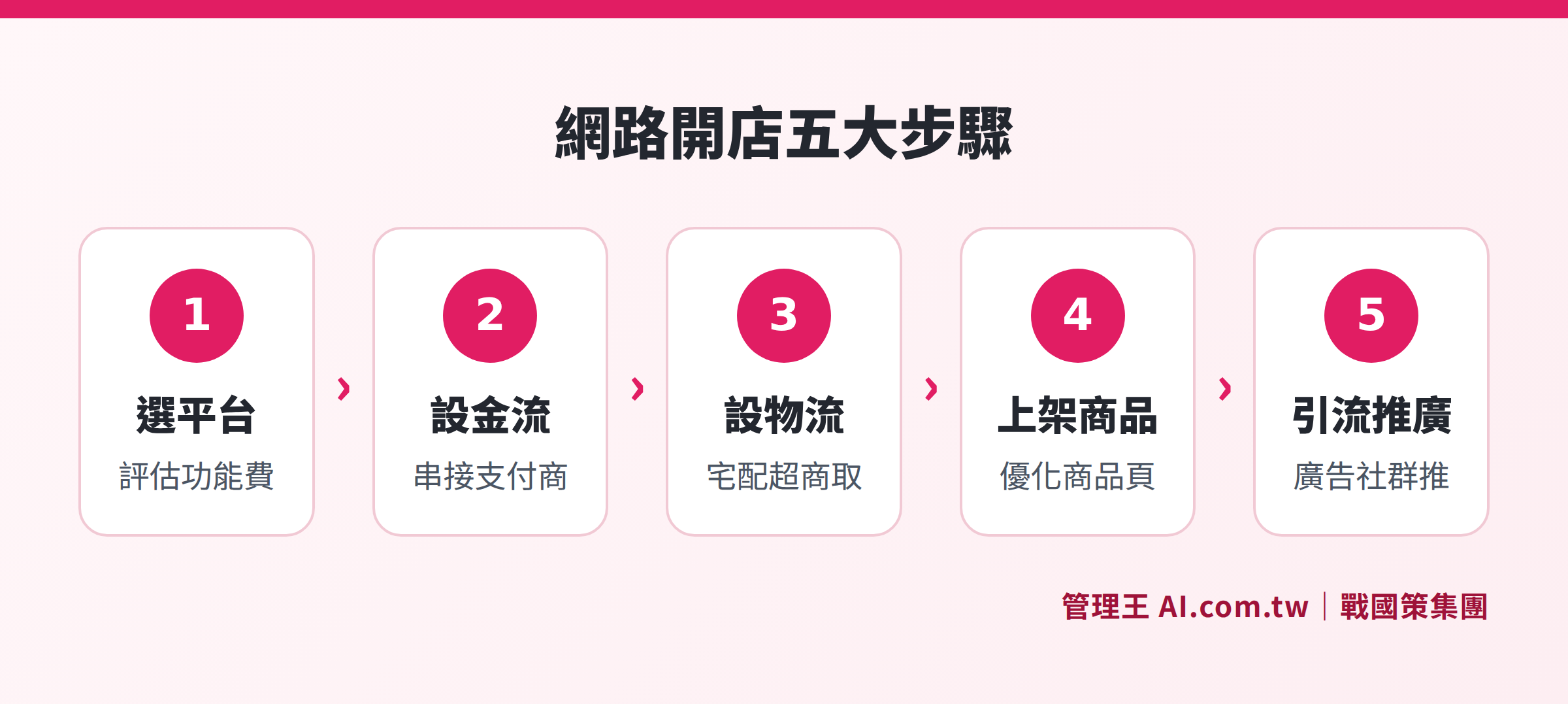
From choosing a platform, integrating payment and logistics, optimizing product listings, launching marketing tools, to continuously tracking orders and inventory - the complete process
Three Store Models: How to Choose Between Self-Hosting, SaaS Rental, and Open Platforms?
Before choosing a store model, clarify your core goals: Are you just testing the waters with a few products? Or are you aiming to build a long-term brand official store? Different goals correspond to different models:
Table: Comparison of Three Online Store Models
| Model | Representative Tools | Major Advantages | Major Disadvantages | Suitable Audience |
|---|---|---|---|---|
| Self-Built Site | WooCommerce, Magento | Fully customizable, no transaction fees, complete data control | Requires self-maintenance, manages security updates, high technical threshold | Tech-savvy, values branding control, long-term high traffic |
| SaaS Rental | Shopify, Shopline, 管理王 | No server maintenance, quick payment and logistics integration, customer support | Monthly fees recur, advanced features require upgraded plans | SMEs, prioritize quick setup, do not want to manage technology |
| Open Platform | Shopee, momo | Built-in traffic, quick exposure, low entry barriers | Commission fees of 5 to 15%, hard to build brand image, customer data not owned | Testing new products, clearing inventory, side business sellers |
The best strategy for most Taiwanese SMEs is "SaaS official store + simultaneous listing on open platforms": the official store accumulates brand image and customer data (every order goes into your CRM), while the open platform brings in cold traffic to enhance exposure, operating on two legs rather than putting all eggs in one basket.
Comparison of Mainstream E-commerce Platforms in Taiwan: Functions and Costs
Commonly evaluated e-commerce SaaS solutions for Taiwanese SMEs have significant differences in function depth and monthly fees. Below is organized based on the official information available (checked in October 2025, subject to each platform's latest announcements):
Table: Comparison of Mainstream E-commerce Platform Functions in Taiwan
| Platform | Free Plan | Starting Monthly Fee | Native Support for Taiwan's Payment Logistics | ERP/CRM Integration |
|---|---|---|---|---|
| 管理王 AI.com.tw | Yes (permanent free) | NT$5,000 | Neweb, ECPay, Spgateway, LINE Pay, JKO; T-CAT, HCT, 7-11, FamilyMart | Native integration of CRM, inventory, accounting, and HR |
| Shopify | No (trial period) | USD$25 and up (approximately NT$800) | Requires additional installation of Taiwan payment app | Requires third-party app for integration |
| Shopline | No (trial period) | Varies by plan, see official site | Native support for mainstream payment processors in Taiwan | Partial function integration |
| WooCommerce | Plugin free | Hosting fees self-paid | Requires installation of Taiwan payment plugin | Requires plugins or custom development |
Key Reminder for Selecting a Platform: Shopify is an international platform, and if focusing primarily on the Taiwanese market, additional installation of Neweb or ECPay plugins is necessary, increasing setup costs. Choosing a SaaS platform that natively supports Taiwan's payment logistics can save significant application and integration hours, allowing customers to check out smoothly from day one of launching a store.
Complete Guide to Payment Integration in Taiwan: Five Payment Methods at a Glance
Payment processes are often the most troublesome aspect of e-commerce, with approval times usually ranging from 1 to 3 weeks. It is advisable to submit applications as soon as the store plan is confirmed. The five most commonly used payment methods in Taiwan are:
Newebpay: Integrates credit card (one-time payment, installment), WebATM, ATM transfers, and convenience store code payments, widely adopted in Taiwanese e-commerce, with complete technical documentation and high compatibility with most e-commerce platforms.
ECPay: One of the leading third-party payment providers in Taiwan, simultaneously offering convenience store logistics integration (7-11, FamilyMart pickup payment), allowing one account to manage both payment and logistics, making it suitable for beginner sellers.
Spgateway: Supports credit card recurring payments and installments, suitable for subscription-based products and periodic delivery scenarios like skincare products.
LINE Pay: The mainstream mobile payment method for LINE users in Taiwan, enabling consumers to complete payments directly within the LINE app, providing a smooth checkout experience and significantly boosting conversion rates among individuals under 40.
JKO Pay: A local electronic payment brand with high penetration in night markets, physical dining, etc., suitable for e-commerce operators with both online and offline channels to provide a consistent payment experience.
What to Prepare for Payment Applications: Company or business registration details, product descriptions (types of products, average price range), website URLs (must be accessible), and bank account for receiving payments. Compared to personal accounts, corporate accounts typically have quicker approval times, so it is advisable to register a company beforehand. According to the "Electronic Payment Institutions Management Act" (regulated by the Financial Supervisory Commission), electronic payment institutions must comply with the FSC's regulations, ensuring that consumer funds stored on the platform are legally protected.
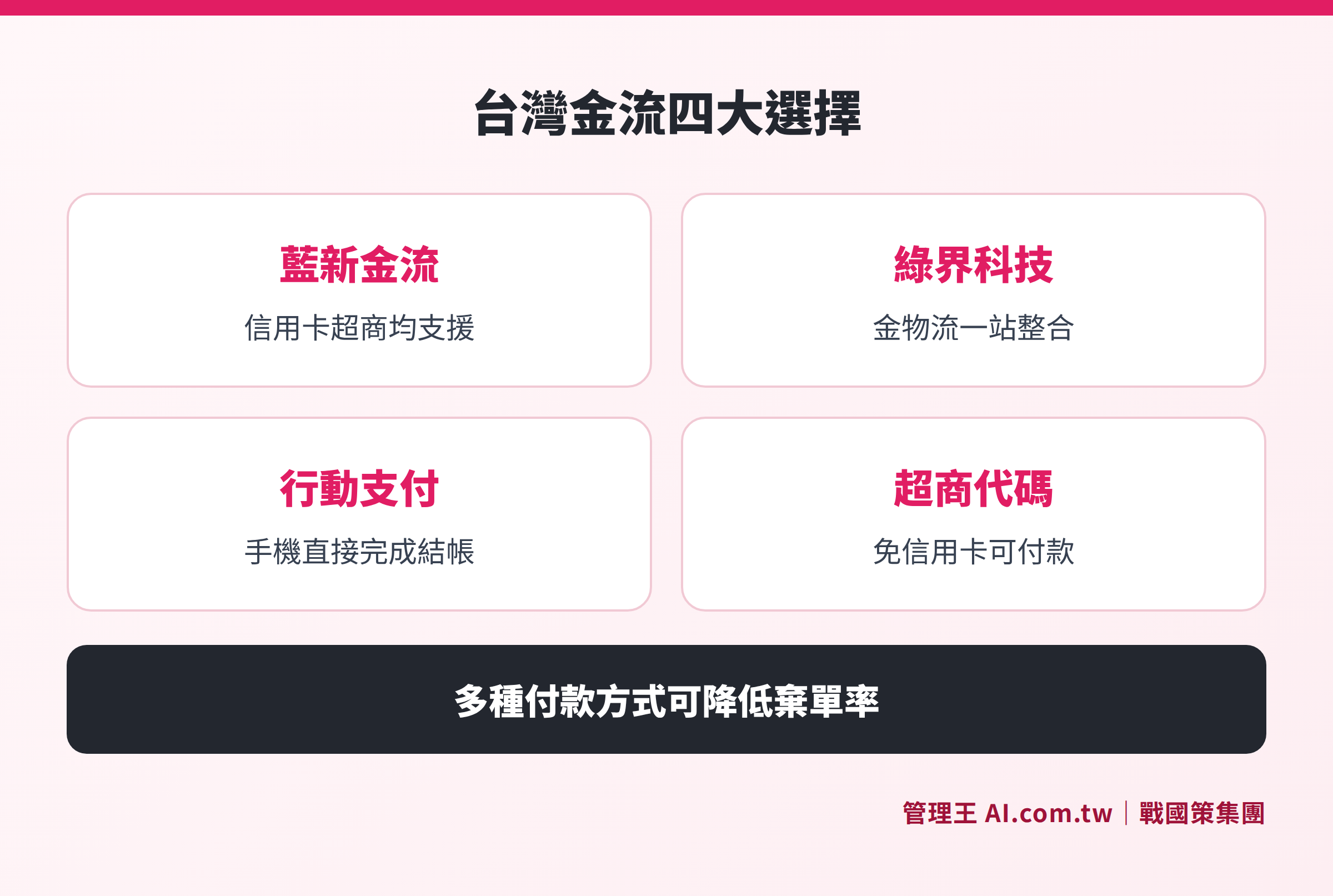
Features and applicable scenarios of T-CAT, HCT, 7-11 convenience store pickup, and FamilyMart convenience store pickup
Complete Guide to Logistics Integration in Taiwan: How to Choose between Home Delivery and Convenience Store Pickup?
The choice of logistics directly impacts the abandonment rate—customers often leave during checkout if they do not see their preferred pickup method. Mainstream logistics options in Taiwan include:
T-CAT: Taiwan's most recognized home delivery service, supporting three temperature levels: room temperature, refrigerated, and frozen, providing either home delivery or specified convenience store (7-11, FamilyMart, OK) pickup. The standard shipping fee for packages within 60 cm total dimensions starts at around NT$130, suitable for delicate brand goods or temperature-controlled foods.
HCT: Founded as a large-scale cargo service for businesses, suitable for B2B or high-price large items (appliances, office furniture), charged based on volume weight, with some plans offering value-added services like home installation, a common choice for traders and manufacturers.
7-11 Convenience Store Pickup (ibon Shipping): With over 6,700 7-11 locations nationwide, convenience store pickup is the most common pickup method in e-commerce, allowing customers to avoid waiting at home, suitable for lightweight packages (within 3 kg), and can be paired with cash-on-delivery features to reduce new customer anxiety.
FamilyMart Convenience Store Pickup (FamiPort): With over 4,200 stores nationwide, offering cash-on-delivery services (payment upon pickup), often integrated with ECPay logistics for a unified backend of payment and logistics reconciliation.
Recommended Approach: Activate at least one home delivery + one convenience store pickup option, allowing customers to choose freely, which can effectively reduce abandonment rates. If primarily selling food and beverages, ensure that both payment and logistics support cold chain services to avoid spoilage disputes during transport.
Electronic Invoices and the Seven-Day Appreciation Period: Regulations Every Taiwanese E-commerce Seller Should Know
Electronic Invoices (eGUI)
According to law, online stores must issue uniform invoices. The Ministry of Finance has implemented an electronic invoice system, allowing online sellers to integrate electronic invoice functionalities through payment processors like Neweb and ECPay, automatically issuing encrypted electronic invoices uploaded to the Ministry of Finance's invoice platform post-order completion, with consumers receiving them via mobile numbers, emails, or other carriers, in accordance with the Ministry of Finance's electronic invoice implementation guidelines. Electronic invoices are more efficient than paper invoices and eliminate the need for manual checks at the end of the month. Per regulations, electronic invoices must be uploaded within the specified timeframe, so it is advisable to use e-commerce platforms that have integrated electronic invoicing to automate this step.
Seven-Day Appreciation Period (Consumer Protection Act Article 19)
According to Article 19 of the Consumer Protection Act, consumers have the unconditional right to return goods and cancel contracts within a seven-day period upon receiving the product in a communication transaction (including online shopping). Sellers cannot require consumers to provide reasons nor charge any fees, and the shipping costs for returning items must be borne by the seller.
The following types of products may be excluded from the seven-day appreciation period provided consumers are clearly informed in advance:
- Perishable goods or those with a short shelf life (e.g., fresh groceries)
- Customized products made to consumer specifications
- Newspapers, magazines, journals
- Opened audiovisual products or computer software
- Completed online services (with prior consent)
- Opened personal hygiene products
Important Reminder: If sellers do not clearly inform consumers of exclusion clauses before purchase, consumers still retain the right to return the goods. It is advisable to clearly state return and exchange policies on product pages and checkout pages to avoid misunderstandings.
Complete Marketing Tools: Everything from Traffic to Repeat Purchases
Once the store is set up and payment logistics are configured, the first challenge is "getting people to find your store," while the second challenge is "encouraging previous buyers to purchase again":
SEO-Friendly URLs and Structured Data: Ensure product page URLs include keywords, images have alt text, and product names naturally include search terms, which helps Google understand the page content and boost natural exposure in search results—long-term, this is the most cost-effective free traffic source.
Google Shopping Feed: Automatically generate product feeds in a format that complies with Google Merchant Center, allowing products to appear in Google Shopping ads, showcasing images, names, and prices, leading to higher click rates than plain text ads.
Coupons and Free Shipping Threshold: First-order discount codes for new customers, festive promotional offers, paired with a “Free shipping over NT$xxx” threshold effectively reduce conversion friction and increase average order values, making them the most direct promotional tools.
Member Loyalty Points: Allowing customers to accumulate points with each purchase to redeem on their next checkout is one of the most effective mechanisms to improve repeat purchase rates. It is advisable to set an expiration date for points to continuously encourage customers to repurchase.
Cart Abandonment Remarketing: For visitors who add items to their cart but do not check out, the system automatically sends reminder emails (including product links) 1 to 24 hours later to re-engage hesitant buyers. This is one of the most efficient mechanisms for optimizing e-commerce conversion rates without needing an extra advertising budget.
LINE Official Account Notifications: Taiwanese consumers are heavily engaged on LINE; all order confirmations, shipping updates, delivery notifications, and pickup reminders can go through LINE, achieving significantly higher open and click rates than emails. It is recommended to integrate LINE notifications from the start.
IG Shopping and FB Shop Sync Listings: Sync products to Instagram Shopping tags and Facebook Shop, driving traffic directly from social media platforms to your store without needing to maintain a separate set of product inventory.
How to Use 管理王: One-Stop Store Setup Without Additional Integration
管理王 AI.com.tw online store system is designed for Taiwanese SMEs, integrating all the aforementioned aspects within a single account—no need to separately sign contracts with payment service providers, logistics companies, or ERP vendors, or to hire engineers for maintenance.
Complete coverage of payment logistics across Taiwan, activated within a day: Five payment options (Neweb, ECPay, Spgateway, LINE Pay, JKO) and four logistics options (T-CAT, HCT, 7-11 store to store, FamilyMart store to store) all natively integrated. On the first day of launching the store, customers can see all familiar payment and pickup options, reducing abandonment rates.
Real-time synchronization of orders and inventory system: Inventory automatically deducts post-order, saving the need for manual verification; LINE notifications are automatically sent to customers post-shipping; inventory automatically replenishes upon returns. This prevents overselling or missed notifications.
Automatic integration of electronic invoices and accounting systems: Electronic invoices are automatically issued and uploaded to the Ministry of Finance upon order completion, eliminating the need for manual invoicing. Payments are automatically entered into accounting ledgers, and monthly reconciliation can be completed directly in the backend without needing separate accounting software.
All-in-one marketing tools: Coupons, free shipping thresholds, member loyalty points, cart abandonment remarketing emails, and marketing automation processes are all built-in, with no need to subscribe to Mailchimp or Klaviyo separately.
Automatic CRM Contact Creation: A CRM contact is automatically created for each ordering customer, retaining their purchase records, preferred products, and customer service interactions, enabling precise targeting during remarketing efforts to reactivate cold leads based on consumer tagging.
AI-Powered Background Removal and Description Generation: When product images are uploaded, AI automatically removes backgrounds and generates draft descriptions significantly reducing editing time.
A free plan is available for permanent use, completely free for teams under 10 members, without requiring a credit card; you can try it before considering the paid plans (NT$5,000 to NT$19,900/month, depending on the number of members and AI usage). 戰國策 Group has serviced over 30,000 companies and offers consultancy support for implementation, with transparent custom development priced at NT$1,000/hour. For detailed plans, please see the pricing page.
Start Your Online Store for Free Today
管理王 integrates payment logistics, inventory, invoices, and CRM, with 戰國策 consultants assisting you in quickly going online with a free plan for permanent use.
Free consultation hotline: 0800-003-191
LINE Official Account: @119m
Official Website: app.AI.com.tw
Free trial: Apply for 管理王 Now
Frequently Asked Questions
Do I need to register a company before opening an online store?
Individual sellers can apply for third-party payment services as a natural person to begin selling, but if annual sales reach the threshold set by the Ministry of Finance, tax registration is required. If planning to operate officially, apply for an electronic payment account or require the company to issue invoices, it is advisable to register a company or business name in advance and consult the local tax office or tax agent for the latest regulations.
Who bears the return shipping charge during the seven-day appreciation period?
According to Article 19 of the Consumer Protection Act, when consumers return products during the seven-day appreciation period, the return shipping costs must be borne by the seller, and sellers cannot charge consumers any fees or require explanations for returns. If the product itself is defective, consumers can request repairs, exchanges, or refunds according to Article 354 of the Civil Code, which is not subject to the seven-day limit. It is advisable to clearly state the return and exchange policies on product pages to reduce misunderstandings between both parties.
How long does it take to apply for payment services for e-commerce in Taiwan?
Applying for payment services from mainstream providers in Taiwan (Newebpay, ECPay, etc.) usually takes 1 to 3 weeks. Corporate accounts (for companies or business names) are generally approved faster than individual accounts. Having company registration details, product description documents, a browsable website URL, and a bank account can expedite the review process. Using an integrated e-commerce platform can also shorten individual application times as some platforms already have integration agreements with payment providers.
Which is better, convenience store pickup or home delivery?
For Taiwanese e-commerce, it is recommended to activate both options to allow customer choice. Convenience store pickup is suitable for light items (under 3 kg) and for customers who do not wish to wait at home, and the cash-on-delivery options can further reduce new customer anxiety. Home delivery is better for larger items, fragile goods, or temperature-sensitive products (like fresh groceries). Offering both pickup options can effectively lower the abandonment rate.
What to do if there is no traffic in the early stages of an online store?
In the initial stage, the "dual-line parallel" strategy is advisable: quickly accumulate reviews and order volumes on an open platform like Shopee while simultaneously building an SEO-optimized official store to accumulate brand assets. Pair this with Google Shopping ads targeting precise keywords and synchronize opening on Instagram and Facebook for more visibility opportunities. In the long term, an SEO-friendly official store is the most cost-effective traffic source—investing early in keyword optimization and structured data for product pages is the most worthwhile step.
Sources
- Consumer Protection Committee of the Executive Yuan - "Consumer Protection Act Article 19 Communication Transaction Cancellation Right": https://cpc.ey.gov.tw
- Ministry of Finance Electronic Invoice Implementation Guidelines (National Regulations Database): https://law.moj.gov.tw
- Financial Supervisory Commission Electronic Payment Institutions Management Act: https://law.moj.gov.tw/LawClass/LawAll.aspx?pcode=G0380237
- T-CAT Taiwan Official Service Introduction: https://www.t-cat.com.tw
- 管理王 AI.com.tw online store system features page: https://app.ai.com.tw/features/online-store
This article is for general informational purposes and does not constitute legal or tax advice. Please refer to the latest announcements from the relevant authorities.