Performance Management Is More Than Just Scoring: The Cycle from KPI and OKR to Discussions | Recommended Performance Management Systems

Performance management is a comprehensive cycle for systematically measuring employee performance in enterprises, covering KPI/OKR goal setting, monthly tracking, 360-degree peer reviews, and performance discussions. This article explains the differences between the two frameworks, common discussion mistakes, protections under Taiwan's Labor Standards Act, and how to establish a complete system using 管理王 AI.com.tw, with a permanently free plan available.
Performance management is a comprehensive process for systematically measuring, guiding, and improving employee job performance, and it is not just a scorecard at year-end. A complete performance management cycle encompasses goal setting (KPI or OKR), continuous tracking, regular discussions, 360-degree peer reviews, and finally linking performance results to compensation and promotion decisions. For SMEs in Taiwan, establishing this cycle not only clarifies what employees need to do and how to improve, but is also an essential foundation for legally managing talent and retaining management records when necessary. This article starts with understanding the essence of performance management, helping you recognize the differences between KPI and OKR, operational methods of 360-degree assessments, common mistakes in discussions, and the legal framework provided by Taiwan’s Labor Standards Act, assisting SME owners and HR in building a sustainable performance management system.
What Is Performance Management? From Annual Assessments to Continuous Cycles
Traditional performance management often involves just one action: at year-end, a supervisor fills out a scorecard to decide on salary adjustments or year-end bonuses. This method has several fundamental problems:
- Employees are unaware of the standards by which their performance is being evaluated throughout the year.
- Supervisors rely on "impressions" to score, which can be skewed by recent performance (recency effect).
- The results are not traceable, leaving employees without recourse if they feel dissatisfied.
- Lack of interim feedback can lead to issues that accumulate over the year and are often too severe to address.
Modern performance management transforms this one-time action into a continuous cycle made up of four components:
- Goal Setting: Before each evaluation period begins, supervisors and employees jointly confirm work goals and evaluation criteria (KPI or OKR), achieving a mutual understanding of what constitutes “success.”
- Continuous Tracking: Monthly or biweekly check-ins, where supervisors and employees communicate progress and obstacles in real-time, allowing problems to be addressed early.
- Regular Evaluation: Formal evaluations on a quarterly or annual basis, incorporating self-assessments, supervisor evaluations, 360-degree peer reviews, etc., to produce well-founded scores.
- Result Linkage: Evaluation results are tied to salary adjustments, promotion opportunities, and training programs, ensuring assessments translate into actionable management measures.
In a nutshell
Performance management is not about scoring at year-end; it's a complete annual cycle from goal setting, continuous tracking, and regular evaluation to result linkage.
The value of this cycle lies in making “performance” visible, conversable, and improvable. Employees know what standards they are being measured against, supervisors have data to communicate rather than relying solely on feelings, and HR and owners have complete records to make informed talent decisions.
What Is KPI? How to Set Effective Key Performance Indicators
KPI (Key Performance Indicators) are core numerical indicators used by enterprises to quantitatively measure whether individuals or teams are achieving strategic goals. The characteristics of KPIs are measurable, time-bound, and directly related to objectives, ensuring that both supervisors and employees share a consistent definition of “achievement.”
The most commonly used framework for setting KPIs is the SMART principle:
- Specific: “Increase customer satisfaction” is not a KPI; “Achieve a customer NPS of above 40 in Q3” is.
- Measurable: There must be specific numbers; vague adjectives (like “improve”) cannot be tracked.
- Achievable: Goals that are too high may cause employees to give up, while too low may lose motivation; reference historical data when setting goals.
- Relevant: KPIs should be directly linked to the core goals of the company or department; otherwise, achieving them may not help the company.
- Time-bound: Set a clear evaluation period (monthly, quarterly, annually), which is essential for determining achievement.
Table: Common KPI Indicators by Departments
| Department | KPI Indicators Example | Focus of Measurement |
|---|---|---|
| Sales | Monthly transaction volume, number of new customers developed | Sales output |
| Marketing | Number of new leads per month, advertising ROAS | Effectiveness of marketing activities |
| Customer Service | Average response time, CSAT score | Service quality |
| R&D | Bug fix speed, on-time delivery rate of features | Development efficiency |
| HR | Days taken to hire, retention rate of new employees in 90 days | HR process quality |
| Finance | Days sales outstanding, monthly close time | Financial process efficiency |
It is recommended to keep the number of KPIs for each employee between 3 and 8; too few lack comprehensiveness, while too many lead to a lack of focus, and employees may not know what is most important.
What Is OKR? How Do Objectives and Key Results Work?
OKR (Objectives and Key Results) is a goal-setting framework developed by former Intel CEO Andy Grove and later widely adopted by Google. The structure of OKR consists of two parts:
- Objective: A motivating, directional qualitative description, such as “Ensure every customer feels value within the first week of service.”
- Key Results: 3 to 5 quantifiable specific indicators used to confirm whether the objective has been achieved, such as “80% feature activation rate for new customers within 7 days” or “Customer satisfaction NPS above 50 in the first month.”
OKRs are typically set on a quarterly basis, and scoring uses a scale from 0 to 1.0, with 0.7 widely considered an ideal performance range — this design encourages employees to set challenging goals rather than deliberately lowering standards to ensure a perfect score. If every OKR is easily achieved at 1.0, it indicates that the goals were set too low.
One of OKR's key design principles is to decouple relates to salary and bonuses. This allows employees to set truly ambitious objectives, rather than lowering standards just to secure bonuses. The essence of OKR is to encourage breakthroughs, not just record standard achievements.
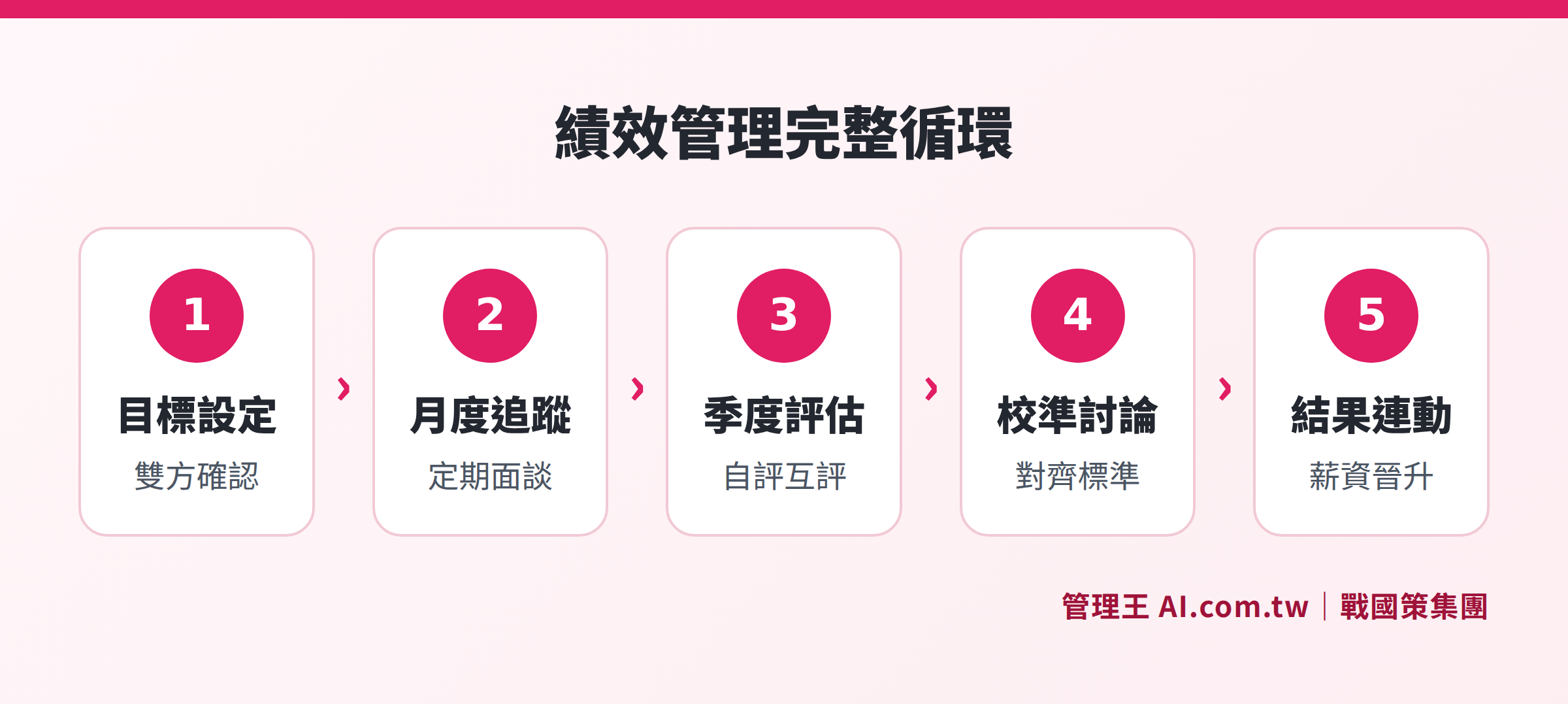
The complete performance cycle from goal setting to result linkage, covering KPI setting, monthly tracking, quarterly evaluations, 360 peer reviews, and salary linkage across five components.
Differences Between KPI and OKR: Which Framework Is Right for Your Company?
KPI and OKR are often used interchangeably, but there are significant differences at their core. KPI focuses on measuring the health of existing processes (“Are we doing things right?”), while OKR drives breakthrough change (“Are we doing the right things and exceeding ourselves?”).
Table: Core Comparisons Between KPI and OKR
| Comparison Item | KPI | OKR |
|---|---|---|
| Core Purpose | Measure the effectiveness of existing processes | Drive breakthrough objectives |
| Nature of Goals | Quantifiable, stable, continuously tracked | Motivational, challenging |
| Evaluation Cycle | Monthly or annually | Primarily quarterly |
| Salary Linkage | Usually linked | Recommended to decouple |
| Suitable Context | Manufacturing, sales, customer service, finance | R&D, product, innovation, strategy |
| Perfect Score Standard | 100% as a target | 70% considered good |
Mature enterprises often utilize both frameworks simultaneously: KPI manages daily operational performance, while OKR promotes strategic breakthroughs. For SMEs just starting to build a system, it’s advisable to start with KPI: it is intuitive to operate, easily understood by employees, and provides supervisors with concrete numbers for discussions. Once the organizational operations stabilize and specific teams need guidance towards more ambitious directions, OKRs can then be introduced for R&D or product departments, without needing to implement company-wide immediately.
360-Degree Assessment: Multi-Angle Reflection of Employees' True Performance
Traditional performance evaluations only involve supervisors scoring, but such a design has obvious blind spots: supervisors only see one aspect of an employee's work and recency effects and interpersonal preferences may bias the objectivity of scoring.
360-degree assessment introduces multiple evaluation sources to examine employees' actual performance from different angles:
- Supervisor Review: Evaluating goal achievement, work quality, and attitude from a management perspective.
- Peer Review: Mutual evaluations among colleagues, reflecting collaboration ability, communication quality, and reliability.
- Upward Review: Evaluating managerial style, guidance ability, and support level from direct reports of the supervisor.
- Self-Assessment: Employee self-evaluation promotes self-reflection and shows supervisors any gaps in recognition between the two parties.
The advantage of 360-degree assessments is their dimensionality and objectivity, which help uncover blind spots in supervisor evaluations. However, there are several points to note: a limited number of evaluators (fewer than 3 to 4 people) can lead employees to guess who gave what scores, impacting honesty; and results from 360 evaluations should be recommended for developmental reference, rather than directly determining salary, to prevent employees from pleasing teammates rather than honestly reflecting true observations.
管理王’s performance management function supports 360-degree peer reviews from four parties, with feedback forms automatically sent and collected by the system, allowing independent score calculations for each evaluator and comprehensive score distribution reports available for HR in the backend.
How to Conduct Performance Discussions? The Three Most Common Mistakes Supervisors Make
Performance discussions (Performance Review / 1-on-1 Meeting) are the most important communication aspect of the entire performance management cycle. Many supervisors report that discussions are awkward, employees have no response, and they are ineffective, often because of the following three common mistakes:
Mistake One: Concentrating on One Annual Discussion
Having only one formal discussion per year means all issues accumulate until the last moment to explode. An effective approach is establishing a monthly 30-minute light check-in habit, allowing supervisors and employees to maintain continuous communication, resolving issues in real-time without accumulation. Monthly informal conversations also relieve the pressure of year-end evaluations — both parties will have a sufficient understanding of each other.
Mistake Two: Scoring Without Records, Speaking from Memory
Statements like “Your performance this quarter was not good” leave employees with no recourse for rebuttal or improvement. Effective discussions require: numbers (KPI achievement rates), specific examples (like “This month’s client case…”), and written records (accessible for both parties later). Discussions without records often yield completely different recollections in subsequent meetings.
Mistake Three: Discussions Become Critiques, Lacking Future Direction
Discussions are not judgments but rather confirmations of consensus and alignment of actions. An effective discussion structure is suggested to follow the three-part framework of Review → Analyze → Act: start by confirming what happened during the period (KPI statistics, specific events), then analyze the reasons together (resource shortages? skills gaps? external factors?), and lastly, confirm the next steps for action (ensuring employees leave with clear goals, not just criticisms).
Legal Framework of Performance Management: Protections Under Taiwan's Labor Standards Act
In Taiwan, performance management is not only a management tool but is also closely tied to labor law. Understanding the legal boundaries helps avoid labor disputes arising from improper performance management practices.
Termination of Contracts Based on Poor Performance
According to Article 11, Paragraph 5 of the Labor Standards Act, employers can terminate labor contracts citing “inability to perform duties.” However, this requires legal notice and payment of severance, not immediate dismissal. This is also the only legal basis for terminating contracts due to performance issues.
The Supreme Court’s ruling (No. 838 of 99 Year) established the “Last Resort Principle of Dismissals," which demands that employers cannot terminate contracts directly due to an employee's underperformance without first completing the following steps and retaining records:
- Conduct performance discussions, clearly informing employees of issues.
- Provide a Performance Improvement Plan (PIP), setting specific improvement goals.
- Allow for a reasonable improvement period (generally 1 to 3 months), documenting the monitoring process.
- Consider whether reassignment or transfer to another position can be possible.
- Only if all the above have failed can termination procedures be initiated.
The Labor Incident Act, enacted in 2020, further enhances employee protections; if improper dismissals occur, courts can order employers to continue employment and compensate for wages, significantly raising legal risks.
Therefore, a comprehensive performance management system is not just an incentive tool for enterprises but also an important safeguard to legally maintain management records. Records from every discussion, the historical trajectory of KPI achievements, and the execution history of PIPs can all serve as critical evidence in labor disputes.
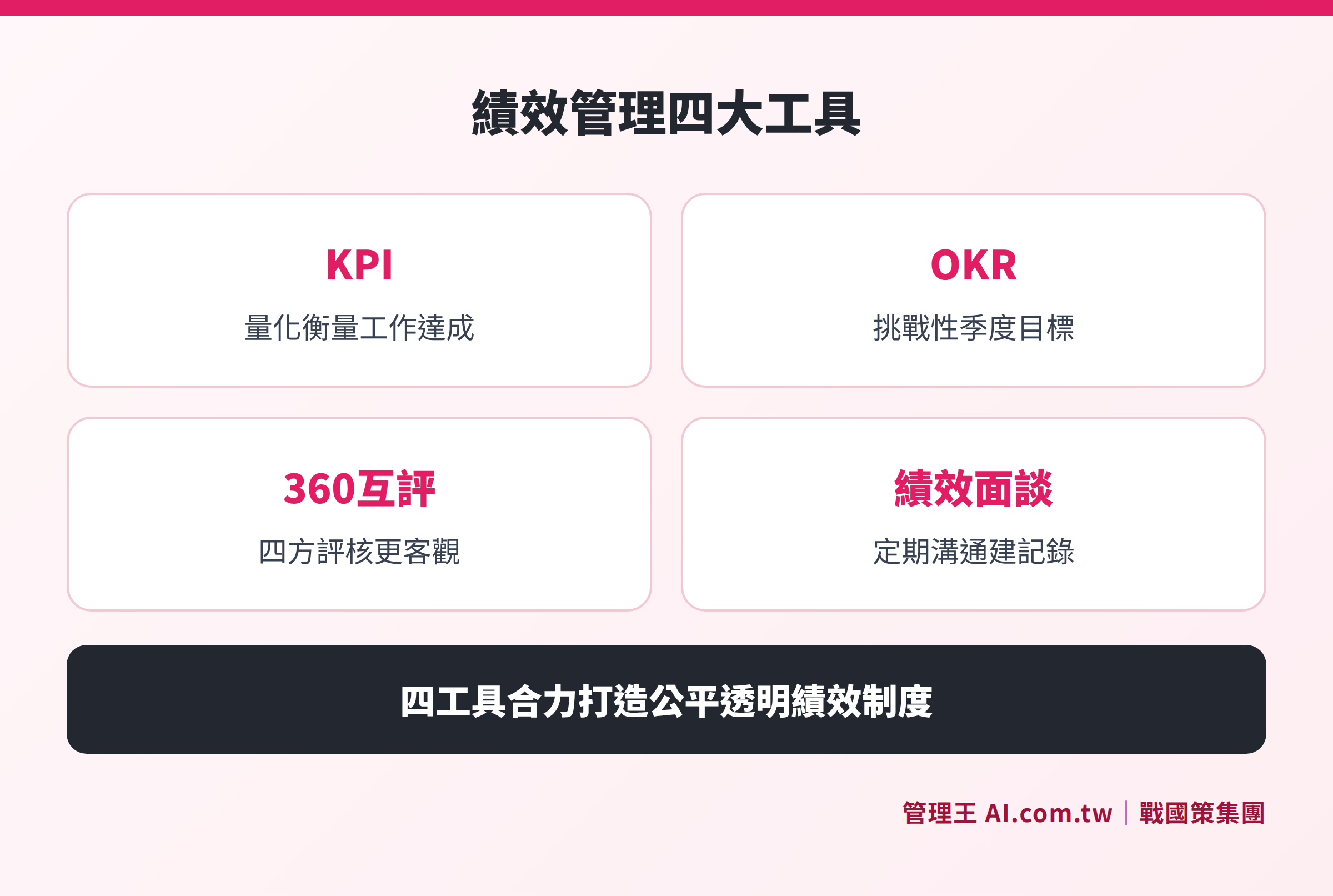
A comparative explanation of the core differences between KPI and OKR across three dimensions: nature of objectives, evaluation cycles, and salary linkage, along with suitable usage contexts for each.
Establishing a Complete Performance Management Cycle with 管理王 AI.com.tw
管理王's performance management function is designed for small to medium-sized enterprises in Taiwan with 10 to 300 employees, allowing owners and HR to complete the entire performance management cycle within the same system without needing to subscribe to additional separate tools or manually transferring data between multiple systems.
The complete process from setting to implementation:
Goal Setting and Hierarchical Links: HR or departmental leaders set quarterly KPIs for each employee in the system, specifying indicator names, target values, and weights. Company goals can be broken down to departments and then to individuals, with automatic creation of goal associations; employees can instantly see how their work connects to company strategies. The system also supports OKR models, with objectives and key results set and tracked separately.
Monthly Evaluations and Tracking: At the end of each month, supervisors fill out employees’ monthly reviews, to which employees can respond in real-time. The accumulated monthly records serve as the basis for discussions, making year-end evaluations not solely reliant on memories but based on complete monthly tracking. The Approval Center can handle electronic confirmation processes for discussion records, storing signed documents in the system after both parties approve.
Quarterly 360-Degree Peer Review: Upon initiating quarterly evaluations, the system automatically sends questionnaires to supervisors, peers, subordinates, and the employees themselves, compiling returned responses into comprehensive scoring reports. Scores from each evaluation party are independently calculated, and HR can view the complete distribution in the backend.
Calibration: The cross-departmental Calibration view allows HR or owners to compare all employees’ scores on the same table, enabling adjustments when any department shows a general trend of higher scoring to ensure that scores are really comparable across teams, making the distribution of promotions and bonuses more convincing.
Linking Results to Salary: Annual scores can be directly linked to payroll calculation systems for bonus calculations, and the establishment and tracking of Performance Improvement Plans (PIPs) occur within the same system, with records maintained throughout.
Free plans are available indefinitely, allowing teams with fewer than 10 people to fully experience the basic features of KPI setting, monthly evaluations, and 360-degree peer reviews without a credit card requirement.
Further reading on feature pages:
- Onboarding Training System: Skill enhancement training for employees whose performance needs improvement.
- Task Management: Execution tracking of daily tasks corresponding to KPI objectives.
- Department Daily Reports: Daily work summaries and KPI daily linkages by supervisors.
- Service Plans and Pricing: Comparison of free and paid plan features.
Also, refer to: How to Choose a Performance Management System? The Latest Taiwan Enterprise Guide for 2026, which provides a detailed comparison between 管理王 and international systems like Lattice and Culture Amp.
Establish Your Performance Management System for Free
管理王 consultants assist you from scratch in setting KPI objectives, introducing monthly discussions and 360 peer reviews, free permanent use for teams with fewer than 10 people, completing the first employee KPI setting in just 30 minutes.
Free consultation hotline: 0800-003-191
LINE Official Account: @119m
Official website: app.AI.com.tw
Free trial: Apply for 管理王 now
Frequently Asked Questions
How to Build a Performance Management System from Scratch?
Start with three actions: (1) Set 3 to 5 KPIs for each employee this season, confirmed jointly by supervisors and employees; (2) Schedule a 30-minute check-in every month to discuss progress and leave written records; (3) Conduct a formal evaluation at season's end and keep records. It’s not necessary to start with a perfect system; the key is to first establish basic habits of “goals in writing and feedback in records” before gradually incorporating advanced components like 360 assessments and calibration meetings.
Can KPI and OKR Be Used Simultaneously?
Yes. A common approach is to use KPIs to continually track performance in daily operations (sales, customer service, finance) while employing OKRs for challenging objectives related to innovative or strategic tasks (new product development, entering new markets). Both frameworks are not in conflict, but it is advisable to familiarize employees with one before gradually introducing the other to avoid confusion from simultaneous implementation.
Is Terminating Employees Based on Poor Performance Allowed by Taiwan's Law?
Article 11, Paragraph 5 of the Labor Standards Act allows employers to terminate contracts citing “inability to perform duties,” but this requires legal notice and severance payment, and immediate dismissal can't be based solely on one poor performance. The Supreme Court’s established “Last Resort Principle of Dismissals” mandates that employers must first complete performance discussions, PIPs, and consider reassignment or other processes, keeping complete records before initiating termination. Performance management without records usually puts one at a disadvantage in labor disputes.
Is 360-Degree Assessment Suitable for Small Companies?
For small companies with fewer than 10 employees, the effectiveness of 360-degree assessments is limited — too few evaluators can lead employees to easily guess who gave what scores, impacting honesty. It is recommended for companies with more than 20 employees, prioritizing managerial or influential cross-departmental roles. A more practical approach for small companies is to ensure regular meetings between supervisors and employees to establish good communication, which holds more immediate value than implementing 360 assessments.
What Is the Cost of 管理王's Performance Management Function?
管理王 offers a free plan for teams with up to 10 people, including essential performance management features. Paid plans start at NT$5,000 per month (30 people maximum, economical model), with the performance management features included in the subscription at no additional cost. Single feature options are also available starting at NT$1,000/month. For detailed feature differences, please see the service plans page.
Sources
- Ministry of Labor: Labor Standards Act Article 11, Paragraph 5 "Inability to Perform Duties" Interpretation — Official Explanation from Ministry of Labor
- China Taiwan Labor Relations Association: Analysis of Last Resort Principle of Dismissals and PIP Procedures — AIRROC Article
- WDA: Advanced Human Resource Management Chapter 5 "Performance Management" — WDA Publication
- National Regulatory Database: Labor Standards Act (including all amended versions) — Original Text of the Regulations