Complete Guide to Procurement Systems: Digital Processes from Requisition, Quotation to Acceptance | Procurement System Recommendations

Procurement systems are management tools that digitize the process from requisition, quotation, acceptance to payment for enterprises. This article explains the four major links in the procurement process, six core functions (multi-level approval, supplier quotation evaluation, budget control, automatic application of contract prices), five criteria for selecting a system, and how 管理王’s free plan supports full process digitization.
Procurement systems are management tools that fully digitize the five stages of procurement: requisition, quotation, purchasing, acceptance, and payment. For small and medium enterprises, not having a procurement system means every procurement expenditure is driven by Excel spreadsheets, LINE groups, and paper approvals, making audits difficult and easily leading to failures in the two stages of supplier quotations and budget control. After introducing a procurement system, every expense is fully digital from the moment the demand is raised to the completion of payment, allowing supervisors to check at any time where each purchase order stands, and accounting personnel no longer need to wait until the end of the month to manually compile reports. For small and medium business owners, the core value of a procurement system lies in making every penny spent traceable, based on evidence, and verifiable.
What is a Procurement System?
A procurement system is an information tool used by enterprises to manage the entire procurement process, covering core functions such as requisition, review, quotation, issuance of purchase orders, acceptance of goods, and payment reconciliation. For manufacturing, retail, catering, or service industry enterprises with large daily procurement needs, a procurement system can replace paper forms and scattered messages on communication software, standardizing, making traceable, and ensuring compliance in the procurement process.
According to the Financial Supervisory Commission's "Guidelines for Establishing Internal Control Systems for Publicly Listed Companies," the procurement and payment cycle is one of the core aspects of internal control in enterprises, and the standard process must cover requisition, price negotiation, goods acceptance, accounts payable recording, and payment authorization. This framework also applies to unlisted small and medium enterprises: the earlier a standardized procurement process is established, the more it can reduce the risks of malpractice and overspending.
The Commercial Accounting Act in Taiwan stipulates that enterprises should establish procedures for procurement-related accounting processing based on internal control needs and management objectives to ensure that every transaction has documentation for auditing. In practice, procurement systems effectively upgrade the processes required by regulations from paper operations to a fully digital audit trail.
Differences Between Procurement Systems and ERP Procurement Modules
A complete procurement system can operate independently or be deeply integrated into ERP systems. The advantage of an independent procurement module is rapid deployment and a lower learning curve; however, if the procurement orders, inventory management, and accounting systems are independent from each other, it requires manual re-entry or additional API connection costs. Although integrated ERP procurement modules may have more complex initial setups, they can significantly reduce data re-entry and system maintenance costs in the long term.
In a nutshell
A procurement system enables every company expense to have a complete digital record from "Requisition → Approval → Quotation → Ordering → Acceptance → Payment," ensuring financial transparency and seamless audits.
Detailed Explanation of the Four Major Stages of Procurement Process
Before understanding the functions of a procurement system, it is essential to break down the complete process of enterprise procurement. Each stage has specific management focus and common risks.
First Stage: Requisition
Department employees submit requisition forms based on production, administrative, or business needs, detailing items, quantities, expected amounts, usage times, and reasons for application. Enterprises without an online requisition system often rely on LINE messages or paper forms to communicate, leading to supervisors having little clarity on “who, when, bought what, and whether there is budget support.” The most important control point of online requisition is that every expense should be initiated within authorized limits, not as a post-factum request.
Second Stage: Procurement and Quotation
Procurement personnel consult one or more suppliers based on the requisition order, comparing prices, delivery times, quality, and payment terms before deciding where to place the order. This stage is most vulnerable to two types of risks: continuously seeking quotes from the same supplier without comparison, and negotiated contract prices not being enforced in every purchase order. The supplier historical quotation comparison function of a procurement system effectively reduces these two risks, providing an objective basis for procurement decisions.
Third Stage: Acceptance
Upon delivery of goods, warehouse management or procurement personnel verify that the items, quantities, and quality meet the specifications of the purchase order; goods must pass acceptance to be transferred into inventory; non-conforming goods are processed for return or exchange. Relying solely on paper signatures for acceptance makes it difficult to provide evidence in case of quality disputes afterwards; digital acceptance allows for real-time photo documentation, establishing comprehensive and undeniable receipt records.
Fourth Stage: Reconciliation and Payment
Once acceptance is complete, the finance department issues payment requests based on payment terms (immediate, 30-day end of month, 60-day end of month, etc.), which are approved by supervisors before payment is made. The automatic connection between payment and accounts payable is the core value of the integration between the procurement system and accounting system—the accounting voucher is automatically generated after payment approval, eliminating the need for re-entry by accounting staff.
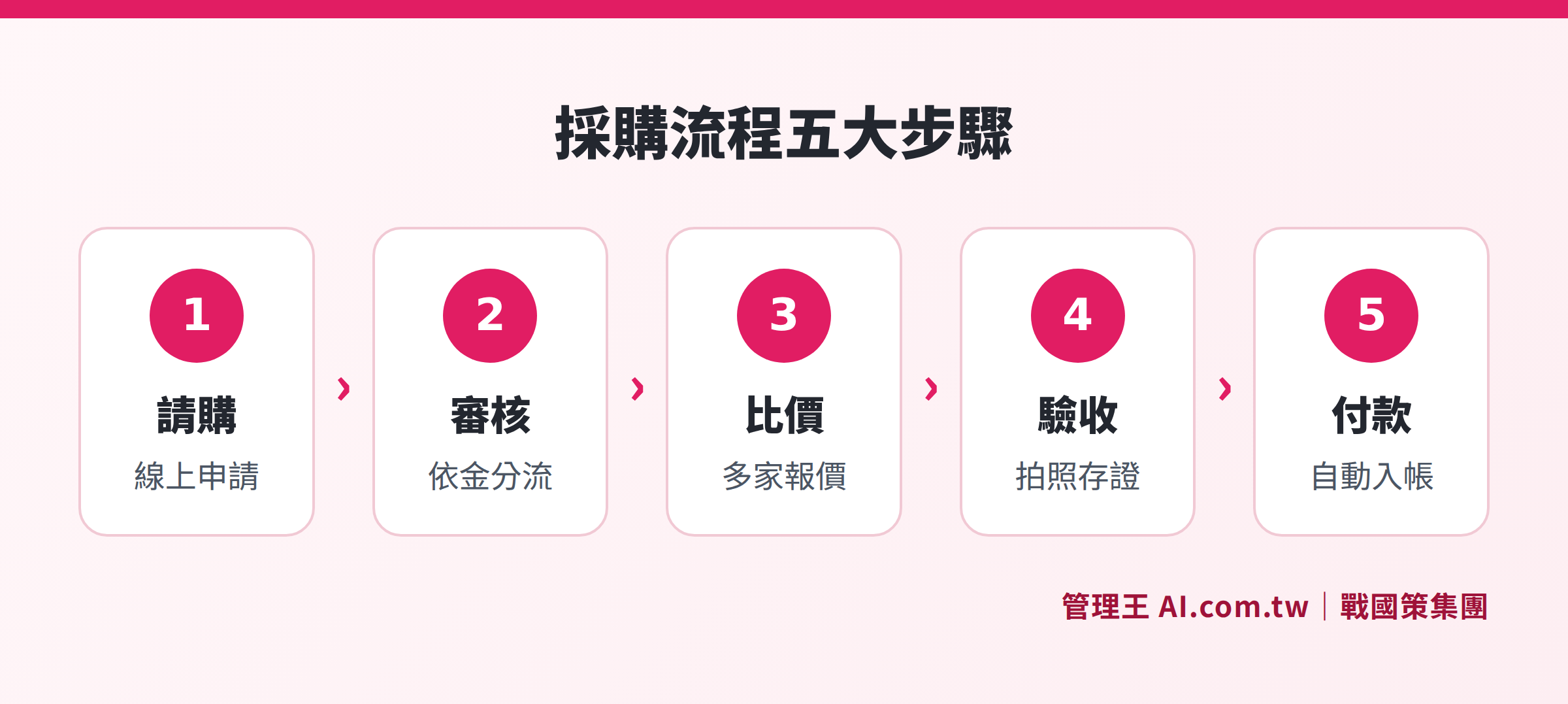
The five key steps from requisition to payment: Submit requisition application, supervisor review and approval, supplier quotation and ordering, acceptance record, complete payment approval
Six Core Functions of the Procurement System
Function 1: Online Requisition and Multi-level Approval
Automatically assign different levels of supervisory approvals according to procurement amounts. Small purchases (such as office supplies) are cleared by immediate supervisors, while large purchases (such as machinery) go through a hierarchical approval process up to senior management. This design balances efficiency (avoiding delays for small purchases) and control (strict scrutiny of large purchases), preventing procurement personnel from bypassing processes due to the hassle of running around for signatures.
Function 2: Supplier Quotation and Long-term Evaluation
The system automatically aggregates historical quotes for the same item from different suppliers, allowing for objective comparisons before procurement on who quoted the lowest price and who has the most stable delivery times. The vendor management system can also rate suppliers based on delivery punctuality, quality compliance, and service attitude, prioritizing high-scoring suppliers for long-term cooperation, making procurement decisions based on objective criteria rather than personal memory or relationships.
Function 3: Real-time Budget Deduction and Overspending Warnings
The monthly or annual budget of each department is automatically deducted with each purchase order. When approaching the budget limit, the system immediately notifies relevant supervisors, thoroughly addressing the issue of "spending first and discovering overspending only at the end of the month." Department heads have clear visibility into their budget status, and financial supervisors can instantly grasp the overall procurement spending progress of the company.
Function 4: Automatic Application of Contract Prices
After signing long-term framework contracts with suppliers, the procurement orders automatically bring in negotiated prices when they are issued. This function eliminates two common problems: procurement personnel forgetting to use contractual discounts and suppliers secretly quoting high prices above contract rates. It ensures that the negotiation results are truly reflected in every purchase order and not just remain in contract documents.
Function 5: Acceptance Photo Documentation
During receipt of goods, photos can be directly taken and uploaded using a mobile phone or tablet, automatically binding the photos with the acceptance and purchase orders. This function upgrades acceptance from "paper signature → stored in a file folder → difficult to locate later" to "photo → real-time upload → permanent storage → instant retrieval." In case of subsequent quality disputes from suppliers, retrieving photos from the acceptance is the most direct form of evidence.
Function 6: Automatic Interaction with Inventory and Accounting
Upon acceptance, the inventory management quantity automatically increases; after payment approval, the accounting system automatically generates accounts payable vouchers. Data from the three systems is in place simultaneously without repeated input, significantly reducing human errors. Coupled with AI anomaly detection, if the procurement price of an item suddenly spikes, the system automatically alerts the supervisors, helping to identify potential procurement anomalies in real-time.
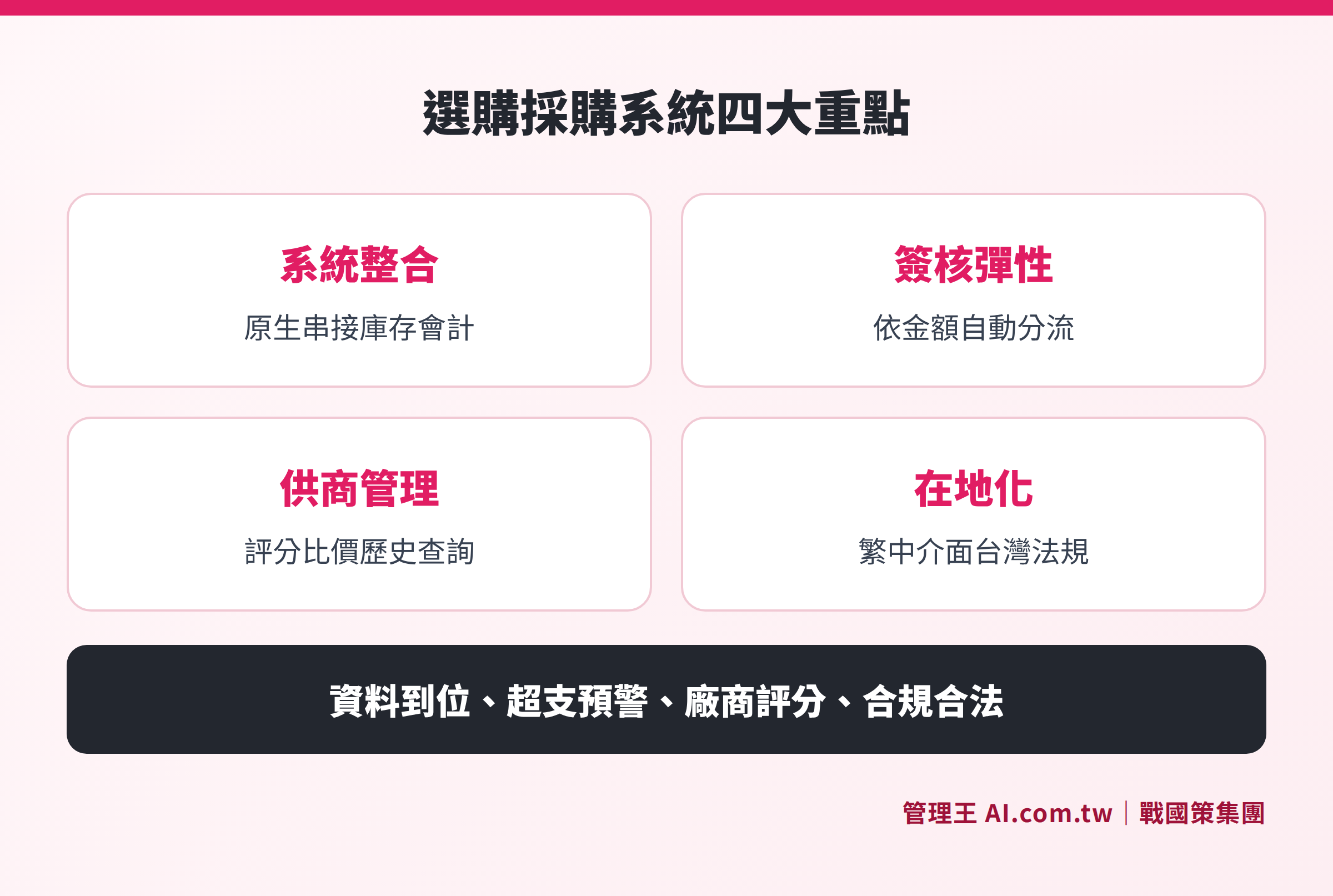
The four core dimensions to evaluate procurement systems: depth of system integration, flexibility of approval process, completeness of supplier management, localization needs in Taiwan
Comparison of the Procurement Process Before and After Digitization
Table: Comparison of Enterprise Procurement Management Before and After System Implementation
| Management Aspects | Before Implementation (Paper + Excel + LINE) | After Implementation (Procurement System) |
|---|---|---|
| Requisition Method | LINE messages or paper forms, supervisors hard to track | Online forms, immediate notification to supervisors for review |
| Approval Process | Paper approval, requiring time to seek signatures | One-click approval on mobile, leaving a digital trail throughout |
| Supplier Quotation | Relying on procurement personnel's memory or scattered Excel sheets | Historical quotes displayed side by side for objective comparison |
| Budget Control | Compiled at the end of the month, no alerts for overspending | Real-time deductions, proactive alerts before overspending |
| Acceptance Records | Paper acceptance sheets, difficult to access long-term | Photos documenting acceptance, automatically linked with purchase orders |
| Accounting Processing | Manual entry into accounting systems, prone to re-entry errors | Automatically transferred into accounting vouchers after payment approval |
Five Criteria for Small and Medium Enterprises When Choosing a Procurement System
Criterion 1: Depth of Integration with Existing Systems
The greatest hidden cost of procurement systems is often not the monthly fee, but the "integration costs between systems." When evaluating, prioritize confirming: Can purchase orders directly link to inventory? Can they automatically write into accounting vouchers after payment approval? Can quotation systems trigger requisitions directly? If additional API integration fees are needed or rely on manual data re-entry, the long-term costs could far exceed the monthly fees.
Criterion 2: Flexibility of the Approval Process
Small and medium enterprises typically have a flatter organizational structure than larger companies, but procurement amounts can vary greatly (from a few hundred dollars for supplies to several hundred thousand for equipment). Confirm whether the system supports automatic redirection based on amount, and whether different approval levels can be set by department to avoid the situation of "implementing a rigid system that ends up being more cumbersome than before."
Criterion 3: Completeness of Supplier Management
Procurement is a long-term supplier relationship management task, not just a "one-time purchase." Evaluation points include: Does it support a supplier evaluation mechanism? Does it retain historical quotation records? Can contract terms and expiry reminders be managed? What is the depth of integration with the vendor management system? These functions determine whether the system can support long-term supplier strategy management for the enterprise.
Criterion 4: Support for Mobile Devices
Supervisors in small and medium enterprises often work away from the office, at factories, or with clients. If the procurement system can only be operated on desktop computers, it will create bottlenecks for approvals. Confirm whether the system has a mobile app or a fully responsive interface, allowing supervisors to approve procurement orders or check acceptance tasks while away, ensuring processes do not stall due to supervisors being on business trips.
Criterion 5: Degree of Localization in Taiwan
This aspect is often overlooked but can be the most painful post-implementation. Evaluation checklist: Is the traditional Chinese interface complete? Does it support Taiwan's electronic invoice formats (triplicate, cloud invoices)? Is it compatible with commonly used accounting firm formats (like 鼎新, 用友, 正航)? Is the data stored on Taiwan servers, meeting audit needs by regulatory authorities? When using foreign SaaS tools, these localization issues often require additional customization costs.
Table: Comparison of Procurement System Selection (Integrated vs. Independent SaaS)
| Evaluation Dimensions | Integrated ERP Procurement Module | Independent Procurement SaaS |
|---|---|---|
| Integrates Inventory and Accounting | Natively integrated, no extra costs | Usually requires additional integration fees |
| Deployment Speed | Requires overall planning, longer | Fast, can be trialed within days |
| Suitable Scale | More than 20 people, with finance and accounting departments | Small businesses with 5 to 20 people |
| Flexibility for Expansion | High, modules can be opened gradually | Limited, will require changing systems as scale grows |
| Localization in Taiwan | Local vendors usually provide complete support | Varies by vendor, needs to be confirmed individually |
| Long-term Maintenance Costs | Low (unified backend management) | Multiple systems lead to more complex maintenance |
Establishing a Digital Procurement Process with 管理王 AI.com.tw
管理王 AI.com.tw’s procurement system is one of the core modules of the ERP system, natively integrated with inventory management, accounting system, vendor management system, and approval center, without any additional integration costs. Here is how the actual operation process works:
- Online Requisition by Employees: Department employees fill out online requisition forms which notify supervisors instantly without needing to run around or send LINE messages.
- Amount Redirected for Approval: The system automatically assigns corresponding supervisors based on procurement amounts, allowing supervisors to approve with a single click on their mobile devices.
- Multi-supplier Quotation and Ordering: Procurement personnel opens a purchase order, and the system automatically retrieves historical quotes for the same item, selecting the best supplier to place the order with contract prices automatically applied.
- Receipt Photo Documentation: Warehouse personnel take photos of the goods during acceptance, which are uploaded in real time and linked with the purchase order, automatically updating inventory numbers.
- Payment and Accounting Synchronization: After payment application approval, accounting vouchers are generated automatically, and accounts payable are immediately recorded without the need for re-entry.
In conjunction with the MRP functionality of the production manufacturing system, it can also automatically calculate shortages based on unfinished work orders and recommend procurement amounts, creating a complete digital cycle from sales forecasts to raw material procurement, especially suitable for small and medium enterprises in the manufacturing sector.
管理王 offers a free plan that can be used indefinitely, supporting up to 10 members, suitable for enterprises starting to implement digital procurement processes to test compatibility before upgrading. Advanced plans (NT$5,000 to NT$19,900/month) provide more AI usage, member limits, and remote training services, with complete pricing available on the service plan page. The 戰國策 Group has served over 30,000 enterprises, and consultants can provide personalized plan recommendations based on enterprise scale and procurement needs.
Is your procurement process still reliant on LINE and paper?
Consultants offer free evaluations of digital procurement solutions; the 管理王 procurement system can be natively integrated with inventory and accounting, and the free plan is available forever with no credit card needed.
Free consultation hotline: 0800-003-191
Official LINE account: @119m
Official website: app.AI.com.tw
Free trial: Apply for 管理王 now
Frequently Asked Questions
How many people should a company have to implement a procurement system?
Even micro-enterprises with 3 to 5 people should consider digitizing the requisition process if they have fixed monthly procurement expenditures (office supplies, raw materials, outsourcing service fees, etc.). 管理王’s free plan supports up to 10 members, allowing businesses to establish norms from basic requisition to payment processes, and upgrade depending on needs. Companies with fixed procurement needs but fewer personnel can initially use the free plan to confirm whether the processes meet their needs.
What is the difference between a procurement system and ERP?
ERP (Enterprise Resource Planning) is an integrated system covering multiple modules, including finance, procurement, inventory, production, and HR; a procurement system is one of its core modules and can also be deployed independently. The greatest advantage of selecting an integrated ERP (including the procurement module) is that data does not need to be re-entered, and all departments share the same master data, leading to lower long-term maintenance costs. If procurement volume is not large and the organization is small, starting with an independent procurement system may be advantageous.
How long does it take to implement a procurement system?
Standard feature settings usually take a few hours to days to complete, and supplier data and item master data can be batch imported from Excel to reduce re-registration efforts. If a customized approval process or integration with existing systems is required, consultants will first conduct a free assessment interview before providing written quotes and timeline plans. 管理王 custom development is transparently priced at NT$1,000/hour, with work commencing only after written confirmation.
Where is procurement data stored? How secure is it?
管理王’s data is stored at the 戰國策 Group’s Taiwan data center (with dual-machine room redundancy, compliant with ISO 27001 standards), all transmissions are encrypted with HTTPS / TLS 1.3, and a complete audit log records all operations, meeting Taiwan's data sovereignty and audit requirements by regulatory authorities. Compared to foreign SaaS tools that store data on overseas servers, local hosting in Taiwan is more aligned with local legal compliance requirements.
Can the procurement system interface with accounting software?
管理王 provides REST API and Webhook interfaces, supporting integration with common accounting tools; it also supports exports in formats compatible with 鼎新, 用友, 正航, and 文中, facilitating collaboration with accounting firms and reducing data organization burdens during monthly reconciliations.
Sources
- Guidelines for Establishing Internal Control Systems for Publicly Listed Companies by the Financial Supervisory Commission, National Regulations Database, Financial Supervisory Commission
- Commercial Accounting Act, National Regulations Database, Ministry of Finance
- 管理王 AI.com.tw Procurement System Features Page, 戰國策 Group (Inquiry date October 2026)