How to Create a Quotation? Understand the Format, Mandatory Fields, and Online Quotation in One Go|Quotation System Recommendations

A quotation is a formal document that a business presents to a client detailing the terms of a transaction. Once confirmed in writing by the client, it forms the basis of a legally binding contract. This article covers mandatory fields, the difference between an estimate and a quotation, setting validity periods, follow-up techniques, and how to automate the entire quotation process using the Guanli Wang online quotation system.
A quotation is a formal written document presented by a business to potential customers that describes the items, quantities, unit prices, taxes, and payment terms for goods or services. A correctly formatted quotation is not just a matter of business etiquette but is also the starting point for a written offer under Article 153 of the Civil Code — once the client confirms it in writing, a contractual relationship is formed and is legally binding. This article introduces the definition of a quotation, mandatory fields, format tool selection, setting validity periods, and online quotation systems, covering the most practical quotation knowledge for small and medium enterprises in Taiwan.
What is a Quotation? Definition and Legal Status
A quotation (English: Quotation, Quote) is a formal written document in which a seller presents the terms of a transaction to a buyer. Its core functions are threefold: to clearly state item names, specifications, quantities, unit prices, taxes, and payment methods; a professional quotation printed with the company letterhead and uniform number allows clients to have a preliminary judgment about the scale and formality of the vendor; once accepted, the quotation can directly turn into a contract or order, avoiding disputes from verbal confirmations.
According to Article 153 of the Civil Code, "Contracts are established when parties express their mutual consent, whether explicitly or implicitly." Therefore, when the client replies via email stating "accepted," confirms through LINE messaging, or directly signs the quotation, the quotation then possesses the effect of an offer, and the seller cannot arbitrarily change the terms. In other words, a quotation is not just "a price for your reference" but a commercial document with legal significance, and businesses should treat every quotation formally, ensuring precise and careful completion of fields and setting validity periods.
In a Nutshell
A quotation is a formal document presented to clients regarding transaction terms; once confirmed in writing by the client, it forms the basis of a legally binding contract.
Quotations are applicable in a wide range of scenarios: manufacturers quote raw materials and processing fees, software companies quote system implementation costs, consulting companies quote service hours, and traders quote imported goods including tax-inclusive CIF prices... As long as it is B2B business transactions, quotations are almost always used. For clients, a clear quotation can effectively accelerate internal approvals and shorten the total time from inquiry to deal closure.
What are the Mandatory Fields in a Quotation?
There is no mandatory unified format for quotations under Taiwanese law, but according to business practices and government procurement specifications, a complete quotation should cover the following fields:
Table: Overview of Mandatory Fields in a Quotation
| Block | Field Name | Importance |
|---|---|---|
| Seller Information | Company Name, Uniform Number | Mandatory: Confirm the legal identity of the transaction party |
| Seller Information | Address, Phone, Email | Mandatory: Contact details and invoicing information |
| Quotation Identification | Quotation Number | Mandatory: Facilitate tracking, version management, and auditing |
| Quotation Identification | Quotation Date | Mandatory: The starting point for calculating validity period |
| Buyer Information | Quotation Recipient Company Name and Uniform Number | Mandatory: Confirm the recipient of the quotation to avoid using the wrong document |
| Buyer Information | Contact Person and Phone | Recommended: For communication and follow-up |
| Item Details | Item Names, Specifications, Quantities, Units | Mandatory: Core description of the transaction object |
| Item Details | Unit Price, Subtotal | Mandatory: Break down to avoid disputes over total prices |
| Amounts | Pre-tax Subtotal, Business Tax (5%), Tax-inclusive Total | Mandatory: Comply with Taiwanese tax regulations |
| Terms | Payment Methods and Conditions | Mandatory: E.g., full payment before delivery, NET 30 days |
| Terms | Quotation Validity Period | Strongly Recommended: Protect sellers from market volatility losses |
| Terms | Delivery Timeline and Location | Recommended: Clearly define the scope of contractual obligations |
| Signature | Company Seal or Authorized Signature | Recommended: Enhance legal validity and customer trust |
Special Reminder: For government procurement estimates, vendors are usually required to stamp the company seal (not in color photocopy) and have the responsible person stamp with a personal seal, and must comply with specific requirements of each bidding document, which are stricter than general business quotations.
What are the Differences Between an Estimate and a Quotation?
In Taiwan, the terms "quotation" and "estimate" are often used interchangeably, but strictly speaking, there are differences in their business meanings:
Table: Comparison between Quotation and Estimate
| Comparison Item | Quotation (Quotation) | Estimate (Estimate) |
|---|---|---|
| Price Certainty | Fixed price, does not fluctuate with time | Estimated amount, may be adjusted based on actual volume |
| Legal Effect | Forms an offer upon acceptance, enforceable | Relative weak legal effect, depends on the case |
| Applicable Scenarios | Product sales, fixed service fees | Renovation projects, design developments, etc. with variable costs |
| Common Industries | Manufacturing, trade, software services | Construction projects, interior design, custom processing |
| Common Validity Period | Generally 7 to 30 days | Usually longer, depending on the nature of the project |
Simple Judgment Principle: If a fixed amount can be given, use a quotation; if the project quantity is uncertain and needs field inspection to determine pricing, use an estimate. Most SMEs engaging in external business development and B2B sales primarily use "quotations."
How to Format a Quotation? Comparison of Three Tools
Currently, small and medium enterprises in Taiwan commonly use three methods to create quotations, each with its advantages and disadvantages:
Method 1: Manual Creation in Word / Excel
The advantage is high flexibility and completely free; the disadvantage is difficulty in unifying formats, often resulting in version confusion with names like "quotation_final version_confirmed version_really final version_v3." Tax calculations require manual checks, there's a high risk of sending out incorrect versions, and it cannot track whether the client opened it. This may be acceptable for micro-enterprises with just one or two salespeople who handle a small volume of quotations monthly, but larger organizations will face management blind spots. Another common issue is inconsistent format aesthetics—salespeople use different versions of templates, leading to differing quality in the quotations handed to clients, which affects the company’s image.
Method 2: Online Quotation Tools (Independent SaaS)
Some SaaS platforms provide functions for quotation generation, allowing for quick template application, automatic tax calculation, and online sending. However, if not integrated with CRM or contract systems, salespeople still need to copy client data between different systems, perpetuating the data silos issue. Each system adds a subscription fee and increases employees' learning costs. Especially when salespeople change devices or leave, the quotation records scattered on personal accounts might also be taken away or lost.
Method 3: Integrated Quotation Systems
Platforms like Guanli Wang Quotation System natively integrate CRM, contracts, and accounting, allowing the quotation process from creation, review, sending, online signing, to customer tracking and automatic follow-up to be completed in the same system. Salespeople don’t need to re-enter data, and supervisors can see the quotation status of the entire team. All quotation records belong to the company as assets and do not disappear when an employee leaves. This is suitable for SMEs with sales teams, requiring version management and supervisory review processes.
When selecting a quotation system, there are four key questions worth asking yourself: Are the salespeople willing to use it (skip if the interface is too complicated)? Can it track client reading behavior? Can it automatically integrate with CRM and contract systems? Do the costs and functions match the company's scale? Matching the answers to these four questions against each system often quickly narrows down the options.
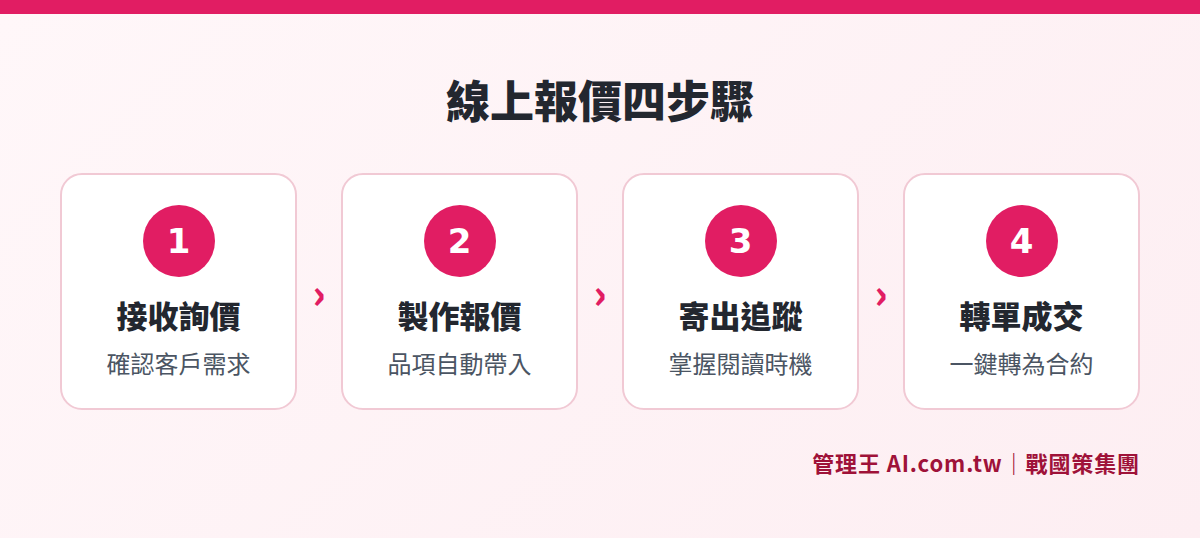
A complete business quotation process from receiving inquiries to creating, sending, tracking, and converting orders into closed deals
How Long Should the Validity Period of a Quotation Be?
Taiwan's Civil Code does not explicitly state a validity period for quotations, but setting a validity period serves two important purposes:
Protecting the Seller: Raw material costs, exchange rates, or labor costs may rise after a quotation is issued; a validity period prevents clients from demanding fulfillment at an old price during market price increases.
Promoting Client Decision-Making: A clear deadline creates a slight scarcity, helping to prompt clients to confirm quickly, thereby shortening the sales cycle.
It is recommended to set different validity periods based on the type of transaction:
- General goods or fixed service fees: 7 to 30 days, adjusted according to the client decision-making cycle
- Custom development or large-scale services: 30 to 60 days, reflecting the complexity of cost assessment
- Urgent quotations or special promotions: 3 to 7 days, emphasizing time sensitivity
- Government procurement estimates: per bidding document specifications, usually 30 to 90 days
If the quotation does not specify a validity period, under Article 158 of the Civil Code, the seller must still wait for a reasonable period. After this reasonable period, the seller may claim not to be bound, but what constitutes a "reasonable period" varies depending on the situation, leading to uncertainty. Therefore, it is advised that each quotation clearly state "This quotation is valid until YYYY/MM/DD" and includes "Automatically void after expiration." Refer to the latest announcements and court practices from authorities.
What to Do if a Client Does Not Respond After Quoting?
Salespeople fear the situation: the quotation is sent out, and the client remains silent. Here is a structured follow-up strategy:
- First Follow-up (3 to 5 days after sending): Confirm if they received and read the quotation, ask if they have any questions or need additional information.
- Second Follow-up (7 to 10 days): Provide a point of information that is specifically helpful to the client (reference case, cost-saving calculation), reiterate the validity period of the quotation.
- Third Follow-up (14 days): Remind them that the validity period is about to expire, ask about the client's current decision-making timeline and considerations.
- Long-term Care (not closed, but no explicit rejection): Contact periodically every 1 to 3 months, so that when the client's needs emerge, they think of you first.
Manual tracking is time-consuming and labor-intensive; salespeople often abandon follow-ups due to "not wanting to pester," allowing the deal to go cold without any noise. Research shows that most deals often occur after the fifth contact, but most salespeople stop after the second follow-up. Small and medium enterprises with sales teams should consider using systems to replace manual tracking, ensuring every quotation is followed up on diligently, rather than relying on personal memory and willpower.
Quotation to Contract: A Complete Process from Signing to Filing
Once the quotation is accepted by the client, the next step is to convert the quoted content into a formal contract. The common process is as follows:
- Client signs the quotation (intention confirmation)
- Seller drafts a formal contract based on the quotation content
- Both parties complete the contract signing through electronic signatures
- Contract is filed and expiry notifications are set
- Invoices are issued, goods are shipped, and the case is concluded according to contract terms
Using a contract management system can make this process smoother — after online signing a quotation, it automatically turns into a contract draft, with layered notifications happening 90, 60, 30, and 7 days before expiration to different levels of supervisors, with version changes traceable, preventing high-risk situations like "Contracts expire but no one knows."
Furthermore, linking contract amounts with the accounting system helps ensure that the timing and amounts of invoicing comply with contract terms, reducing manual verification costs during financial reconciliation. Salespeople can also track daily quotation progress in the Sales Daily Report, allowing supervisors to grasp the entire team's sales funnel at a glance. The procurement process can also communicate with procurement systems, ensuring external quotations and purchasing costs maintain a reasonable profit margin.
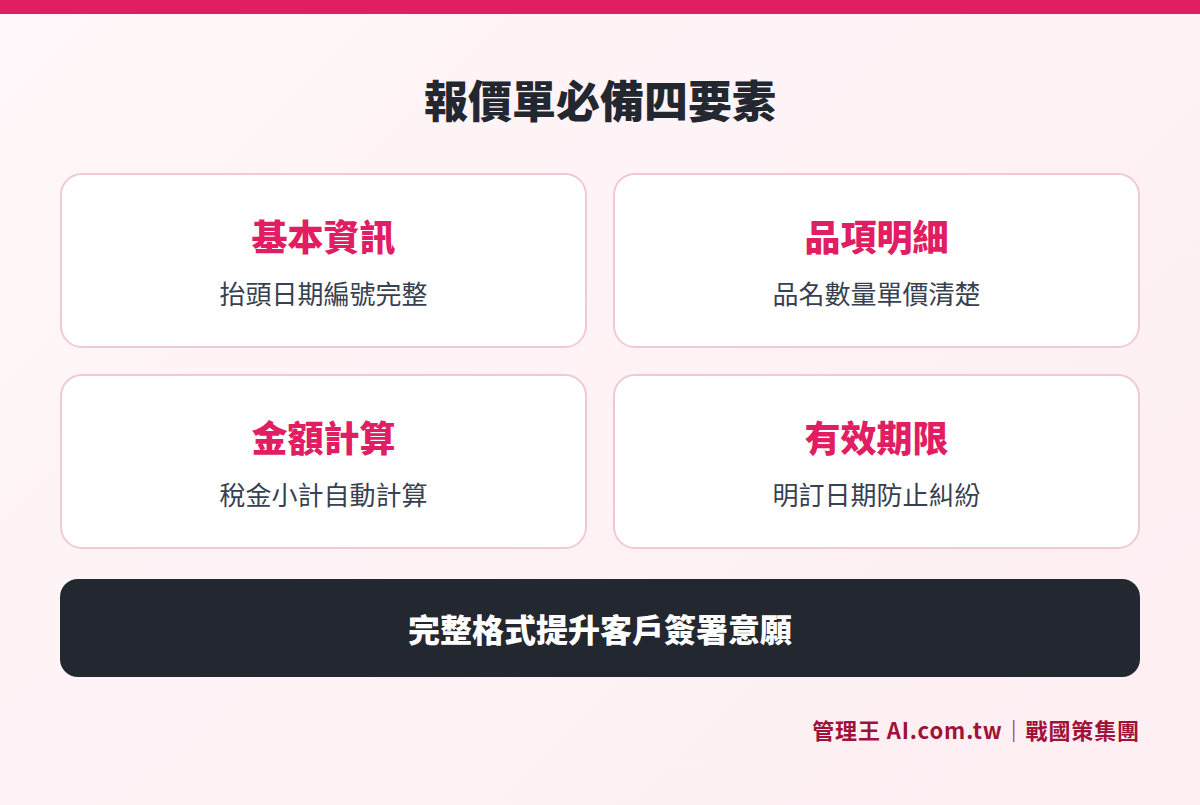
A quotation must include the four key elements: basic information, item details, amount calculations, and validity period.
How to Use the Guanli Wang Quotation System?
For small and medium enterprises in Taiwan, the Guanli Wang AI.com.tw Quotation System provides a complete workflow from inquiry to deal closure, integrated into nine systems:
Quickly Create Quotations: Once salespeople select clients in the CRM system, they can automatically pull in items from the product catalog, with discounts and taxes calculated automatically, completing a professional quotation PDF with the company logo in just a few minutes, eliminating manual tax calculations and reducing the risk of quoting incorrect prices. The quotation number is automatically generated by the system, preventing duplication and skipped numbers; multi-currency (New Taiwan Dollar, US Dollar, Chinese Yuan, etc.) can also be automatically converted, saving traders from having to use calculators for exchange rates.
Online Sending and Reading Tracking: After the quotation PDF is automatically sent out, the system tracks whether the client opens the email, how long they stay, and how many times they check it, allowing salespeople to follow up accurately at the moment of the client's highest interest, rather than chasing blindly the next day.
Automatic Follow-up, Saving Sales Time on Chasing: If clients do not reply within the set number of days, the system will automatically send follow-up emails or LINE messages in a "human sales voice" during Taiwanese working hours, rotating through different phrases, and automatically stopping once the client either closes the deal or declines. Salespeople no longer need to ask if the client has made a decision, leaving time for more worthwhile discussions.
Version Management and One-Click Transfer to Contract: The same quotation can retain multiple revised versions, clearly tracing each adjustment; once a deal is closed, it can be transferred to contract management in one click, with no need for re-entering data, seamlessly connecting to subsequent signing processes.
Plans and Costs: The free plan provides basic quotation functionality for permanent use; for AI quotation suggestions, batch quoting, or higher AI usage levels, please refer to the pricing plan page (starting from NT$5,000/month in the economic option), subject to the latest announcements on the official website.
All data is stored in the 戰國策 group’s Taiwan data center (with dual server redundancy, ISO 27001 compliance), ensuring that the client list and quotation records do not leak to overseas servers, complying with personal data laws and data sovereignty requirements. The 戰國策 group has practical experience serving over 30,000 enterprises, ensuring that Guanli Wang's quotation system has considered Taiwanese business habits from day one—LINE notifications, traditional Chinese interface, tax-compliant invoice settings—ready to use from day one, with high employee acceptance.
Let Consultants Assist in Planning Quotation Processes
Guanli Wang consultants provide free explanations on how to implement the quotation system, covering everything from format design to automatic follow-ups.
Free consultation hotline: 0800-003-191
LINE Official Account: @119m
Official Website: app.AI.com.tw
Free Trial: Apply for Guanli Wang Now
Frequently Asked Questions
What is the validity period for a quotation if it is not specified?
According to Article 158 of the Civil Code, an unsolicited offer must be accepted within the period that "can be reasonably expected for the acceptance to arrive under normal circumstances." In practice, if a quotation does not specify a validity period, courts typically determine a reasonable period depending on the nature of the transaction, commonly being 7 to 30 days. To avoid disputes, it is advised that each quotation clearly indicate a validity period and add "Automatically void after expiration," based on the latest interpretations by regulatory authorities.
If a client verbally says "yes" but does not sign the quotation, is it valid?
According to Article 153 of the Civil Code, verbal promises can also form contracts. However, if there are disputes over conditions later, it is challenging to prove oral agreements without written documentation. It is recommended that salespeople immediately confirm transaction terms via email or LINE after a client verbally agrees, leaving a written record of "mutual consent" that can be evidenced.
Is it mandatory to stamp the company seal on a quotation?
Generally, there are no mandatory stamping requirements for standard B2B commercial quotations; however, stamping can enhance customer trust and serve as authorization evidence in case of disputes. Government procurement estimates typically require vendors to place seals and cannot be color photocopied, following the specific requirements of each bidding document.
What is the substantive difference between an online quotation system and a Word quotation?
Word/Excel creations are flexible but difficult to manage versions, prone to calculation errors, cannot track client reading status, and require manual reminders for follow-ups. An online quotation system such as Guanli Wang can automatically calculate taxes, track readings in real-time, automatically follow up, facilitate online signatures, and streamline integrative functions with CRM, contracts, and accounting, making it suitable for SMEs with sales teams.
What is the difference between a quotation and an invoice?
A quotation is a document that proposes conditions before a transaction has occurred; an invoice is a tax document issued after a transaction, representing that payment has been made or is due. The legal nature, issuance timing, and tax handling of the two are entirely different, and they should not be confused. If using an online system, invoices can be automatically generated corresponding to quotations once they are established, ensuring tax compliance.
Sources
- National Legislation Database - Civil Code Article 153 (Formation of Contracts)
- National Legislation Database - Civil Code Article 158 (Acceptance Period)
- E-Lawyer - Does the Quotation Have Legal Effect? Lawyer Analysis on Contract Signing Details
- FastLaw - How Strong is the Legal Effect of Quotations? Lawyer Analysis of Legal Effect and Precautions
- Introduction to Guanli Wang Quotation System Functions