How Much Does a Quotation System Cost? Cost Analysis of Switching from Excel to Online Quotation Systems|Recommended Quotation Systems

Is it worth it to switch from Excel to an online quotation system? This article breaks down the market cost structure, hidden costs, and ROI calculation methods to help Taiwan's SMEs make the most beneficial decisions.
How much does a quotation system cost? This is the first question that many SMEs in Taiwan ask when considering replacing Excel for quotations. The monthly fees for online quotation systems can range from free to tens of thousands of NTD, leading to significant cost disparities; however, the true cost analysis must consider not just the software subscription fees but also the "hidden costs" of using Excel. This article helps you clarify the numbers from aspects of cost structure, hidden costs, and ROI calculations, enabling you to make decisions that are most advantageous for your company.
Understanding at a Glance
The lowest monthly fee for a quotation system is free; when calculated, the labor and error costs of using Excel often exceed the subscription fees, and one calculation will reveal whether it's worth switching.
Hidden Costs of Excel Quotation: Why is a "Free" Tool the Most Expensive?
Many business owners say "Excel is free," but this calculation overlooks three significant hidden costs.
1. Labor Time Costs
Salespeople spend an average of 15 to 30 minutes on each quotation, from opening the template and filling in fields to calculating taxes, formatting, saving, and sending. If the monthly salary is NT$45,000, the approximate hourly wage is NT$250, meaning that the labor cost for one quotation can be NT$63 to NT$125. For a sales team producing 60 quotations a month, this results in a loss of NT$3,750 to NT$7,500 in potentially billable work hours each month.
2. Version Confusion and Calculation Errors
After revisions like v3 or v4, sales might still send out v2; if taxes or discounts are miscalculated and corrections are needed later, this can damage customer relationships and the company’s credibility. These types of "soft losses" are difficult to quantify, but each instance results in actual lost sales.
3. Lost Follow-Ups on Opportunities
After sending out quotations, it's common for sales to forget to follow up. Without system reminders, by the time a salesperson remembers to check in—after two weeks of customer consideration—the moment has likely passed. Conservatively estimating, 1 to 2 out of every 10 quotations may be lost due to lack of timely follow-up, representing the biggest hidden cost.
4. Employees Leaving with Customer Lists
Sales contacts often exist in personal phones and Excel files; when employees leave, they take this information with them. New hires have no background data, meaning they must develop relationships from scratch, requiring extra time and opportunity costs to rebuild customer trust. This issue is particularly severe in B2B intensive SMEs, but is often underestimated by owners.
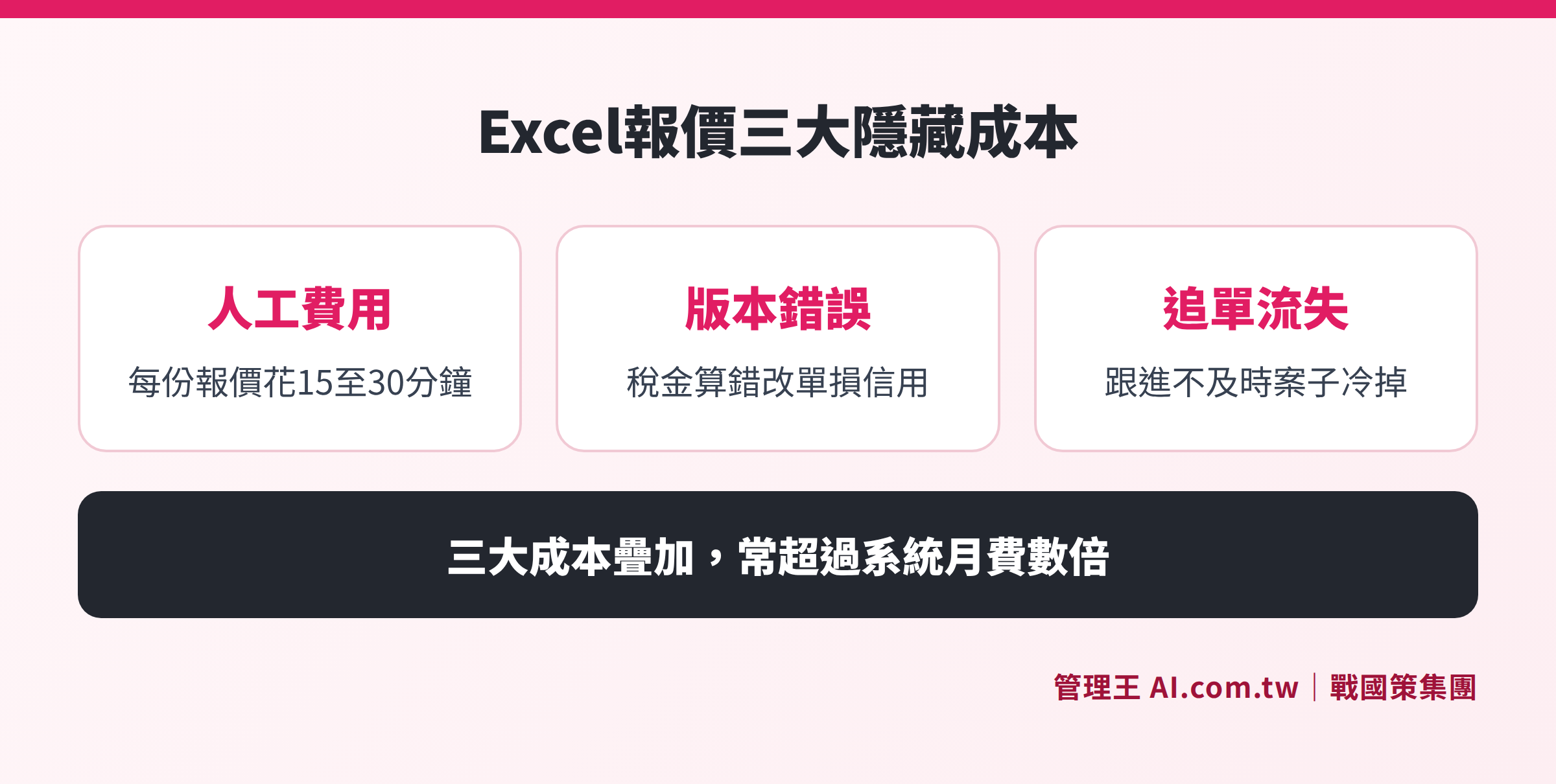
The true cost of Excel comes from the cumulative effects of labor time, version confusion, and lost follow-ups.
Cost Structure of Online Quotation Systems
Online quotation systems in the Taiwanese market can be divided into three main types based on their pricing structure. Understanding this structure is essential for making accurate comparisons.
Subscription-Based SaaS (Mainstream)
Monthly or annual payments, tiered by number of users or functionality. This is the most common choice for SMEs, requiring no IT maintenance and available for immediate use.
Custom Development (Large Enterprises)
Custom developed by software companies based on demand, including a one-time development fee and annual maintenance cost. Development fees typically range from NT$300,000 to NT$1,500,000, plus an annual maintenance contract of 15% to 25%. Over five years, the total ownership cost often exceeds 3 to 5 times that of subscription models.
Free Tools (Individuals or Very Small Scale)
Primarily based on Google Sheets templates or free online generators, suitable for individuals with fewer than 10 quotations a month, but lacking tracking, version management, and backend integration capabilities.
Table: Comparison of Cost Structures for Three Types of Quotation Tools (2026)
| Type | Applicable Scale | Monthly Fee Range | Implementation Time | Integration Capability |
|---|---|---|---|---|
| Excel / Free Tools | 1 to 3 People | Free | Immediate | None |
| Subscription-Based SaaS | 3 to 300 People | NT$0 to NT$20,000 | 1 to 2 Weeks | Medium to High |
| Custom Development | Over 100 People | Over NT$30,000 (amortized) | 3 to 12 Months | Depends on Development Specifications |
Market Comparison of Quotation System Costs (Subscription-Based SaaS)
The following are the published prices of major subscription plans in the Taiwanese market (as of November 2026), listed only for reference according to the official websites.
Table: Cost Comparison of Quotation Function Subscriptions in Taiwan (According to Officially Published Plans)
| System | Lowest Paid Plan | Key Features | Remarks |
|---|---|---|---|
| Quote in Seconds | NT$329/month (Solo) | Quotation, E-signature | Pure quoting tool |
| Vital CRM | NT$800/month (annual payment) | CRM with quotation functionality | User-based pricing |
| Meta8 | NT$1,499/month (Basic) | CRM with quotation processes | — |
| ORDERLY | NT$2,980/month (Team) | Quotation and order integration | — |
| 管理王 AI.com.tw | Free plan for permanent use | Quotation, CRM, Accounting, HR integrated | 100+ modules under one subscription |
Data is based on information publicly available on each official website as of November 2026; actual figures are subject to each vendor's latest announcements.
Notably, many systems offer "annual payment discounts." For 管理王, subscribing annually allows getting 14 months for the price of 12, equivalent to about 15% off; if the monthly fee is NT$10,000, an annual payment saves NT$20,000, equivalent to two months free. When assessing costs, the total annual payment often provides more reference value than simply comparing monthly fees.
Calculating the Cost of Switching from Excel to an Online Quotation System: Three Steps to Clarify
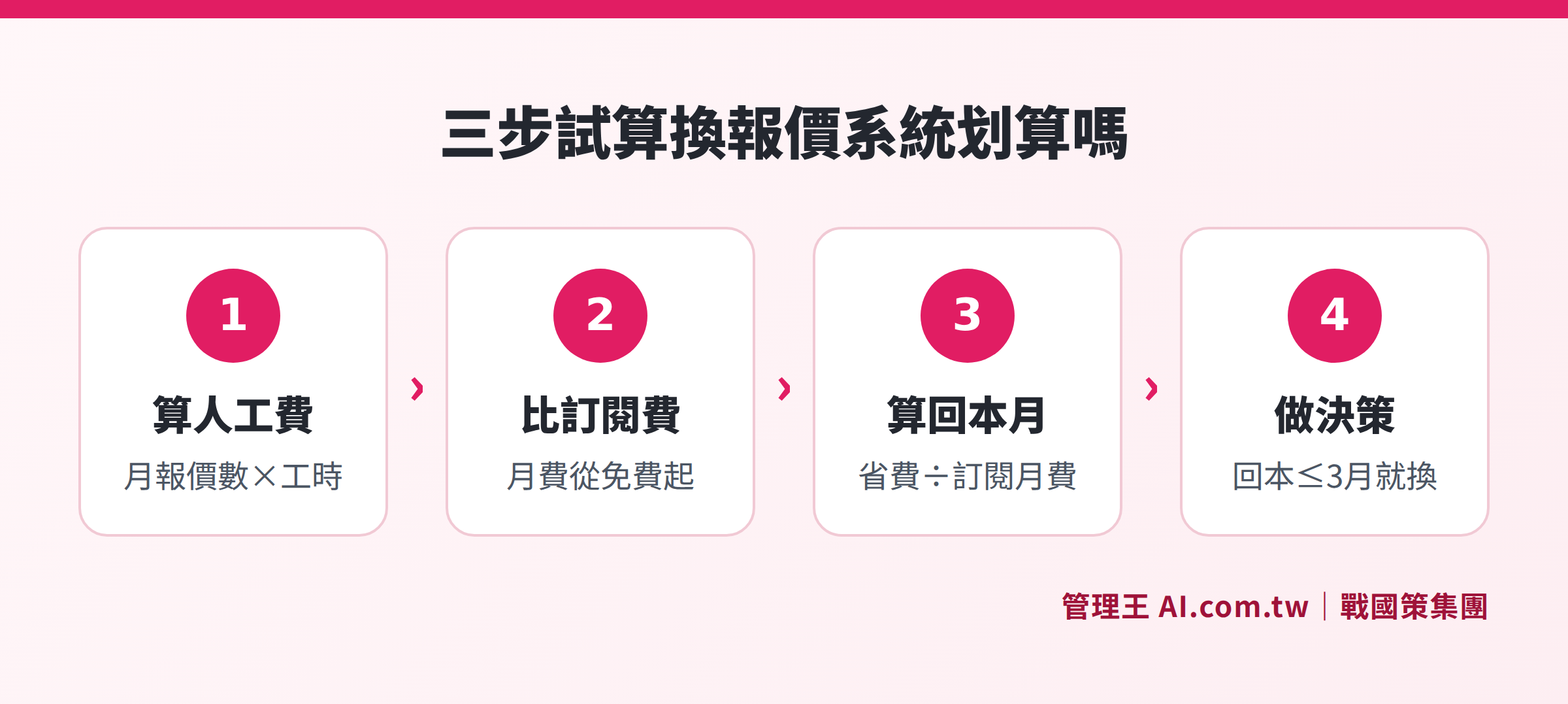
Calculate the monthly Excel cost, compare subscription fees, and calculate the payback period.
Step 1: Calculate Current Monthly Cost of Excel
Monthly quotations × Time to produce (minutes) ÷ 60 × Hourly wage = Labor cost
Add estimated lost revenue from un-followed quotes (if not quantifiable, start at zero)
Example: For a sales team of 30 people, each generating 20 quotations a month, with an average of 20 minutes per quotation and an hourly wage of NT$250:
30 × 20 × 20 ÷ 60 × NT$250 = NT$50,000 in monthly labor costs spent on filling out quotations.
Step 2: Compare Subscription Fees
Using 管理王’s business plan priced at NT$10,000/month as an example, which includes 60 members, 3,000 AI points, and more than 100 modules including CRM, contracts, and accounting, the monthly fee is equivalent to 20% of the calculated labor cost.
Step 3: Calculate Payback Period
(System monthly fee ÷ Monthly saved labor cost) = Payback period
NT$10,000 ÷ NT$50,000 = 0.2 months → Payback in less than one month
This estimation only considers labor time without accounting for version errors, lost follow-ups, or lost customer data due to employee turnover, which would further highlight the benefits of switching.
The following table provides calculations for different sizes of sales teams, assisting you with your own situation:
Table: Monthly Cost Estimates of Excel Quotations for Different Sales Team Sizes
| Team Size | Monthly Quotations | Estimated Monthly Labor Cost | Recommended Plan Monthly Fee | Estimated Payback Period |
|---|---|---|---|---|
| 1 to 3 People | 20 to 50 | NT$1,250 to NT$3,125 | Free plan | Immediate payback |
| 5 to 15 People | 100 to 300 | NT$8,333 to NT$18,750 | NT$5,000 to NT$10,000 | Less than 1 month |
| 20 to 50 People | 400 to 1,000 | NT$33,333 to NT$62,500 | NT$10,000 to NT$19,900 | Less than 1 month |
Hourly wage calculated at NT$250; actual figures should be based on your company's employee salaries and quotation volumes.
When is Custom Quotation System Worth It?
Custom development costs are high, but it may be worth evaluating in the following situations:
- The quotation process involves multi-level approvals (such as for government procurement or engineering bids), and standard SaaS cannot meet the needs
- Need deep integration with existing ERP systems (e.g., SAP, Oracle)
- The company exceeds 500 employees, and subscription cumulative costs surpass total ownership costs of customization
For example, in a company with 100 employees, if the subscription monthly fee is NT$19,900 for 60 months, that amounts to NT$1,194,000; if the custom development cost is NT$500,000 plus NT$125,000 in maintenance over five years, the total is NT$625,000, making customization cheaper after five years. Conversely, if development costs exceed NT$1,500,000, subscriptions are likely the better option.
Advice for SMEs: Start with the subscription model for three months, and assess the process before considering whether to make custom adjustments.
Five Cost Traps in Implementing a Quotation System
Many business owners order based on monthly fees but later find "additional" costs surpass the subscription fee:
1. Implementation Consultant Fees: Some vendors charge separately; 管理王 offers free consultation interviews, included remote training for business plans and above.
2. Integration Fees: Fees may apply for external API connections, payment configurations, and existing data imports. 管理王 offers 70+ natively integrated modules with no additional integration fees.
3. Additional User Fees: For systems that charge per active user, expanding the sales team will incur extra costs. The flagship plan of 管理王 has no limits on the number of members.
4. AI Features Charged Separately: Some systems require upgrades or separate purchases for AI analysis or automated follow-ups. All AI functionalities are built into 管理王 plans with no additional costs.
5. Data Binding: Difficulty exporting data when deactivating increases transition costs. 管理王 supports exporting in CSV, Excel, and PDF formats, allowing for complete database exports anytime upon request.
Annual vs Monthly Payments: How Much Can You Save?
"Trying monthly payments first" is reasonable, but when a decision is made to continue, annual payments are usually more cost-effective. For example, with 管理王, an annual payment provides 14 months for the price of 12, equivalent to an extra two months of usage, translating to roughly 14% savings monthly.
For newly implemented companies, the recommended strategy is: start with monthly payments for 1 to 3 months, confirm acceptance and functionality compatibility with the sales team, and then switch to annual payments to secure discounts. Some vendors also offer discounts for the first month or free trial periods, which should be verified during assessment.
When viewing 管理王 pricing plans, remember to include annual payment discounts in total ownership cost calculations, rather than only comparing the monthly fee figures.
How to Use 管理王's Quotation System
管理王's quotation system offers a free plan that can be used permanently, allowing SMEs to establish standardized quotation processes without payment:
- Create Item Catalogs: Establish standard unit prices for products and services at once, allowing sales to select directly instead of re-entering each time.
- One-Click PDF Generation: Professional quotations including company logo, terms, and signature fields completed in minutes.
- Online Signing: Customers can sign directly through an emailed link without needing to print or mail documents.
- Automatic Tracking of Opening Emails: The system tracks whether the customer opens the quotation and how many times, enabling timely follow-ups by sales.
- Automated Follow-Ups: If the customer hasn't replied within seven days, the system automatically sends follow-up emails in the salesperson's tone, rotating phrases across three rounds.
- One-Click Contract Conversion: After a deal is done, connect easily to contract management, without needing to re-enter data.
- Integrate CRM and Accounting: Business opportunity data flows automatically to the CRM system, with invoices connected to the accounting system, creating a seamless end-to-end process.
Plans above the business type include 8 to 16 hours of remote implementation training, ensuring the team quickly gets the hang of it, and custom adjustments are transparently priced at NT$1,000/hour; written quotes will be provided before work starts, with costs not exceeding budget.
View complete features of the quotation system|Overview of recommended quotation systems: 5 key selection points|Comparison of quotation generators
Quotation System Cost Consultation: Is it Worth Switching Systems?
Consultants can assist in evaluating your business scale and quotation volume, recommending the most suitable plan with free appointments that do not require a credit card.
Free consultation hotline: 0800-003-191
Official LINE account: @119m
Official website: app.AI.com.tw
Free trial: Apply for 管理王 now
Frequently Asked Questions
How much does a quotation system cost per month?
Monthly fees for quotation systems on the market range from free to tens of thousands of NTD. 管理王 offers a free plan for permanent use; paid plans range from NT$5,000 to NT$19,900/month, tiered by the number of members and AI usage. If only the quotation function is needed, it can also be added for NT$1,000/month.
What costs are involved in switching quotation systems? What are the additional fees beyond the monthly fee?
In addition to the monthly fee, potential extra costs may include implementation consultant fees, existing data import fees, special API integration fees, and custom development fees. Choosing 管理王 can help avoid most extra costs since over 70 modules integrate natively without charging integration fees, and remote training is included in plans above the business level, while data can be imported by users themselves.
Is Excel really cheaper than online systems?
While Excel appears free at first glance, the hidden costs associated with labor time, calculation errors, version confusion, and lost follow-ups often far exceed the monthly fees of a SaaS subscription that may cost thousands of NTD. For a sales team of 30, the labor monthly cost for producing quotations alone can reach NT$50,000, significantly higher than a similarly capable system's monthly fee.
Which is cheaper, a custom quotation system or a subscription model?
In nearly all cases for SMEs (under 300 employees), subscription models are more cost-effective. Custom development typically costs between NT$300,000 and NT$1,500,000, plus annual maintenance fees; subscriptions require no large upfront investments. It is only when a business grows to over 500 employees and has highly customized needs that reevaluation is necessary.
What is the difference between 管理王's quotation system and standalone quotation tools?
Standalone quotation tools (like Quote in Seconds) focus solely on quotations and are priced lower but with limited features, lacking CRM tracking, AI automated follow-up, or backend integration. 管理王's quotation system is integrated within the 100+ module All-in-One system, and the same subscription includes CRM, accounting, HR, contracts, AI auto-follow-up, and other functions; for companies requiring multi-system integration, the overall ownership cost is lower without the need for subscriptions to multiple SaaS solutions.
Data Sources
- 管理王 AI.com.tw Official Feature Page: https://app.ai.com.tw/features/quotation (as of November 2026)
- 管理王 AI.com.tw Plans and Pricing: https://app.ai.com.tw/pricing (as of November 2026)
- Quote in Seconds Official Pricing: https://quote.foreverwebs.com/ (as of November 2026)
- 恒远数位科技: Analysis of Quotation System Customization Costs (as of November 2026)
- 一等一科技: Are You Still Using Excel for Quotations? Reference for Digital Quotation Processes (as of November 2026)