What is a Maintenance Management System? Understand the Entire Process from Reporting to Closing|Maintenance Management System Recommendations

A Maintenance Management System digitizes the entire process from equipment reporting, dispatching, execution, to closure. This article explains six major processes, feature lists, industry applications, and purchasing points, recommending solutions suitable for small and medium enterprises in Taiwan.
A Maintenance Management System (CMMS) is a complete digital management platform that handles equipment reporting, work dispatching, maintenance execution, and closure. In simple terms, customers or internal personnel report faults through the system, which automatically notifies maintenance personnel, tracks processing progress, and ultimately leaves behind a complete maintenance record and knowledge base. For maintenance industries such as machine tools, equipment manufacturing, and elevator maintenance, implementing a maintenance management system is not just about making fewer phone calls, but ensuring that every step from "reporting to closing" is documented, auditable, and allows management to grasp site conditions without relying on verbal inquiries. This article clarifies the definitions, core processes, feature lists, and purchasing points, assisting maintenance industry owners in Taiwan to evaluate the suitability of implementation.
What is a Maintenance Management System? Definition and Core Concepts
The core of a maintenance management system is the "Work Order." Each repair request, from submission to completion, corresponds to a work order, which records: the reporter, equipment number, fault description, assigned maintenance technician, execution time, materials used, confirmation of completion, and client signature. This process ensures that every maintenance case can be tracked, analyzed, and improved.
Traditional methods rely on LINE group messages and manual records via Excel, with common issues including: lost work orders, unclear responsibilities, and managers only able to check progress by individually asking technicians. A maintenance management system centralizes this communication onto one platform, fundamentally solving the issue of "work orders falling into a black hole."
Understand in One Sentence
A maintenance management system is a digital platform that keeps records, tracks, and analyzes each work order from "reporting" to "closure," serving as the groundwork for upgrading customer service in the equipment maintenance industry.
According to the Ministry of Labor's Occupational Safety and Health Administration's "Reference Manual for Machinery Integrity Management Procedures" (2019), factories should establish complete maintenance record systems including maintenance plans, maintenance procedures, and documentation retention, which is also one of the regulatory backgrounds for implementing maintenance management systems. Systematic preservation of maintenance records is not only an efficiency issue but also a basic requirement for regulatory compliance and customer accountability.
The Complete Process of a Maintenance Management System: Six Steps from Reporting to Closure
A complete maintenance management process typically divides into the following six stages. Understanding the work contents of each stage aids in designing processes that meet the actual operations of the company when implementing the system:
Table: Six Stages of Maintenance Management Process
| Stage | Description | Common Execution Methods |
|---|---|---|
| 1. Report Issue | Customers or internal personnel report equipment anomalies or faults | Online forms, apps, QR code reporting, phone to work order |
| 2. Create Work Order | System automatically or manually creates maintenance work orders and classifies priority | Automatic assignment, manual dispatch by supervisor |
| 3. Dispatch Scheduling | Assign personnel and schedule based on technician skills, location, and workload | Visual scheduling board, map dispatching, automatic allocation |
| 4. Execution of Maintenance | Technicians perform on-site maintenance, taking photos, recording materials and hours | Mobile app on-site reporting, voice notes |
| 5. Completion Confirmation | Technicians report completion, customers confirm and sign | Electronic signatures, photo evidence, customer rating |
| 6. Closure Analysis | Statistics on maintenance time efficiency, costs, and equipment reliability metrics | Report dashboards, automated monthly reports |
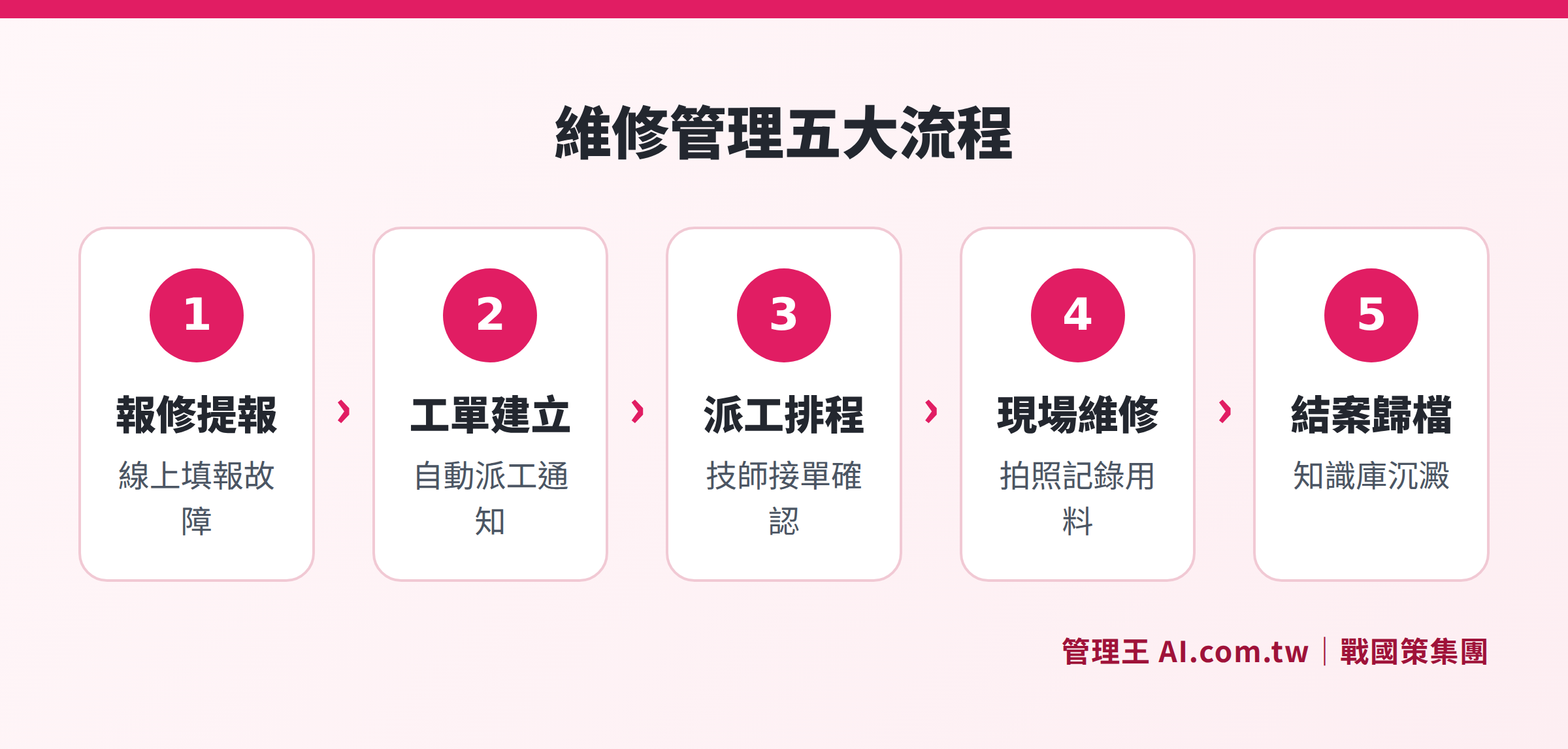
Complete steps of the maintenance management process from reporting an issue, work order creation, dispatch scheduling, on-site maintenance to case filing.
Core Feature List of a Maintenance Management System
Customer Equipment Profiling
Each piece of equipment establishes an "Asset Card," recording: brand model, serial number, installation date, warranty expiration, responsible technician, historical maintenance records, original technical documents, and parts list. New technicians, when taking over, can understand the complete history of this machine just by opening the equipment page, without needing to ask predecessors or sift through paper files. Equipment files also clarify warranty management — which equipment is nearing expiration, which remains under warranty for vendor handling, all clearly displayed.
Maintenance Case Tracking
Work order statuses are updated in real-time: pending processing → assigned → in progress → awaiting parts → completion awaiting confirmation → closed. Customers can check current progress through a shared link, reducing follow-up calls; maintenance managers can see the total number of outstanding work orders in the company, overdue work order lists, and technician workload distribution at a glance without needing to call and inquire individually. For B2B maintenance service providers, enabling customers to self-check progress is key to enhancing customer satisfaction.
Maintenance Knowledge Base
After each closure, technicians enter "fault cause classification" and "solution methods," and the system automatically accumulates this into a searchable knowledge base. The next time the same fault occurs, searching for the equipment model will retrieve the previous solutions, used parts, and hours, shortening diagnostic time and preserving years of accumulated maintenance experience within the company instead of letting it vanish with technician departures.
Preventive Maintenance Scheduling
Automatic generation of preventive work orders based on equipment maintenance cycles (e.g., changing oil seals every three months, calibrating every six months, major maintenance yearly) notifying technicians and customers in advance to arrange maintenance times. Transitioning from passive maintenance (repairing only when broken) to active maintenance (regular upkeep) is a fundamental method for reducing unexpected downtime losses. Research in equipment management practices suggests that the cost of preventive maintenance is usually less than one-third of emergency repair costs.
AI Fault Diagnosis and Reporting
Input fault symptoms, and AI compares them with the knowledge base and historical cases, providing a ranked list of possible causes and suggested inspection steps, allowing technicians to prepare tools and materials before arriving on site, avoiding the inefficient situation of "the first visit is just to check, and the second visit brings parts." After maintenance completion, AI automatically generates maintenance reports summarizing the fault cause, handling methods, and subsequent suggestions, greatly saving technicians' reporting time.
Daily Maintenance Reports
Supervisors receive automatically compiled maintenance daily reports: the number of tasks completed today, average processing times, overdue work order lists, and technician workload rankings, keeping managers informed without manual organization. At the end of the month, a monthly report can also be automatically generated, summarizing each customer's maintenance frequency, costs, and satisfaction, serving as a basis for service contract renewals and quotes.
Preventive Maintenance vs Predictive Maintenance: Which Should Small and Medium Enterprises in Taiwan Choose?
Maintenance management has three levels; understanding the differences among these levels helps choose a system that fits the scale and budget of your company while avoiding excessive or insufficient features:
Table: Comparison of Three Maintenance Strategies
| Maintenance Strategy | Description | Suitable Audience | System Requirements |
|---|---|---|---|
| Breakdown Maintenance (Reactive) | Equipment is only repaired when broken, no prior planning | Low-value equipment, ample spare parts | A basic work order system is sufficient |
| Preventive Maintenance (Regular) | Scheduled periodic maintenance based on time or usage | Most small and medium enterprises in Taiwan | Maintenance scheduling + reminder notifications |
| Predictive Maintenance (Sensor-based) | Detects anomalies through IoT sensors, predicting failures | Large manufacturers, high-precision equipment | IoT integration + AI analysis |
For most small and medium enterprises in the equipment maintenance industry in Taiwan, preventive maintenance is the most practical starting point: low implementation costs and immediate effects, without having to install expensive sensors on equipment. Starting with "periodic maintenance scheduling + reminder notifications," first digitizing maintenance processes, and building equipment ledgers and knowledge bases, then gradually introducing AI predictions as maintenance data accumulates, is a more solid upgrade path that aligns with the budget considerations of most small and medium enterprises.
Which Industries are Suitable for Maintenance Management Systems?
The application scope of maintenance management systems is quite broad, and here are common scenarios for implementation in Taiwan:
Tool and Machinery Equipment Manufacturers: After-sales service departments use the system to manage customer equipment maintenance contracts, fault dispatching, and spare parts inventory, enhancing customer warranty service satisfaction.
Elevator, Air Conditioning, and Fire Safety Equipment Maintenance: Regular inspections, emergency repairs, and customer notifications are entirely digitized, meeting regulatory requirements for maintenance record retention by governing authorities.
Medical Equipment Maintenance: Records of instrument calibration and maintenance retention satisfy traceability requirements for medical device management regulations.
Factory Equipment Maintenance Departments: Internal equipment preventive maintenance, emergency fault handling, and spare part management to improve equipment operational efficiency (OEE). One hour of downtime can lead to losses far exceeding maintenance costs, and systematic management makes downtime predictable and controllable.
Property Management: Handling tenant repair requests, managing outsourcing contractors, expense reimbursement to enhance tenant satisfaction while providing property companies with transparent maintenance records in front of the management committee.
According to SAP Taiwan, Computerized Maintenance Management Systems (CMMS) primarily aim to enhance equipment operational efficiency (OEE) in manufacturing while reducing unplanned downtime, achieving a long-term goal of transitioning from reactive maintenance to preventive maintenance.
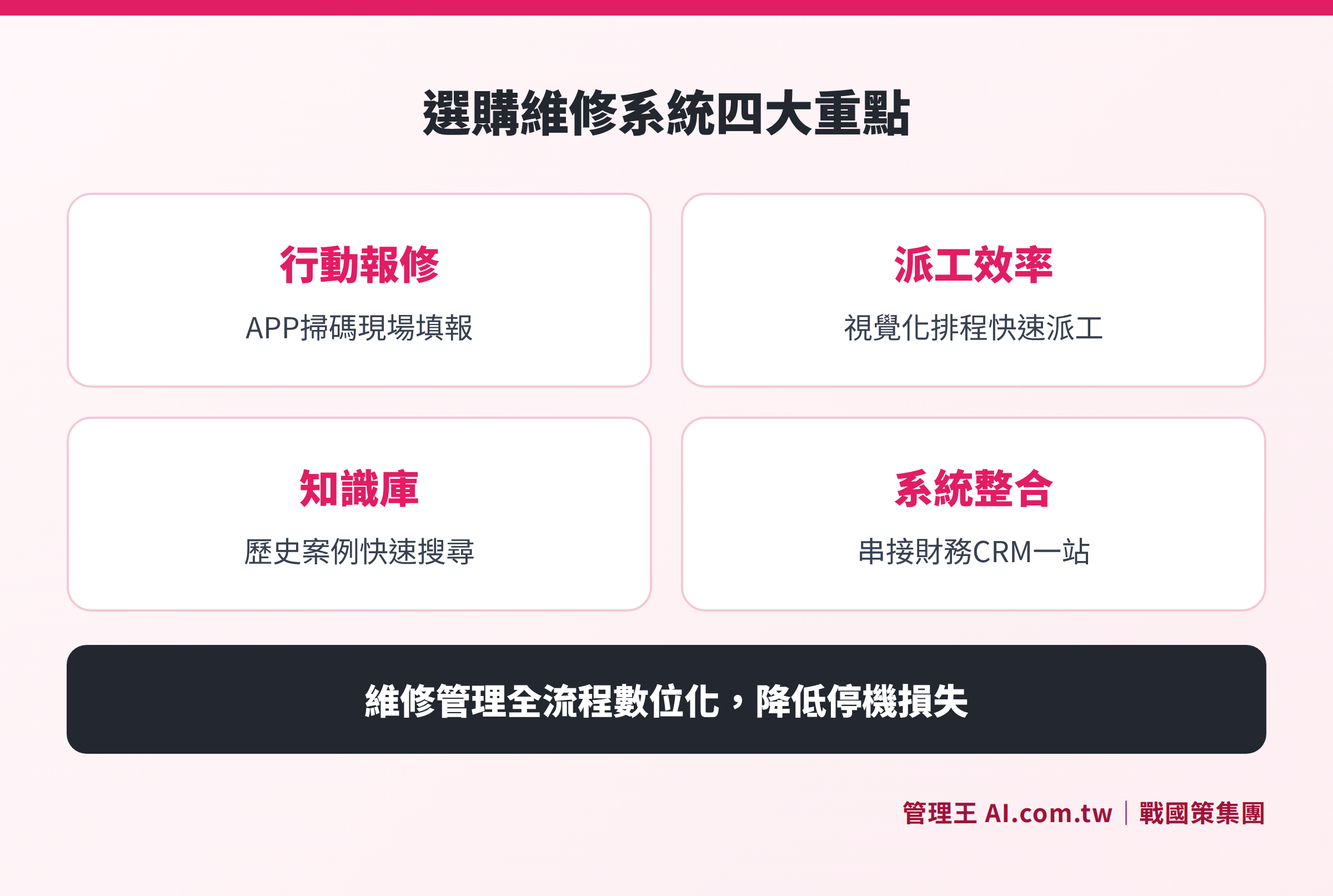
Evaluation focus on mobile reporting, dispatching efficiency, knowledge base queries, and system integration
Five Major Evaluation Points for Choosing a Maintenance Management System
In Taiwan, numerous maintenance management solutions are available, and it is suggested to compare from the following five dimensions during evaluation:
1. Mobile Reporting Experience
On-site technicians rely on their mobile devices; can the app operate offline, allow photo uploads, and scan QR codes for equipment? The simpler the interface, the higher the reporting rate, making the data valuable. If technicians find it troublesome and do not report, the system loses its significance.
2. Dispatch Efficiency and Scheduling Flexibility
Is there a visual scheduling board? Can it automatically suggest the nearest dispatch based on technician location? Are overdue orders automatically escalated to notify supervisors? In external service industries, dispatch efficiency directly affects how many customers can be served daily.
3. Knowledge Base and Historical Query
Can past repair records for similar equipment, including used parts and hours, be searched quickly? This is crucial for shortening diagnosis time and ensuring that the maintenance knowledge of experienced workers does not disappear when they retire.
4. Integration with Business and Financial Systems
Can repair charges, material procurement, and customer invoices connect directly from work orders, avoiding duplicate input? The ideal situation is: after case closure, generate invoices in one click that enter the financial system, and customers receive electronic invoices, all seamlessly.
5. Localization and Customer Support
Does it comply with Taiwan's electronic invoicing, business accounting law, personal data protection laws, and other regulations? Is there a Traditional Chinese interface and customer support in Taiwan? Can issues be communicated in Chinese in real-time, which is vital for small and medium enterprises in Taiwan?
How to Manage Maintenance with 管理王?
管理王 AI.com.tw Maintenance Management System is an integrated maintenance management module designed specifically for small and medium enterprises in Taiwan, with core features including:
- Customer Equipment Profiling: Establish an equipment data card recording model, serial number, warranty period, and past maintenance records, enabling new technicians to get up to speed immediately.
- Maintenance Case Tracking: Work orders are entirely visible from reporting to closing, and customers can self-check progress through shared links, reducing follow-up calls.
- Daily Maintenance Reports: Automatically compile daily and monthly reports for supervisors, eliminating the need for manual organization, allowing them to see which work orders are overdue and which technician has heavy workloads directly from the reports.
- Maintenance Knowledge Base: Automatically accumulates fault solutions after case closure for technician reference, retaining maintenance experience within the company.
- AI Fault Diagnosis: Automatically suggests possible causes and solutions based on symptoms inputted, generating complete maintenance reports while saving technicians' reporting time significantly.
The 管理王 Maintenance Management System integrates natively with its platform's CRM system, customer service work orders, task management, AI customer service system, and report analytics, ensuring smooth data flow. Customers can report issues through AI customer service → automatically create a maintenance work order → notify technicians of dispatch → and integrate billing after closure, all completed within the same system without additional integration fees.
The free plan is available for permanent use, allowing teams of fewer than 10 members to begin digitizing their maintenance processes immediately without tying a credit card. For those needing more AI usage, member counts, or onboarding training, options include Economical (NT$5,000/month), Business (NT$10,000/month), or Flagship (NT$19,900/month) plans.
The 戰國策 Group services over 30,000 companies; 管理王 is a brand under its umbrella, with data stored in Taiwanese facilities, complying with ISO 27001 standards and meeting Taiwan's data sovereignty and regulatory compliance requirements.
Free Trial of the Maintenance Management System
Consultants assist you in establishing a digitized maintenance process from reporting to closure, suitable for tool machinery, equipment maintenance, property management, and other industries, with the free plan available for permanent use.
Free consultation hotline: 0800-003-191
LINE Official Account: @119m
Official website: app.AI.com.tw
Free Trial: Apply for 管理王 now
Frequently Asked Questions
How is a Maintenance Management System different from a general customer service work order system?
A general customer service work order system (e.g., Zendesk) primarily deals with tracking "service requests" and lacks features such as equipment ledgers, maintenance knowledge bases, and preventive maintenance scheduling. The core of a maintenance management system is "equipment life cycle management": from creating machine records, maintenance plans to each maintenance record, completely documenting each equipment's status, making the equipment history searchable and analyzable. If you need to manage customers' equipment, it is advisable to choose a specialized maintenance management system rather than a general customer service work order platform.
Do small companies with only 3 or 4 technicians need to implement a maintenance management system?
Even with a team of three technicians, the main benefits of implementing a system are "knowledge retention" and "transferability." If even one experienced technician leaves, the experience passed down orally disappears; when customers inquire about progress, they can only respond, "I’ve asked the technician to call back." The system accumulates this knowledge into a searchable knowledge base, enabling customers to self-check progress. The 管理王 free plan supports teams of fewer than 10, suitable for small teams to establish digital processes from scratch.
How long do maintenance management system records need to be retained? Are there regulations?
According to the Ministry of Labor's Occupational Safety and Health Administration regulations, maintenance records related to machinery integrity should be properly preserved; the Environmental Protection Agency requires records for specific equipment (such as continuous drinking water supply fixed equipment) to be retained for over two years. Requirements from different industry regulatory authorities vary, so it is advisable to abide by regulations applicable to actual business operations. 管理王's maintenance records can be permanently stored in Taiwanese facilities, supporting exports in CSV, Excel, and PDF formats for easy regulatory audits. This article serves as general information and does not constitute legal or tax advice; actual matters should comply with the latest announcements from regulatory authorities.
How to evaluate the effectiveness of implementing a maintenance management system?
The main indicators to observe are: (1) Average Maintenance Response Time (the time from reporting to technician arrival/start of processing); (2) First Contact Resolution Rate (FCR) (the proportion of problems solved on the first visit, typically targeted at over 80% in the industry); (3) Preventive Maintenance Coverage Rate (the percentage of equipment included in the regular maintenance plan). The 管理王 report analytics module can automatically calculate these three indicators, assisting management to continuously optimize maintenance service quality.
How long does it take for a maintenance management system to go live and be usable?
The 管理王 Maintenance Management System is a SaaS cloud service; the free plan can be registered in just 30 seconds without software installation. Bulk import of equipment data (in CSV format) is usually completed within 1 to 3 working days, and basic process setups (reporting categories, technician accounts, notification settings) take about 1 to 5 working days, depending on company size. Business and flagship plans include remote onboarding training, where consultants assist with initial setups and staff training.
Sources
- Ministry of Labor Occupational Safety and Health Administration "Reference Manual for Machinery Integrity Management Procedures" (January 2019): https://www.osha.gov.tw/
- SAP Taiwan — What is CMMS Software? Introduction to Asset Management Systems: https://www.sap.com/taiwan/products/scm/asset-management-eam/what-is-cmms.html
- Administrative Yuan Public Overseas Report Information Network "Application Report of Computerized Maintenance Management System (CMMS)": https://report.nat.gov.tw/
- Environmental Protection Agency "Regulations on the Use and Maintenance Management of Fixed Equipment for Continuous Drinking Water Supply": https://oaout.moenv.gov.tw/Law/LawContent.aspx?id=FL015499
- 管理王 AI.com.tw Maintenance Management System Features Page: https://app.ai.com.tw/features/repair-management
- 管理王 AI.com.tw Service Plan Pricing: https://app.ai.com.tw/pricing