Restaurant Reservation System Recommendations: Compare These 8 Key Features Before Choosing|Reservation System Recommendations

When choosing a restaurant reservation system, it's not just about whether it offers online booking. You should also consider the 8 key features including anti-overbooking mechanisms, automatic LINE reminders to reduce No-Shows, Google My Business integration, CRM connections, etc. This article analyzes each feature to help restaurant owners quickly make the right selection decision.
When choosing a restaurant reservation system, simply checking if it offers online booking is far from sufficient. With features ranging from 24-hour self-booking and anti-overbooking measures to automatic reminders that reduce No-Shows and integration with Google My Business, the functionality varies greatly among different systems, as do their cost structures. This article organizes 8 key features to help restaurant owners and chain brand managers quickly identify which features are 'essential' and which are 'bonus' while comparing recommendations for restaurant reservation systems, enabling them to select the system best aligned with their restaurant's scale and needs, turning every reservation opportunity into actual in-store revenue.
Key Takeaway
The core value of a restaurant reservation system is: allowing customers to make self-service bookings 24/7, with automatic reminders to minimize No-Shows, while providing a clear overview of seat availability in the backend to save manpower on phone calls.
Why Do Restaurants Need a Reservation System?
The restaurant industry in Taiwan is highly competitive, and every empty seat represents lost revenue. Traditional phone reservations face three major pain points:
High Labor Costs: Each reservation call takes several minutes to handle on average, leading to congestion during peak hours when customers cannot get through, resulting in potential bookings lost; after-hours calls go unanswered, missing a significant number of requests for the same evening or the following day.
High Error Rate: Manually recording numbers, times, and table assignments in handwriting or Excel can lead to mistakes or forgotten updates, causing double bookings; customers modifying or canceling reservations without timely updates can waste vacant seats even more.
No-Show Difficulties: Customers who book but do not show up create a dilemma for restaurants that cannot fill the spot immediately, especially after resources have already been allocated. Systems without a reminder mechanism see noticeably higher No-Show rates compared to those with automatic reminders.
According to the Department of Statistics, Ministry of Economic Affairs Survey on the Operations of Wholesale, Retail, and Restaurant Industries, the restaurant industry in Taiwan generally faces dual pressures of labor shortages and rising costs, making digital reservation management a crucial direction for reducing labor burdens.
After implementing an online reservation system, restaurants can allow customers to self-book 24/7, use LINE or SMS for automatic reminders significantly reducing No-Shows, and present real-time booking distribution in the backend, enabling more accurate preparation and staffing.
To understand the complete picture of reservation systems, you can refer to Comprehensive Guide to Restaurant Reservation Systems: Features, Costs, and Implementation Steps Explained.
Feature 1: 24-Hour Online Booking Page
The most basic and important feature of a restaurant reservation system is to provide a publicly accessible booking page that operates 24/7. Customers do not have to wait for the restaurant to open or place a phone call; they can directly select the date, time, and number of people on their mobile devices or computers and complete the reservation in seconds.
Details to confirm when selecting a system include:
- Can it be linked to your own domain?: Having a reservation page under your own brand domain (e.g., reservation.yourestaurant.com.tw) appears more professional than redirecting to a third-party platform, also helping with SEO.
- Mobile Device Experience: More than 70% of consumers use mobile phones to make reservations, making it crucial that the page is user-friendly on mobile devices.
- Language Support: Restaurants with foreign customers need to verify if the system supports English and Japanese interface switching.
Management King AI.com.tw reservation system provides a public booking page that can be linked to a personal domain, allowing customers to self-book without installing an app, with a 100% Traditional Chinese interface tailored to Taiwanese business practices.
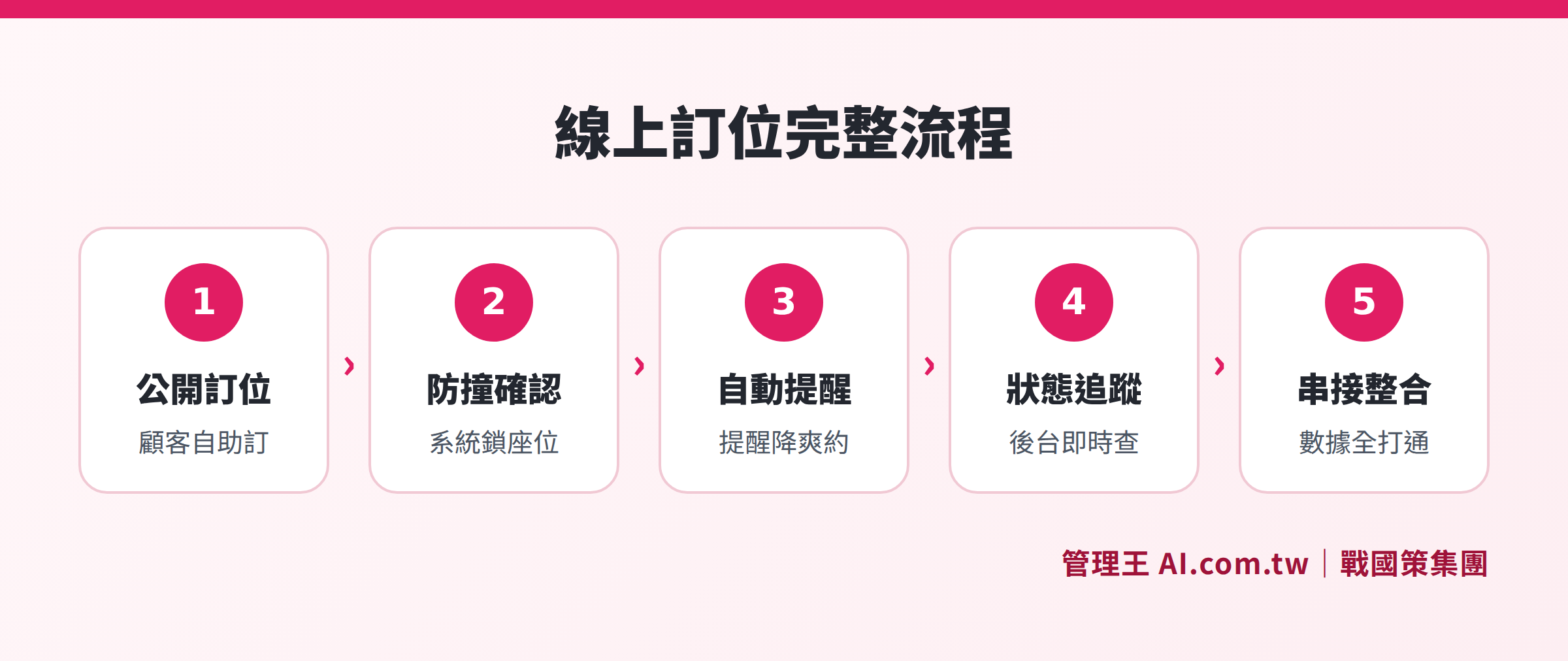
Complete flow from customer self-booking to backend management showing 8 core features
Feature 2: Seat and Resource Management (Eliminating Overlapping Reservations)
Overlapping reservations can drive both customers and staff crazy. When selecting a system, check if the 'anti-conflict mechanism' is functioning correctly: during the same time slot, the same table or private room must not accept multiple reservations.
Good seat management features should include:
- Classifying Reservable Resources: In addition to regular dining tables, the capacity of private rooms, outdoor areas, and bar seats can be set separately.
- Maximum Number of Groups per Time Slot: Set limits based on kitchen capacity for each time slot to avoid exceeding service capabilities.
- Aisle and Table Turnaround Settings: Restaurants with medium to high turnover rates need to set maximum dining times per table to ensure timely seating for the next guests.
Management King’s reservation system supports all bookable resources, including seats, private rooms, and staff, with automatic anti-conflict measures that completely eliminate overlapping reservation disputes.
Feature 3: Automatic Confirmation and Multi-Channel Reminders (Reducing No-Shows)
No-Shows (customers who book but don’t show up) are one of the most troublesome issues for restaurants. Studies show that systematic automatic reminders can significantly reduce No-Show rates, minimizing revenue losses for each seat.
A standard reminder sequence should include:
- Immediate Reservation Confirmation.: Confirmation sent immediately via LINE or Email upon successful booking, including reservation details and a cancellation link.
- 24-Hour Reminder.: Reminder sent the day before the meal, allowing guests to make changes on-the-fly.
- 1 to 2 Hour Reminder.: Ensures guests remember their appointment, displaying the restaurant address and transportation information.
The choice of reminder channel is also important. In Taiwan, LINE notifications have a much higher open rate than emails, so confirm that the system supports LINE messaging notifications; SMS messages can serve as a backup, effectively reaching elder demographics who may not frequently use LINE.
Management King’s reservation system supports automatic sending of LINE, SMS, or Email confirmations after a reservation is made, and sends automatic reminders 24 hours and 1 hour before the meal, effectively reducing No-Show rates, ensuring every seat generates actual revenue.
Feature 4: Full Reservation Status Tracking
A clear overview of the day's reservations and the current status of each booking (pending confirmation / confirmed / arrived / not arrived / canceled) should be easily accessible from the backend. This allows managers to anticipate table turnover for the day, adjust floor staffing accordingly, and manage supplies more accurately.
Table: Key Information Displayed in Reservation Status Tracking Backend
| Information Fields | Description |
|---|---|
| Reservation Time | Scheduled dining time |
| Number of Guests | Number of reservations and guests |
| Reservation Status | Pending Confirmation / Confirmed / Arrived / Not Arrived / Canceled |
| Customer Notes | Special requests such as allergies, birthday celebrations, table connections, etc. |
| Action Buttons | Status changes, note modifications, sending reminders |
A good reservation backend should also support cross-day viewing, allowing floor managers to see the reservation distribution for the coming days in advance, deciding whether to schedule more staff or prepare supplies ahead of time.
Management King’s reservation system provides a complete status transition from pending confirmation to confirmed, arrived, not arrived, and canceled, allowing managers to quickly see the day's and future reservations. It also integrates with Management King CRM system, automatically accumulating each reservation into customer history records.
Feature 5: Integration with Google My Business
Google is the primary entry point for consumers searching for restaurants in Taiwan. When customers see your restaurant on Google Maps or in search results, having a direct 'Make a Reservation' button displayed can considerably increase conversion rates compared to asking customers to open another webpage or call.
When selecting a system, confirm:
- Does it support Google Reserve integration?: This allows the reservation button to appear directly in Google search results.
- Does it synchronize management of Google My Business reviews?: Satisfied customers can be guided to leave Google reviews after their reservations, enhancing local SEO rankings.
Seamlessly converting local search traffic into orders is one of the highest ROI practices for restaurant marketing investments. Management King’s reservation system supports integration with Google My Business, turning local searches directly into reservation sources, complemented by the Google Review Management feature, allowing for immediate post-reservation review invitations, increasing restaurant visibility and trust in search results.
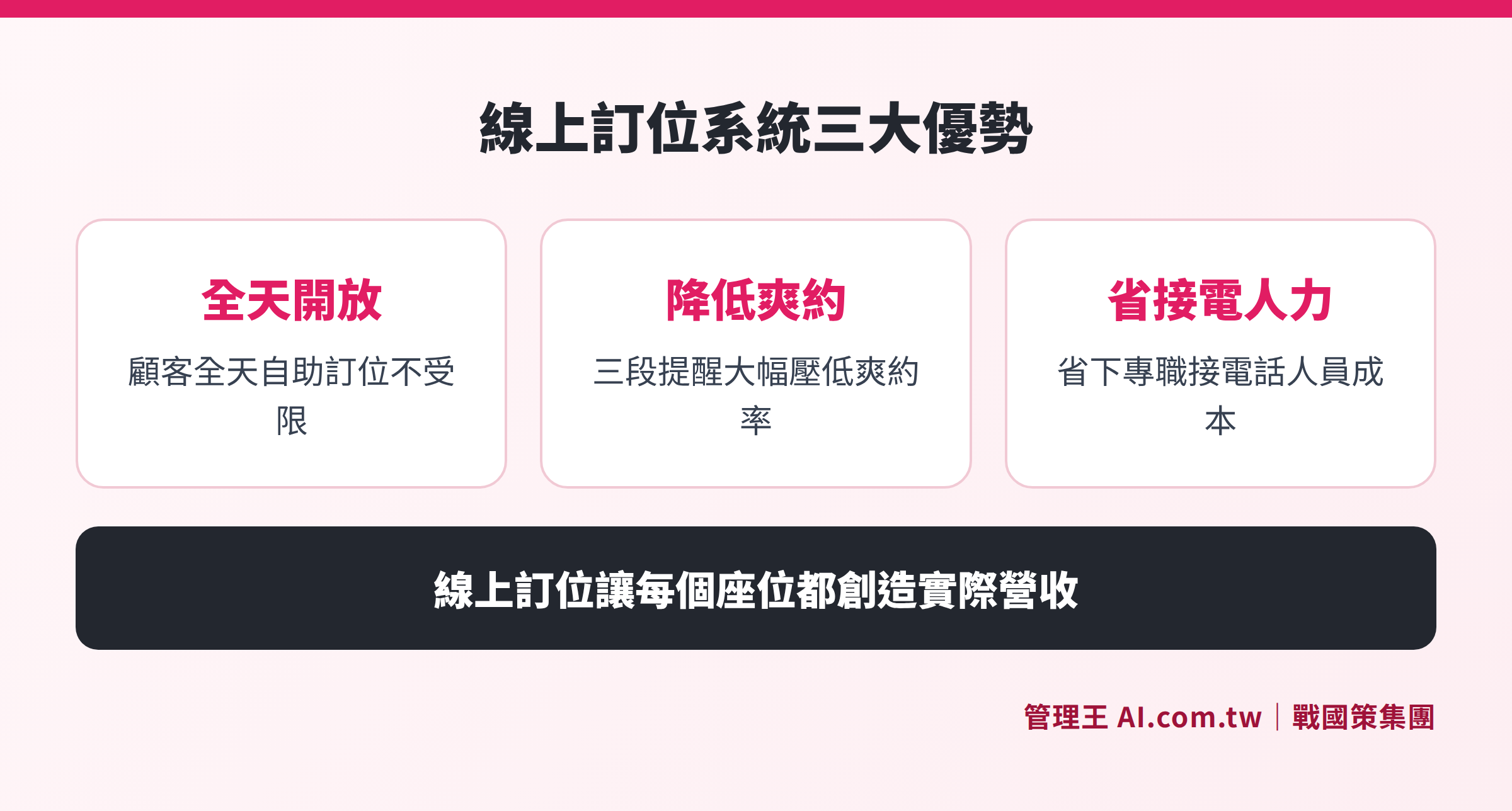
Comparison of efficiency, No-Show control, and customer experience between phone reservations and online reservation systems
Feature 6: VIP Priority Reservations and Online Deposit Payments
VIP Priority Reservations: Frequent customers, members, and high-spending guests should have priority access to reservations. Whether the system can set 'VIP customers can book N days in advance' is a detail in managing brand loyalty.
Online Deposit Payments: The most effective way to filter casual bookings is by requiring a deposit. When choosing a system, confirm:
- Does it support online credit card or mobile payment for deposits?
- Can the deposit policy (partially refundable or fully refundable) be customized?
- When customers cancel, does the system automatically calculate the refund amount?
Automatic Matching of Large Group Reservations: For gatherings of 8 or more, which are challenging for restaurants to manage manually, the system should be able to automatically combine adjacent tables into larger tables, saving floor staff the hassle of manual adjustments.
Management King’s reservation system supports VIP customer priority seat reservations, online deposit payments to filter casual bookings, and automatic matching for large group reservations. When integrated with the membership point collection system, VIP reservations and point redemption can be completed on the same platform.
Feature 7: Centralized Management for Multiple Locations
Chain brands or restaurant groups with multiple outlets need to confirm if the system supports 'centralized backend management for multiple locations':
- Reservation data from each outlet can be viewed in a single backend.
- Different outlet seating configurations can be managed separately, without interference.
- Headquarters can set up unified promotional plans, automatically applying them to all outlets.
Lacking this feature, managing more than three locations requires supervisors to log into separate backends for each, doubling management costs.
Management King’s reservation system supports centralized backend management for multiple locations, allowing chain brands to efficiently coordinate operations. When integrated with POS systems, it creates a complete cycle from reservations to ordering and checkout.
Feature 8: Integration with CRM, POS, and Marketing Systems
Table: Business Value of Integrating Restaurant Reservation System with Other Systems
| Integrated System | What Can Be Done After Integration |
|---|---|
| CRM Customer Management | Automatically accumulate reservation history and consumption preferences, allowing sales staff to proactively engage frequent customers. |
| POS Ordering System | Reservation information is pre-communicated to the kitchen, shortening the time from seating to serving. |
| Membership Point Collection | Automatically accumulate points after completing reservations, increasing incentives for repeat visits. |
| Marketing System | Automatically push birthday month reservation discounts and seasonal promotional plans. |
| Ordering Takeout | Integrate with online ordering, allowing customers to complete reservations and order food simultaneously. |
If each system operates in isolation, reservation data cannot flow into CRM, and marketing promotions cannot be tailored for regular customers, requiring manual exports and imports for every analysis, which wastes significant manpower.
Management King integrates over 100 modules, including reservations, CRM, marketing, and POS systems, into one account with an All-in-One structure, ensuring data flows seamlessly without additional integrations or connection fees. The ordering system, membership point collection, and marketing automation features can all be utilized together, making reservation data an asset for customers.
How to Use Management King’s Reservation System
For example, a typical operating process for a medium-sized Taiwanese restaurant adopting Management King’s reservation system is as follows:
Setup Phase (Complete within 1 Day): Create table data in the backend (regular tables, private rooms, bar seating), set the maximum number of groups accepted in each time slot, enable LINE and SMS automatic reminders, and place the reservation page link on the official website and LINE official account.
Daily Operations: Floor managers open the backend in the morning to get a clear overview of the day’s reservation distribution; the system automatically marks guests as 'Not Arrived' if they do not show up; vacant tables can immediately be made available for the next group after a cancellation; accumulated customer data automatically enters the CRM.
Advanced Applications: VIP members are allowed to book 7 days in advance; anniversary or festive promotions are sent through marketing automation featuring exclusive reservation discounts; Google My Business displays available reservation slots in real time, enabling passing customers to book immediately.
Management King’s reservation system offers a free plan for permanent use, suitable for small restaurants to try core functions first; for full AI reminders, multi-location management, and CRM integration, you can upgrade to a paid plan. For details, see the service plan page.
Businesses related to scheduling can also refer to the appointment system features, applicable for clinics, beauty salons, spas, and other service industries based on time slots.
Free Consultation for Restaurant Reservation System Purchase Advice
Describe your restaurant's scale and needs, and consultants will assist you for free in comparing features and assessing the most suitable implementation plan, clarifying selection queries within 30 minutes.
Free consultation hotline: 0800-003-191
LINE official account: @119m
Official website: app.AI.com.tw
Free trial: Apply for Management King now
Frequently Asked Questions
Does a restaurant reservation system need to support LINE notifications?
In Taiwan, LINE is the most commonly used communication tool among consumers, with a much higher message open rate compared to email. If the system only supports email notifications, many guests may miss confirmation messages or reminders, making it difficult to effectively control No-Show rates. It's recommended to prioritize systems that support LINE push notifications, with SMS as a supplementary channel to cover customers who do not use LINE.
What is the difference between a restaurant reservation system and an appointment system?
A reservation system (table booking system) is specifically designed for restaurants that need to manage tables, time slots, and capacity, focusing on features like anti-overbooking, backend seating charts, and supply management. An appointment system (appointment booking) is more general and suited for one-to-one service types like beauty or medical services, usually lacking the specific needs of restaurants like multiple tables at the same time or table merging. If you run a restaurant, it is advisable to select a reservation system specifically designed for the food and beverage sector.
What are the costs associated with a reservation system?
Common fee structures in the Taiwanese market include three types: (1) charging per reservation (around NT$3 to NT$10 per booking), which may exceed fixed plans for popular restaurants with high booking volumes; (2) fixed monthly fees (usually ranging from NT$1,000 to over NT$5,000), suitable for restaurants with stable booking volume; (3) free versions with basic functions, where advanced features require paid upgrades. The Management King reservation system offers a free plan for permanent use, including core reservation management functionalities, making it suitable for restaurants assessing their first implementation.
How long does it take to implement a reservation system?
Generally, independent restaurants can launch their online booking pages for customers within 1 day after system setup is completed. For chain brands needing CRM, POS, or multi-location integration, longer planning and setup times are required depending on complexity. It's advisable to confirm the complete implementation schedule with the service provider before introduction.
What protections are in place for customer reservation data?
According to personal data protection laws, businesses that collect and utilize customer details such as names, phone numbers, and emails must have clear notification and consent mechanisms. When selecting a reservation system, check if the system provides opt-in records, if the data is stored in Taiwanese data centers, and if it has relevant information security certifications (like ISO 27001). Management King stores data in Taiwan’s dual-datacenter facilities, compliance with ISO 27001 standards, and supports opt-in record functions compliant with personal data laws.
Data Sources
- Department of Statistics, Ministry of Economic Affairs Survey Report on the Operations of Wholesale, Retail, and Restaurant Industries
- USDA Foreign Agricultural Service - Taiwan Food Service Hotel Restaurant Institutional Annual 2025
- Management King AI.com.tw Reservation System Features Page
- National Regulations Database - Personal Data Protection Act