Retail POS System Recommendations: How to Choose for Clothing and Specialty Stores|POS System Recommendations

The POS system requirements for clothing and specialty stores differ from those of the food and beverage industry, focusing on multi-SKU inventory management, compliance with electronic invoicing, member point accumulation, and integration across multiple stores. This article organizes essential POS features, common pitfalls, and the solutions from 管理王 AI.com.tw, helping retail owners quickly find a suitable POS system for their businesses.
The POS system requirements for clothing and specialty stores differ from those of general retail: you need more than just a checkout tool, but a complete cash register backend that can manage multiple SKUs (color × size), instantly deduct inventory, integrate electronic invoicing, synchronize online and offline orders, and accumulate member points. This article organizes the core standards, essential functions, and common pitfalls for selecting a POS system, allowing owners to find the best option among various choices.
What are the Differences Between POS Needs for Clothing and Specialty Stores Versus Food and Beverage?
Many people compare POS systems by asking, "Which POS is better?" but overlook that the requirements for clothing and food service systems are inherently different. Food service POS focuses on table status management, ordering processes, and kitchen printing; the core challenges for clothing and specialty stores are complex product SKUs, multiple inventory and order sources, and high integration requirements for invoicing and membership.
The table below summarizes the core needs of both business types:
Table: Comparison of Core POS Requirements for Clothing/Specialty Stores vs Food Service
| Requirement | Clothing/Specialty Stores | Food Service |
|---|---|---|
| --- | --- | --- |
| Multi-SKU Products (color × size) | Must support | Rare |
| Kitchen Order Printing | Not needed | Core feature |
| Inventory Transfer (between stores) | Used frequently | Occasionally needed |
| Online Orders (E-commerce/Social) | Increasingly important | Relatively minor |
| Return/Exchange Management | High frequency | Rare |
| Member Point Accumulation and Discounts | Core requirement | Core requirement |
| Electronic Invoicing Integration | Must comply with regulations | Must comply with regulations |
| Store Inventory Overview | Essential for chain brands | Essential for chain restaurants |
Once these differences are understood, you can eliminate "food service-oriented" systems when selecting a POS and focus on evaluating solutions that truly fit the clothing sector.
In a Nutshell
The challenge of clothing store POS systems lies not in checkout, but in the completeness of multi-SKU inventory management and return/exchange processes.
Essential Functions for Clothing and Specialty Store POS Systems
Before choosing a POS, list the basic functions that are non-negotiable, to avoid discovering later that essential requirements need to be purchased separately or are simply not supported.
Here are the essential functions that clothing and specialty stores should confirm:
Checkout and Payment
- Barcode scanning for quick checkout (supports USB or Bluetooth scanners)
- Mixed payments (one order split into cash + credit card + stored value)
- Integration with credit card EDC machines (Fubon, Yuanta, Neweb, etc.)
- Mobile payments (Apple Pay, Google Pay, LINE Pay, Jkopay)
- Automatic issuance of electronic invoices (integration with ezPay, Neweb, and other electronic invoice value centers)
Products and Inventory
- Multi-attribute SKU management (color, size, style, etc.)
- Real-time inventory deduction upon sale, automatic restocking reminders
- Complete return/exchange process (returns and exchanges from different stores)
- Multi-store inventory transfers and headquarters control
Members and Marketing
- Member creation and purchase history inquiry
- Point accumulation, points used for checkout
- Coupon redemption (scan QR code or enter code)
- Birthday and festive notifications
Reports and Management
- Daily sales reports (items, employees, payment methods)
- Inventory counting support (export to Excel, scan verification)
- Store performance summary, product ranking
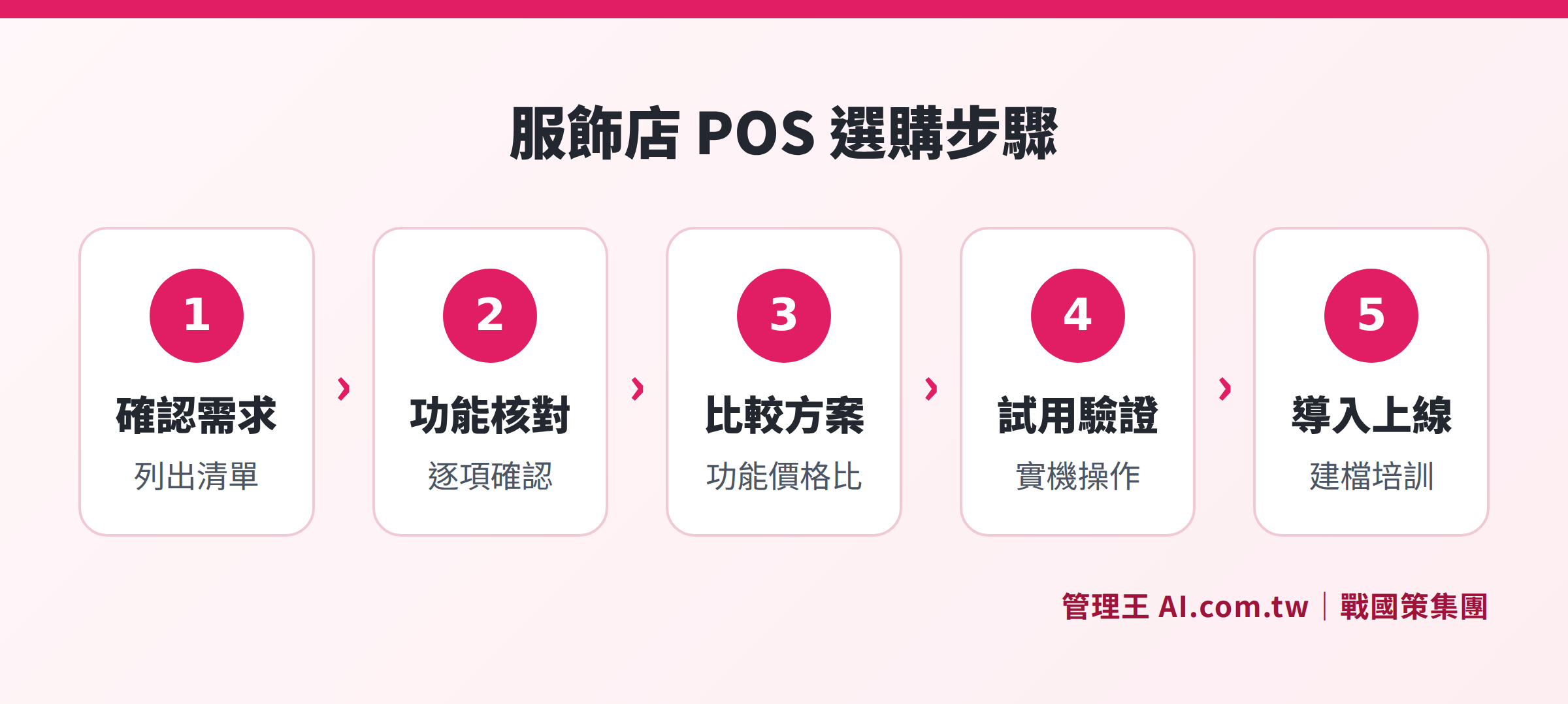
The 5-step purchasing process from confirming business needs to going live
Multi-SKU Inventory Management: The Most Challenging Issue for Clothing Stores
SKU management in the clothing industry is one of the most complex among all sectors. A single T-shirt may have 5 colors and 4 sizes, leading to 20 distinct SKUs; a medium-sized clothing store may have thousands of SKUs.
Common inventory management pain points:
- Clerks manually check size availability, resulting in slow response times and increased error rates
- Inventory between stores is not linked, so if Store A sells out, Store B may still have stock, but it's unknown
- End-of-season inventory counts are time-consuming, leading to significant discrepancies with book figures
- E-commerce and physical store inventories are managed separately, leading to overselling of the same SKU
A truly suitable POS system for clothing stores should achieve "one system to manage all channel inventory," allowing e-commerce orders, in-store sales, and returns/exchanges to reflect the same numbers in real-time, enabling owners to check SKU availability via a mobile device even when they are not in the store.
Essential questions to ask about inventory functions when selecting a POS:
- How many layers of product attributes (color/size) can be set?
- Is inventory updated in real-time or is there a delay?
- Can multi-store inventories check and transfer stock?
- Can e-commerce orders share the same inventory pool?
Electronic Invoicing and Mobile Payments: Regulations and Consumer Habits in Taiwan
When opening a physical store in Taiwan, electronic invoicing is not just an added feature, but a legal requirement. According to the Ministry of Finance’s regulations, retailers must use electronic invoicing systems that comply with standards, upload invoice data through an electronic invoicing integration service platform (MIG), and provide consumers with access methods (mobile barcodes, national ID card, EasyCard, etc.) to retrieve electronic invoices.
Points to confirm about electronic invoicing integration:
- Does the POS integrate with government-approved electronic invoicing value centers (e.g., ezPay, Neweb)?
- Does it support consumer-provided access methods (mobile barcodes, member access codes)?
- Are prize notifications automatically sent by the system?
- Is the process for voiding, discounting, and reissuing smooth?
In terms of mobile payments, Taiwanese consumer habits primarily involve LINE Pay, Jkopay, and credit card tap payments (Apple Pay/Google Pay). When selecting a POS, confirm whether these payment methods are "natively integrated" (the system directly displays the confirmed amount) or "manually confirmed" (clerks need to open another app to verify), as the latter is prone to errors during peak times.
5 Key Questions for Selecting Retail POS
Clothing and specialty stores of different sizes and formats have different priority needs for their POS systems. Use the following 5 questions to confirm your requirements and then evaluate the solutions accordingly:
Table: 5 Key Questions and Corresponding Points for Selecting POS for Clothing/Specialty Stores
| Question | Importance | Corresponding Evaluation Focus |
|---|---|---|
| --- | --- | --- |
| Do you have more than 500 SKUs? | ★★★★★ | System SKU limit and search speed |
| Do you have multiple stores or a plan to open more? | ★★★★★ | Multi-store inventory transfer and headquarters reporting |
| Do you sell online? | ★★★★☆ | E-commerce order integration and inventory sharing |
| Do you have more than 1,000 members? | ★★★★☆ | Member management and marketing automation capabilities |
| Do you need customized features? | ★★★☆☆ | Does the vendor provide APIs or custom development? |
Selection pitfalls to be aware of:
- Watch for "hidden fees after the trial period" clauses
- Confirm whether binding specific hardware is mandatory (some vendors require purchasing specific POS hardware)
- Is customer support from a local Taiwanese team or overseas? Can issues be resolved quickly during peak seasons?
- Does the contract allow discontinuation at any time, and can data be fully exported?
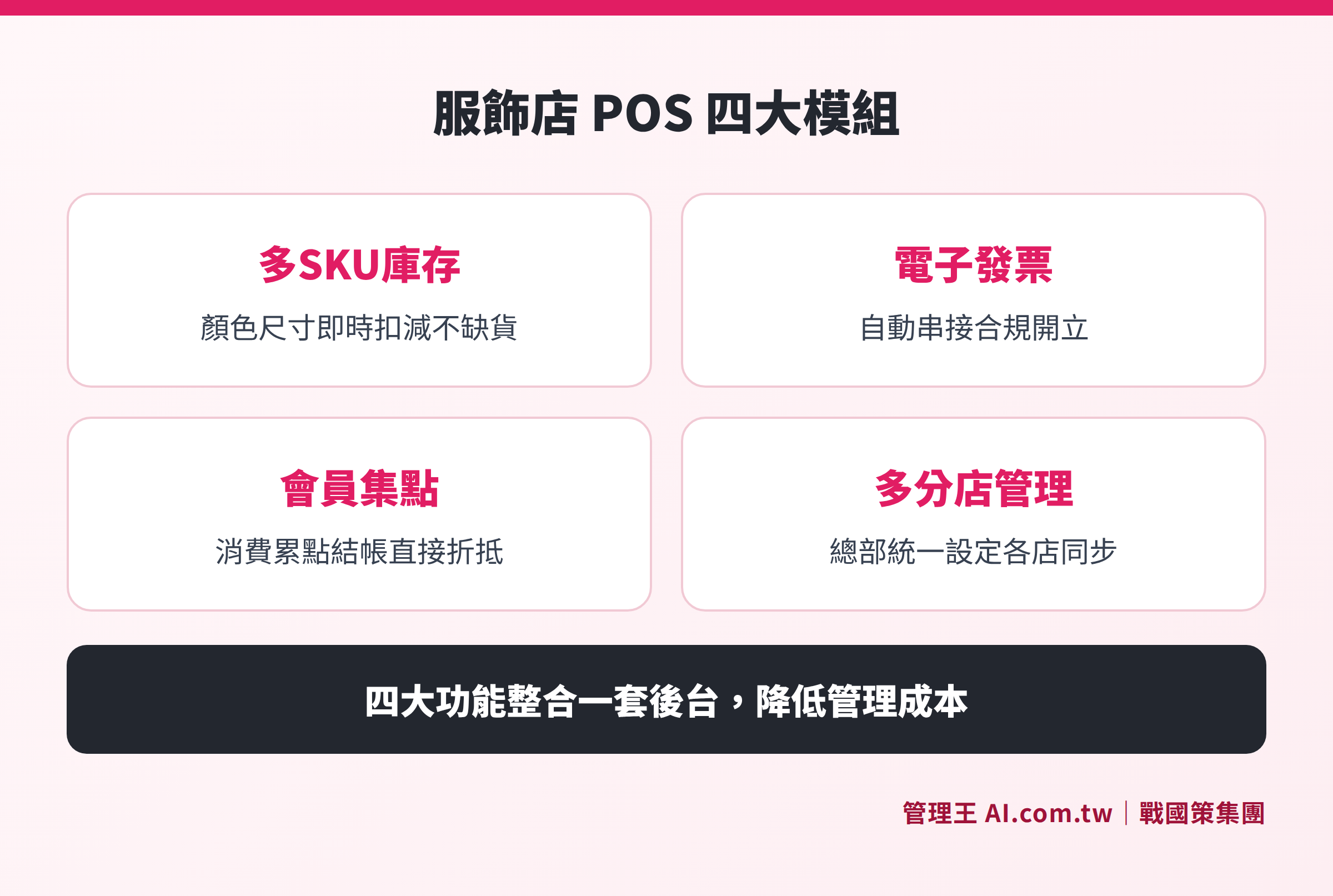
Explanation of four key modules: Multi-SKU inventory, electronic invoicing, member point accumulation, and multi-store management
Multi-Store and Online-Offline Integration: Advanced Needs for Specialty Brands
With the flourishing development of specialty brands in Taiwan, more businesses have multiple physical stores while also accepting orders through their own websites and social media, and even selling on platforms like Shopee, MOMO, or 91APP. This omnichannel sales model places higher demands on POS systems:
Core functionalities for multi-store management:
- Headquarters can uniformly set product data and pricing, automatically syncing to all stores
- Real-time inventory can be checked from each store, supporting transfer requests and confirmation processes
- Store performance and employee performance can be uniformly compared at headquarters
Online-offline inventory integration (O2O):
This is the most frequently reported issue by many specialty store owners—managing inventories separately between e-commerce platforms and physical stores often results in overselling when "the item was sold online but the system hasn’t updated yet" or "the store has stock but the website shows out of stock," leading to missed sales.
True online-offline inventory integration means that whether items are scanned at the store for checkout, orders are received at the official website, or customer service checks for customers, all draw from the same inventory pool, and updates are in real-time.
Cross-store return and exchange handling:
The return and exchange rates in the clothing industry are higher than in other sectors, with customers potentially wanting to return items purchased at Store A to Store B. The POS system needs to support cross-store purchase record inquiries and permit Store B to complete return and exchange processes without requiring customers to return to Store A.
How to Use 管理王
管理王 AI.com.tw POS cash register system is an integrated solution of "software POS + cloud backend" that allows clothing and specialty store owners to go online without needing to purchase expensive dedicated POS terminals—just a tablet, a Bluetooth printer, and a scanner are enough.
Core functions tailored for clothing and specialty stores:
Checkout and Payment: Supports quick checkout with barcode scanning, mixed payments (splitting between cash, card, and mobile payments), integrating with EDC card machines from Neweb, Fubon, and Yuanta, as well as contactless payments like EasyCard and iCash. Electronic invoices are automatically issued through Neweb and other electronic invoicing value centers without manual data entry, adhering to Taiwan's tax regulations.
Real-time inventory management: Each sale deducts inventory in real-time and updates in the cloud, with a complete return and exchange process, enabling owners to monitor the real-time stock and sales of each SKU even when they are not inside the store, thus avoiding stockouts or overstocking of popular items.
Member point accumulation integration: Points are accumulated in real-time during purchases and can be directly used for checkout; integrates with the coupon center for discount codes and referral rewards redemption at the POS.
Multi-store management: Chain brands can uniformly set products and pricing from headquarters, which automatically syncs to all stores; transaction data from each store is compiled in real-time at headquarters, with financial reports generated automatically by the accounting module.
Integrated backend: POS is one of the 100+ functions of 管理王, and using the same account enables seamless interaction with CRM customer management, inventory management, without needing additional API integration, allowing customer consumption data to naturally flow.
A free plan is available for permanent use; small clothing stores can start with the free version and upgrade after confirming the process meets their needs. For more information, refer to the complete guide for selecting a POS system, or check the hardware equipment list for POS systems to identify necessary hardware.
Plan costs: The free plan is permanently available; paid plans start at NT$5,000/month, for complete pricing refer to the 管理王 service plan.
Implement Clothing Store POS with Consultant Assistance
The 管理王 consulting team assists in planning POS cash register solutions for clothing stores, from requirement interviews to system launch, with free consultations.
Free Consultation Hotline: 0800-003-191
LINE Official Account: @119m
Official Website: app.AI.com.tw
Free Trial: Apply for 管理王 now
Frequently Asked Questions
Does a clothing store POS system really need multi-SKU management?
Yes. Clothing products inherently have multiple specifications, such as color and size. If the POS system cannot manage multi-attribute SKUs, inventory must be maintained manually, leading to stockout or overselling issues. Always confirm how many layers of attributes the system supports, whether the SKU limit is sufficient, and whether attribute changes are convenient before selecting.
Is a traditional cash register with an electronic invoicing machine sufficient? Why upgrade to POS?
A traditional cash register combined with an electronic invoicing machine can meet the basic needs for invoicing but cannot provide real-time inventory management, member point accumulation, sales report analysis, or multi-store integration. If your pain points include "not knowing the inventory of all SKUs," "being unable to track which products sell best," or “taking several days for seasonal inventory counts,” upgrading to a cloud POS system will yield significant improvements. You can refer to this article on 5 signals for upgrading from a traditional cash register to a POS.
How does the POS system synchronize when opening a new store?
The advantage of a cloud POS system is that all stores share the same backend. Product data, pricing, and member information can be set once at headquarters; when opening a new store, only a new store account needs to be created, and the data will synchronize automatically. Sales records from each store are also compiled in real-time, allowing headquarters to see performance without waiting for daily closing.
Can a customer return clothes purchased at Store A to Store B?
This depends on whether the POS system supports cross-store order inquiries and return exchanges. A good retail POS system allows any store to check the customer’s comprehensive purchase history across all channels and enables Store B to complete the return exchange process for an order placed at Store A, eliminating the need for the customer to return with a paper invoice, significantly enhancing the customer experience.
Is 管理王 POS suitable for small clothing stores?
Yes. 管理王’s free plan can be used permanently without forced binding of dedicated hardware (a tablet is sufficient), and no technical background is required. The system interface is fully in Traditional Chinese, and customer service is provided by a Taiwanese team through an 0800 hotline Monday to Friday from 9:00 AM to 6:00 PM. Small clothing stores can evaluate and expand as needed.
Sources
- Ministry of Finance Northern District National Tax Bureau Electronic Invoice Section
- Ministry of Finance Electronic Invoicing Implementation Guidelines (National Regulations Database)
- 管理王 AI.com.tw POS Cash Register System Features Page
- 管理王 AI.com.tw Service Plans and Pricing
This article is for general information only and does not constitute legal or tax advice; actual regulations are based on the latest announcements from the competent authority.