What are the Differences Between RPA and AI Agent? How to Choose Process Automation|AI Agent Recommendations
Both RPA and AI Agents can automate work, but they are fundamentally different: RPA is a rule-driven script robot, while AI Agents are goal-oriented smart agents. This article explains the differences between the two, selection criteria, and best practices for using them together.
RPA (Robotic Process Automation) and AI Agent (AI Smart Agents) both enable businesses to "automate work execution," but there are essential differences: RPA executes fixed processes step by step according to predefined rules; AI Agents can understand vague goals, judge steps independently, and adapt in changing environments. Simply put, RPA is a "fixed-step robotic arm," while AI Agents are "thinking digital employees." When businesses face the choice of "should we switch to RPA or go straight to AI Agents?" the answer depends on the predictability of the processes and the degree of data structure. This article summarizes the core differences and selection criteria, and explains how to implement them in Taiwan's small and medium enterprises.
What is RPA?
RPA (Robotic Process Automation) is a technology that uses software robots to mimic human actions on computers. Software robots operate around the clock by simulating keyboard inputs, mouse clicks, and screen captures to copy, paste, fill out, and submit data across applications.
According to Gartner's definition, RPA tools "execute if-then-else conditional judgments on structured data, driving clients' servers, mainframes, or HTML web pages via UI interactions or API connections." In simpler terms, it records repetitive click processes performed manually with code and plays it back automatically.
Tasks that RPA excels at:
- Copying order data from ERP to another system
- Regularly fetching reports, consolidating them into Excel, and sending them out
- Handling invoice verification: reading PDF amounts, verifying purchase orders, and automatically passing them to accounting
- Reading return and exchange requests from customer service inboxes and automatically filling them into the work order system
RPA's strength lies in its high precision, speed, and tirelessness. As long as the process remains unchanged, robots can execute tens of thousands of times with zero errors. However, once upstream systems are restructured or field positions change, the robot can become "stuck" and requires manual reconfiguration.
RPA has two operational modes: Attended mode requires employee initiation, suitable for real-time assistance at service desks; Unattended mode can automatically schedule tasks in the background without the need for human intervention, ideal for batch order processing at night or regular financial report consolidations. Businesses can mix the two modes based on their operational nature to maximize automation benefits.
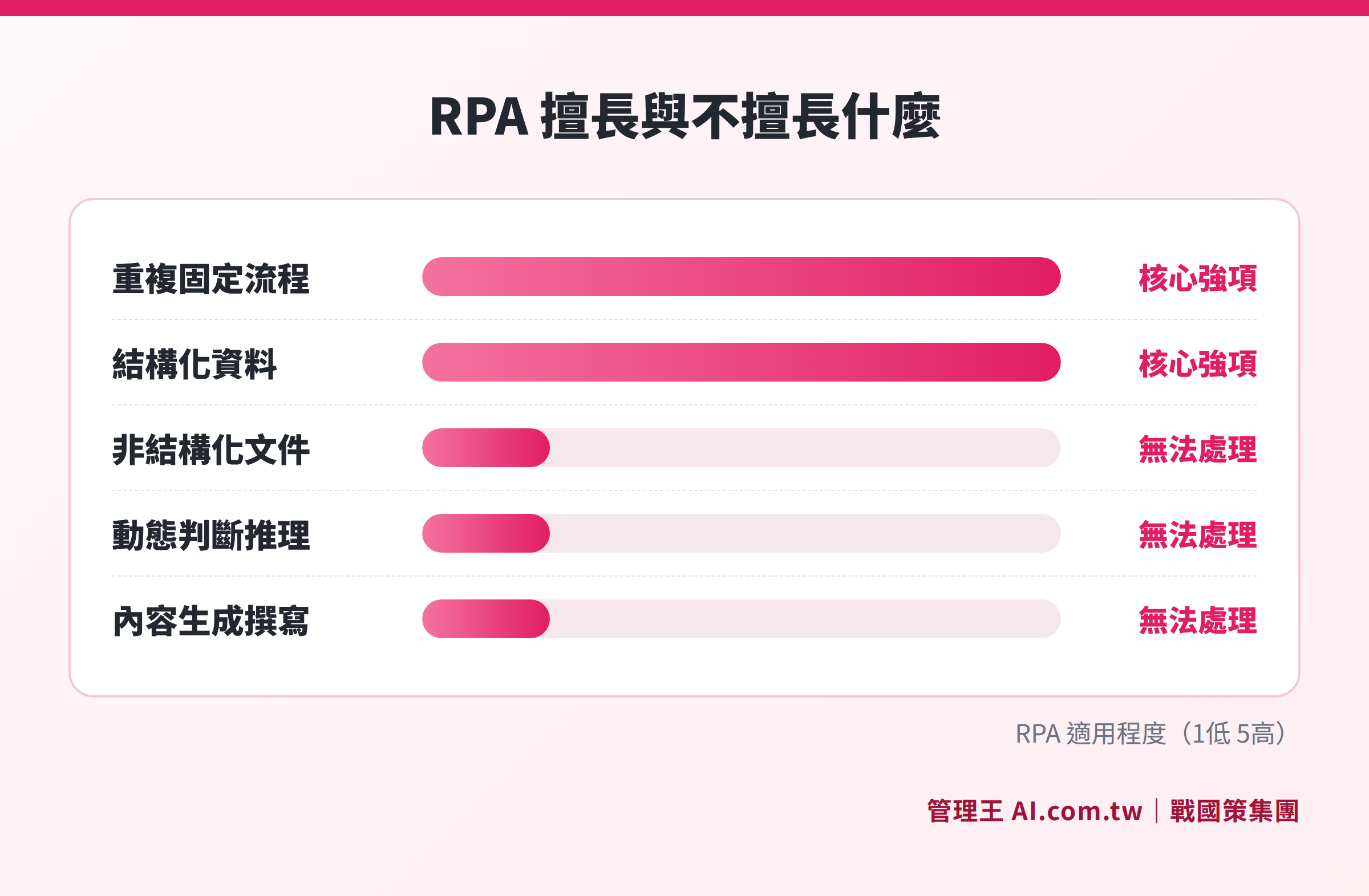
RPA is rule-driven, structured data; AI Agent is goal-oriented, unstructured data
What is AI Agent?
AI Agent is a software system based on a large language model (LLM) that can receive natural language goals, plan multi-step processes independently, call external tools (search, API, database), and adjust subsequent actions based on execution results.
The most significant difference from RPA is: AI Agents do not need each step to be pre-written; they can understand instructions like "Help me organize a list of unreplied customers this week, then write a personalized follow-up email for each." They can break down tasks, query the CRM, generate text, and send emails by themselves.
Tasks that AI Agents excel at:
- Reading unstructured documents (contracts, emails, meeting minutes) and summarizing key points
- Dynamic selection of response strategies based on customer conversation context
- Cross-system information gathering, consolidating into decision proposal reports
- Automatically adjusting handling methods when new situations arise (e.g., changes in complaint phrasing)
The advantage of AI Agents is their ability to handle ambiguous situations, while the downside is the higher computing costs, slower response times compared to RPA, and occasional hallucinations in complex reasoning, requiring human confirmation for critical decisions.
The core feature of AI Agents is their "Tool Calling" capability: they can decide which tools to use in the reasoning process, what data to check first, and what actions to take next, creating a cycle of "perception → thinking → action → re-perception." This enables AI Agents to complete cross-system composite tasks that RPA cannot manage, rather than just answering questions.
In a nutshell
RPA = scripted robot (fast, precise, fears changes); AI Agent = thinking assistant (highly flexible, able to judge, requires human review)
Comparison of Core Differences Between RPA and AI Agent
Table: Overview of Core Differences Between RPA and AI Agent
| Comparison Dimension | RPA | AI Agent |
|---|---|---|
| Decision Method | Predefined rules (if-then-else) | Language model reasoning, self-judgment |
| Data Format | Structured (forms, fields, fixed PDFs) | Structured + unstructured (emails, images, natural language) |
| Adaptability | Fails when the environment changes, needs reconfiguration | Automatically adjusts, can handle ambiguous inputs |
| Integration Method | Prioritizes UI operations (simulates mouse and keyboard) | Prioritizes API calls, also supports computer vision |
| Execution Speed | Extremely fast (millisecond level) | Slower (LLM reasoning takes seconds) |
| Learning Capability | Cannot learn automatically, requires manual updates | Can iteratively improve from feedback |
| Suitable Task Scale | Single, repetitive isolated tasks | Cross-system, end-to-end composite processes |
| Implementation Cost | Low to medium (depending on process complexity) | Medium to high (requires LLM integration) |
| Error Risk | Massive errors when programming is wrongly configured | Occasional reasoning deviations, human review required |
When to Choose RPA?
RPA is best suited for the following scenarios and should be prioritized:
1. Highly repetitive, fixed processes
Operations repeated in the same order every day, such as exporting sales reports from ERP every Friday, comparing inventory, and sending them to the boss. Once tasks are regularized, RPA can run thousands of times without error.
2. Consistent data formats
Inputs that consist of fixed-field forms, uniform-format PDFs, or known structured databases that do not require "understanding the content" but merely "moving the data."
3. Integration with legacy systems
Many small and medium enterprises in Taiwan still use outdated ERP or inventory systems over ten years old, without APIs for integration. RPA can integrate through UI simulation without modifying legacy systems.
4. High compliance tracking requirements
In cases like financial reconciliation and tax reporting that require complete execution records, RPA logs every step, making audits convenient.
5. Limited budget
RPA licensing fees and maintenance costs are relatively predictable, suitable for businesses that do not want to invest heavily in AI development budgets.
When to Choose AI Agent?
AI Agents are notably advantageous in the following scenarios:
1. Inputs are not fixed and contain unstructured content
Customer emails, LINE messages, contract documents, meeting transcripts—RPA cannot understand these. AI Agents can read, summarize, and judge the next steps.
2. Processes will vary depending on circumstances
For example, customer inquiries can vary widely, and each time, responses need to be determined according to conversation content—this requires judgment, not rigid scripts.
3. Content generation is required
Writing development emails, summarizing reports, suggesting purchase amounts—all these require language capabilities, which RPA cannot fulfill.
4. Need to connect multiple systems with multiple steps
AI Agents can autonomously perform tasks in one go, such as reading emails → checking CRM → creating tasks → sending confirmation emails.
5. Desire for increasing intelligence over time
AI Agents can learn from employees' corrections, improving their accuracy when encountering similar situations next time.
6. Multilingual or cross-linguistic needs
AI Agents possess inherent multilingual understanding capabilities, able to read English contracts and summarize key points in Traditional Chinese or respond to foreign customers in English. RPA cannot understand semantics, and thus cannot handle cross-language work, which is another dimension where the two differ significantly.
How to Integrate RPA and AI Agent?
Many mature automation architectures choose a combination where "RPA handles the execution layer, and AI Agent manages the decision layer":
Table: Example of RPA + AI Agent Integration Roles
| Business Scenario | Responsible for AI Agent | Responsible for RPA |
|---|---|---|
| Order Processing | Reading customer emails, determining order type, extracting key data | Entering data into ERP, sending confirmation documents |
| Customer Service Routing | Understanding customer issues, assessing emotions, determining routing | Automatically creating work orders, assigning responsible persons |
| Financial Reconciliation | Reading non-standard formatted invoices, matching descriptive texts | Entering amount data into accounting systems |
| HR Recruitment | Reading resumes, filtering qualified candidates, writing initial replies | Entering hiring data into HR systems, sending notification emails |
This mixed structure allows for leveraging both advantages: AI Agents handle parts that require "thinking," while RPA manages parts that need "precise execution," resulting in overall efficiency far surpassing the use of either tool independently. For enterprises with existing RPA infrastructure, there is no need for a complete overhaul; they can first supplement the judgment segment with AI Agents, gradually upgrading their automation capabilities.
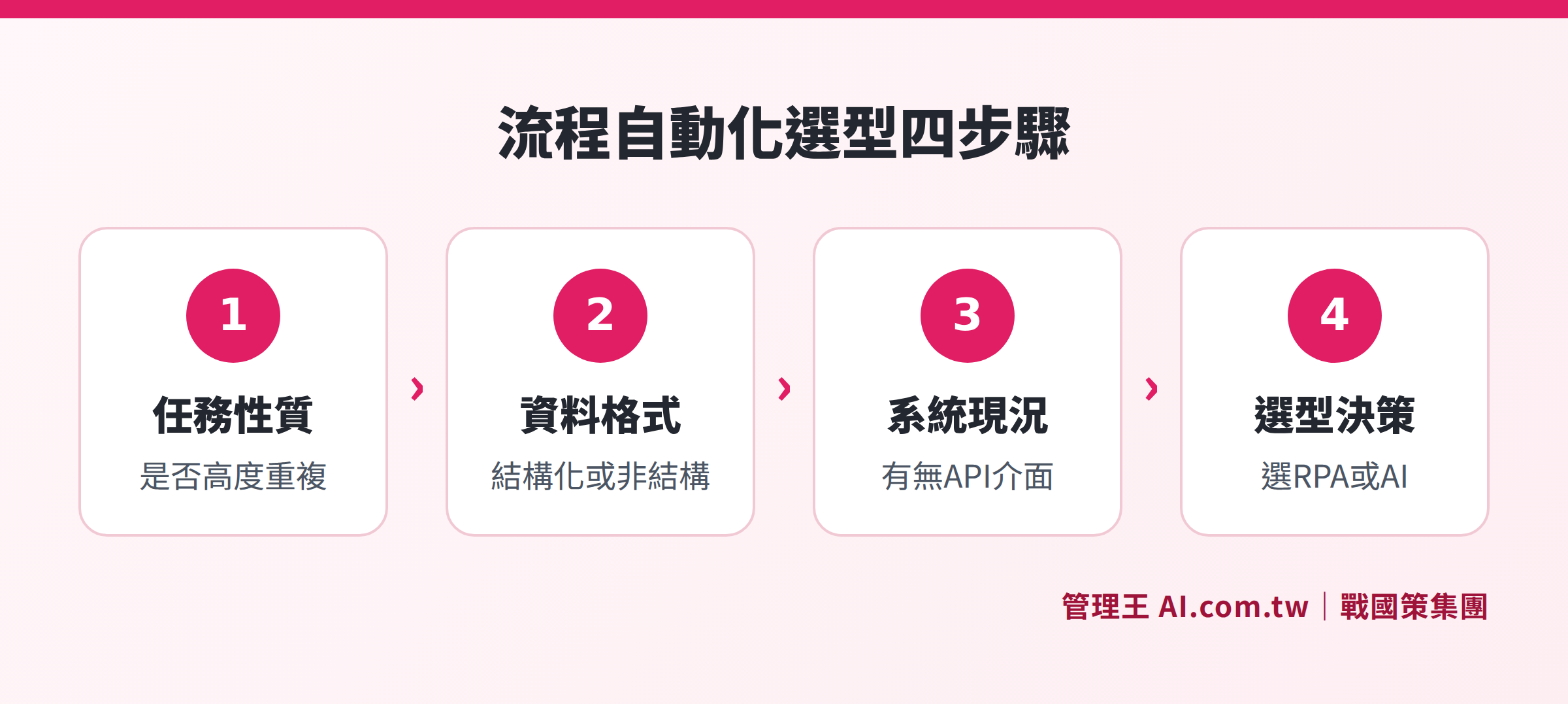
Choose the most suitable automation solution based on task type, data format, system status, and budget
How to Use 管理王 AI Employee
If you are evaluating how to implement AI automation for your business, 管理王 AI.com.tw's AI Employee offers plug-and-play AI Agent capabilities without needing to build your own LLM or integrate APIs.
Practical operations of 管理王 AI Employee:
Document and communication automation: Select a customer in the CRM or task module and directly call "AI help me write a development email." After reading the customer background, the AI Employee generates a personalized email draft in 10 seconds, and the sales team can send it with a single click after reviewing. This process combines the content generation ability of AI Agents with the structured integration of 的 CRM data.
Knowledge base Q&A: Upload ISO files, SOPs, and FAQs to the AI Knowledge Base, and employees can directly ask in LINE or the system, "How do I handle Y equipment failure?" The AI Employee checks internal documents and replies within seconds, saving time spent on confirming with supervisors.
Cross-module automated tasks: The AI Employee does more than chat; it can perform actions—query CRM customers, create tasks, schedule meetings, all directly within the system, creating a complete process for marketing automation and AI customer service.
Approval and auditing automation: Combined with the Approval Center, the AI Employee can pre-review documents, highlight anomalies, so that supervisors only need to confirm key decisions, significantly reducing approval waiting times.
管理王's AI Employee integrates natively with over 70 modules, allowing data to seamlessly intercommunicate between CRM, tasks, accounting, and HR without additional integration fees or API connections. The free plan can be used permanently and includes a one-time trial of all features for AI points, suitable for small and medium enterprises that want to evaluate the benefits before deciding whether to invest.
To explore the complete application scenarios of AI Agents in Taiwan's small and medium enterprises, you can refer to What is an AI Agent? 5 Scenarios for Using AI as Employees and Cost Comparison Between AI Employees and Administrative Assistants. If you are evaluating tools like n8n, Copilot, Gemini, you can also refer to AI Agent Tool Recommendations Comparison.
For complete plans and pricing, please visit our official website, or contact our consulting team for a free evaluation. 戰國策 Group has served over 30,000 businesses, and our consultants are familiar with the practices of small and medium enterprises in Taiwan, helping you assess the implementation methods for RPA and AI Agents.
Choose RPA or AI Agent? Free Consultation
Consultants assist you in analyzing business processes to confirm whether RPA or AI Agent is more suitable for your needs, and offer free trials of 管理王 AI Employee functionality.
Free consultation hotline: 0800-003-191
LINE official account: @119m
Official website: app.ai.com.tw
Free trial: Apply for 管理王 now
Frequently Asked Questions
Can RPA and AI Agents be used together?
Yes, and it is recommended to use them together. A common division of labor is: AI Agents handle "understanding" and "judgment," such as reading unstructured emails and deciding the next steps; RPA handles "execution," such as filling organized data into systems and submitting forms. The two complement each other, covering more business processes.
Is the barrier to entry for small and medium enterprises to adopt AI Agents high?
It depends on the tool choice. Building LLMs or integrating OpenAI's APIs does indeed require technical capability, but using integrated platforms like 管理王 AI Employee only requires setting the work scenarios without programming, making it possible to start using it within a day.
What are the most common reasons for RPA failures?
The most common reason is "upstream system changes": whenever field positions change or new fields are added to forms, the previously recorded RPA scripts will execute incorrectly. Another common reason is "unexpected input formats," such as receiving a differently formatted report, which RPA cannot recognize. This is precisely the advantage of AI Agents—they do not rely on fixed positions and can read and understand content.
What types of companies in Taiwan are suitable for using RPA?
Common RPA application scenarios for Taiwanese companies include compiling production reports and batch submissions in manufacturing; performing reconciliation in financial industries, and synchronizing inventory or order forwarding in retail. If these processes contain a lot of unstructured data (such as customer emails or contracts), consider pairing them with AI Agents.
What should be done if AI Agents provide incorrect answers?
AI Agents' outputs should be viewed as "drafts" or "suggestions," and important decisions (payments, approvals, hiring) must be executed only after human review. 管理王 AI Employees are designed with this principle in mind: the AI completes the draft, and employees confirm before submission. If the AI makes an error, employees can correct it and easily add to the knowledge base to prevent the same mistake from recurring.
Data Sources
- Gartner IT Glossary - Robotic Process Automation (Gartner, industry standard definition)
- UiPath - What is RPA? (UiPath official, RPA definition and applications)
- Automation Anywhere - What is RPA? (Automation Anywhere official)
- Blue Prism - Autonomous AI Agents Guide (Blue Prism official, AI Agent definition)
- TechTarget - AI Agents vs. RPA: Key Differences and Overlap (TechTarget, technical analysis)
- Features page for 管理王 AI Employee (管理王 official, product feature description)