Self-hosted Website or E-commerce Platform? A Comprehensive Comparison of Cost, Flexibility, and SEO|Recommended Online Store Platforms
作者:戰國策集團

Choosing between a self-hosted website or an e-commerce platform? The key is not which is better, but your technical abilities and budget. Self-hosting offers maximum flexibility but has a high technical threshold; Taiwan's mainstream e-commerce platforms allow for rapid launch and logistics integration with vendor support, but monthly fees are a long-term expense. This article compares costs, SEO, and flexibility one by one.
A self-hosted website (WordPress + WooCommerce) and an e-commerce platform (WACA, Shopline, 管理王) each have applicable scenarios, with no absolute superiority. A self-hosted website gives you complete control over code, URL structure, and page design, without needing to pay monthly fees; however, you must manage server security, plugin updates, and technical issues yourself, leading to significant long-term maintenance costs. E-commerce platforms relieve you from technical maintenance, allowing for quick setup, with logistics integration supported by vendors; however, monthly fees are ongoing expenses, and some platforms charge transaction commissions, causing costs to rise quickly at higher sales volumes. The real question is not "which one is better," but "what are your technical abilities, budget structure, and business goals for the next three years?" This article compares five aspects: cost, flexibility, SEO, technical threshold, and logistics integration in Taiwan, helping you find the answer that best suits you.
What are Self-hosted Websites and E-commerce Platforms? Understanding the Basic Concepts
A self-hosted website refers to renting your own virtual server, installing WordPress and WooCommerce (or Magento, PrestaShop, etc.), and having complete control over the entire e-commerce website at the code level. Technically, you bear the server costs, and you must handle all security updates, plugin conflicts, and performance optimizations yourself or hire engineers.
An e-commerce platform (also known as a SaaS e-commerce platform) is a subscription-based service where the vendor is responsible for server maintenance, system security, and functional updates; you only need to set up products, logistics, and marketing tools in the backend. Taiwan's mainstream e-commerce platforms include WACA, Shopline, Cyberbiz, and integrated enterprise systems like 管理王 AI.com.tw that bundle store modules.
There's also a third model called open platforms (such as Shopee and momo mall), where you list products utilizing the existing platform traffic, with commission rates typically ranging from 5% to 15%. This is suitable for testing the waters or clearing inventory, but it is challenging to establish a brand image, so this article will not focus on it.
Understanding in One Sentence
The true cost of a self-hosted website is the "time and expense of technical maintenance," while the true cost of an e-commerce platform is the "monthly fees plus the long-term cumulative transaction commissions." The total ownership costs over three years between the two options are not significantly different; the decision hinges on whether you have technical resources.
Comprehensive Cost Comparison: Initial Fees, Monthly Fees, and Hidden Expenses
Many believe that self-hosting is cheaper, but actual calculations need to include: server fees, domain fees, theme costs, plugin costs, and the often-overlooked "technical maintenance costs." E-commerce platforms have monthly fees (or annual fees) and transaction commissions for some platforms.
Table: A Three-Year Ownership Cost Comparison between Self-hosted Websites and E-commerce Platforms (Estimated for Taiwan Market)
| Cost Item | Self-hosted (WordPress + WooCommerce) | E-commerce Platform (using WACA Business Growth Plan as an example) |
|---|---|---|
| Server Fees | NT$2,400 to 7,200/year (shared hosting) or higher | Included in monthly fee |
| Domain | NT$500 to 1,000/year | Usually needs to be purchased or provided by the platform |
| Theme | NT$0 (free theme) to NT$5,000 (paid theme, one-time) | Included in the plan |
| Transaction Commission | None (payment processing fees are charged by the payment providers) | WACA does not charge a commission for the entire plan; Shopline charges a commission of 1.5% to 2% |
| Platform Monthly Fee | None | WACA Business Growth Plan NT$3,099/month (annual payment NT$37,188) |
| Technical Maintenance | Self-managed or outsourced (cost varies by person) | Managed by the vendor, no extra cost |
| Three-Year Subtotal (Estimated) | Starting at NT$30,000 (higher with technical maintenance) | Starting at NT$111,564 (WACA Business Growth Plan for three years) |
Payment processing fees are incurred in both models, charged by third-party processors like BluePay and Green World, and are unrelated to the choice of e-commerce platform. Credit card processing fees typically range from 2% to 3.5% of the transaction amount, based on the latest announcements from various payment service providers.
An overview of the costs for Taiwan's mainstream e-commerce platform plans (as of November 2026, based on each official website's latest announcements):
Table: Overview of Costs for Taiwan's Mainstream E-commerce Platform Plans
| Platform | Free Plan | Entry Paid Monthly Fee | Transaction Commission | Suitable for |
|---|---|---|---|---|
| WACA | Yes (30 products) | NT$3,099 (Business Growth Plan, annual payment) | No commission for any plan | Small to medium-sized e-commerce businesses emphasizing cost transparency |
| Shopline | No (14-day trial) | Annual fee system, see official website for details | 1.5% to 2% GMV | Medium to large brands needing OMO functions |
| 管理王 AI.com.tw | Yes (permanently free) | NT$5,000/month (economic plan) | No commission | Small and medium enterprises needing integrations with CRM, accounting, and HR |
WACA cost information source: waca.net official website (as of November 2026). Shopline cost information is based on the latest announcements from the Shopline official website.
Annual fee structure comparison among WACA Business Growth Plan, Shopline, and self-hosted WordPress
Flexibility and Customization: Is Self-hosting Really More Free?
The biggest advantage of a self-hosted website lies in its unlimited functionality: you can modify any code, install any plugins, and adjust any page logic without being constrained by platform regulations. This is particularly valuable in the following situations:
- Having a special checkout process (e.g., B2B multi-tier pricing, subscription product cycle settings)
- Needing highly customized product page designs
- Having a skilled engineering team that can develop, maintain, and optimize independently
But freedom comes at a price. After every WordPress core update or plugin update, conflicts may arise, leading to shopping cart failures or broken pages. Protection against attacks (SQL Injection, brute-force attempts on the WordPress backend) also needs to be set up by yourself, and these are hidden costs.
Flexibility on e-commerce platforms is relatively limited; however, modern platforms offer sufficient customization space:
- Both WACA and Shopline provide drag-and-drop page editors to adjust layouts, colors, and fonts
- Most platforms support embedding custom explanation blocks on product pages
- Advanced needs can be met through platform APIs or custom development services
For most customization needs of small to medium-sized e-commerce businesses in Taiwan, modern e-commerce platforms can meet over 80% of requirements. Unless you have very special business logic, "flexibility" is usually not a decisive reason for self-hosting.
SEO Comparison: Does Self-hosted Website Still Have Advantages?
Five years ago, self-hosted websites indeed had a significant edge in SEO over e-commerce platforms due to: complete control over the URL structure, the ability to create blog content freely, and server-level caching configuration. However, by 2025, the SEO capabilities of mainstream e-commerce platforms have greatly improved:
- Custom URLs: WACA and Shopline both allow customization of product and category page URLs
- Meta tags: All mainstream platforms support custom Title, Description, and OG tags
- Structured data: Modern e-commerce platforms automatically output product Schema.org structured data (including product name, price, stock, and reviews)
- Speed: Platform vendors generally optimize server speed more effectively than individuals managing self-hosted setups, providing a more stable mobile experience
- Content marketing: Most platforms offer built-in blog features to continuously accumulate SEO content
The current practical advantages of self-hosted websites in SEO mainly remain in two areas:
- More complete control over internal links: Allows for the establishment of complex category and filter page structures
- Fully customizable XML Sitemap: More beneficial for large e-commerce sites with over 10,000 SKUs
For small to medium-sized e-commerce businesses in Taiwan with SKUs in the hundreds, the SEO functions of modern e-commerce platforms are sufficient. The key to SEO performance lies in the quality of content and external links, rather than the choice of platform.

Five questions to help you decide between self-hosting and using an e-commerce platform
Technical Threshold and Maintenance Costs
This is the aspect in which the two models differ the most.
Technical requirements for a self-hosted website:
- Purchasing and configuring web hosting (server environment settings)
- Installing WordPress, WooCommerce, and necessary plugins
- Applying for and updating SSL certificates (Let’s Encrypt is free but needs regular updates)
- Security settings against hackers (limiting backend login attempts, WAF firewall)
- Regular database and file backups (automated daily backups)
- Plugin version management and compatibility testing
- PHP version upgrades (when required by the hosting provider)
Any issues in these areas can lead to temporary inaccessibility of pages, loss of customer order data, or malicious code being attached to the site, affecting Google search rankings. If you do not have a full-time engineer, these tasks usually need to be outsourced, with costs varying by vendor.
Technical maintenance of an e-commerce platform:
- The vendor is responsible for server maintenance, security updates, and performance optimization
- Logistics integration has official documentation and customer support
- For system issues, directly contact platform customer service
- No programming background is required; drag-and-drop configuration
For business owners or small e-commerce teams without a technical background, the "technical maintenance effort" saved by using an e-commerce platform is a significant hidden saving in itself.
Particular Concerns of Taiwanese Sellers: Logistics Integration
The e-commerce ecosystem in Taiwan has several local characteristics that significantly impact logistics integration:
- Taiwanese consumers are accustomed to picking up goods from convenience stores (7-11, FamilyMart), necessitating integration with logistics services like Green World or Black Cat
- LINE Pay and Jkopay are common payment methods for older demographics; if your main customer base is over 40, integration becomes even more important
- Electronic invoicing integration (B2G invoice donation, carriers, and triplicate invoices) is a legal requirement in Taiwan and is not optional
- BluePay and Green World Technology are the most common third-party payment processors in Taiwan; it is crucial to confirm that the chosen platform natively supports these services
Logistics integration for self-hosted WordPress + WooCommerce in Taiwan:
Both BluePay and Green World offer WooCommerce plugins available for free download and installation, but require self-integration and testing; an accessible website URL must be provided for account verification. Logistics for convenience store pickup usually requires additional installation of a logistics plugin, with several settings involved.
Logistics integration for e-commerce platforms in Taiwan:
Local e-commerce platforms (WACA, Shopline, 管理王) natively integrate with mainstream logistics providers in Taiwan, with standardized activation processes and customer support available for resolving issues. For sellers unfamiliar with technical settings, this is a significant advantage, reducing the time from deciding to open a store to officially launching online.
What Situations Call for Self-hosting? What Situations Call for E-commerce Platforms?
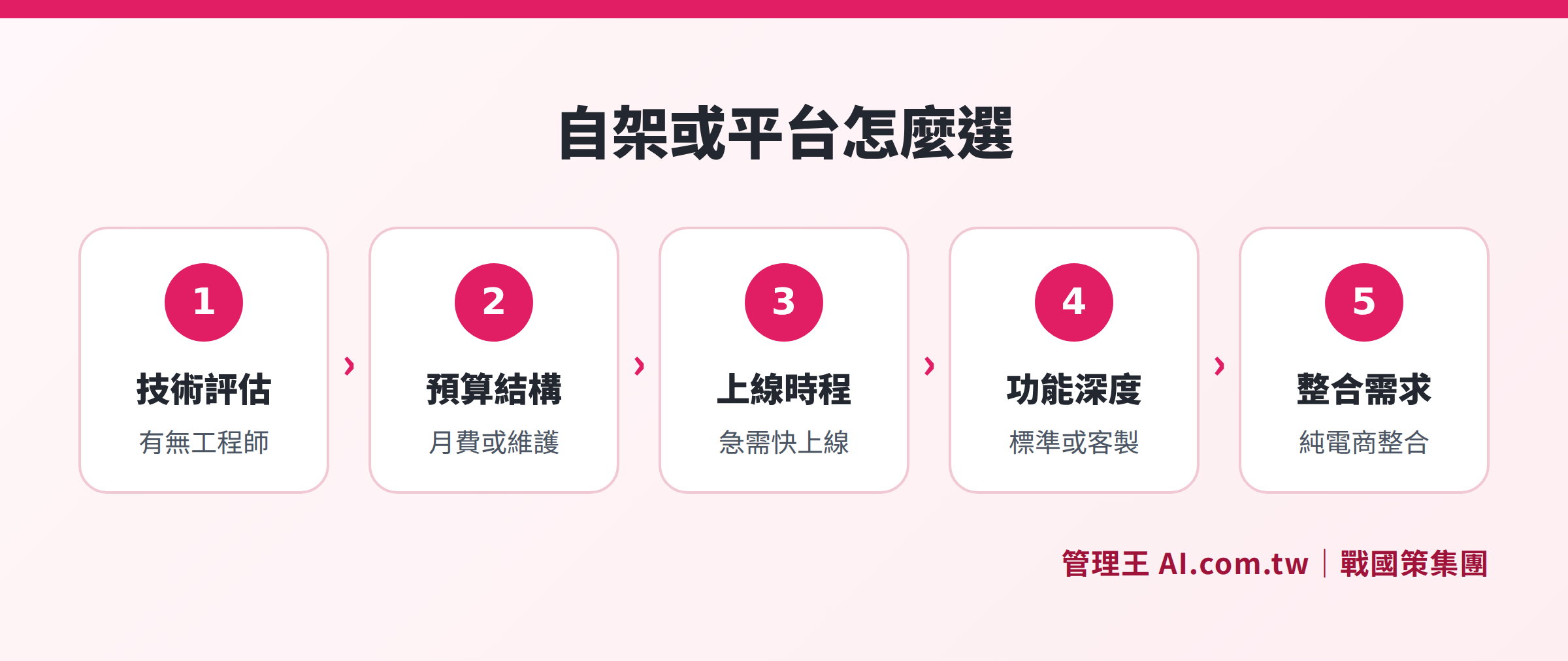
The following five questions help you quickly identify:
- Do you or your team have engineers? Yes → Self-hosting is more cost-effective; No → E-commerce platforms are safer
- What is your expected monthly order volume? If the order volume is high and you're considering platforms with commissions → a self-hosted option may have lower total costs over three years
- What features do you require? Standard e-commerce features → E-commerce platforms suffice; highly customized business logic → Self-hosting offers greater flexibility
- How quickly do you need to go online? Need to be online within 1 to 2 weeks → E-commerce platforms are faster; can wait 1 to 3 months → Self-hosting is an option
- What other systems do you need? Just need e-commerce → Any platform is fine; simultaneously need CRM, accounting, HR → Consider an integrated platform
Table: Comparison of Suitable Scenarios for Self-hosted Websites and E-commerce Platforms
| Scenario | Recommended Choice | Reason |
|---|---|---|
| Have full-time engineers, more than 10,000 SKUs | Self-hosting (WordPress) | Technical threshold resolved, high customization needs |
| No technical background, need quick setup | E-commerce platform | Saves technical maintenance effort, quickly validates the business |
| Limited budget, monthly orders less than 200 | 管理王 free plan | Permanently free, includes logistics integration |
| Need to manage customers, orders, and accounting | Integrated platform (like 管理王) | One account integrates all operations |
| Value no commission from the platform | WACA or 管理王 | Both have no commission |
| Need online and offline OMO integration | Shopline or 91APP | Designed specifically for OMO scenarios |
How to Open an Online Store with 管理王 AI.com.tw?
The online store system from 管理王 AI.com.tw is a comprehensive solution that integrates e-commerce and enterprise management, particularly suitable for small to medium-sized enterprises needing both e-commerce functions and backend management (CRM, inventory, accounting).
The operational process is as follows:
- Permanent use of the free plan: Register for free at app.ai.com.tw, no time limit for under 10 people, including basic e-commerce functions
- Product listing: Create product categories in the backend, upload images, set specifications (color, size), and stock quantities; AI automatically generates background removal and product descriptions, saving editors' time
- Logistics integration: Natively supports BluePay, Green World, Smart Payment, LINE Pay, Jkopay (payment) and Black Cat, Hsinchu Logistics, 7-11, FamilyMart convenience store pickup (logistics), with a Chinese-guided interface for settings
- Marketing tools: Built-in coupons, discount codes, free shipping for certain amounts, member loyalty points, synchronizing with IG Shopping and FB Shop
- Integrated backend: Orders automatically enter the accounting system, customer data automatically syncs to CRM, and inventory is updated in real-time inventory management
Compared to self-hosted WordPress, 管理王 eliminates the technical processes of server management, plugin maintenance, and manual logistics integration; compared to pure e-commerce platforms, it adds the capacity for integrated enterprise backend, linking online orders with overall company operations.
管理王 serves over 30,000 enterprises, with AI features (automatic product description generation, intelligent recommendations) included in the plan without the need for additional subscriptions to ChatGPT. Data is stored in Taiwan's data centers, complying with personal data protection regulations.
Interested business owners can try directly through the free plan or refer to the pricing plans to evaluate the suitable scale. Related reading on the same topic: Complete Guide to Opening an Online Store, Online Store Cost Estimation, Are Free Store Platforms Really Free?.
Want to know which store-opening method is best for you?
Consultants offer free consultations to assess your product scale, technical capabilities, and budget, providing specific store opening suggestions in 30 minutes.
Free consultation hotline: 0800-003-191
Official LINE account: @119m
Official website: app.AI.com.tw
Free trial: Apply for 管理王 now
Frequently Asked Questions
Is it troublesome to migrate from a self-hosted website to an e-commerce platform?
The degree of trouble is moderately high. Content that needs to be migrated includes: product data (usually can be exported as CSV and imported), customer accounts and historical orders (formats may not be compatible and may require manual handling), SEO settings (old URLs need to be set up with 301 redirects to avoid drops in Google rankings). It is recommended to carry out the migration during months with lower traffic and to ensure all old URLs have redirection rules set before officially activating the new platform.
Is Opening a Store with WordPress Really Cheaper?
Not necessarily. The WordPress core and the WooCommerce plugin are free, but costs need to be factored in: hosting fees (NT$2,400 to over 7,200/year), paid plugins (for payment integration, security protection, etc.), and, most importantly, the time spent on technical maintenance or outsourcing costs. If you spend over 2 to 3 hours dealing with technical issues each month or need to hire outsourced engineers, the actual costs over three years may not necessarily be lower than those of e-commerce platforms.
What Level of SEO Can E-commerce Platforms Achieve?
Modern e-commerce platforms (WACA, Shopline, 管理王) support custom URL slugs, Meta Titles, Meta Descriptions, OG tags, and structured data for products using Schema.org. This suffices for most small to medium-sized e-commerce SEO needs. Limitations mainly exist in the flexibility of URL structures for multi-level category pages and extensive Sitemap customization. If your SEO strategy focuses on product pages and blog content, an e-commerce platform is adequate.
Can I Use Both a Self-hosted Website and Open Platforms Simultaneously?
Yes, and this is a common strategy: a self-hosted official website (or SaaS platform) as a brand mall, while also opening a channel store on Shopee or momo mall, leveraging the existing platform traffic to attract new customers. The key is to ensure that the product pages of the official mall are adequately optimized for SEO so that customers can find your official website through search engines, avoiding excessive reliance on the open platform traffic and reducing the impact of potential commission increases in the future.
How Does 管理王's Online Store Function Compare to Specialized E-commerce Platforms?
The core advantage of 管理王 lies in its integration: one account manages e-commerce orders, customer CRM, inventory management, and company accounting, especially suitable for businesses where e-commerce is only one of the business models (for example, also having physical stores, sales or service businesses). If your core business is large-scale e-commerce (with over 5,000 SKUs, monthly orders exceeding 1,000, and no need for ERP integration), specialized e-commerce platforms may be stronger in the depth of e-commerce-specific functions. You can evaluate their suitability through the free plan.
Sources
- WACA plan costs and features (Waba International Information Co., Ltd., as of November 2026)
- WordPress Official Taiwan Website (WordPress Foundation, as of November 2026)
- 管理王 AI.com.tw pricing plans (戰國策 Group, as of November 2026)
- 管理王 online store system features page (戰國策 Group, as of November 2026)