Recommended SEO Tools: Complete Comparison of Free and Paid Tools|AI SEO Tools Recommendation
An introduction to the functional differences and applicable scenarios of free (Google Search Console, GA4, Keyword Planner) and paid (Ahrefs, Semrush, Moz Pro) SEO tools, helping you choose the most suitable SEO toolset based on budget and needs.
SEO tools can be categorized into free and paid types, each suitable for different scenarios. Free SEO tools are primarily based on Google’s official suite, including Google Search Console, Google Analytics 4, and Google Keyword Planner, providing ranking data, traffic analysis, and keyword suggestions, making them suitable for startups or small to medium-sized enterprises with limited budgets. Paid SEO tools like Ahrefs, Semrush, and Moz Pro offer advanced features such as competitor analysis, large-scale keyword databases, and backlink tracking, making them suitable for growing companies that need to deeply mine competitive intelligence. This article整理整理了 free and paid SEO tools' core functions, pricing, and target users based on information published on their official websites (as of November 2025), helping Taiwan's SMEs find the most suitable SEO tools recommendation.
What are the Five Core Functions of SEO Tools?
Regardless of whether they are free or paid, mainstream SEO tools are designed around the following five core functions:
1. Keyword Research: Identify the actual terms your target audience searches for on Google, assess monthly search volume and competition, and help select keywords worth optimizing.
2. Ranking Tracking: Regularly crawl your website's ranking position for various keywords on Google and observe changes in performance after content optimization.
3. Competitor Analysis: Analyze which keywords competitors are targeting, which content is attracting the most traffic and backlinks, and identify content gaps.
4. Technical SEO Audit: Automatically check website speed, mobile-friendliness, structured data, 404 errors, and other technical issues affecting Google crawling.
5. Content Optimization Suggestions: Analyze the SEO score of existing pages, providing suggestions for optimizing titles, descriptions, and content density to enhance ranking potential.
Upon understanding these five functions, you can select the suitable toolset based on the areas you most need to strengthen. If you wish to understand the overall strategy of SEO in the AI era first, you can refer to What is AI SEO? New Ranking Strategies for SMEs in the AI Search Era.
Recommended Free SEO Tools: Google Official Tool Suite
The free tools provided by Google can meet the basic SEO needs of most small and medium-sized enterprises, so it is recommended to start with this combination:
Google Search Console
Completely free and requires only a Google account. It provides actual performance data for your website's visibility on Google search: impressions, clicks, click-through rate (CTR), and ranking position for each keyword. It also includes a URL inspection tool to check how Google crawls specific pages, supporting sitemap submission and indexing management. The Core Web Vitals report tracks page experience metrics. Data is retained for up to 16 months, with a maximum of 1,200 API queries per minute.
Google Analytics 4 (GA4)
Free to use. By connecting with Search Console, you can view landing page performance for organic traffic, user interaction rates, and conversion paths in GA4. The event tracking model allows you to track behaviors such as time on page, scroll depth, and file downloads, providing a comprehensive assessment of SEO content effectiveness.
Google Keyword Planner
A Google Ads account is required (free to sign up, no credit card needed). You can enter industry or service-related terms to obtain relevant keyword suggestions, monthly search volume trends, and competition levels. Free account users see search volumes as ranges (e.g., "1,000–10,000"), while accounts running Google Ads can see exact figures.
Bing Webmaster Tools
Completely free, covering all functionalities without a paid upgrade version. The IndexNow feature allows immediate notifications to Bing after content goes live for crawling. In 2026, the AI exposure report was added, tracking brand visibility in Copilot and Bing AI citations, providing valuable references for companies leveraging AI search.
Table: Comparison of Free SEO Tool Functions
| Tool | Main Functions | Data Source | Suitable Scenario |
|---|---|---|---|
| Google Search Console | Ranking tracking, indexing management, Core Web Vitals | Google Official | Must-have for all websites |
| Google Analytics 4 | Traffic analysis, conversion tracking, landing page reports | Google Official | Tracking SEO conversion effectiveness |
| Google Keyword Planner | Keyword suggestions, search volume ranges, competition levels | Google Ads Backend | Beginner in keyword research |
| Bing Webmaster Tools | Ranking tracking, SEO analysis, AI exposure reports | Microsoft Official | Supplement Bing and AI search data |
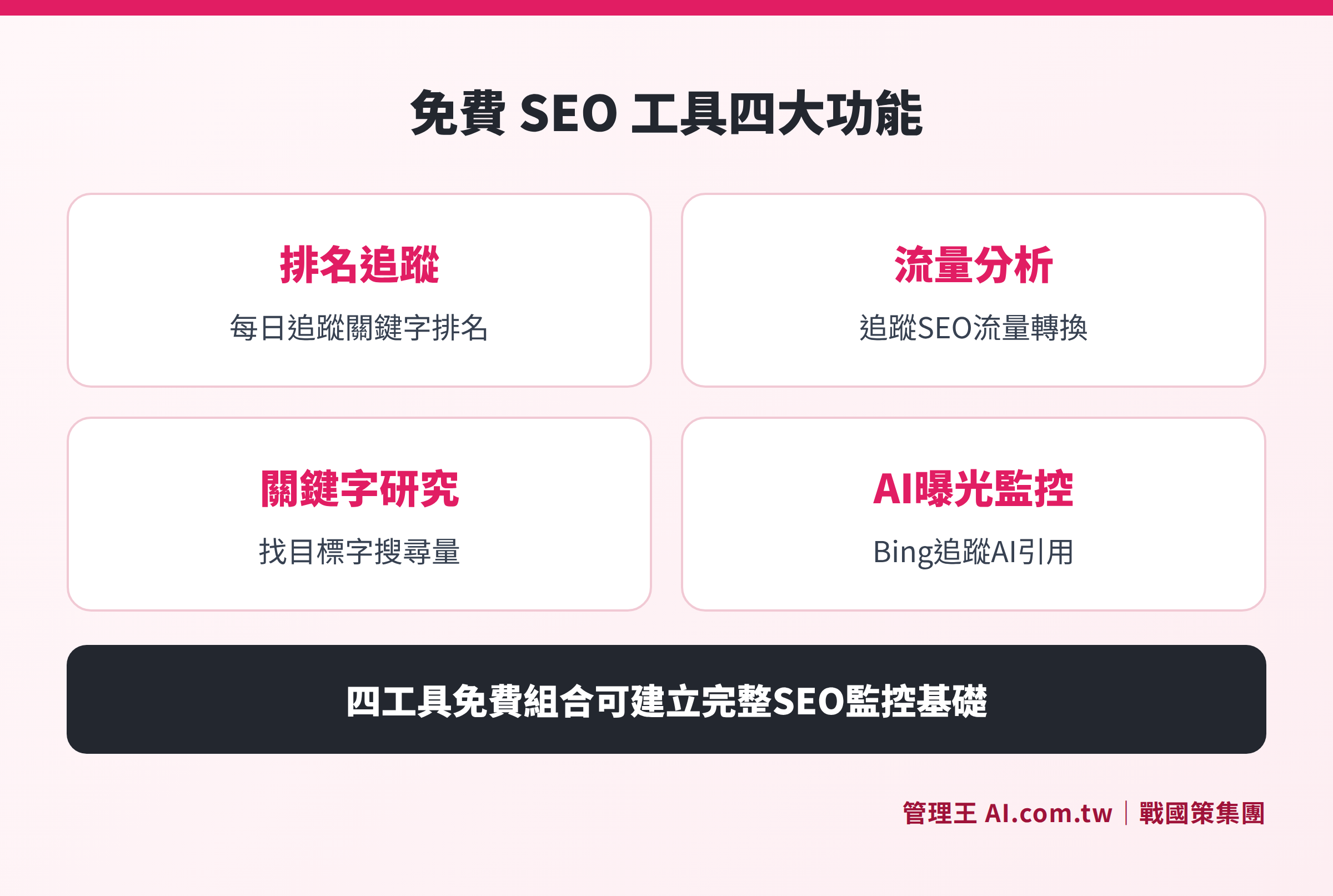
Function allocation explanation of four major free SEO tools: Search Console for rankings, GA4 for traffic conversion, Keyword Planner for finding keywords, and Bing tools to supplement AI search data
In-depth Comparison of Paid SEO Tools: Ahrefs, Semrush, Moz Pro
The following fees are in USD, based on information published on their official websites, as of November 2025. Actual rates are subject to the latest announcements from each official site.
Ahrefs
Known for its backlink database, it specializes in competitor analysis and external link research. The Starter plan is $29 USD per month, the Lite plan is $129 USD per month, the Standard plan is $249 USD per month, and the Advanced plan is $449 USD per month. Annual payment can save about 17%. The Lite plan tracks 750 keywords and manages 5 projects; the Standard plan tracks 2,000 keywords, 20 projects, and provides 2 years of historical data.
Semrush
A comprehensive SEO platform covering the widest range of functions, integrating AI search visibility monitoring (tracking brand exposure in ChatGPT, Perplexity, and Gemini). The SEO Base plan is $139 USD per month, the AI search-inclusive Starter plan is $199 USD per month, and the Pro+ plan is $299 USD per month. Annual payment can save about 16%. All plans include keyword tracking, competitor analysis, website audits, and ranking tracking.
Moz Pro
Offers a low entry cost for paid options. The Starter plan is $49 USD per month (or $39 per month if billed annually), the Standard plan is $99 USD per month (or $79 per month if billed annually), the Medium plan is $179 USD per month (or $143 per month if billed annually), and the Large plan is $299 USD per month (or $239 per month if billed annually). All plans include AI keyword suggestions, AI search and GEO tracking, and content optimization suggestions; plans Standard and above provide a 7-day free trial.
Table: Comparison of Entry Plans for Paid SEO Tools (as of November 2025 based on publicly available information)
| Tool | Entry Monthly Fee (USD) | Keyword Tracking Limit | Competitor Analysis | Backlink Analysis | AI Search Monitoring |
|---|---|---|---|---|---|
| Ahrefs Lite | $129 | 750 | Yes | Strength | Partial |
| Semrush SEO Base | $139 | 500/day | Yes | Yes | Yes |
| Moz Pro Starter | $49 | 50 | Basic | Basic | Yes |
Summary
Free tools help you see your rankings and traffic, while paid tools allow you to see competitors' strategies and weaknesses, complementing each other rather than replacing one another.
What are the Differences Between Free and Paid SEO Tools?
The core limitation of free tools lies in their data scale and competitive perspective. Google Search Console can only see your website's data, not your competitors' keyword strategies. The search volumes from Google Keyword Planner are range values, lacking precision. When you need to know "which keywords competitors are using to gain the most traffic" or "how the backlink ecology in this industry looks," free tools fall short.
Paid tools fill these gaps in competitive intelligence:
- Comprehensive Backlink Database: Track which websites link to you or your competitors to find external link opportunities.
- Competitor Keyword Discovery: View competitors' top 10 or top 100 traffic-generating keywords to duplicate effective strategies.
- Exact Search Volume Numbers: Not ranges, but actual monthly search volume figures for more reliable topic selection.
- Large-Scale Website Audits: Paid plans can crawl hundreds of thousands to millions of pages monthly, suitable for large websites.
For newly started SMEs, it is recommended to use free tools for 3 to 6 months to establish SEO directions, before assessing whether to upgrade to paid tools.
Five Key Questions for SMEs in Taiwan Selecting SEO Tools
Before selecting tools, ask yourself these five questions to quickly narrow down your options:
1. What functionality do I need the most?
Just starting? Prioritize keyword research → Google Keyword Planner is sufficient; want to track effectiveness? → Search Console + GA4; need competitor analysis? → Consider paid tools.
2. What is my budget?
Free tools can support the basic needs of most SMEs. If there's a budget, the Moz Pro Starter ($49 USD/month) is the low-cost entry point; if comprehensive competitor intelligence is needed, the Lite plans of Semrush or Ahrefs are around $130 USD/month.
3. What is the size of my team?
Single operator: free tools or Moz Starter is enough. For collaborative work or marketing teams: Semrush or Ahrefs Standard plans support multiple users.
4. Do I need localized features?
Ahrefs, Semrush, and Moz primarily have English interfaces, and their databases focus on global markets, with local keyword data in Taiwan being less complete than locally designed tools. If you need a traditional Chinese interface and Taiwanese customer support, prioritize tools designed with local market integration.
5. Do I need integration with other systems?
If the enterprise uses CRM, accounting, marketing, and other systems simultaneously, data interoperability between tools is important. Isolated SEO tools often require additional integration fees or rely on manual data copying.
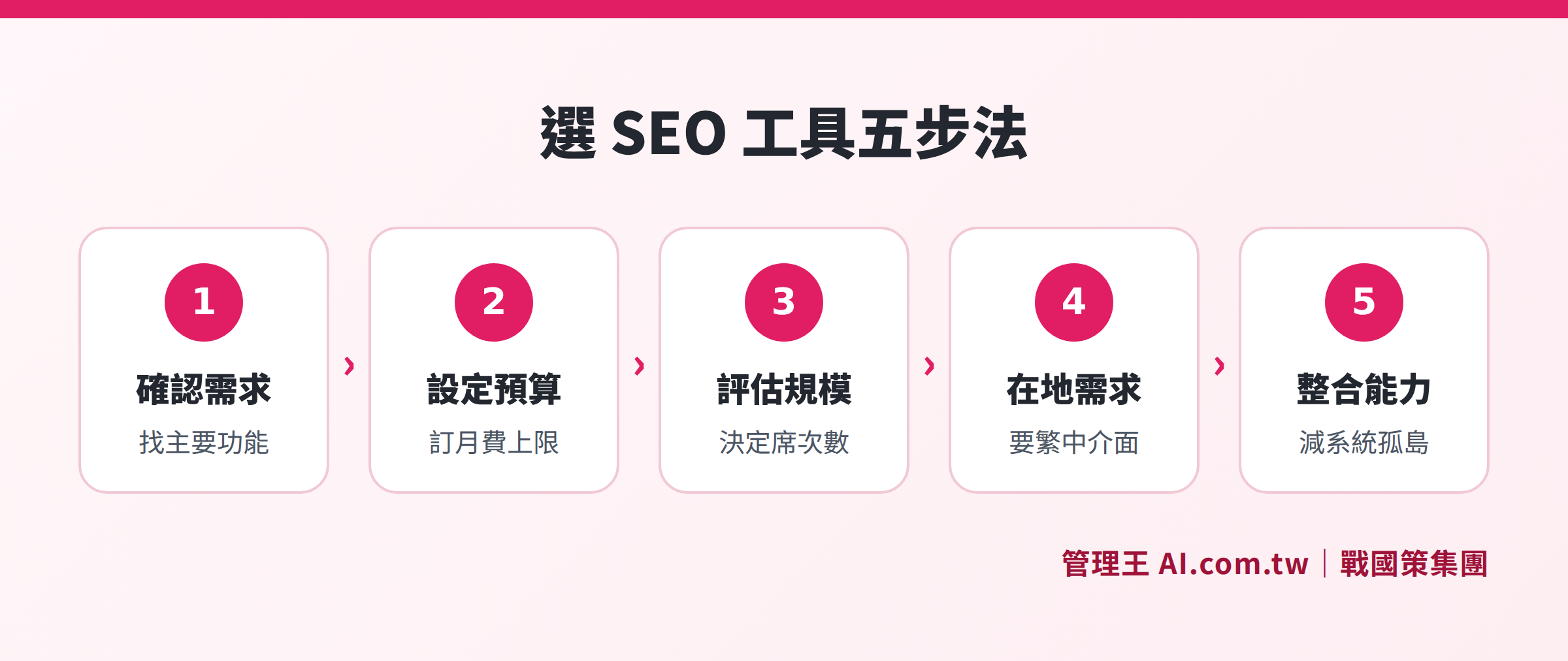
A five-step process from confirming core needs to assessing budget, team size, localization demands, and system integration capabilities.
New Directions for SEO Tools in the AI Era
After 2025, the rise of AI search (ChatGPT, Perplexity, Gemini, Microsoft Copilot) has created a new battlefield for SEO tools: Generative Search Visibility (GEO) Monitoring.
Traditional SEO tools track Google organic search rankings; next-generation tools are starting to track how often brands are cited in AI responses. New plans from Semrush and Moz Pro have added AI search monitoring features, and Bing Webmaster Tools also provides free Copilot citation reports.
For SMEs in Taiwan, this trend means the goal of SEO content is not just to "rank in the top three pages on Google" but also to have AI assistants actively cite your website when answering related questions. This is the most crucial difference between AI-assisted SEO tools and traditional SEO tools.
If you want to delve into AI SEO strategies, please refer to What is AI SEO? New Ranking Strategies for SMEs in the AI Search Era to learn how to build visibility in the era of generative search.
How to Use 管理王 AI-SEO?
管理王 AI-SEO is a one-stop SEO automation tool designed for Taiwanese SMEs that want to gain natural Google traffic but cannot afford SEO consultants, integrating keyword research, daily ranking tracking, competitor analysis, AI content generation, and technical SEO audits into one system.
The practical operation methods are as follows:
- AI Keyword Research: Enter your industry or main services, and the system will automatically recommend about 50 target keywords, along with monthly search volumes and competition levels, helping you lock in long-tail keywords that have traffic potential and are easier to compete for.
- Daily Automatic Tracking: The system automatically crawls Google rankings daily, visualizing the ups and downs of each keyword in trend charts, making it clear which articles are rising and which keywords have dropped out of the top ten pages.
- One-Click Competitor Intelligence Breakdown: Input a competitor's URL, and the system will automatically retrieve the keywords, content themes, and backlink sources that competitors are targeting.
- AI Content Generation: Input a keyword, and AI will produce a draft of about 2,000 words adhering to SEO standards, complete with H1/H2/H3 structures and internal linking suggestions.
- Technical SEO Audit: Automatically check website speed, mobile-friendliness, structured data, and 404 errors, supporting automatic generation of Schema.org markup.
In addition, 管理王 AI-SEO is natively integrated with other modules of the same account, including competitor analysis, Landing Page, social scheduling management, CRM system, and marketing automation, allowing SEO, content, social, and advertising data to be viewed in the same interface without additional integration fees.
The free plan is available for perpetual use, including AI keyword research (one-time quota) and basic ranking tracking features, suitable for trial use before assessing whether to upgrade. For complete functional plan costs, please refer to 管理王 service plans.
戰國策 Group has served over 30,000 businesses, and 管理王's AI-SEO is designed by a Taiwanese team with a traditional Chinese interface, a Taiwanese market keyword database, and LINE notification integration, making it closer to the actual operation habits of Taiwan’s SMEs compared to foreign SaaS products.
One-Stop Solution for SEO Keyword Tracking and Competitor Analysis
管理王 consultants assist Taiwanese SMEs in quickly mastering AI-SEO, covering keyword research, daily ranking tracking, and competitor analysis, with immediate free consultation available.
Free consultation hotline: 0800-003-191
LINE Official Account: @119m
Official Website: app.AI.com.tw
Free Trial: Apply for 管理王 now
Frequently Asked Questions
Is using only Google Search Console enough?
For newly started websites, Google Search Console is already the most important SEO tool, as it provides real data on the website's rankings, clicks, and impressions on Google. Coupled with Google Analytics 4 to track traffic conversions, it is very adequate for initial SEO optimization. When you begin to need to analyze competitor strategies or find backlink opportunities, then consider upgrading to paid tools.
Which is more suitable for SMEs in Taiwan: Ahrefs, Semrush, or Moz Pro?
Each has its strengths: Moz Pro has the lowest entry cost ($49 USD/month), suitable for small companies with limited budgets; Ahrefs excels in backlink analysis, preferable for enterprises needing in-depth competitor research; Semrush covers the most comprehensive functions, including AI search monitoring. All three have English interfaces, and the completeness of local keyword data needs to be assessed individually. Costs are subject to the latest announcements on their official websites.
Can SEO tools replace SEO consultants?
SEO tools provide data and suggestions but cannot replace strategic judgment and content execution. Tools tell you that "this keyword is searched 2,000 times a month with moderate competition," but a person must determine whether it is worth optimizing and how to write the content. For SMEs, good SEO tools allow one person to perform monitoring work that traditionally required a dedicated SEO consultant, significantly reducing outsourcing costs.
What is the difference in keyword data between free SEO tools and paid tools?
The differences are mainly in accuracy and scale. Google Keyword Planner for free accounts only provides search volume ranges (e.g., "1,000–10,000"); paid tools like Ahrefs or Semrush provide precise monthly search volume figures. In terms of scale, paid tools' keyword databases typically reach billions of entries, while the number of suggested terms in free tools is relatively limited, covering depth in keyword mining at a lower rate.
When should I upgrade from free tools to paid tools?
Consider upgrading when the following situations arise: (1) a need to analyze the keyword strategies of more than 3 competitors; (2) the website has grown to require tracking more than 100 keywords; (3) a need to find high-quality external link opportunities; (4) complex technical issues on the site requiring large-scale automated audits. If the main goal right now is to track your rankings and traffic effectiveness, free tools can still support that.
Data Sources
- Google Search Console Official Documentation (Google Official)
- Google Analytics 4 Official Documentation (Google Official)
- Google Keyword Planner Official Documentation (Google Ads Official)
- Ahrefs Plans and Pricing (Ahrefs Official, queried November 2025)
- Semrush Pricing Page (Semrush Official, queried November 2025)
- Moz Pro Plan Documentation (Moz Official, queried November 2025)
- Bing Webmaster Tools Official Documentation (Microsoft Official)