How to Create a Legal and Fair Shift Schedule? Comprehensive Summary of Shift Management Rules and Templates | Recommended Scheduling Tools

A complete analysis of Taiwan's Labor Standards Act shift schedule regulations, covering daily working hours limits, overtime pay calculation tables, four types of shift schedules (fixed, rotating, flexible, responsibility system), five steps for legal scheduling, and how to use a schedule management system for automatic compliance.
Shift management is a system for businesses to arrange employee work hours, shift rotations, and vacations according to the Labor Standards Act. A legal shift schedule must not only comply with the maximum limits of 8 hours per day and 40 hours per week, but also correctly designate holidays and rest days, control monthly overtime hours, and ensure at least 11 hours of rest between shifts. For industries with multiple shifts, such as food service, retail, manufacturing, and healthcare, a poorly designed schedule can lead to labor disputes, fines, and even criminal liability. Conversely, systematic shift management can achieve the three major goals of legality, fairness, and cost-effectiveness, ensuring that employers, supervisors, and employees all get what they deserve.
What is Shift Management? Why Do Businesses Need to Do It Well?
Shift Management refers to the systematic planning process for employee attendance hours, covering four core dimensions:
- Time Scheduling: Setting daily start and end times, break and rest periods
- Workforce Allocation: Number of personnel for each shift, cross-department or cross-site support planning
- Regulatory Compliance: Compliance with working hour limits, holiday guarantees, shift intervals according to labor laws
- Cost Control: Estimation of overtime pay, trial calculations of labor costs, warnings for exceeding hours
The quality of the schedule directly affects three parties: for employers, it is a dual control of labor costs and legal risks; for supervisors, it presents a daily challenge of scheduling efficiency and employee collaboration; for employees, it is a fundamental guarantee for work-life balance and salary accuracy.
When a company grows beyond 10 employees, the shift management approach shifts from "personal negotiations" to "systematic scheduling." A lack of systematic schedules often results in costs like: HR spending days reconciling accounts at month-end, employee complaints about unfairness leading to resignations, and facing complicated paper records during labor inspections.
In a nutshell
Three essential elements of a legal shift schedule: normal hours not exceeded, complete protection of holidays, and at least 11 hours of rest between shifts.
Overview of Shift Schedule Regulations in Taiwan's Labor Standards Act
The Labor Standards Act in Taiwan has clear regulations regarding shift schedules. Here are the core regulations enterprises must know (Source: official data from the Ministry of Labor):
Table: Summary of Labor Standards Act Shift Schedule Regulations
| Regulation Item | Legal Content | Reference Clause |
|---|---|---|
| Daily Normal Working Hours | Not exceeding 8 hours | Article 30 Paragraph 1 |
| Weekly Normal Working Hours | Not exceeding 40 hours | Article 30 Paragraph 1 |
| Weekly Days Off | 2 days every 7 days (1 holiday + 1 rest day) | Article 36 |
| Maximum Daily Hours (including overtime) | Not exceeding 12 hours | Article 32 |
| Maximum Monthly Overtime | Not exceeding 46 hours (can reach 54 hours with union agreement) | Article 32 |
| Shift Change Rest Interval | At least 11 consecutive hours when changing shifts (minimum 8 hours for special industries) | Article 34 |
| Attendance on Holidays | Principally prohibited; violators must pay double wages | Article 39 |
| Continuous Work Rest Regulations | At least 30 minutes of rest after 4 hours of continuous work | Article 35 |
| Attendance Record Retention | Must maintain records for 5 years | Article 30 Paragraph 5 |
The three most common red lines that companies often cross are:
- Scheduling employees to work overtime on holidays without paying double;
- Not ensuring a 11 hour rest interval between shift changes (enforced since March 1, 2018);
- Exceeding a total of 46 hours of monthly overtime without obtaining union or labor-management meeting consent.
Additionally, Article 30 Paragraph 3 of the Labor Standards Act also provides for flexible working hour systems of 2 weeks, 4 weeks (Article 30-1), and 8 weeks, which eligible industries may use for flexible shift scheduling, but they must obtain consent and maintain records as mandated.
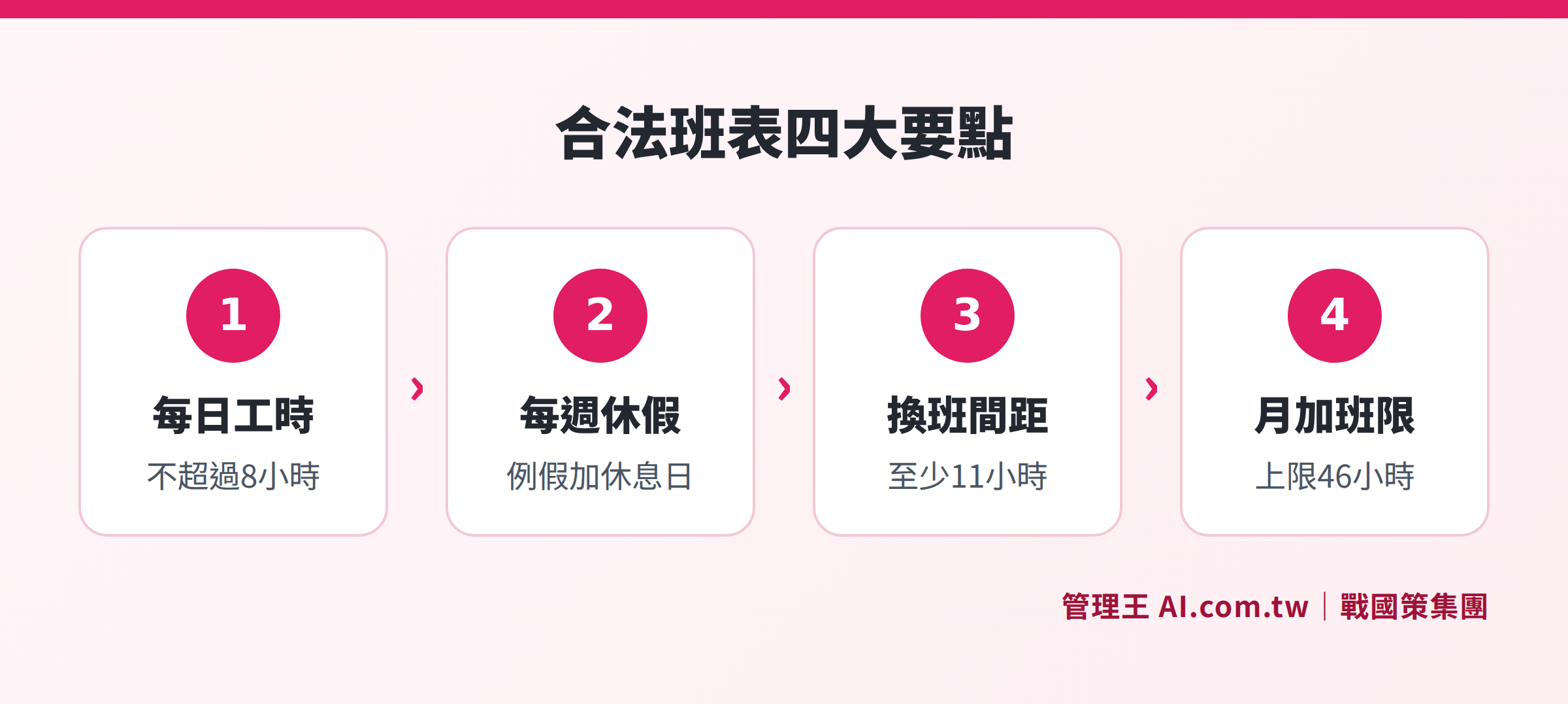
Sequential explanation of four key regulations: maximum 8 hours of daily work, 2 days of rest per week, 11 hours rest between shifts, and maximum of 46 hours overtime per month.
How to Calculate Overtime Pay? Complete Rate Table
Many small and medium business owners often find themselves confused about the differences between "1.34 times" and "1.67 times." According to Article 24 of the Labor Standards Act, overtime pay calculation varies depending on the type of attendance and time of day:
Table: Overtime Pay Calculation Rates (based on Article 24 of the Labor Standards Act)
| Type of Attendance | Time Period | Wage Multiplier Explanation |
|---|---|---|
| Regular Weekday Overtime | 1st-2nd hour | Hourly wage plus 1/3, approximately 1.34 times |
| Regular Weekday Overtime | 3rd-4th hour | Hourly wage plus 2/3, approximately 1.67 times |
| Work on Rest Days | 1st-2nd hour | Hourly wage plus 1/3, approximately 1.34 times |
| Work on Rest Days | 3rd-8th hour | Hourly wage plus 2/3, approximately 1.67 times |
| Work on Rest Days | 9th-12th hour | Hourly wage plus 5/3, approximately 2.67 times |
| Attendance on Holidays (Special Cases) | All day | Wages doubled, totaling 2 times |
| Attendance on National Holidays | All day | Wages doubled, totaling 2 times |
Employees may choose to substitute overtime pay with compensatory leave, with the duration negotiated between the employer and employee; if the leave is not taken by the deadline or upon termination of the contract, the employer must compensate at the original overtime pay standard.
> This table is organized according to current Labor Standards Act provisions, and actual values are subject to the latest announcements from the Ministry of Labor. Certain industries subject to Article 84-1 of the Labor Standards Act (such as senior supervisory staff, professional workers under a responsibility system) have additional exceptions that should be confirmed with the local labor authority.
Common Types of Shift Schedules and Applicable Scenarios
Different industries have different optimal shift systems; choosing the wrong type not only complicates management but may also make compliance more difficult.
Fixed Shift System
The entire company has a unified work time (e.g., Monday to Friday 09:00–18:00), making scheduling the simplest yet least flexible. Suitable for administrative, design, software development, finance, and other internal positions. Management focuses on properly arranging special leave and controlling overtime at the end of the month.
Rotating Shift System (Morning, Afternoon, Night shifts)
The mainstream shift system for 24-hour or long-hour service industries, typically rotating in three shifts, each lasting 8 hours. Special attention must be paid to Article 34 of the Labor Standards Act: there must be at least 11 consecutive hours of rest when switching shifts; violations can incur fines of up to NT$1 million. Suitable for food service, convenience stores, manufacturing, healthcare institutions, and security services.
Flexible Working Hour System
Allows employees to freely choose their start and end times outside of core hours (e.g., 10:00–16:00). The Labor Standards Act allows for 2-week or 8-week flexible working hours, but conditions must be met, and agreement from the union or labor-management meeting is necessary. Suitable for remote workers, software engineers, and creative roles.
Responsibility System (Labor Standards Act Article 84-1)
Certain positions (senior supervisory staff, surveillance or intermittent work, etc.) can have working hours agreed upon separately between employer and employees, but must be reported to labor authorities and cannot be applied arbitrarily. Without proper reporting, any classification as a responsibility system will still require overtime pay to be calculated according to general hour regulations.
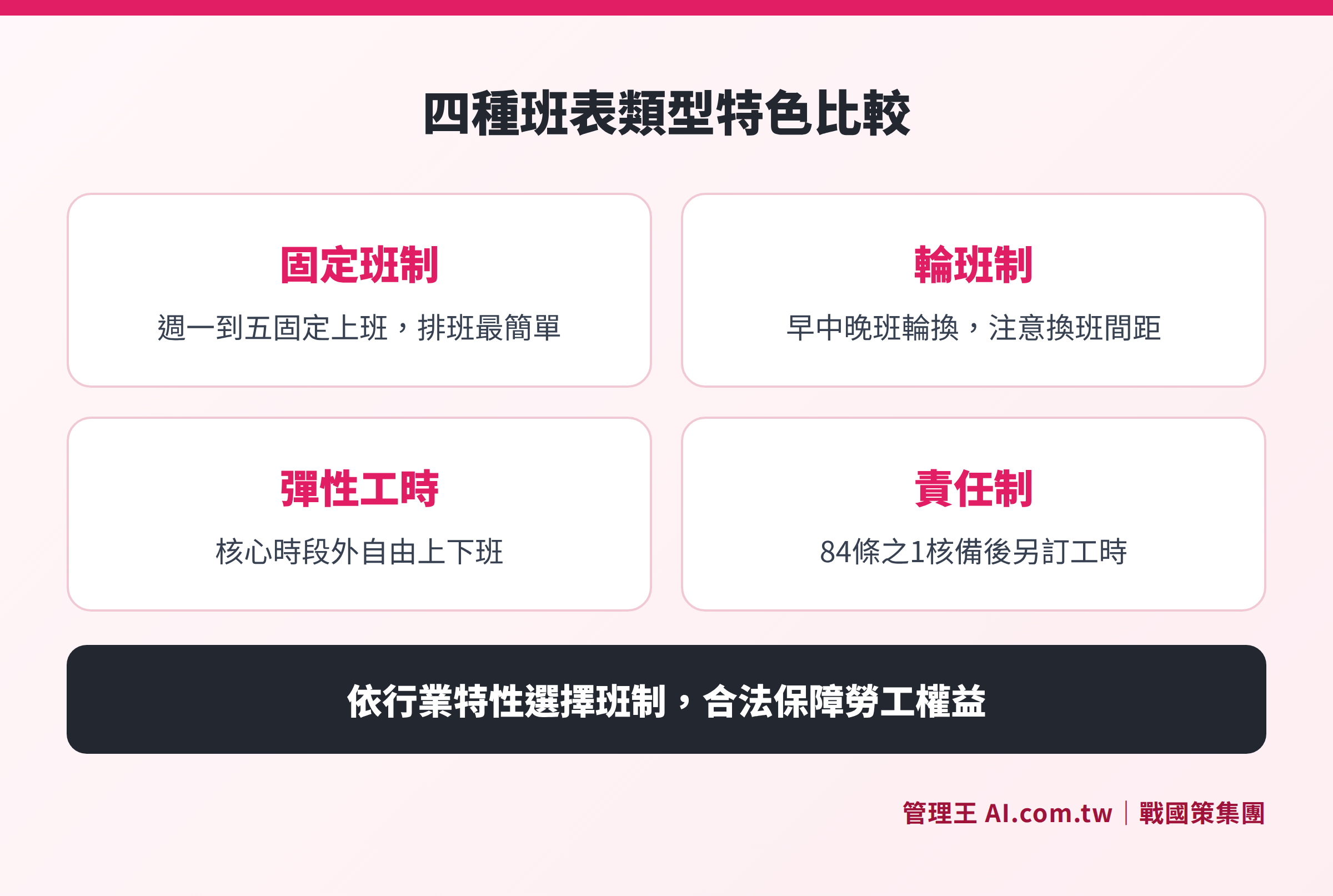
Comparison of the main characteristics and applicable industries of fixed shifts, rotating shifts, flexible work hours, and responsibility systems.
How to Create a Legal and Fair Shift Schedule? Five-Step Process
Creating a good shift schedule is not just about filling in the boxes; it must consider legal compliance, cost, and fairness.
Step One: Assess Workforce Needs
List the minimum number of people needed for each time period based on business peak and off-peak seasons (such as lunch and dinner rushes in food service or holidays in retail). Do not simply copy last month’s schedule; first ask, "What special situations are there for this month's business volume?"
Step Two: Confirm Employees' Available Scheduling Times
Gather each employee's fixed holiday preferences and special needs (childcare leave, further studies, part-time restrictions), and try to accommodate them as much as possible within the confines of the Labor Standards Act. This step directly affects employee satisfaction and reduces the frequency of last-minute leave requests.
Step Three: Apply the Labor Standards Act Framework for Review
Individually confirm for each employee: not exceeding 40 hours weekly, 2 days off every 7 days (including 1 holiday), maximum of 46 hours of overtime monthly, and ensuring 11 hours of rest between shifts.
Step Four: Trial Calculate Monthly Labor Costs
Before officially announcing, trial calculate the month’s labor costs and estimated overtime pay to avoid the awkward situation of “having people scheduled” but “exceeding the salary budget.”
Step Five: Announce in Advance and Retain Records
It is recommended to announce schedules at least 1 week in advance (the Labor Standards Act does not define a standard number of days, but labor and management may agree upon one in work rules), and any last-minute changes require notifying employees and obtaining consent; all versions of the schedules and modification records should be retained for labor inspections.
Integration Logic of Shift Management with Payroll and HR Systems
Shift management is not an isolated function; it is the starting point of the entire human resource management chain. Once the schedule is confirmed, it will interact with three downstream systems:
Attendance Clock-In: Employees clock in according to the scheduled times, and the system compares the schedule with actual attendance, automatically marking absences such as lateness or early leave. If the company uses clock-in systems integrated with the schedule, unusual attendance will be immediately notified to supervisors, eliminating the need to discover issues only at month-end.
Overtime Approval: If employees continue to work beyond their scheduled hours, the system automatically generates an "overtime application form," which requires online approval from supervisors to be counted towards overtime pay. This process resolves the dilemma of "supervisors not knowing employees are working overtime" and "difficulty rejecting unauthorized overtime."
Payroll Calculation: The payroll calculation system integrates the schedule with attendance data, automatically applying different multipliers to calculate wages based on actual hours worked and overtime types (weekdays/rest days/public holidays), meaning HR only needs to review and doesn’t have to recalculate at month-end.
Attendance Analysis: The attendance analysis ranking compiles monthly attendance data, showing which employees have high lateness frequencies and which departments have high overtime ratios, providing a basis for supervisors to adjust scheduling in the coming month.
With the integration of these three systems and the shift schedule, data only needs to be entered once, creating a complete closed loop from scheduling to payroll distribution, reducing errors and disputes caused by manually copying data between different systems.
Common Issues in Shift Management and Dispute Resolution
What to do if employees reflect that the schedule is unfair?
Unfair disputes often stem from an uneven allocation of night shifts, holiday shifts, or Spring Festival shifts. The solution is to let the data speak: export the number of night shifts and holiday shifts for each employee over the past 3 months and, if the disparity exceeds a reasonable range, make adjustments. Responding to employees with "reports" rather than "supervisory intuition" can help gain their trust.
How to respond to staff shortages due to last-minute leave?
Establish a "make-up shift application mechanism" where employees willing to work overtime can actively apply, and upon supervisor approval, the schedule is updated immediately. This approach also leaves a legal record of the consent for overtime, avoiding future "forced overtime" disputes.
How to record attendance in compliance with the Labor Standards Act?
According to Article 30 Paragraph 5 of the Labor Standards Act, employers must keep records of employee attendance, recording the time work begins and ends, and preserve these records for 5 years. Companies using electronic clock-ins (via mobile GPS/IP/WiFi) need to ensure their system can export daily attendance details for labor inspections.
How to manage remote employees' attendance hours?
Remote workers must also comply with Labor Standards Act working hour regulations. A "clock-in plus log report" model can be adopted, allowing remote employees to record actual working hours daily for supervisors to review at month-end. This retains work flexibility while meeting legal requirements.
What to do if there is insufficient rest between shifts for rotating employees?
If business requires shifting in less than 11 hours, it can be shortened to no less than 8 hours, as stated in the exception of Article 34 with the announcement from the competent authority and approval from the union or labor-management meeting. Employers with 30 or more employees must report to the local competent authority. It is recommended to consult with the local labor bureau in advance to confirm whether it meets the announcement scope.
How to Use 管理王 Shift Management System
The 管理王 AI.com.tw shift management functionality is designed specifically for small and medium enterprises in Taiwan, incorporating compliance checks within the scheduling process to eliminate the need for supervisors to look up regulations separately.
Monthly Two-Dimensional Interface: Displays the entire month’s 30 days × all employees in a two-dimensional table, color-coded by shift category, supporting cross-month copying so that adjustments can be made easily from the previous month’s schedule, significantly enhancing planning efficiency.
Real-Time Workforce Allocation Alerts: The dashboard compares the number of online personnel to expected needs for each time slot, alerting when there is workforce surplus or shortage; special periods like anniversaries or long weekends can be pre-marked for doubled manpower needs to avoid last-minute hires during peak seasons.
Real-Time Cost Estimation: Each adjustment to a shift immediately triggers a trial calculation of that month’s labor costs, overtime pay, and holiday double pay, allowing scheduling decisions and budget control to run concurrently, preventing overages from being discovered only at month-end.
Automated Labor Law Compliance Checks: The system checks each employee’s total working hours, consecutive working hours, holidays, and days off against labor law requirements, offloading the complex compliance verification process to the system and reducing the risk of unintentional violations of hour regulations.
Automatic Adjustments for Leave: Integrated with electronic leave approvals, employees are automatically removed from the schedule when requesting leave, prompting supervisors to arrange for backup, preventing mismatches between leave requests and schedules that could lead to understaffing.
AI Recommendations and Fairness Reports: AI suggests optimal scheduling based on sales activity from the past six months and generates fairness reports highlighting the differences in the number of night shifts and holiday shifts among employees, using data to respond to questions like "who has more shifts and who has fewer" to build trust in management.
Shift management can seamlessly integrate with scheduling systems, clock-in systems, payroll calculations, attendance analysis, field management, and HR systems. When schedule changes occur, attendance, salary, and personnel reports are all automatically updated, eliminating errors and manual compiling of hours.
A free plan is available for permanent use, allowing users to experience all basic features without binding a credit card, including schedule preparation, attendance record export, and labor law compliance prompts. Check pricing plans for advanced options that offer AI scheduling suggestions and monthly cost estimation features.
Make Shift Management Compliant and Effortless
管理王 consultants provide free assistance to help you create a digital scheduling system compliant with the Labor Standards Act, integrating attendance, overtime approvals, and payroll calculation, shortening month-end calculations from several days to just a few hours.
Free consultation hotline: 0800-003-191
LINE official account: @119m
Official website: app.AI.com.tw
Free trial: Apply for 管理王 now
Frequently Asked Questions
How many days in advance should the schedule be announced to employees?
The Labor Standards Act does not specify a set number of days for schedule announcements; it is practically recommended to notify at least 1 week in advance so employees can arrange their personal matters. For rotating shifts, according to Article 34 of the Labor Standards Act, shifts should generally be rotated weekly, except for those agreed by labor. It is recommended to clearly specify the schedule announcement period in work rules or employment contracts to establish a mutual understanding between labor and management.
Can employees be scheduled for overtime on holidays?
According to Articles 36 and 39 of the Labor Standards Act, employees should not be made to work on holidays. If they are required to work due to force majeure conditions such as natural disasters or emergencies, employers must still pay double wages as mandated and compensate with paid leave afterwards. Arbitrarily scheduling employees on holidays may violate labor laws, possibly resulting in imprisonment for up to 2 years or fines.
Is a minimum 11-hour rest required between shifts?
According to Article 34 of the Labor Standards Act (enforced since March 1, 2018), there must be at least 11 consecutive hours of rest when changing shifts in a rotating system. Certain special industries may, with announcements from the competent authority and compliance with regulations, shorten the break to no less than 8 hours, but employers with over 30 employees must report to the competent authority.
What is the maximum overtime allowed per month?
According to Article 32 of the Labor Standards Act, the general maximum permissible overtime hours per month is 46. If consent is obtained from the union or labor-management meeting, it can be extended to 54 hours per month, but not exceeding 138 hours in 3 months in total. Any overtime beyond legal limits may result in penalties under labor laws, even if employees agree.
Do electronic schedules and clock-in records have legal validity?
Yes. Article 30 of the Labor Standards Act requires employers to maintain attendance records but does not specify whether they should be in paper or electronic form; as long as they can comprehensively record the start and end times of work each day and be kept for 5 years, they comply with regulations. The added advantage of electronic records is that each modification creates an audit log, making it harder to tamper with, and provides more complete evidence during labor inspections, currently recognized as the standard attendance management method by competent authorities.
Data Sources
- Ministry of Labor Global Information Network - Working hour systems and flexible measures
- Ministry of Labor Labor Standards Act Article 34 Shift Change Regulations
- Ministry of Labor Global Information Network - Overview of Labor Standards Act Rights
- Introduction to 管理王 AI.com.tw Shift Management Features
This article is for general information and does not constitute legal advice. Actual practices are subject to the latest announcements from the Ministry of Labor.