SME ERP Recommendations: A Selection List When Budget is Limited|ERP System Recommendations
For small and medium-sized enterprises (SMEs) with limited budgets, the key to selecting an ERP is to 'first solve the most painful processes, then gradually expand.' This article provides five essential selection indicators, a cost structure comparison of cloud vs. packaged ERP, information on government subsidies, as well as descriptions of the plans available on 管理王AI.com.tw, helping Taiwanese SMEs find suitable ERP starting solutions.
The most common question small and medium-sized enterprises (SMEs) have when adopting ERP is: "With a limited budget, which one should we buy?" The answer depends on your company's size, industry type, and the most urgent process bottlenecks to address. According to Industrial Technology Research Institute data, 97.65% of businesses in Taiwan are SMEs, most of which face limited funding and IT manpower, turning ERP selection into a math problem of 'sufficient functionality vs. cost-effective.' When budgets are tight, the core logic for selecting ERP is: first solve the most painful processes, then gradually expand, rather than purchasing all modules at once. Cloud ERP adopts a monthly subscription model instead of high licensing fees, allowing SMEs to trial with low risk and upgrade as needed, which has become the mainstream choice for Taiwanese SMEs adopting ERP in recent years. This article provides a practical selection checklist to help budget-conscious owners quickly identify a suitable solution.
Why Is It Especially Difficult for SMEs to Select ERP?
SMEs in Taiwan face three layers of pressure in ERP selection:
Budget pressure: Traditional packaged ERP requires licensing fees, consultant implementation fees, customization development costs, and maintenance fees, resulting in significant total ownership costs, which are not friendly to companies with fewer than 50 employees.
Manpower pressure: Implementing ERP requires internal contacts to coordinate with consultants to build the system, test, and train staff. Most SMEs do not have dedicated IT personnel, and the owner or accountant often has to double up, increasing the impact on daily operations the longer the implementation takes.
Decision-making pressure: There are numerous ERP providers on the market, from international giants to local cloud software, with dense functional descriptions that make it challenging to determine which features are truly necessary for one's company.
In a nutshell
When the budget is limited, the strategy for selecting ERP is 'go live first, solve the most painful processes first,' rather than buying all modules at once.
Priority Order for Selection When Budget is Limited
Given limited funds, the following priority order is recommended:
Table: Suggested Priority Order for SME ERP Implementation
| Priority Level | Applicable Pain Points | Recommended Priority Modules |
|---|---|---|
| Priority to resolve | Inventory accounts do not match, shipping errors | Inventory Management (Purchasing, Inventory, Shipping) |
| Priority to resolve | End-of-month reconciliation takes too long, accounts receivable and payable are chaotic | Accounting, Accounts Receivable, Accounts Payable |
| Mid-term goal | Quotations made in Word, need to re-enter orders after transactions | Quotation System, Order Management |
| Mid-term goal | Separate electronic invoicing from ERP, double entry required | Electronic Invoice Integration |
| Long-term expansion | Production scheduling relies on manual processes, only realizing shortages when they occur | BOM, Production Orders, MRP |
| Long-term expansion | Payroll calculations rely on Excel | Payroll Calculation, Attendance Integration |
Key Principle of Selection: First ask yourself, "What are the three biggest headaches the boss faces at the end of the month?"—these are the modules to prioritize for implementation.
For example, a trading company with 20 employees engaged in retail wholesale typically experiences the greatest pain in inaccurate inventory accounts and shipping errors; thus, the priority to resolve would be the inventory management module rather than hastily establishing payroll calculations or production functions. Conversely, a hardware parts manufacturer with 30 employees would prioritize BOM management and MRP shortage notifications—it would require both inventory management and production modules to be implemented together, or else data flow will still be obstructed.
Implementing in stages from small to large, each step must verify that 'data flows within the same system' to avoid incurring additional costs for integration later on.
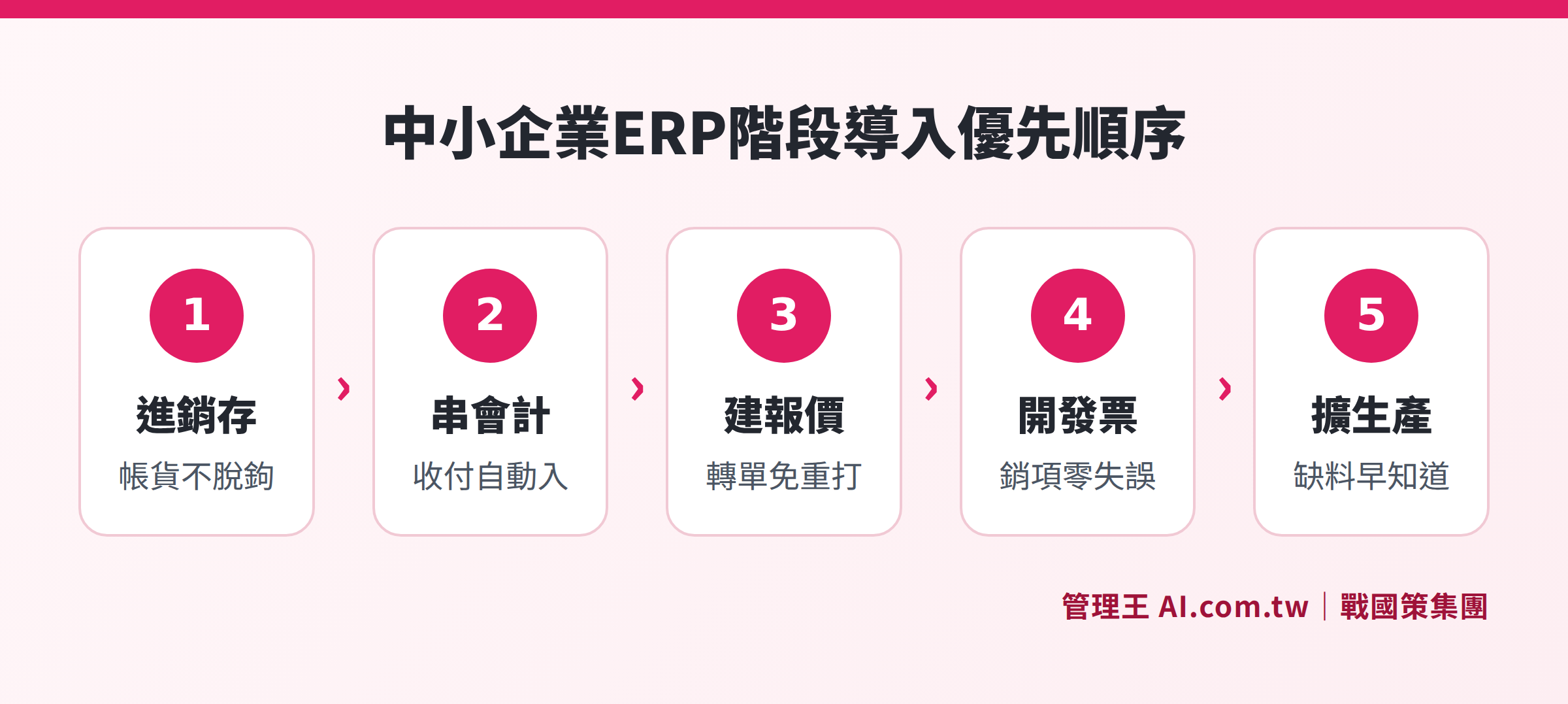
Based on budget and urgency: Inventory Management → Accounting → Quotations → Invoices → Production and Manufacturing implementation path
SME ERP Selection Checklist: 5 Essential Indicators
Here are five core indicators for SMEs with limited budgets when selecting ERP:
1. Is the monthly fee transparent with no hidden charges?
Cloud ERP charges on a monthly subscription basis, so before selection, be sure to confirm:
- What modules are included in the monthly fee? Are additional charges incurred for each module?
- Is there a 'usage limit' (e.g., number of orders, number of products) and will exceeding this incur extra charges?
- What is the rate for custom development? Is pricing transparent?
- Are upgrade costs reasonable?
2. Can it be deployed quickly (within 4 weeks)?
SMEs have limited resources and cannot afford implementation periods of over six months. During selection, inquire:
- Can standard features go live within four weeks?
- Are there tools for data import? Can old Excel or data from old systems be imported?
- Is there online training or implementation support?
3. Does it natively support Taiwanese regulations?
Unique regulatory requirements in Taiwan, including electronic invoicing (taxation digitization), labor and health insurance calculations, payroll withholding declarations, etc., if not natively supported, will require customization, increasing costs and risks.
4. Is ERP integrated with CRM, attendance, invoices in the same system?
The most common dilemma for SMEs is "too many systems, data breaks in the middle." When selecting, evaluate: Can the CRM used by sales, the ERP used by finance, and the attendance system used by HR share the same customer, product, and employee data within the same account?
5. Does after-sales service have local support in Taiwan?
With foreign SaaS software, time zone and language issues make it challenging to resolve problems in real-time. Confirm during selection: Is there a traditional Chinese interface, a local customer service phone number in Taiwan, and a Line account for inquiries?
Cloud ERP vs. Packaged ERP: Where Are the Budget Differences?
Table: Cost Structure Comparison of Cloud ERP and Packaged ERP
| Comparison Items | Cloud ERP (Subscription) | Packaged ERP (Licensing) |
|---|---|---|
| Initial Investment | Low (can be activated with a monthly fee) | High (licensing fee + consulting fee) |
| Implementation Time | Short (2 weeks to 1 month) | Long (3 to 12 months) |
| Updates and Upgrades | Automatic, maintained by the service provider | Additional version upgrade fee required |
| Customization Flexibility | Limited, depending on the service provider's level of opening | High flexibility, but costly |
| IT Personnel Requirement | Low | Medium to high |
| Suitable Scale | Businesses with 1 to 50 employees | Businesses with more than 50 employees or those with special processes |
| Data Storage | Cloud (confirm server location) | On-premises or private cloud |
For SMEs with limited budgets, the advantage of cloud ERP lies in its low barrier to entry, with monthly fees adjustable based on scale, without the need to wager a large sum of money up front. If business grows and needs become more complex in the future, one can reassess whether to upgrade plans or add custom modules.
For more analysis on cloud ERP, refer to Pros and Cons of Cloud ERP: What Type of Companies is the Subscription Model Suitable For?.
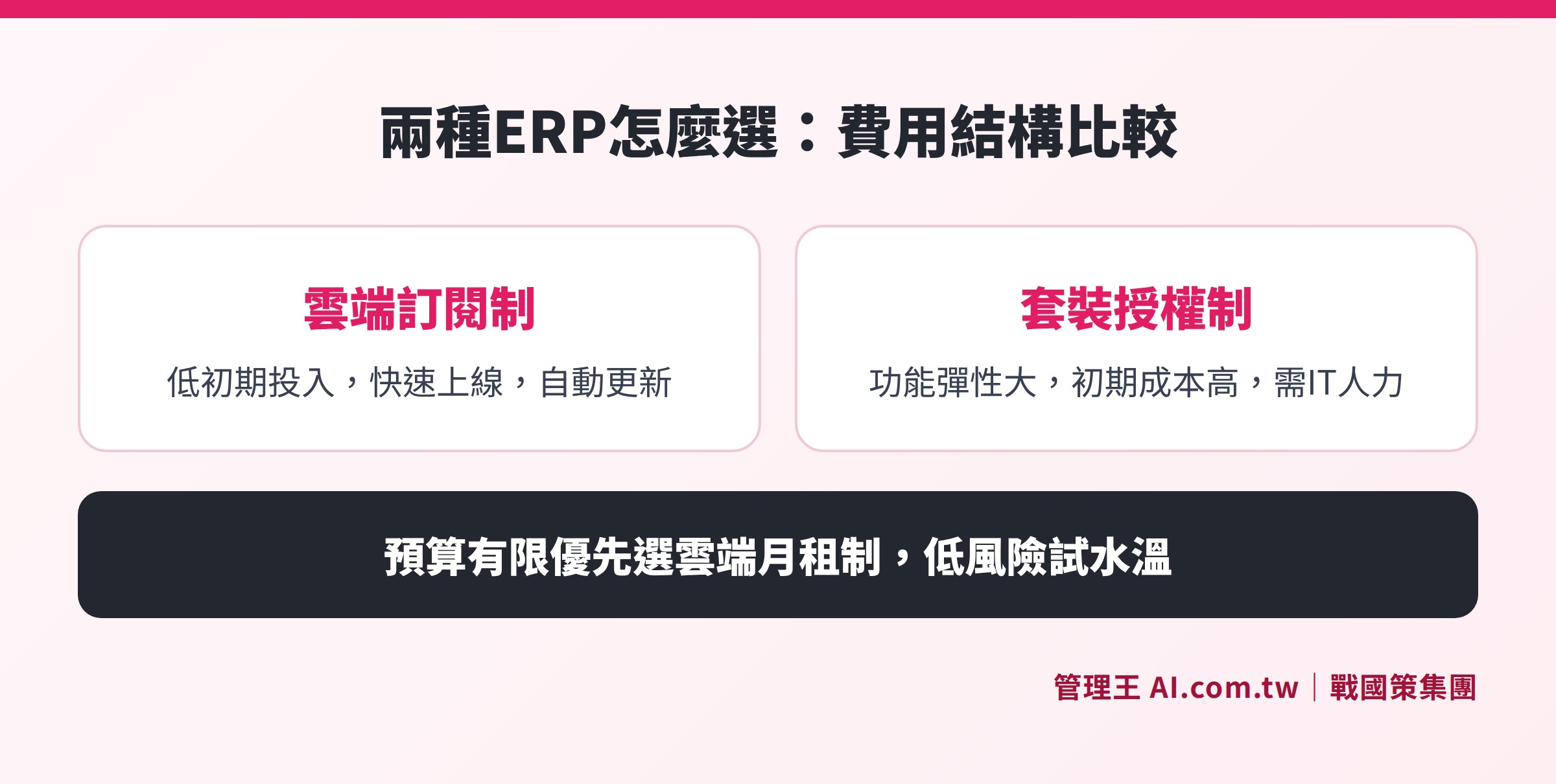
Comparing the total cost of ownership between the low initial cost of cloud ERP via subscription and the high licensing and consulting fees of packaged ERP
Government Subsidies: Lowering the Barriers for SMEs Adopting ERP
The Taiwanese government offers several subsidies for SMEs undergoing digital transformation, effectively lowering ERP implementation costs:
Cloud Marketplace Industrial Pavilion (for manufacturing industries): Hosted by the Ministry of Economic Affairs’ Small and Medium Enterprise Administration, manufacturing firms can apply for a maximum of NT$50,000 in digital points to offset eligible cloud solution costs (with a maximum offset rate of 50%). Eligibility: Medium-sized manufacturing enterprises that meet the SME recognition standards, with a capital amount of less than NT$100 million or fewer than 200 employees, and have a factory registration as per the law.
Application Notes:
- Have not received subsidies for the same project in the past three years
- No tax delinquency records
- Confirmation is required during application that the selected cloud solution has passed review
It's recommended that enterprises verify with their chosen service provider whether the plan has been registered as an eligible cloud solution before implementing ERP to smoothly use the government subsidies during application. The number of subsidies is limited, and once the annual quota is exhausted, it will not be replenished, so early application is advised.
For more information on related subsidy programs, please contact the Ministry of Economic Affairs’ Small and Medium Enterprise Administration or call 0800-280-280.
How to Use 管理王: Monthly Subscription ERP, Free Plan Available for Lifetime Use
管理王 AI.com.tw ERP System is an integrated cloud management system designed by 戰國策 Group specifically for Taiwanese SMEs, with all ERP functionalities available under a single account, eliminating the need to purchase additional software or pay consultant fees for setup.
Plan Selection:
- Free Plan: For up to 10 users, can be used permanently, includes basic ERP functionalities.
- Economical Plan: NT$5,000/month, for up to 30 users, suitable for SMEs in the initial adoption phase.
- Business Plan: NT$10,000/month, for up to 60 users, includes 8 hours of remote implementation support.
- Flagship Plan: NT$19,900/month, unlimited users, includes 16 hours of remote implementation support.
- Annual payment discount: Pay for 12 months and receive 14 months of service.
Operational Steps:
- Create product master data in Inventory Management and import initial inventory.
- Sales can convert a quote into an order with one click after completion in the Quotation System, with inventory automatically deducted.
- Issue purchase orders and stock in the Procurement System, and accounts payable will be generated automatically.
- Generate electronic invoices automatically for shipments, and offset accounts receivable upon payment.
- Check profit and loss statements directly in the Accounting System at month-end without manual organization.
Manufacturers with production needs can further enable the Production and Manufacturing module to create BOMs, issue production orders, and allow MRP to automatically calculate shortages. Payroll Calculations will directly read attendance data and automate entries.
For customization needs, the pricing is transparent at NT$1,000/hour, with a free initial assessment to evaluate development hours before proceeding. Services are provided by a local Taiwanese team, available at 0800-003-191 from Monday to Friday, with a traditional Chinese interface compliant with Taiwanese business regulations.
With over 30,000 enterprises served by 戰國策 Group, detailed plans can be found on the 管理王 Pricing Page.
Selection Advice for Different Scales
For each scale of enterprise, priority considerations differ slightly:
Microenterprises with up to 10 employees: Begin with the free plan, focusing on inventory management and basic accounting to keep financial data accurate, then evaluate expansion.
Growth enterprises with 10 to 30 employees: Needs for inventory management, quotations, and procurement can be covered by a monthly plan under NT$5,000; make sure to confirm native integration with electronic invoices and accounting.
Medium-sized enterprises with 30 to 100 employees: Usually require the integration of CRM and ERP for multiparty collaboration and management reports; evaluate whether a single account can integrate CRM, ERP, and EIP (electronic signature, attendance) during selection.
Companies with manufacturing operations: BOM, production orders, and MRP are core functionalities. Many cloud ERPs only have basic inventory management without production modules, so verify these requirements before selection.
If your company is still unclear about what ERP is, you can first refer to What is an ERP System? A Comprehensive Overview for SMEs from Inventory Management to Finance to understand the foundational concepts before proceeding with selection. For more detailed classifications of ERP systems, refer to What Types of ERP Systems Are There? Differences Between Cloud, Packaged, and Custom Models.
Additionally, some SMEs may not intend to implement a complete ERP immediately but at least need to get an Inventory Management System running to solve the issue of inaccurate inventory accounts, which is also the first step in adopting ERP.
Don’t Know Where to Start with ERP Selection?
管理王 consultants provide free consultations to help you evaluate the most suitable ERP solutions for your company's size and budget, ensuring quick deployment without unnecessary detours.
Free consultation hotline: 0800-003-191
LINE Official Account: @119m
Official Website: app.AI.com.tw
Free Trial: Apply for 管理王 now
Frequently Asked Questions
How much does ERP cost for SMEs per month?
The monthly subscription fee for cloud ERP varies based on the number of users and the range of functionalities. 管理王 AI.com.tw offers three tiers: free (for up to 10 users), NT$5,000 (for up to 30 users), and NT$10,000 (for up to 60 users), with the latest charges available on the official website. In addition to the monthly fee, it's essential to check for any limits on the number of products or orders, as well as the rates for customization.
Can ERP be implemented with a budget of only NT$5,000 per month?
Yes. 管理王 AI.com.tw's economical plan is NT$5,000/month, covering core functions such as inventory management, procurement, accounting, electronic invoicing, and quotations. Microenterprises with up to 10 users can even start with the free plan and upgrade as their business grows.
How long does it take for SMEs to implement ERP?
Cloud ERP is generally much faster to implement than packaged software. Typically, clients from the trading industry on 管理王 can go live within one to two weeks after importing products and initial inventory; companies with production requirements may take longer depending on the number of items as BOM needs to be established, with dedicated personnel assisting with the import.
Are there government subsidies available?
Yes. Manufacturers can apply for subsidies from the Ministry of Economic Affairs’ Small and Medium Enterprise Administration for the 'Cloud Marketplace Industrial Pavilion,' which offers a maximum 50% offset on cloud solution costs (up to NT$50,000). The eligibility criteria, subsidy amounts, and item specifics align with the latest announcements from authority bodies, so it's advised to confirm beforehand with 管理王 consultants whether the chosen solution meets subsidy requirements.
Can we transfer existing Excel data after implementing ERP?
Yes. 管理王 supports importing customer, product, initial inventory, and accounting data, with personnel assisting in converting historical data from old ERP or Excel to minimize transition risks.
Sources
- Industrial Technology Research Institute: Introduction to Cloud ERP Applications in Supply Chain Integration
- CNA: Get 50,000 Now! 'Cloud Marketplace Industrial Pavilion - Cloud Solution Subsidy' Launched
- Ministry of Economic Affairs, Small and Medium Enterprise Administration: https://www.sme.gov.tw/
- Management System Features Page of 管理王 AI.com.tw
- Pricing Plans of 管理王 AI.com.tw