What is Social Listening? Using Online Sentiment to Find Business Opportunities and Potential Customers | Recommended Social Listening Tools

Social listening helps businesses identify high-intent potential customers, monitor brand reputation, and analyze competitors' dynamics from online sentiment in platforms like FB groups, Dcard, and PTT. It is a core strategic tool for business development and brand management.
Social listening is a systematic approach to tracking conversations online regarding brands, competitors, and industry keywords, and then analyzing these to derive actionable insights. Unlike simply "monitoring if anyone mentions me," the focus of social listening is on "why people are saying this" and "what should I do next." For small and medium-sized enterprises in Taiwan, platforms like FB groups, Dcard, PTT, LINE communities, and Google reviews are where consumers or business owners express needs, complain about issues, and compare products daily. These unstructured voices represent untapped business opportunities and warning signals. Mastering social listening means business development, brand management, and product improvement are supported by data, rather than relying solely on intuition and experience.
What is Social Listening? Complete Analysis of the Core Concepts
Definition: The Complete Process from Monitoring to Insight
The complete definition of social listening is: Collect → Analyze → Respond → Adjust Strategy — a four-step cycle. According to the marketing tool platform Sprout Social, social listening includes tracking direct mentions of the brand, keyword discussions, competitor conversations, and industry trends, and then converting these raw voices into actionable business decisions.
Many people confuse "social monitoring" and "social listening," but the two have significantly different levels of thinking:
Table: Social Monitoring vs. Social Listening
| Aspect | Social Monitoring | Social Listening |
|---|---|---|
| Objective | Track direct mentions and tags | Understand the overall context and trends of conversations |
| Time Frame | Real-time, short-term | Long-term, cross-time comparisons |
| Response Method | Passive response | Proactive prediction and strategy adjustment |
| Users | Customer service, community editors | Marketing managers, brand strategists, business executives |
| Output | Notices, to-do lists | Insight reports, strategic recommendations |
The two are not in competition but rather different layers of the same process: monitoring ensures you miss nothing, while listening allows you to understand the big picture.
Sources of Data for Social Listening
Commonly used sources for social listening in Taiwan include:
- FB groups and fan pages: The most active discussion venues for B2B and B2C business owners in Taiwan
- Dcard, PTT: Real consumer reviews and experiences, crucial platforms for negative review alerts
- Google reviews: Local business ratings directly impact search rankings and consumer decisions
- LINE communities and groups: Taiwan's unique high-penetration instant messaging communities
- Threads, IG, TikTok: The frontline for brand exposure and KOL distribution
- Little Red Book: An essential review community for brands targeting the cross-strait market
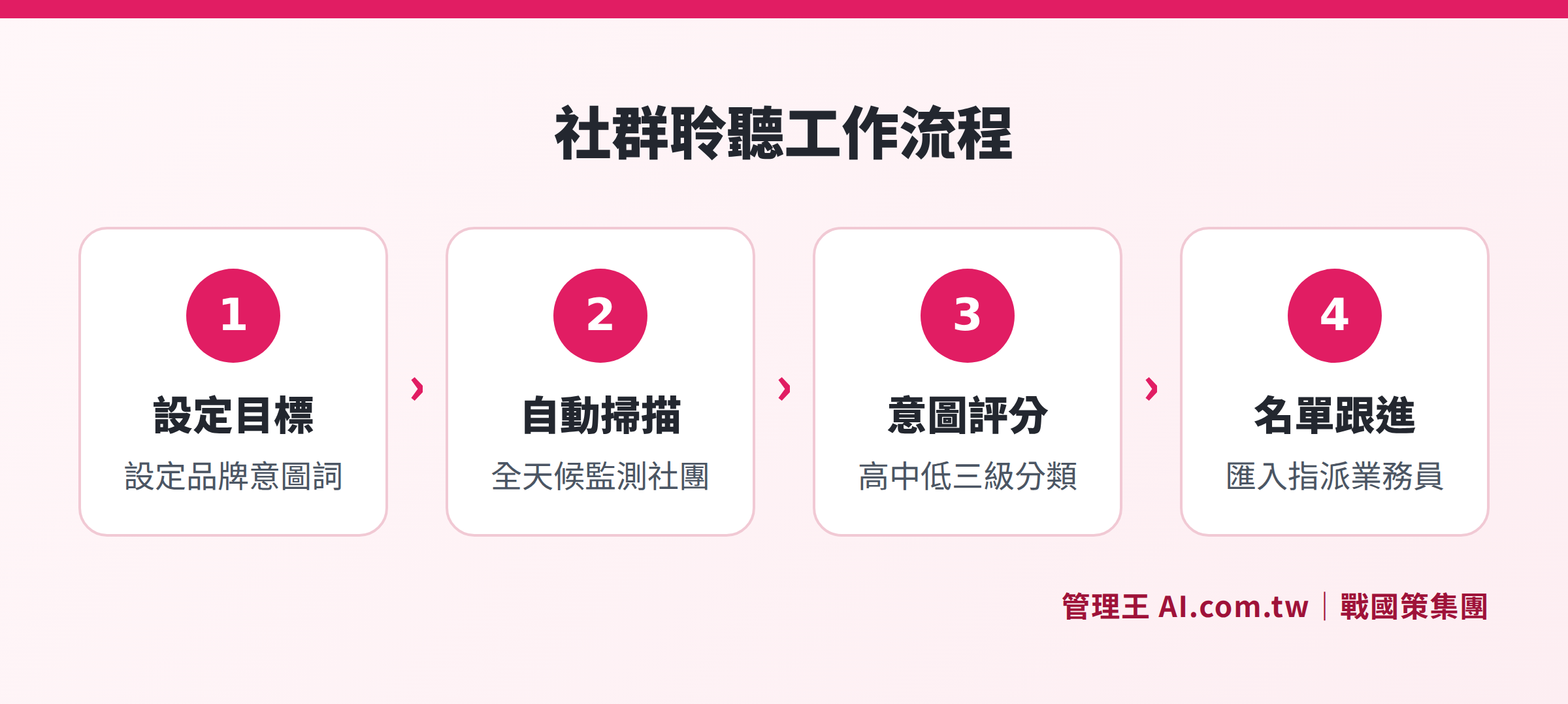
The complete workflow of social listening from keyword setup, automatic collection of posts, AI intent scoring, to CRM import for follow-up
What Can Social Listening Discover? Six Major Business Application Scenarios
Scenario 1: Business Development — Discover High-Intent Potential Customers
Every day, there are posts asking for services, comparing vendors, or seeking recommendations on FB groups, PTT entrepreneurship boards, and Dcard job boards. For example, "Can someone recommend an accountant in Taipei?" "I need someone to help me with SEO," "Looking for storage and logistics providers." These posts are clear signals of purchasing intent and represent a golden list for B2B business teams.
Social listening allows business teams to extract potential customers with needs and budgets directly from the social noise without relying on cold calls or paid ads.
Scenario 2: Brand Management — Negative Review Alerts and Reputation Monitoring
Consumers rarely directly mention brands when complaining; they often discuss in groups or forums. Without social listening, companies may not realize there's a problem until their Google rating falls below 3.5. Proactively setting up brand keyword monitoring can enable immediate responses before negative reviews spread, reducing the cost of crisis management from "PR firefighting" to "customer service communication."
Scenario 3: Competitor Analysis — Knowing Yourself and Your Competitors to Seize Opportunities
Monitoring competitor names and keywords related to their strengths and weaknesses (for example, "XXX is expensive," "XXX has poor after-sales service") allows understanding of competitors' weaknesses from the consumer's perspective, which can help adjust self-positioning and sales pitches.
Scenario 4: Product Improvement — Drive R&D with Real Voices
Consumers discussing pain points in communities are more genuine and timely than focus groups. Needs like "Why isn't there a mobile app?" or "Can the reports be exported to Excel?" directly appear in the community and serve as the most straightforward vote for the product roadmap.
Scenario 5: Marketing Optimization — Find Messages that Resonate
When testing different ad copies, social listening helps marketing teams understand which statements truly resonate with the audience and which conversations drive the most shares, optimizing the creative direction for the next round of campaigns.
Scenario 6: Market Trend Forecasting — Stay Ahead of Competitors
When a surge of discussions on a new topic suddenly appears in the community (for example, "AI customer service," "carbon emission reporting"), it signals that market demand is forming. Establishing related content and services three to six months ahead of competitors can significantly reduce market education costs.
How to Conduct Social Listening? A Standard Process from Setup to Action
Effective social listening is not just about "posting keywords and looking at results," but rather a continuously operated workflow:
Step 1: Define Listening Objectives
First, confirm whether the goal of this listening is to find leads, monitor the brand, or understand competitors? Different goals correspond to different keyword strategies.
Step 2: Set Up Keyword Matrix
This includes brand terms (brand names, abbreviations, common misspellings), product terms (features, use cases), intent words ("looking for recommendations," "which is better?" "has anyone used this?"), competitor terms, and industry terms.
Step 3: Choose Monitoring Platforms
Decide which platforms to monitor based on the target audience; the main platforms for B2B in Taiwan are FB groups, LinkedIn, and PTT; B2C also needs to cover Dcard, IG, and Google reviews.
Step 4: AI Filtering and Scoring
The large volume of original posts requires automated tools for filtering, focusing on eliminating ads and filtering irrelevant noise, and ranking by purchase intent strength, allowing humans to only review high-value signals.
Step 5: Convert into Actionable Information
- Business Development: Import high-intent posters into CRM and assign sales to follow up
- Brand Management: Immediately notify customer service to respond to negative reviews
- Competitor Analysis: Compile monthly reports of competitor pain points
- Product Improvement: Compile a list of feature needs quarterly
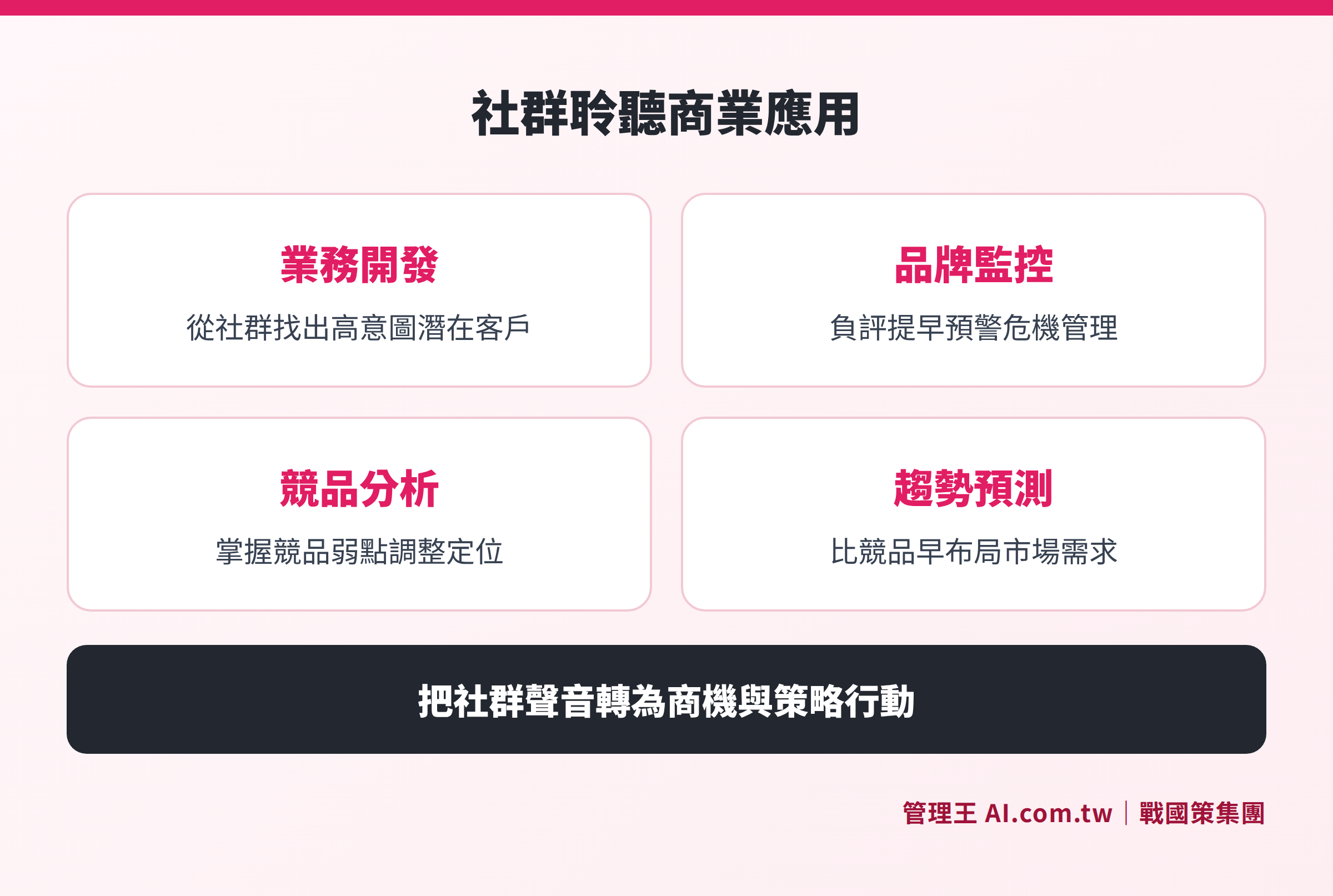
Introduction to the six application scenarios: business development, brand monitoring, competitor analysis, product improvement, marketing optimization, and market trend forecasting.
How to Choose Social Listening Tools? Five Key Evaluation Points
Social listening tools available in the Taiwanese market range from international giants to local services. Before choosing, ensure you confirm the following five points:
Table: Key Evaluation Points for Social Listening Tools
| Evaluation Item | Description | Why It Matters |
|---|---|---|
| Taiwan Platform Coverage | Does it support FB groups, Dcard, PTT, LINE? | Foreign tools often lack integration with mainstream discussion areas in Taiwan. |
| Complexity Analysis in Traditional Chinese | Can AI understand Taiwan's terminology and slang? | Direct translation from English models often misjudges the Taiwanese context. |
| Intent Scoring Mechanism | Can it distinguish between high and low intent, rather than just hitting keywords? | Filtering quality determines the time efficiency of business operations. |
| CRM Integration | Can good leads go directly into the system and be assigned to sales? | Data silos lead to a high loss rate of leads. |
| Transparent Pricing | Low trial thresholds, clear charging logic | Small and medium-sized enterprises have limited budgets, making flexibility crucial. |
In a Nutshell
The value of social listening lies not in how much data is collected, but in how many insights turn into business actions.
International tools (like Brandwatch, Meltwater, Sprout Social) offer comprehensive functions but have high monthly fees and lack integration with localized platforms in Taiwan (LINE, PTT), making them suitable for large enterprises with dedicated marketing analysts. Local tools (like OpView, QSearch) have advantages in complex Chinese sentiment analysis and cater well to brand monitoring and public opinion analysis needs. Meanwhile, 管理王's AI automated social listening tool serves as an integrated option directly embedded in the business development process, making it more suitable for small and medium-sized enterprise teams focusing on "lead conversion."
How to Use 管理王's AI Automated Social Listening Tool for Social Listening?
管理王's AI Automated Social Listening Tool is specifically designed for B2B and B2C business development in Taiwan, fully automating the "discover leads" step of social listening.
Main Features:
24/7 Automatic Scanning of Designated Groups: Simply set up keywords (for example, "looking for an accountant," "want to start a company," "need to find an ERP"), and the system will automatically scan the built-in whitelist of over 50 groups commonly used by small and medium-sized enterprises in Taiwan, eliminating the need for salespeople to keep scrolling on their phones.
AI Purchase Intent Scoring (0 to 100): A large language model determines the purchase intent strength of each post, automatically categorizing them into high, medium, and low levels, allowing salespeople to focus only on high-intent leads, greatly improving development efficiency.
De-duplication and Dumb-proof Filtering: Automatically excludes ad posts and previously contacted potential clients to avoid awkward duplicate outreach.
One-click Integration into CRM and Automatic Drafting of Development Emails: The entire process from discovering high intent leads to sending out the first development email can be completed in one go, and combined with marketing automation features, follow-up sequences can also be set up.
With social scheduling management and ad management features, it forms a complete loop of "listening → discovering leads → developing → advertising and remarketing → closing deals," all handled by a single system from initial outreach to customer conversion.
The free plan can be used permanently, and you can start detecting FB group opportunities on the day you sign up, without needing to bind a credit card. For plan details, please refer to the 管理王 pricing page.
Common Misunderstandings and Best Practices in Social Listening
Myth 1: Only Monitoring Brand Names and Ignoring Intent Keywords
Many companies set up monitoring for brand names but forget that consumers usually do not spontaneously mention brands when discussing needs. For example, "I want to find an ERP system" or "Any recommendations for accounting software?" are the real high-value business signals.
Best Practice: The keyword matrix should cover four dimensions: brand terms, product terms, pain point terms, and intent terms.
Myth 2: Collecting Data without Subsequent Actions
"We did social listening, but no one followed up on the leads" is a common failure pattern. The value of listening entirely depends on whether subsequent actions are taken.
Best Practice: Establish a standardized SOP that clarifies who is responsible for each type of insight and what actions must be taken within what time frame.
Myth 3: Low Frequency, Missing Timely Signals
Brand crises or business opportunities often emerge or dissipate within 24 to 48 hours. Only reviewing reports once a week often means missing the best intervention timing.
Best Practice: Set up real-time notifications for negative reviews and high-intent leads; competitor and trend analysis can be compiled weekly or monthly.
Social Listening Entry Recommendations for Small and Medium-Sized Enterprises in Taiwan
For budget-limited small and medium-sized enterprises, it is recommended to start with the following three prioritized scenarios, each having clear activation thresholds and quantifiable goals:
- Prioritize Business Development: Set 5 to 10 high-intent keywords and systematically scan 3 to 5 relevant FB groups daily, quantifying the task of finding leads. The goal is to produce at least 20 high-intent leads weekly for sales follow-up.
- Next, Brand Alerts: Set up monitoring for brand names and common misspellings, checking at least once a day for negative reviews or complaints, using Google review management tools to track rating dynamics and ensure responses to negative reviews within 24 hours.
- Monthly Competitor Analysis: Regularly compile key discussions about competitors each month to inform sales pitches and product improvements, allowing the product roadmap to be based on market voices.
Once you have established basic processes, gradually introduce tools for automation to avoid initially investing too heavily in tool costs.
How to Measure the Effectiveness of Social Listening? Key Indicators Overview
The return on investment of social listening is not easy to measure directly, but its effectiveness can be indirectly verified through several dimensions:
Business Development Effectiveness Indicators
- Number of High-Intent Leads Discovered Weekly: After setting a baseline, track changes in lead counts before and after the tool's implementation.
- Lead Conversion Rate: The conversion ratio from social leads to first contact and into the sales process.
- Time Saved on Business Development: Compare how much time each salesperson spends weekly finding leads before and after implementation.
Brand Monitoring Effectiveness Indicators
- Response Time to Negative Reviews: The average time from when a negative review appears to when the brand first responds, with a goal of shortening this to within 24 hours.
- Changes in Sentiment Ratios: Track the monthly proportions of positive, neutral, and negative reviews.
- Changes in Google Ratings: Using the Google review management tool, observe the long-term trends of ratings following proactive responses.
Marketing Strategy Effectiveness Indicators
- Topic Engagement Rate: The change in interaction rates of related posts after the brand joins community conversations.
- Occurrence Frequency of Competitor Comparison Posts: How often consumers compare your brand with competitors, which indicates brand visibility in their minds.
- Hit Rate of Popular Topics: Comparing traffic and interactions between content based on trends discovered through social listening and content created independently.
Complete Funnel Traceable After CRM Integration
The most comprehensive measurement method is to mark the sources of leads from social listening in the CRM and finally compare the differences in conversion rates, amounts, and collaboration duration between "customers from social listening" and "customers from ads or other channels." Many sales-oriented B2B companies find that leads from social listening tend to convert at a significantly higher rate than cold calls or ad-generated leads due to their inherent demand and active search for solutions.
Try the AI Automated Social Listening Tool Now
Professional consultants will assist in setting up monitoring of FB group keywords to discover high-intent potential customers from social sentiment, turning lead development into a replicable, systematic process.
Free consultation hotline: 0800-003-191
LINE official account: @119m
Official website: app.AI.com.tw
Free trial: Apply for 管理王 now
Frequently Asked Questions
Is social listening the same as public opinion monitoring?
Not entirely. Public opinion monitoring (also known as reputation monitoring) generally refers to tracking all mentions of a brand online, focusing on quantity statistics and sentiment analysis, inclined towards "what is being said." Social listening has a broader scope, encompassing not only brand mentions but also industry trends, competitor dynamics, and the evolution of consumer needs, aiming to understand "why this is being said" and "what we should do," making it a more strategic business intelligence function.
Does social listening require a large budget?
Not necessarily. You can start with free or low-cost tools, such as manual searches in FB groups combined with simple spreadsheet logging. Companies with larger budgets can adopt local tools (monthly fees ranging from a few thousand to tens of thousands) or integrated systems (such as 管理王's AI automated social listening tool, which has a free plan for permanent use). The key is to first establish processes and then consider scaling with tools.
What is the most important platform for social listening in Taiwan?
For B2B business development, FB groups are the most effective single platform for social listening in Taiwan because business owners and procurement staff tend to inquire about vendor recommendations in groups; for B2C brands, it's necessary to also cover Dcard, IG, and Google reviews due to the authentic evaluations consumers often refer to before making decisions.
Can one person conduct social listening?
Yes, but it requires tool assistance. Manually scanning social noise is very time-consuming; a salesperson spending three hours daily scrolling through groups might find only a few effective leads. Using AI automated filtering tools allows the same person to sort through dozens of high-intent leads in just thirty minutes, focusing their time on "judgment and development" rather than "collection and filtering."
What are the regulatory restrictions on social listening data?
The Personal Data Protection Act in Taiwan regulates the collection and use of personal data. As a general principle, publicly available posts can be used for commercial analysis, but when actively contacting individuals, it is necessary to inform them of the source and give them the right to refuse. It is recommended to explain the channel through which the information was obtained in development emails or messages and provide an opt-out option to comply with the spirit of personal data laws. Detailed regulations should refer to the latest announcements from the Ministry of Justice.
Sources
- Sprout Social - What is Social Listening and Why Does It Matter (English), 2024 Inquiry
- OpView Community Reputation Database - What is Social Listening Research Method (Traditional Chinese), 2024 Inquiry
- 管理王 AI Automated Social Listening Tool Features Page
- 管理王 AI.com.tw Service Plans
- Ministry of Justice Text of the Personal Data Protection Act, Nationwide Regulations Database, 2024 Inquiry