How to Schedule Social Media Posts? A Guide to Managing FB, IG, and LINE Posts|Recommended Social Media Scheduling Tools

Social media scheduling allows marketing editors to plan and automatically publish posts across multiple platforms like FB, IG, and LINE in bulk. This article explains the complete batch scheduling SOP, best posting time settings, AI copywriting tips, and recommends social media scheduling tools suitable for small and medium-sized enterprises in Taiwan.
Social media scheduling is a marketing method that allows you to plan posts for multiple platforms such as Facebook, Instagram, LINE, Threads, and Xiaohongshu at once, with the system automatically publishing them at designated times. For small and medium-sized enterprises, adopting social media scheduling tools means that social media editors no longer need to manually post while watching the clock or work on holidays. The marketing team can concentrate on creating a whole month's content at the beginning of the month, allowing each post to appear punctually during peak activity times for fans, while continuously optimizing content strategy through performance data, upgrading social media management from 'manual oversight' to 'data-driven automation.'
What is Social Media Scheduling? Definition and Core Concept
Social media scheduling refers to the mechanism of pre-setting the content, publishing time, and target platform for posts, allowing tools or systems to automatically publish at designated times. This differs from "posting immediately after writing"—scheduling separates content creation from content publishing, enabling marketers to focus on production when they have inspiration and time, reaching fans at optimal times.
The core process of social media scheduling includes four key steps:
- Content Planning: Determine the themes, frequency, and allocation for each platform over a specific period (usually one week to one month).
- Copy and Material Production: Write the post text, accompany it with images or videos, and adjust formats according to the characteristics of each platform.
- Set Publishing Times: Choose the best times based on platform data and schedule them in the calendar.
- Automated Publishing and Tracking: The system publishes posts according to the schedule and compiles interactions data such as likes, shares, and comments in real-time.
In a nutshell
Social media scheduling allows you to "make a plan for the whole month at the beginning of the month, with the system automatically posting on time throughout the month," so editors no longer have to watch the clock.
Current State of Social Media Usage in Taiwan: Why Scheduling Tools are Becoming Increasingly Important
According to the National Communications Commission (NCC) 2024 communication market survey report, the usage rates of major social media platforms in Taiwan are as follows:
Table: Usage Rates of Major Social Media Platforms in Taiwan (NCC 2024 Survey)
| Platform | Usage Rate | Characteristics |
|---|---|---|
| 82.8% | Mature community in Taiwan with broad fan page reach | |
| LINE | 99.4% | First app opened daily, highest private messaging engagement |
| 47.1% | Visual branding content, high interaction among younger demographics | |
| YouTube | 68.5% | Main focus on video content, good long-tail SEO effects |
| TikTok | 24.7% | Quick dissemination of short videos, main battlefield for Generation Z |
| Threads | Rapidly growing | Integration with Meta ecosystem, active text-based influencers |
For small and medium-sized enterprises, maintaining consistent updates across these multiple platforms can take at least ten to twenty hours of fragmented time each week if done manually. Additionally, given Instagram and Facebook's algorithms favoring update frequency, many smaller brands often see their accounts become dormant due to "lack of time to post." Social media scheduling tools are crucial in addressing this issue.
Differences in Scheduling Across Platforms: The Nuances of FB, IG, LINE, and Threads
Different platforms have significant differences in scheduling rules and content formats, so it's essential to be aware of the following key points before posting:
Table: Comparison of Scheduling and Content Specifications Across Platforms
| Platform | Suggested Character Count | Hashtag Strategy | Optimal Posting Frequency | Supported Scheduling Methods |
|---|---|---|---|---|
| 180–280 characters | Few (within 3) | 3–5 posts per week | Native scheduling via Meta Business Suite | |
| 150–300 characters | 5–15 related tags | 4–7 posts per week | Meta Business Suite or third-party tools | |
| LINE Official Account | Within 200 characters (image and text) | Not applicable | 2–3 broadcasts per week | LINE Official Account Manager |
| Threads | Within 500 characters | 1–3 tags | 1–3 posts per day | Meta Business Suite (from 2024) |
| Xiaohongshu | 300–800 characters | 5–10 Chinese tags | 3–5 posts per week | Requires third-party integration |
| 300–1,200 characters | 3–5 tags | 2–3 posts per week | Native scheduling or third-party tools |
Particular attention is needed for scheduling LINE Official Accounts: LINE's broadcast messaging (Broadcast) is charged based on the number of messages, so segmenting the audience before scheduling is essential to avoid increased blocking rates from pushing notifications to unrelated users. According to LINE's official documents, scheduling can target specific tagged groups through the "audience settings" function, effectively reducing the block rate and increasing open rates.
Complete Guide to Optimal Posting Times: When to Post for Maximum Reach?
Based on the Meta Business Suite's official analytics and various published studies, common high-reach times in the Taiwanese market are as follows:
- Facebook / Instagram: Best performance on weekdays from 11:30–13:30 (lunch breaks) and 19:00–21:00 (after work relaxation)
- Threads: Similar to Facebook, good performance in the morning from 7:30–9:00 during commuting times
- LINE broadcasts: Highest open rates from Monday to Friday at 9:00–10:00, with good times on weekends at 10:00–11:00
- Xiaohongshu: Peak activity times are in the evenings from 20:00–22:00 and afternoons on weekends
However, the "best time" can vary based on the daily habits of a brand's audience. Utilizing the "most active times" feature in Meta Business Suite or the intelligent time suggestions in 管理王's social scheduling system can help pinpoint personalized best times based on your audience's historical interaction data, which is more accurate than applying general recommendations.
Moreover, the posting frequency and rhythm are equally important. Studies show that if a Facebook page posts fewer than three times a week, the algorithm will drop the post's priority display on fans' feeds; Instagram prefers a consistently stable update rhythm. Suddenly posting intensively and then going silent for long periods can harm reach more than consistently posting four to five times a week. Therefore, the core value of scheduling tools lies not just in "saving time" but in helping brands maintain a "consistent posting rhythm," allowing algorithms to view your content as from an active account, gradually accumulating advantages in natural reach over time.
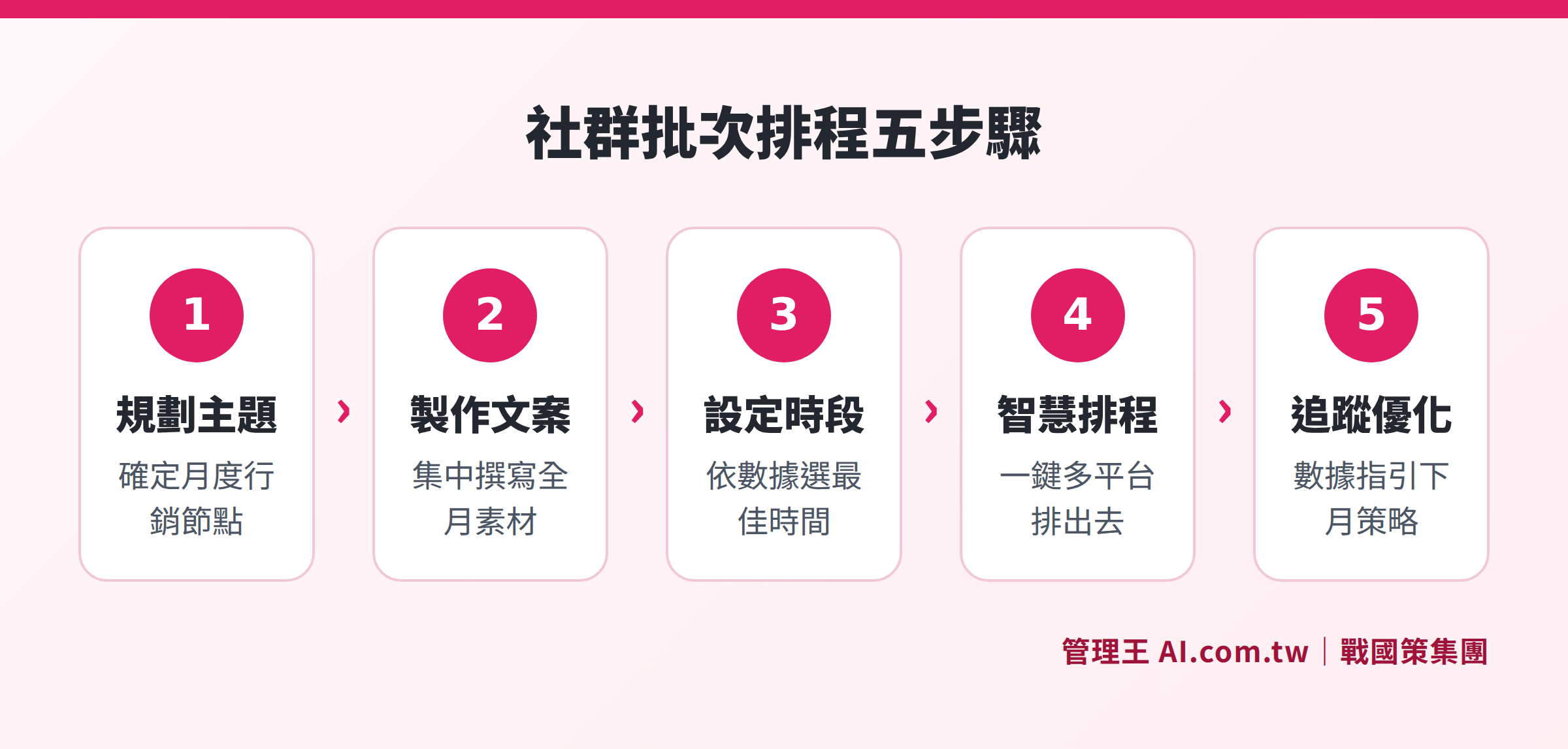
Complete workflow from planning themes at the beginning of the month to automatic publishing and tracking performance in five steps
Batch Scheduling SOP: From Planning at the Beginning of the Month to Automatic Publishing Throughout the Month
Batch scheduling refers to completing the planning and scheduling of posts for an entire period (usually at the beginning of the month or bi-weekly) in one work session, maximizing marketing efficiency. Here are the standard processes for batch scheduling suitable for small and medium-sized enterprises in Taiwan:
Step 1: Define the Marketing Themes and Key Dates for the Month
List upcoming festivals (e.g., Mid-Autumn Festival, Singles' Day, anniversary sale), new product launch dates, promotion date, and long-term brand themes (knowledge-based content, customer testimonials, product introductions, etc.) to create a framework for a month's worth of content.
Step 2: Decide on Posting Frequency and Formats per Platform
Allocate the proportion of various content types according to the characteristics of each platform. For example: Instagram focuses on image-based knowledge cards, Facebook emphasizes long-form interactive posts, LINE targets limited-time offers, and Threads publishes immediate opinions and topics.
Step 3: Concentrate on Writing Copy and Preparing Materials
Complete the first draft of all post texts for the month in one day, using AI-assisted tools to accelerate generation, followed by unified manual proofreading to adjust brand tone, and prepare corresponding images and video materials.
Step 4: Input into the Scheduling Tool All at Once
Enter all post content, materials, and timestamps into the scheduling tool, setting the corresponding platform combinations and posting times for each piece. Tools with "smart rewriting" functions can automatically adjust word counts and hashtags for each platform, saving the time of making individual edits.
Step 5: Post-Publishing Tracking and Adjustments
Review the interaction data for each post weekly, determine which content types and timings perform best, and use this as reference for the next month’s planning, forming a continuous optimization data feedback loop.
How to Use AI Copy Generation in Conjunction with Social Media Scheduling
In recent years, the popularity of AI copy tools has significantly improved editors' efficiency. However, several key principles should be considered when using AI-generated social media posts to truly infuse "human touch" into the copy:
- Provide Adequate Brand Context: Supply examples of brand tone, target audience descriptions, and key product features so that the AI-generated copy aligns with the brand personality.
- Select Tools Optimized for Traditional Chinese Context: Some foreign AI tools generate Traditional Chinese copy with obvious traces of machine translation or simplified Chinese phrases; select tools trained for the Taiwanese context.
- Provide Three Styles to Choose From: For each piece of copy, ask AI to generate three versions—"professional," "friendly," and "lively"—to then manually select the most suitable.
- Manual Review Before Scheduling: AI-generated drafts must undergo manual proofreading to ensure brand information is correct, promotional conditions are accurate, and no prohibited language is used.
The best way to combine AI copy generation with scheduling tools is to integrate both tasks into the same workflow. Traditionally, copy was written in Google Docs, screenshots saved to Google Drive, and then each post was manually copied into each platform’s backend for scheduling, repeating the process for each platform. If material naming or version management isn’t done well, confusion easily occurs. An integrated social media scheduling tool allows you to complete the entire process of AI generation → manual revision → material upload → platform selection → time scheduling within the same interface, enabling team leaders to conduct online reviews and approvals before publication, ensuring each post meets brand standards.
The AI editor function of 管理王 AI.com.tw is specifically trained for the Taiwanese Traditional Chinese business context and can generate 30 draft posts from scratch in as little as ten minutes, also supporting automatic format adjustments according to each platform’s characteristics.
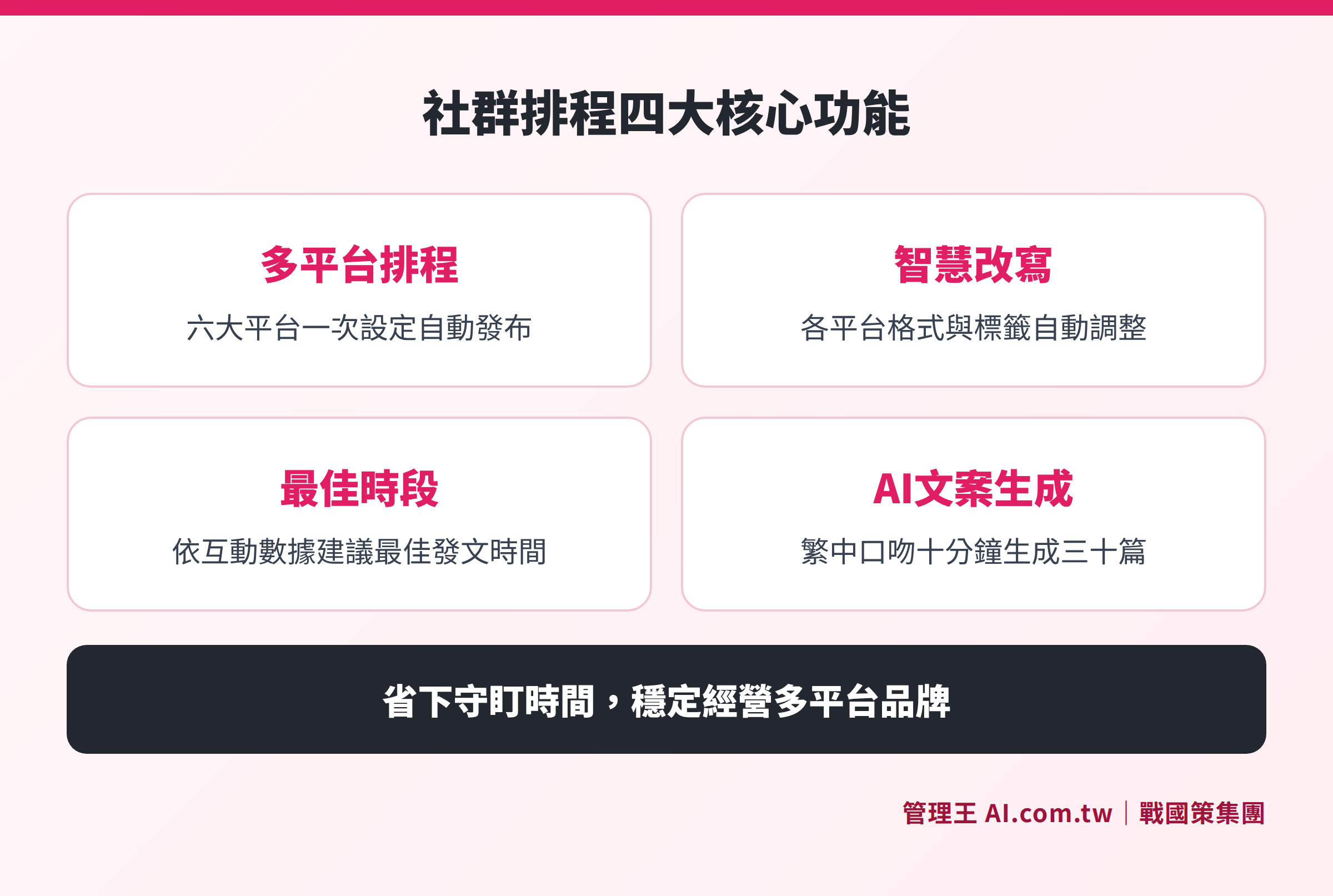
Four major features: Multi-platform scheduling, smart rewriting, optimal timing, and AI copy generation addressing Taiwanese enterprise pain points
How to Choose Social Media Scheduling Tools? A Purchasing List for Taiwanese Enterprises
When Taiwanese enterprises select social media scheduling tools, the following dimensions are critical to consider:
1. Does it support mainstream platforms in Taiwan?
LINE Official Account is an essential channel for Taiwanese enterprises, and many foreign tools do not support LINE integration. Xiaohongshu is also an important platform for some consumer brands targeting the Mandarin-speaking market, so ensure the tool supports it.
2. Does the AI copy support Traditional Chinese?
The quality of the copy directly affects engagement rates. Opt for a tool that can generate "Taiwanese tone" Traditional Chinese copy to avoid using mainland terms or machine translation nuances.
3. Is performance tracking unified across platforms?
The native backend data of each platform is dispersed, and logging in every week to check is very time-consuming. Choosing a tool that displays all platform KPIs (reach, engagement, tracking, conversion) in one interface can significantly enhance reporting efficiency.
4. Does it integrate with other marketing tools?
Social media posts typically aim to drive traffic to websites, enroll in memberships, or purchase products. Selecting solutions that can natively integrate with CRM, e-commerce platforms, and landing page tools allows data to flow directly, eliminating the need for separate API connections.
5. Account authorization security
Marketing teams that collaborate with multiple members should confirm whether the tool provides comprehensive account permission control to prevent loss of social assets due to employee turnover or account theft.
6. Local customer support availability
Being able to rapidly obtain support in Chinese when encountering issues during use is more critical than waiting for overseas support tickets.
7. Free trials and flexible plans
Prioritize tools that offer permanent free plans or long trial periods, allowing you to fully evaluate the operational experience before paying. Additionally, confirm whether plans can flexibly upgrade as the enterprise grows—from personal brands or small businesses to chain enterprises, needs may change rapidly within one to two years. It’s also essential to pay attention to the billing methods of paid plans: some tools charge based on the number of accounts (the more social accounts connected, the higher the cost), while others bill based on "number of members" or "number of posts," so assess the long-term total cost based on your usage situation to avoid significant subscription fee hikes as scale increases.
Using 管理王 AI.com.tw for Social Media Scheduling
管理王's social media scheduling management function is the core module of the marketing systems among the nine systems of 管理王 AI.com.tw. It supports multi-platform scheduling for more than six platforms, including Facebook, Instagram, LINE Official Account, Threads, Xiaohongshu, and LinkedIn.
Operational Steps:
- Log into 管理王's backend and navigate to "Marketing System → Social Media Scheduling Management".
- Select "New Scheduled Post" and choose the platforms to be published (multiple selections allowed).
- Enter the copy in the unified editor or click "AI Editor Generate" to let the system produce the draft.
- Activate the "Smart Rewriting" function so the system automatically adjusts the word count and hashtag format for each platform.
- Click on "Optimal Timing Suggestions" to view the recommended posting times based on past data.
- Preview before publication to see the actual presentation effects on each platform in a simulated interface.
- Click on "Add to Schedule"; the system will automatically publish at the designated time.
Integration Advantages with Other Systems:
管理王's social media scheduling integrates natively with the CRM system, allowing automatic social posts or LINE broadcasts to be triggered at specific points in the customer lifecycle (e.g., 7 days after the first purchase, birthday month for members), along with the marketing automation function to design an omnichannel customer journey. By pairing with ad management, natural traffic (scheduling posts) and paid traffic (advertising) can complement each other, viewing the overall return on investment across all channels in a unified backend.
The free plan allows usage on three platforms with a quota of thirty scheduled posts per month, permanently free to use, especially suitable for budget-limited Taiwanese small and medium enterprises starting to build social rhythms without the need for a credit card for immediate trial.
More marketing-related tools can be referenced:
- AI Automated Social Monitoring Tool: Detecting intentions in FB groups and automatically filtering potential customers
- Email Marketing: Sending EDMs and communicating with members
- Landing Page Creation: Goal pages for social posts driving traffic
- Membership Points System: Combining social activities with member rewards
Further reading:
Let consultants help plan your social media scheduling strategy
The 管理王 consulting team offers free consultations to help establish multi-platform scheduling processes and select suitable tools, upgrading social media management from fragmented observation to systematic automation.
Free consultation hotline: 0800-003-191
LINE Official Account: @119m
Official website: app.AI.com.tw
Free trial: Apply for 管理王 now
Frequently Asked Questions
Can social media scheduling tools be used for free?
Yes. The 管理王 AI.com.tw free plan can be used permanently, allowing connections to three social platforms and a quota of thirty scheduled posts per month, along with one-time points for AI copy generation, making it suitable for personal brands or small enterprises as an entry-level option. Paid plans (starting at NT$5,000/month) unlock more platforms, higher post quotas, and additional AI points available for upgrade according to needs.
Can LINE Official Accounts schedule through third-party tools?
LINE Official Accounts support third-party integrations via the Messaging API, allowing legally authorized tools to perform scheduled broadcasts. Before use, ensure the tool has the LINE Officially recognized Verified API Partner qualification, and take note that LINE's messaging broadcasts are charged by the number of messages sent, so it is advisable to segment the audience before scheduling to control costs.
Does social media scheduling affect organic reach?
According to Meta's official statement, posts published using the native scheduling feature of Meta Business Suite (including third-party authorized tools) do not differ in organic reach compared to manual real-time posts. What truly affects reach are content quality, interaction data, and publishing timing, not the use of scheduling tools themselves.
How many people on a marketing team are suitable for introducing social media scheduling tools?
Even a one-person marketing team can benefit significantly from social media scheduling tools—saving time spent logging into each platform for manual posting daily allows limited energies to focus on content quality. For marketing departments of three to five people, batch scheduling enables team collaboration during review sessions, maintaining uniformity in posts and avoiding errors or style inconsistencies.
Can different posts be set for different audience groups?
Facebook and Instagram's native tools support limited audience settings (e.g., age restrictions); LINE Official Accounts can send different messages to various customer groups through tagging and audience segmentation. For more precise personalized outreach (e.g., triggering different posts based on purchasing behavior or CRM tags), marketing automation tools need to be incorporated, and 管理王's marketing automation function supports such advanced applications.
Data Sources
- National Communications Commission (NCC) 2024 Communication Market Report (2024, statistics on the usage rates of various social platforms in Taiwan)
- Introduction to LINE Official Business Account in Taiwan (LINE Official Account features and charging explanation, inquiry for 2026)
- Meta Business Suite Official Scheduling Feature Description (Facebook/Instagram scheduling features and reach rate explanations, inquiry for 2026)
- 管理王 Function Page: Social Media Scheduling Management (Official function introduction of 管理王)