How are Reservation System Costs Calculated? Breaking Down Monthly Fees, Commissions, and Deposit Mechanisms|Reservation System Recommendations

The costs of reservation systems can be categorized into three main models: monthly fee, pay-per-use, and platform commission. The monthly reservation volume determines the most cost-effective option. This article breaks down the cost structures of prominent solutions such as VibeAI, Eatsy, and 管理王 based on publicly available information, explaining the logic behind deposit mechanisms and hidden costs to help restaurant owners in Taiwan find suitable reservation system recommendations.
When Taiwanese restaurants assess reservation systems, the most common question is not "Are the features enough?" but "How are the costs calculated?" The cost structure of reservation systems divides into three main models: monthly fee (fixed monthly fee, comprehensive features), pay-per-use (pay a small fee for each reservation, no monthly fee), and platform commission (no fixed monthly fee, using commissions to exchange for platform traffic). Which model is "cheap or expensive" depends on your monthly reservation volume—small restaurants with low monthly reservations typically find pay-per-use to be the most economical; larger and more stable businesses may find that the single-cost of a monthly fee is lower. This article breaks down the operational logic of the three charging models, who covers the costs of deposit mechanisms, and the annual total cost that must be calculated before selecting a system.
What are the costs of reservation systems? Three popular charging models
The cost structures of reservation systems in the Taiwan market can be summarized into three models, each with differing "cost-effectiveness" depending on the type of restaurant.
Model 1: Monthly Fee
Businesses pay a fixed subscription fee each month to gain access to the full functionality of the platform. The cost threshold is positively correlated with feature depth: free plans cover basic reservation pages and backends, while paid plans add tools like automatic reminders, CRM, and member point systems. This model is suitable for businesses with stable monthly reservation volumes that need comprehensive backend functions.
Model 2: Pay-per-Use
No fixed monthly fee; pay based on the actual number of reservations each month. Costs are lower in months with fewer reservations and higher during peak seasons. This model can help businesses with significant seasonal variances (like tourist hotspot restaurants) or new small restaurants reduce fixed cost risks.
Model 3: Platform Commission
The platform lists the restaurant on a consumer exploration platform; consumers search for reservations on the platform, and the restaurant pays commissions or prepayment mechanisms to share profits with the platform. This model is suitable for businesses lacking in-house traffic that wish to leverage platform exposure to drive early reservation volumes.
In a nutshell
The costs of reservation systems are divided into three: monthly fee, pay-per-use, and platform commission; the monthly reservation volume determines which is the most cost-effective—low volumes prefer pay-per-use, while stable high volumes prefer monthly fees.
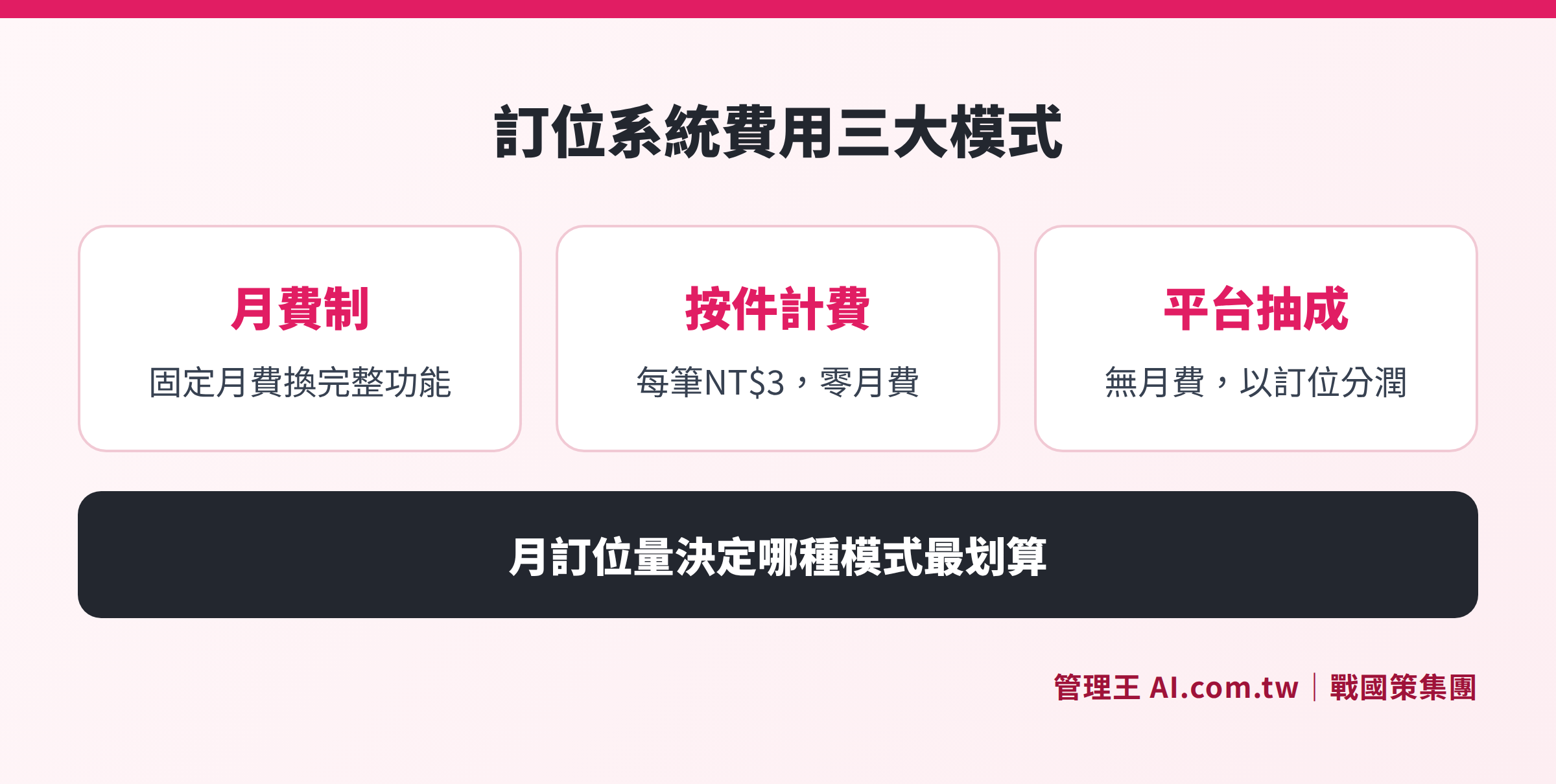
Comparison of cost structures, applicable scenarios, and representative systems for monthly fee, pay-per-use, and platform commission
Monthly Fee: Fixed Costs for Stable Functionality
The monthly fee model is currently the most common charging method for reservation systems in Taiwan, with offering plans ranging from free to over NT$799 per month.
Table: Major Monthly Fee Based Reservation Systems in Taiwan (Based on publicly available information, queried November 2026)
| System | Free Plan | Basic Paid Plan | Advanced Plan | Notes |
|---|---|---|---|---|
| VibeAI | NT$0 (3 employees) | NT$399/month (unlimited employees, auto reminders) | NT$799/month (full features) | Also available for individual features starting at NT$33/month |
| 管理王 AI.com.tw | NT$0 (permanent, 10 people) | NT$5,000/month (30 people) | NT$10,000–NT$19,900/month | Reservations included in 100+ features plan |
| inline | None (14-day trial) | Not disclosed, must inquire | Not disclosed, must inquire | Must consult sales contact |
Three criteria for choosing the monthly fee model:
- Stable and larger monthly reservation volume (over 100 reservations per month): The per-reservation cost of the monthly fee model is lower than pay-per-use.
- Need for comprehensive CRM and reminder functionalities: Auto-reminders reduce no-shows, and monthly fee plans typically include this.
- Integration with other systems: If integrating with CRM, POS, and loyalty programs, a comprehensive monthly fee plan saves API integration costs.
Pay-per-Use: Most Cost-Effective for Low Monthly Reservations
The representative for pay-per-use is Eatsy (a reservation system designed for independent restaurants by a Taiwanese team), with a transparent cost structure:
- Monthly Fee: NT$0 (no fixed monthly fee, no contract)
- Per Reservation (no deposit collected): NT$3
- Per Reservation (deposit collected): NT$5
For example, if there are 60 reservations in a month and no deposit is collected, the cost would be NT$3 × 60 = NT$180; if a deposit is collected, it would be NT$5 × 60 = NT$300. Both include the SMS reminder costs.
This model is best suited for the following scenarios:
- Recently opened, with unstable reservation volume
- Significant differences between peak and off-peak seasons (e.g., tourist spot restaurants)
- Wants to low-risk test the performance of a reservation system
According to Eatsy's official website (partners.eatsy.tech), it offers a 7-day free trial, no credit card required, and the database is transferable.
Platform Commission Model: Represented by EZTABLE
EZTABLE is the main "consumer exploration" reservation platform in Taiwan, using a prepaid deposit mechanism: consumers pay a certain amount when making a reservation on the platform, and the payment received by the restaurant has already deducted the platform commission. EZTABLE currently does not publicly disclose specific commission rates on their official website, and businesses must inquire through their sales contacts.
The core logic of the platform commission model is "exchanging profits for traffic":
- Advantages: The platform already has a membership base, which can drive early reservation volumes, especially beneficial for newly opened restaurants.
- Disadvantages: Customer data is controlled by the platform, and the restaurant receives only the net amount after commission; over time, the hidden costs per reservation are difficult to calculate accurately.
It is recommended to judge by asking, "Does most of my reservations come from my own customers or from the platform?": If a restaurant already has stable LINE friends, fan pages, or returning customers, tool-based systems (inline, VibeAI, Eatsy, 管理王) are generally more cost-effective, and the data fully belongs to the restaurant.
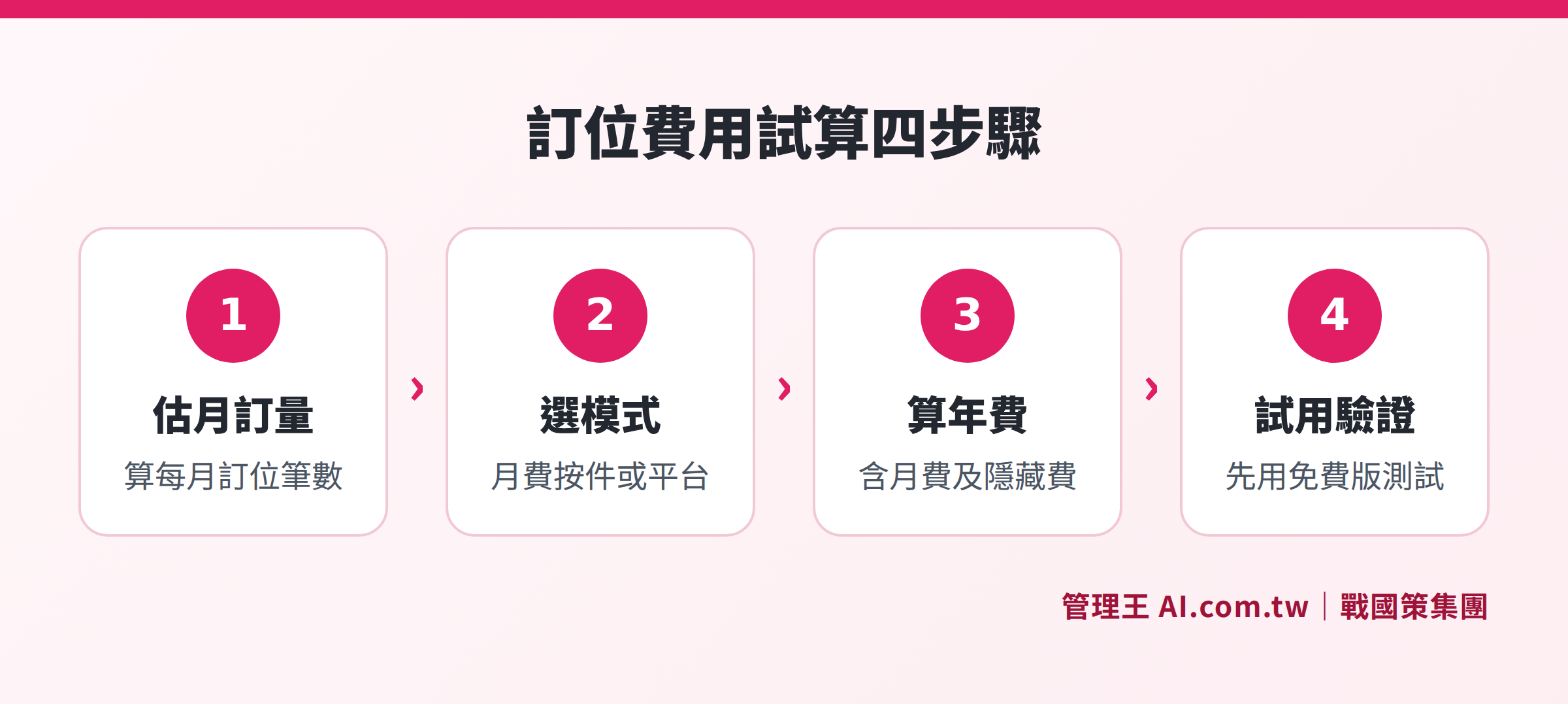
Estimating monthly costs based on monthly reservation volumes, including deposit handling fees and hidden costs, to calculate total annual holding costs in four steps
Deposit Mechanism: Cost Logic and Setting Recommendations
A deposit is a key tool to reduce no-shows, but the logic behind deposit fees varies between systems, which businesses need to understand:
Who collects the deposit, and where does the money go?
- Tool-based systems (VibeAI, Eatsy, 管理王): Deposits go directly into the restaurant's account, and the system only collects platform handling fees (Eatsy NT$5 per reservation, including payment processing).
- Platform-based systems (EZTABLE): Deposits are collected by the platform, and after deducting commissions, the funds are paid to the restaurant, who receives the net amount after tax.
How is the deposit amount set?
The deposit amount is set by the restaurant, with no legal standard. Common practices include:
- Per person charge: NT$200 to NT$500 per person
- Fixed charge per table: NT$500 to NT$1,000 per table
- High-priced or private rooms: 20% to 30% of the private room fee or set meal price
Setting it too high may reduce willingness to reserve, while setting it too low may not effectively deter no-shows. It is recommended to reference the average per-person spending from the restaurant's menu and set the deposit to be 10% to 20% of that.
Deposit rules for cancellations and no-shows
Whether the deposit is refundable, and under what conditions it is forfeited, needs to be clearly stated by the restaurant on the reservation page. The Consumer Protection Act has regulations regarding "prepaid consumption"; it is suggested that the reservation page specifies the "cancellation deadline and refund methods" in accordance with the latest announcements from regulatory agencies.
Complete Comparison of Cost Structures for Each Platform in 2026
Table: Comparison of Cost Structures of Major Reservation Systems in Taiwan (Based on publicly available information, queried November 2026)
| System | Charging Model | Minimum Cost | Deposit Function | Auto Reminders | Notes |
|---|---|---|---|---|---|
| inline | Monthly Fee | Not disclosed, must inquire | Yes | Yes (SMS / LINE) | 14-day free trial |
| EZTABLE | Platform Commission | Not disclosed, must inquire | Yes (prepaid) | Yes | Exposed via commission |
| VibeAI | Monthly Fee | NT$0 (3 people) | NT$399/month | NT$399/month | Individual features available starting at NT$33/month |
| Eatsy | Pay-per-Use | NT$3/reservation | NT$5/reservation (including payment processing) | Included in the fee | No monthly fee, no contract |
| 管理王 AI.com.tw | Monthly Fee | NT$0 (permanent) | Yes (included in free plan) | Yes | Reservations included in 100+ features plan |
The above costs may vary due to plan updates according to the publicly available information. It is advisable to confirm the latest prices with each vendor before purchasing.
Beyond Monthly Fees: Commonly Overlooked Hidden Costs
When selecting a reservation system, monthly fees are only the apparent costs; the following items are often overlooked:
- Setup and configuration fees: Some systems charge a one-time onboarding or training fee (the business version of 管理王 includes 8 hours of remote training, and the flagship version includes 16 hours; free and economic versions require self-exploration or purchasing consulting services).
- SMS reminder fees: If automatic reminders use SMS channels, some systems charge separately for SMS points; confirm whether this is included in the monthly fee to avoid exceeding the budget at the end of the month.
- Hardware costs: If a reservation iPad or waiting kiosk is needed, those costs must be calculated separately; most small and medium-sized restaurants can use existing phones or tablets without additional purchases.
- API integration fees: Integrating a single reservation system with CRM or POS may require in-house development or outsourcing for API needs, which may vary in cost depending on complexity; choosing systems with native integration for these functions can save on this expense.
- Annual payment discounts: 管理王 allows annual payments of 12 months for 14 months (equivalent to a 15% discount), and VibeAI also offers annual payment discounts to reduce annual costs.
Calculating Costs for the 管理王 AI.com.tw Reservation System
The cost structure of 管理王 AI.com.tw reservation system is transparent: the reservation function is included in all plans and does not require additional individual purchases.
According to the 管理王 pricing page (queried November 2026):
- Free Plan: NT$0, permanently usable, up to 10 members
- Economic Version: NT$5,000/month, 30 member limit, 1,000 AI points per month
- Business Version: NT$10,000/month, 60 members, 3,000 AI points per month, including 8 hours of remote training
- Flagship Version: NT$19,900/month, unlimited members, 10,000 AI points per month, including 16 hours of remote training
The reservation system is natively integrated with CRM system, member point system, online ordering system, and POS system, eliminating the need for API integration fees—this is an important difference when calculating annual TCO, as the API integration costs for most single-function reservation tools can be significant.
The free plan is permanently usable, and core features such as creating reservation pages, seat management, and automatic confirmation reminders are all included; if advanced AI analytics and marketing automation are needed, plans can be upgraded as business grows.
Further Reading:
- Complete Guide to Restaurant Reservation Systems: Features, Costs, and Implementation Steps Explained
- Recommended Restaurant Reservation Systems: Compare these 8 Features Before Choosing
- Comparison of inline Reservation System with Other Solutions: Charges, Features, and Suitable Restaurant Types
Free Trial of 管理王 Reservation System
Consultants assist in evaluating whether a monthly fee or pay-per-use is more cost-effective, integrating reservations with CRM, loyalty, and POS—all in a 30-second free registration, no credit card required.
Free consultation hotline: 0800-003-191
LINE Official Account: @119m
Official Website: app.AI.com.tw
Free Trial: Apply for 管理王 now
Frequently Asked Questions
What is the typical monthly fee for reservation systems?
The monthly fees for reservation systems in the Taiwan market range from NT$0 to over NT$799. VibeAI's free plan is permanently available (for up to 3 employees), with a basic version at NT$399/month and a professional version at NT$799/month; 管理王 offers a free plan for permanent use, with paid plans starting at NT$5,000/month; Eatsy has no monthly fee, charging NT$3 per reservation; inline and EZTABLE require inquiries for pricing. The final costs depend on the monthly reservation volume, required feature depths, and whether a deposit collection feature is needed.
What does commission-based revenue mean in reservation systems?
The commission system means that restaurants do not pay a fixed monthly fee but rather a percentage of the reservation amount as the platform fee. EZTABLE uses a prepaid deposit mechanism where consumers pay a certain amount when making a reservation, with the restaurant receiving funds after commission deductions. The exact commission rate is not publicly disclosed on the EZTABLE website and must be inquired about. The advantages of a commission system are that there is no pressure from a fixed monthly fee, making it suitable for restaurants that rely on the platform for traffic; however, the long-term costs are opaque, and customer data is controlled by the platform.
Which is more cost-effective, monthly fee or pay-per-use?
This mainly depends on the monthly reservation volume. Rough estimates: with 60 reservations a month, Eatsy’s pay-per-use cost is about NT$180 (NT$3 × 60); VibeAI's lightweight monthly fee is NT$399—at this point, pay-per-use is more affordable. When monthly reservation volume exceeds 130, Eatsy's fees (around NT$390) become similar to VibeAI’s lightweight version (NT$399), making the monthly fee model more competitive. It is recommended to start with pay-per-use, then evaluate switching to monthly fee as the reservation volume stabilizes.
Is there an additional cost for the deposit function in reservation systems?
It depends on the system. 管理王's free plan includes an online deposit collection feature; Eatsy charges NT$5 per reservation when collecting deposits (increasing from NT$3); and VibeAI’s deposit collection is part of paid plans (starting at NT$399/month). It is advised to check whether deposit handling fees are included in the platform fees or need to be borne separately during evaluation.
Is there a need to pay for hardware costs when implementing a reservation system?
Not necessarily. 管理王, VibeAI, and Eatsy are all purely cloud-based and can be operated via browsers, without enforced hardware purchases. If a restaurant wishes to place self-service reservation iPads or waiting kiosks on-site, those hardware costs will need to be calculated separately. Inline supports iPad table management but requires self-provisioned hardware. Most small to medium-sized restaurants can operate through phones or existing tablets without purchasing additional hardware.
Data Sources
- VibeAI Official Website (vibeaico.com)|Plan costs and feature descriptions, queried November 2026
- Eatsy Official Partner Website (partners.eatsy.tech)|Pay-per-use plan descriptions, queried November 2026
- 管理王 AI.com.tw Official Website (app.ai.com.tw)|Reservation system feature page and pricing plans, queried November 2026