How to View the Ranking of ERP Vendors in Taiwan? Ask These 8 Questions Before Choosing a Vendor|ERP System Recommendations
Taiwan's ERP vendors range from lightweight cloud solutions with monthly fees of a few hundred NTD to enterprise systems with annual fees in the millions, showcasing a wide spectrum. This article organizes publicly available information from mainstream vendors like Digiwin, Zhenhang, SAP Business One, and 管理王 and provides 8 key questions to ask before selecting a vendor: scale, industry, budget, functional modules, support for Taiwanese regulations, implementation timeline, service support, etc., to help Taiwan's SMEs make the best choice.
When searching for "ERP vendor ranking" in Taiwan, you will find that there is almost no official or impartial ranking available—because choosing an ERP system does not have a universally best option, only the one that is best suited for you. The Taiwanese market offers a wide spectrum of products, from lightweight cloud-based inventory systems with monthly fees of a few hundred NTD to large-scale ERP systems with annual fees starting in the millions. Manufacturing needs BOM and MRP, trading requires multi-currency and accounts receivable tracking, and retail demands POS integration, leading to entirely different functional needs. The truly effective way to select is not to find the "top ranked" vendor but to clarify your own company’s size, industry processes, budget, and service requirements before comparing the publicly available functionalities and solutions of various vendors to pick the one that best matches your needs. This article references only publicly available information from each vendor's official website (as of November 2026) and provides the 8 key questions to ask before selecting a vendor.
Why Can’t You Find a Recognized ERP Vendor Ranking in Taiwan?
There are several reasons why Taiwan has no recognized ERP rankings:
Significant Product Positioning Gaps: Even though they are all called "ERP," the monthly fee for Digiwin A1 Business Application Cloud starts at a few hundred NTD, while SAP Business One's annual fee ranges from several hundred thousand to millions; with such different positioning, comparisons are practically impossible.
Different Levels of Industry Customization: ERP for manufacturing emphasizes BOM, production orders, and MRP; distribution focuses on inventory management and accounts receivable; while service industries prioritize contracts and attendance. The selection criteria vary significantly across different industries—what is deemed a good system for manufacturing might not apply to services at all.
Lack of Price Transparency: Most ERP vendors in Taiwan adopt a pricing inquiry strategy, where prices are not publicly listed on their websites; figures on external media or comparison sites may not reflect the latest official quotes, making them of limited reference value.
Clear Market Segmentation: Large manufacturing groups, mid-sized enterprises with around 100 personnel, and small companies with fewer than 30 individuals each correspond to specific vendors and products, each focusing on different markets.
Therefore, this article does not establish a subjective ranking but rather organizes publicly available information from major ERP vendors in Taiwan, allowing you to filter based on the "8 questions".
Overview of Mainstream ERP Vendors in Taiwan
The following is organized based on publicly available information from each vendor's official website (as of November 2026); any changes in pricing and packages should be based on the latest announcements on their websites.
Table: Comparison of Main ERP Vendors' Official Information in Taiwan
| Vendor | Suitable Scale | Product Positioning | Price Transparency | Implementation Method |
|---|---|---|---|---|
| Digiwin | 5 to Group | SmartERP (SMEs), A1 Business Application Cloud (lightweight), T100 (Group) | A1 monthly fee public (NT$600-800/month/module); Mid-to-large pricing inquiries | Cloud + Consultant Implementation |
| Zhenhang Information | 30-200 people | Zhenhang N5 New Generation ERP, Zhenhang 3/5/7 Series | Inquiry-based | Consultant Implementation |
| Wencong Information (CERP) | SMEs | Cloud inventory and finance | Monthly rent system, price upon inquiry | Purely Cloud-Based |
| SAP Business One | 50-500 people | International Standard Mid-sized ERP | Inquiry-based in Taiwan | Consultant Implementation |
| Oracle NetSuite | More than 50 people | Purely Cloud Full Module ERP | Inquiry-based in Taiwan | Consultant Implementation |
| 管理王 AI.com.tw | 1-50 people or more | All-in-One AI Integrated Business System (ERP + CRM + Marketing + Customer Service) | Public on website: Free permanently usable; monthly fee NT$5,000-19,900 | Cloud-based, ready to use |
In Brief
Taiwan's ERP vendors can be categorized into three tiers: lightweight cloud-based (monthly fees of several hundred to several thousand), mid-sized consultant implementations (annual fees of several hundred thousand), and large group systems (annual fees starting in the millions)—first confirm which tier you fall into before comparing vendors.
Ask These 8 Questions Before Choosing a Vendor
Before contacting any vendor, clarify your needs with these 8 questions; the clearer your answers, the quicker the selection process will be.
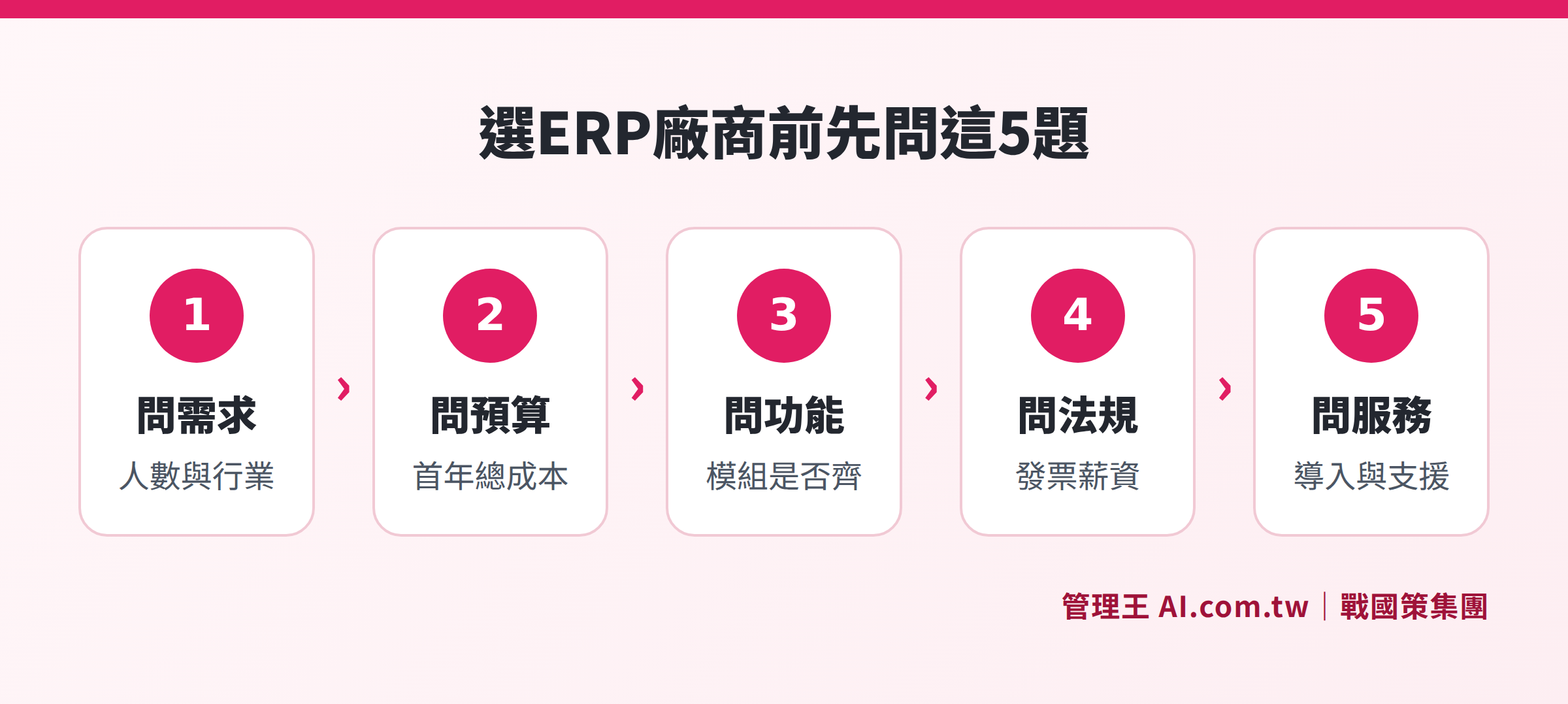
Questions 1 to 4 confirm basic needs (scale, industry, budget, functionality), and questions 5 to 8 assess service capabilities.
Question 1: How many people are in the company, and how many departments will use it?
The number of users determines licensing costs, and the number of departments influences module needs. A 5-person small company and a 100-person enterprise have entirely different complexity requirements for ERP.
Question 2: What is the main industry: trading, manufacturing, or services?
- Trading: inventory management, procurement, accounts receivable, invoicing
- Manufacturing: all of the above plus BOM, production orders, MRP, and quality management
- Services: contracts, work hours, attendance, billing
Without verifying whether the vendor has corresponding industry modules, it's easy to purchase a system that lacks critical functionality.
Question 3: What is the budget (total cost for the first year)?
Total First-Year Cost = Licensing fee or monthly fee × 12 + Implementation cost + Customization cost + Training cost. Many companies only consider monthly or annual fees, overlooking implementation and customization costs, resulting in actual expenditure exceeding expectations in the first year.
Question 4: Is there a need for production or manufacturing? Is there a need for multi-currency or multi-company functionality?
The manufacturing module (BOM, production orders, MRP) and multi-currency are key functionalities that require additional confirmation. Some vendors require additional purchases, while others offer native support.
Question 5: How well do they support local Taiwanese regulations?
Local compliance items to verify include:
- Electronic invoicing (B2B, B2C)
- Business tax declaration (401 report)
- Labor and health insurance rates and payroll calculations
- Withholding certificates
Local vendors usually support these natively, while international vendors may require customization.
Question 6: How fast does the implementation need to be? How much IT personnel do you have?
With cloud ERP, you can start testing once it’s activated; the overall timeline for going live can take from a few weeks to several months, depending on data volume. Traditional packaged ERP implementations often require consultants on-site, taking from six months to over a year, requiring IT personnel to cooperate.
Question 7: Is the response speed of customer service and technical support acceptable?
Confirm: Customer service hours (business hours or 24/7), language (Traditional Chinese), channels (phone, LINE, email), SLA commitments.
Question 8: If you want to switch systems in the future, can the data be exported?
Confirm whether exporting in CSV or standard formats is feasible. If data is locked in a specific system, switching costs could be very high in the future.
How to Compare Functionality? 4 Aspects
After clarifying your needs, look at the functionalities across these four aspects:
Aspect One: Degree of Process Integration
Does the complete process from quoting → order → shipment → invoicing → payment run in the same system, or do you need to bridge between them using Excel? Each additional manual data transfer increases the risk of errors.
Aspect Two: Completeness of Modules and Additional Charges
Verify if essential modules are included in the subscription plan or if additional purchases are required. Commonly necessary modules that may require additional purchase include: electronic signatures, payroll, production, and BI reporting.
Aspect Three: Integration with Existing Tools
Can existing CRM, email, and accounting software be integrated, or do they all need to be replaced?
Aspect Four: Usability of the Interface and Learning Costs
No matter how many features there are, if employees can't use them, they are meaningless. Confirm if trial usage is possible and the costs and methods for training.
Monthly Rental vs. One-time Purchase: Comparing Cost Structures
Table: Cost Structure Comparison Between Cloud Monthly Rental and Traditional One-time Purchase
| Comparison Items | Cloud Monthly Rental | Traditional One-time Purchase |
|---|---|---|
| Initial Costs | Low (monthly fees start low) | High (licensing fee paid in full at once) |
| Implementation Costs | Usually lower; some vendors include in package | Consultant implementation fees calculated separately, often several tens to hundreds of thousands |
| Upgrades | Managed by service provider, automatic updates | Requires a maintenance fee (usually 15-20% of the license fee/year) to upgrade |
| IT Personnel Requirements | Low (no need to build own server) | High (need to maintain servers and databases) |
| Flexibility for Customization | Generally lower, mainly focuses on standard modules | Higher customization flexibility, but costs are also higher |
| Long-Term Costs | Monthly fees accumulate; over five years, this may exceed one-time purchase | High initial costs but relatively fixed long-term maintenance costs |
| Suitable for Enterprises | Under 50 people, standardized business, few IT personnel | Over 100 people, complex processes, having IT department |
Most small and medium enterprises (under 50 people) in Taiwan tend to choose cloud monthly rental systems in recent years, mainly due to lower initial investment, no need for IT personnel, and quick implementation.
For more in-depth understanding of considerations for choosing cloud ERP, refer to Advantages and Disadvantages of Cloud ERP: Which Companies Are Suitable for Monthly Rentals?.
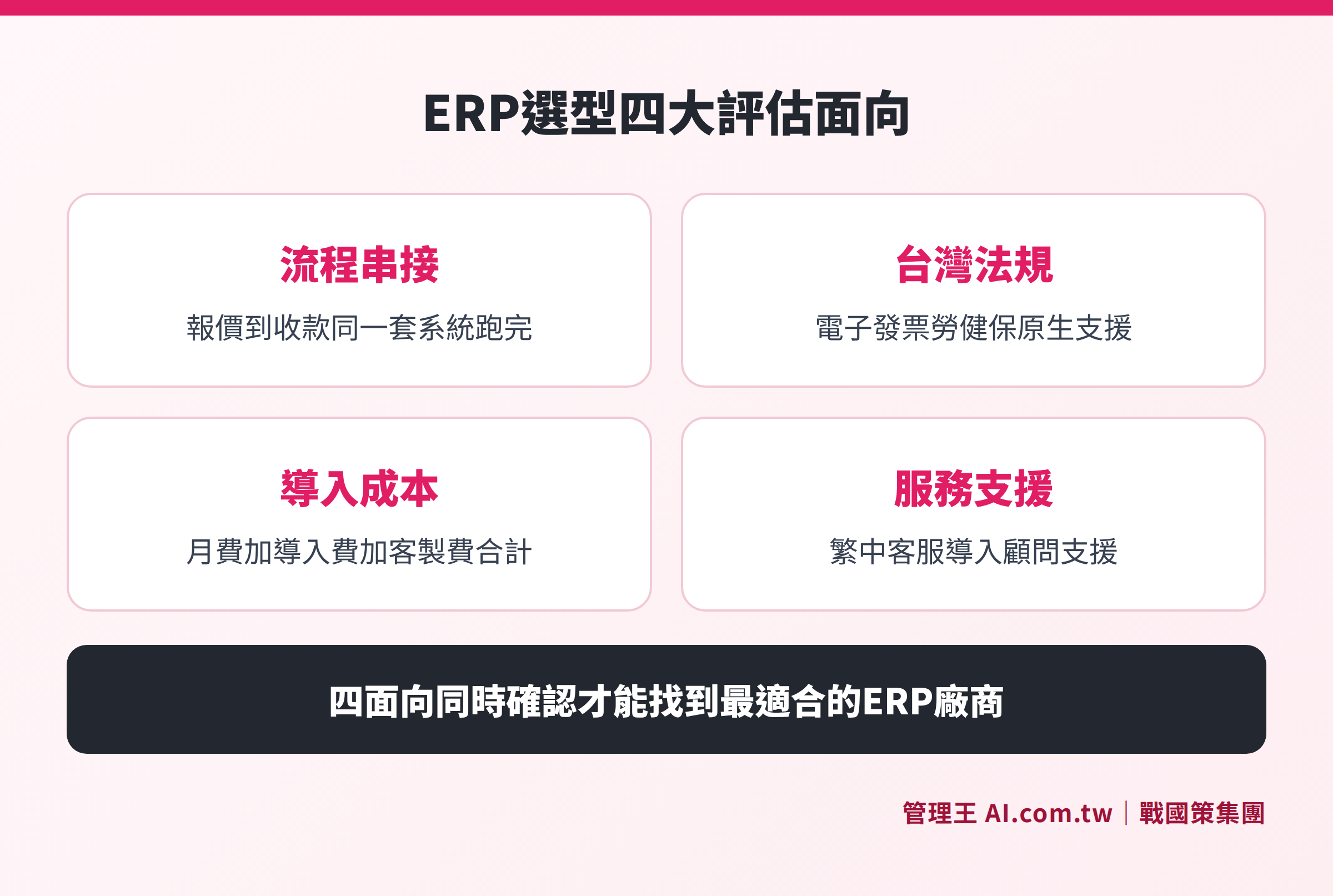
Key considerations for selection explained across four dimensions: process integration, local regulations, implementation costs, and service support.
Implementation Timeline and Vendor Service Capabilities
Once you have selected a vendor, the implementation timeline typically consists of several stages:
- Requirement interviews and settings: Confirm processes, import basic data (customers, products, initial inventory)
- Testing and adjustments: Test core processes to ensure they meet actual operations
- Training: Help department employees get started
- Official launch: Switch to the new system
For typical trading enterprises using cloud ERP (like 管理王), data imports can usually lead to go-live within about one to two weeks; for manufacturing companies, establishing BOM may take longer depending on the number of items involved. Traditional packaged ERP systems require consultants on-site and customization, leading to timeframes from six months to over a year.
When selecting a vendor, "service support" is an often underestimated factor. If problems arise after going live, can you find someone to resolve them that same day? It’s advisable to confirm:
- Customer service hours and language (Traditional Chinese)
- Reporting channels (phone, LINE, email)
- Whether a dedicated consultant is available
- SLA (Service Level Agreement) for urgent issues
For a detailed breakdown of implementation costs, refer to How Are ERP System Costs Calculated? Breakdown of Licensing, Implementation, and Maintenance Costs.
How to Use 管理王
管理王 AI.com.tw is an All-in-One AI integrated business system created for Taiwan's SMEs by 戰國策 Group, where the ERP module shares the same data with CRM, approvals, and attendance without the need for additional integration.
Here’s a practical operational example:
- After a sale closes in CRM, the quote is converted to an order with one click.
- The order triggers automatic deductions from inventory and issues an electronic invoice.
- Procurement directly creates accounts payable and increases inventory.
- Upon receipt and reconciliation, accounts receivable is automatically offset, and data is entered into accounting.
- For manufacturing companies, once a production order is issued, the system automatically calculates material requirements, and MRP lists shortages and recommended purchase volumes (manufacturing).
- Payroll directly reads attendance and bonus data for calculations, automatically posting once completed.
In terms of plans, the free plan can be used permanently (up to 10 members), and the startup costs for typical trading companies are low with quick implementation. The business plan (NT$10,000/month) includes remote training and support. For detailed plans, please see the pricing page.
戰國策 Group serves over 30,000 businesses, with a Taiwanese team providing service in Traditional Chinese, and a 0800 customer service hotline (0800-003-191) with a response within 30 minutes on weekdays.
To better understand budget considerations for SMEs selecting ERP, consider reading Recommended ERP for SMEs: A Selection List When Budget is Limited and What Types of ERP Systems Are There? Differences Between Cloud, Packaged, and Customized Types.
For a detailed comparison of Digiwin ERP, refer to Is Digiwin ERP Suitable for Small Companies? Functions, Implementation Barriers, and Alternative Options.
If you want to understand ERP systems from the ground up, please read What is an ERP System? SMEs Understanding Inventory to Finance All at Once as a foundational article before revisiting this vendor comparison for better context.
Find the Most Suitable ERP Vendor, Let Consultants Help You Compare
Explain your company size and industry, and 管理王 consultants will assist in evaluating the best ERP solution for you for free at 0800-003-191 with a response within 30 minutes on weekdays.
Free consultation hotline: 0800-003-191
LINE Official Account: @119m
Official Website: app.AI.com.tw
Free Trial: Apply for 管理王 Now
Frequently Asked Questions
Is there an official ERP vendor ranking in Taiwan?
Currently, there are no government agencies or impartial third-party institutions that publish a recognized ERP vendor ranking in Taiwan. The "rankings" or "recommendation lists" in the market are often created by the vendors themselves or compiled by media editors, and one should remain vigilant for sponsorship relations when referring to them. When choosing, it’s more reliable to use the functionalities, packages, and service conditions publicly disclosed by the vendors as evaluation criteria rather than comparing rankings.
What are the differences between local ERP vendors and SAP or Oracle?
The primary differences lie in three aspects: Support for Local Taiwanese Regulations (electronic invoicing, labor and health insurance payroll, business tax declaration; local vendors usually support this natively while international vendors may require customization); Initial Costs (local cloud ERPs typically have lower entry thresholds compared to international vendors); Service Languages (local vendors provide customer service in Traditional Chinese, while international vendors rely on local agents, with service quality varying based on the agent).
All ERP vendors claim to be suitable for SMEs; how can we differentiate?
Ask a few specific questions: "What is the monthly or annual fee?" "Are implementation fees calculated separately?" "How long until we can go live?" "Is Taiwan's electronic invoicing built-in or does it require customization?" Vendors that can directly answer these questions typically have higher transparency.
If I regret choosing ERP and want to switch, can I take my data with me?
Before formalizing a contract, it's crucial to confirm the data export format (CSV or standard format) and conditions. Some systems support complete data exports, while others might have limitations. Data portability is an important condition for long-term cooperation; if uncertain, it’s advisable to specify export terms in the contract.
What are the most common pitfalls for SMEs when implementing ERP?
Based on vendors' implementation experiences, common issues include: only looking at monthly fees while overlooking implementation costs (which can sometimes be dozens of times the monthly fee); purchasing a large ERP that has complete functionality but only utilizing 20%; failing to assess employee acceptance, leading to abandonment post-implementation; and not confirming whether electronic invoicing and other local regulations are natively supported, resulting in needing costly customizations later.
Data Sources
- Digiwin Official Website (as of November 2026)
- Digiwin A1 Business Application Cloud Pricing (as of November 2026)
- Zhenhang Information Official Website (as of November 2026)
- Wencong Information CERP Official Website (as of November 2026)
- SAP Business One Taiwan (as of November 2026)
- 管理王 AI.com.tw ERP Features Page (as of November 2026)
- 管理王 AI.com.tw Pricing Plans (as of November 2026)
According to brand comparison principles, this article only cites publicly available information from each vendor’s official website, without diminishing or speculating, based on the information available as of November 2026. For the latest prices and functionalities, please contact each vendor's official channels directly.