What is Supplier Management? A Complete Guide from Selection to Performance Tracking for Partners|Recommendations for Supplier Management Systems

Supplier management covers the entire cycle of selecting partners, signing contracts, assigning leads, profit sharing, and performance evaluation. This article focuses on the QCDS four-dimensional framework, six core processes, and local pain points in Taiwan, helping SMEs establish a replicable digital partner ecosystem, recommending the use of 管理王 AI.com.tw's supplier management system.
Supplier management (Supplier Management) is a complete management mechanism for enterprises to manage external partners from selection, contract signing, daily collaboration to performance evaluation. For small and medium-sized enterprises in Taiwan, partners are not just entities selling products to you, but key partners determining product quality, delivery stability, and the expansion of the profit-sharing ecosystem. Simply put, effective supplier management leads to reduced procurement costs, fewer profit disputes, and scalable channel size; ineffective management results in uncontrolled lists scattered in Excel and LINE groups, leading to disputes at the end of the month. This article provides a complete guide for small and medium-sized business owners in Taiwan, covering definitions, selection criteria, core processes, performance tracking, and digital tools.
What is Supplier Management? Understand the Core Concept in Five Words
Supplier management (Supplier Relationship Management, abbreviated SRM) is a systematic approach encompassing the governance of relationships with all external partners. According to D&B research, supplier management involves full-chain control from "planning, procurement, manufacturing, distribution, to return," with the core goal of reducing procurement costs, ensuring stable material supply, and managing supply chain risks.
For small and medium-sized manufacturing, trading, or agency enterprises in Taiwan, supplier management typically encompasses three levels:
- Transaction Management: Compliance with processes such as requisition, procurement, receipt, and payment
- Relationship Management: Centralized management of vendor master files, contracts, and transaction records
- Performance Management: Regular assessments and replacements based on quality, delivery time, service, and costs
Understand in One Sentence
Supplier management is not merely about "finding cheap suppliers," but establishing a digital ecosystem that allows external partners to supply stably in the long term, proactively report, and automatically reconcile.
The scope of partners is broader than just "suppliers," including agents, franchise owners, referrers, and service providers; any external partner helping a business generate results or provide services falls under this category. This is also why modern systems are commonly referred to as "Partner Leads Management Systems" because the management logic connects suppliers from manufacturing to service industries.
Why is Supplier Management Crucial for SMEs?
Many SME owners mistakenly believe that supplier management is a system needed only by large companies, but in fact, the opposite is true: large corporations have dedicated procurement departments, while SMEs are the ones that most need automated tools to compensate for manpower shortages.
Here are common consequences of SMEs not engaging in supplier management:
- Vendor data scattered across multiple phones or lost when staff leave
- Profit sharing settlements relying on Excel, leading to disputes each month
- Uncertainty about which vendors have the most stable delivery times and best quality, making procurement decisions based on intuition
- Leads assigned to external partners vanish without follow-up
- No one tracks contracts' expiration, resulting in unnecessary overpayments through automatic renewals
Conversely, establishing a complete supplier management mechanism can bring three concrete benefits:
Table: Comparison of Supplier Management Benefits
| Management Aspect | Before Digitization | After Digitization |
|---|---|---|
| Vendor Master File | Stored on individual person's phones | Unified record, clear on one page |
| Lead Distribution | Sent via LINE and considered done | System distribution + notification + status tracking |
| Profit Sharing Reconciliation | Manual Excel calculations at month-end; discrepancies between accounts | System automatic settlement, easily generating reconciliation statements |
| Performance Evaluation | Assessed based on impressions, difficult to replace | QCDS data evaluations, rankings are clear |
| Contract Management | Time-based reminders rely on memory | Automated reminders before expiration |
According to a supplier evaluation study by 中方科技, many enterprises still rely on "annual Excel" evaluations, which causes problems such as delays in discovering issues, subjective scoring, and disconnection between results and procurement decisions. The fundamental change brought by digital systems is the evolution from "annual snapshots" to "real-time monitoring"—every transaction and report automatically recorded, allowing management to access data anytime, making supplier management a true competitive advantage for businesses rather than just an administrative burden.
Partner Selection: What Standards to Select Cooperative Partners?
Choosing suppliers is the starting point of the entire management process and the most difficult aspect to quantify. The commonly used evaluation framework in the industry is QCDS Four Dimensions:
Table: QCDS Supplier Selection Framework
| Dimension | English | Recommended Weight | Evaluation Indicator Examples |
|---|---|---|---|
| Quality | Quality | 35–50% | Incoming quality rate, rejection rate, PPM value |
| Cost | Cost | 15–20% | Price competitiveness, willingness to collaborate on cost reduction annually |
| Delivery | Delivery | 20–30% | On-time delivery rate, emergency order response speed |
| Service | Service | 10–15% | Quality of technical support, compliance with regulations |
(Source: 中方科技 Supplier Evaluation System Practices; D&B)
Evaluation levels are generally divided into four grades A/B/C/D:
- A Grade (90–100 points): Preferred vendors, priority for procurement, better payment terms
- B Grade (75–89 points): Qualified vendors, normal transactions
- C Grade (60–74 points): Observation vendors, limited procurement volume, improvement plan required
- D Grade (below 60 points): Eliminated vendors, transactions stopped
In addition to QCDS, small and medium-sized enterprises in Taiwan should also specifically assess the following localized conditions:
- Unified Number and Financial Reliability: Verify the legality of vendor operations through tax ID inquiries or D&B credit checks
- Compliance with Taiwan's Taxation Regulations: Ability to issue triplicate/electronic invoices correctly, comply with withholding declarations
- LINE Notifications and Traditional Chinese Interface: Taiwanese vendors generally rely on LINE for communication, the collaboration platform needs to support this
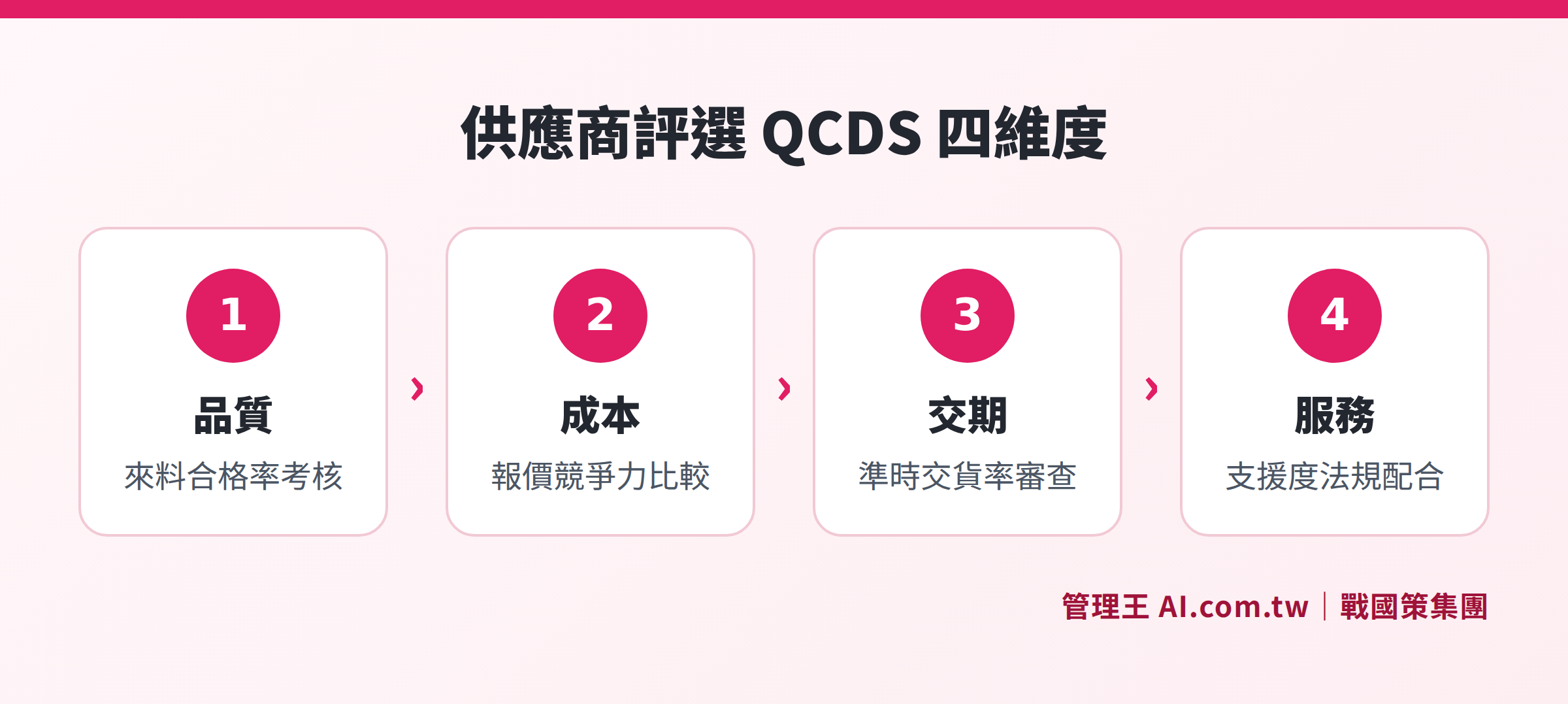
QCDS Four-Dimensional Selection Process: Quality→Cost→Delivery→Service, ranked from A/B/C/D
Six Core Processes of Supplier Management
Complete supplier management is not a one-time action; it is a cyclical continuous mechanism. The following six steps cover the entire cycle from starting cooperation to daily management:
1. Vendor Registration and Classification
Gather each partner's unified number, service items, contact window, and bank account in a centralized registry and classify by type (agents, franchise owners, referrers, parts suppliers, etc.). This is the foundation for all subsequent management, paired with an Contract Management System to link contracts and vendor data on one page.
2. Lead Assignment and Notification
Business development or CRM lists can be directly assigned to designated partners, with notifications sent through both Email and LINE channels, allowing vendors to receive them immediately and start communication. This step addresses the issue of "leads sent into the void." Coupled with a CRM system, customer lists can seamlessly flow to external partners.
3. Vendor Self-Reporting
Each vendor has an independent backend, allowing them to update the status of each lead (Pending Contact → In Communication → Closed → Rejected); the main company can see the progress in real-time without needing to call for updates. Coupled with Daily and Weekly Reporting Functions, daily development numbers are automatically aggregated.
4. Procurement and Payment Processes
The entire process from purchase requisition → procurement order → receipt → payment is conducted online, with electronic records maintained at each step. The Procurement System supports multi-level approval, price history, and automatic application of contract prices, ensuring procurement no longer relies on memories of past pricing.
5. Automatic Profit Sharing Settlement
The system automatically calculates the profit sharing owed to each vendor based on transaction results and generates reconciliation statements at the end of the month with one click. Coupled with a Rewards System, different profit sharing ratios and settlement cycles can be set for various vendors, transforming previously contentious profit calculations into transparent and auditable automated processes.
6. Performance Ranking and Elimination of Weakness
The system generates performance rankings of vendors based on total leads, number of transactions, and transaction rates, coupled with regular reviews using QCDS scoring to highlight which vendors are motivated to achieve results and which are complacent, with the data laid out clearly.
Supplier Performance Tracking: How to Implement Assessments?
Performance tracking is often the part of supplier management that is most commonly "talked about but not done," usually due to the reasons: lack of a system to automatically collect data, too low assessment frequency (once a year), and lack of correlation between results and procurement decisions.
Effective performance tracking requires three key elements:
1. Real-Time Data Collection
Do not wait until the end of the year for surveys. Each time goods are received, reports are submitted, and settlements are made, the system should automatically record relevant data; quality acceptance rates, timeliness rates, and reporting speeds should be based on real transaction data.
2. Multi-Dimensional Weighted Scoring
Use the QCDS structure to adjust weights according to the actual needs of the enterprise. For manufacturing, quality weight is higher; for services, timeliness and communication speed are more critical. Each vendor's scoring should suggest trends (improving or deteriorating), not just current figures.
3. Link Scoring Results to Procurement Decisions
A-grade vendors should be prioritized for orders, C-grade vendors need to be notified of improvement plans, and D-grade vendors should trigger alternative supplier procedures. If the scoring results are just reports that never influence procurement behavior, then the system is essentially useless.
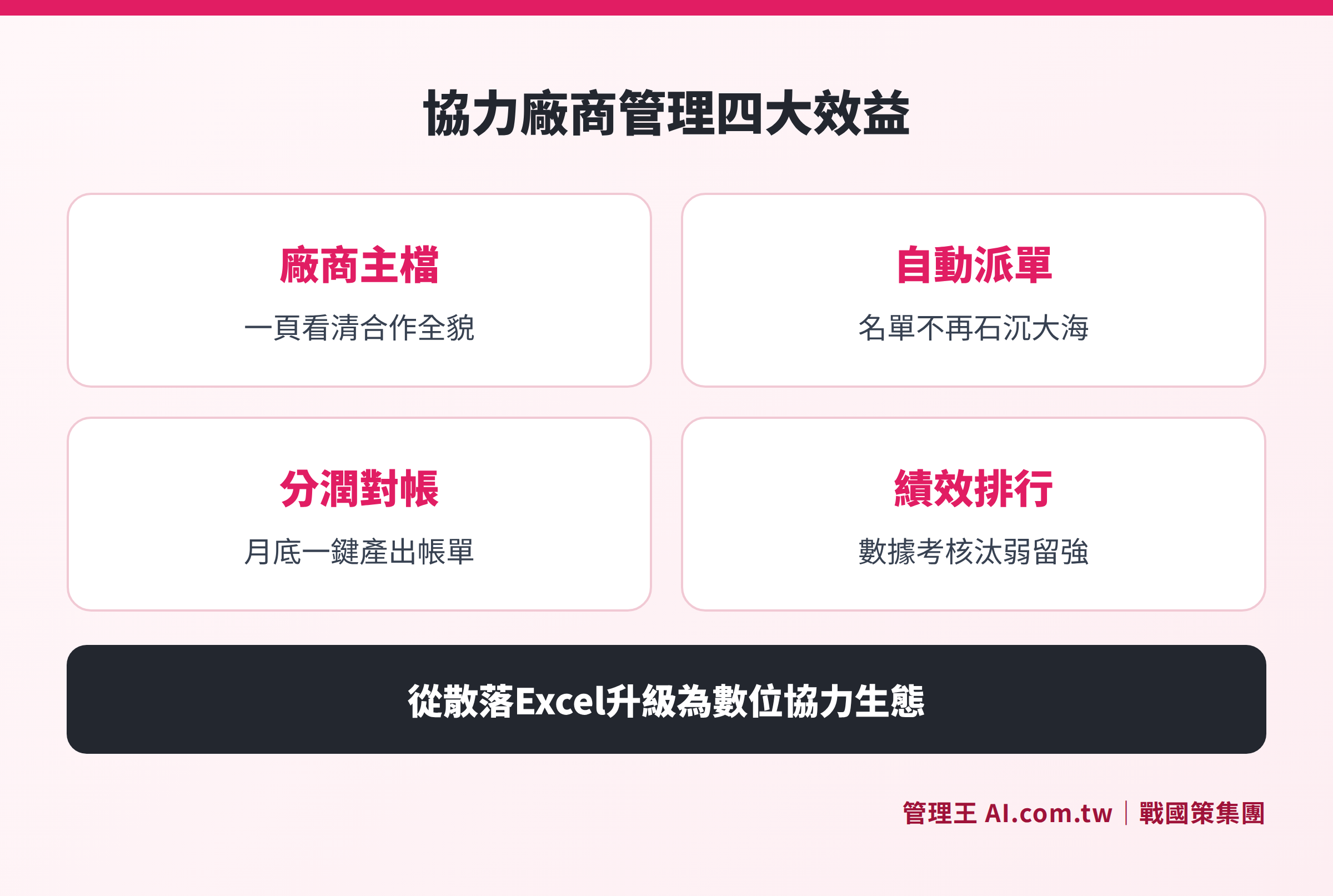
Six Core Management Processes: Vendor Registration → Lead Distribution → Self-Reporting → Procurement Payment → Automatic Profit Sharing → Performance Ranking
Unique Situations in Taiwan: Three Pain Points of Partner Management
Small and medium-sized enterprises in Taiwan also face local pain points that foreign tools cannot resolve in supplier management:
Pain Point One: LINE is the Primary Communication Tool
Vendors in Taiwan commonly use LINE to confirm orders and send notifications; systems lacking LINE integration face low vendor acceptance. Management systems need to support LINE notifications to ensure vendors receive assignments in real time without needing to install additional apps.
Pain Point Two: Electronic Invoices and Withholding Declarations
When making payments to vendors, it is essential to confirm that they can correctly issue electronic invoices and comply with annual withholding declaration requirements (when compensating or renting). The Accounting System must support integration for vendor payments and invoice verification to avoid human errors in reconciliations.
Pain Point Three: Flexible Design of Profit Sharing Contracts
Profit sharing structures for agents and referrers in Taiwan vary by industry (e.g., project amount × %, fixed fees, price differences); contract terms need to be flexibly designed, and profit sharing calculations must be automated based on actual transaction amounts rather than manual Excel calculations.
In terms of electronic signatures, the electronic signature feature can facilitate online signing of collaboration contracts in compliance with the Electronic Signature Law, reducing the time needed for back-and-forth mailing.
Five Key Questions to Consider When Choosing a Partner Management System
There is significant variability in the functionality of supplier management systems on the market; when SMEs evaluate options, it is recommended to prioritize asking the following five questions:
1. Does it support bi-directional LINE notifications?
Vendors in Taiwan work daily using LINE; if a system can only send Email notifications, acceptance from vendors will drop significantly, likely leading to an unutilized system. Confirm that the platform can simultaneously push LINE messages during assignments and status changes to ensure vendors truly receive notifications.
2. Can the profit sharing calculations be customized?
The profit-sharing structure varies significantly by industry: manufacturing may involve fixed discounts, while trade may rely on price differentials, and service industries might calculate based on a percentage of transaction amounts. Before selecting a system, confirm that multiple profit-sharing calculation rules can be set up to avoid additional work in Excel at month-end.
3. Is the vendor backend independent and user-friendly?
Vendors need a backend that doesn’t require them to remember complicated passwords and has a simple interface; otherwise, they will be reluctant to update their status. If the backend operation is complicated, vendors will still call you for inquiries, reverting to the original problem.
4. Can it integrate with ERP or accounting systems?
After profit settlements, payment information needs to enter the Accounting System, and procurement orders need to integrate with Inventory Management. If native integration is not possible, data has to be copied manually, leading to high chances of error and low efficiency.
5. Is there local customer support available?
Supplier management involves profit-sharing accounts and contracts; if issues arise, quick support is needed during working hours. Prioritize choosing service providers that have a Taiwanese customer support team available for Chinese consultations from Monday to Friday.
How to Use 管理王's Partner Management System?
管理王 AI.com.tw's partner management system integrates the six processes mentioned above, completing everything from vendor master files to profit reconciliation in a single system without needing additional API integrations. Here’s the actual operation process:
- Create Vendor Master Files: Enter the unified number, service items, contact window, bank account, classify by agents/referrers/service providers, and set profit-sharing ratios
- Assign Tasks from CRM: Directly assign leads to designated vendors; the system sends notifications via Email and LINE simultaneously, allowing vendors to initiate contact immediately upon receipt
- Vendor Backend Reporting: Vendors log into their dedicated backend to update the status of each lead, with the main company able to see these updates in real-time
- Monthly Automatic Settlements: At the end of each month, the system calculates the profit due to each vendor based on transaction records, producing reconciliation statements with one click for both parties to confirm before payment
- Performance Rankings: Weekly automatic aggregation of vendor daily reports, generating rankings based on transaction rates, informing you which partners are worth deeper collaboration
The free plan allows indefinite use of basic vendor management features, suitable for small and medium-sized enterprises just starting to build a partner system; paid plans starting at NT$5,000 per month unlock advanced features such as AI automatic lead distribution and cross-company merged reports. For detailed plan comparisons, please see the Management King Pricing Page.
In conjunction with the ERP system, data from procurement, inventory, and accounting systems can automatically circulate, updating inventory in real-time upon receipt and automatically transferring payments into accounting vouchers, saving time on manual comparisons among the three systems.
Free Trial of the Partner Management System
Consultants assist you in establishing vendor master files, profit-sharing rules, and performance evaluations within 60 minutes, with the free plan available indefinitely
Free consultation hotline: 0800-003-191
LINE Official Account: @119m
Official Website: app.AI.com.tw
Free Trial: Apply for 管理王 Now
Frequently Asked Questions
What are the differences between Supplier Management and Procurement Management?
Procurement management focuses on "what to buy this time, from whom to buy, and how much to spend" and is associated with transactional management. Supplier management has a broader scope, including vendor selection, long-term relationship maintenance, performance evaluation, and designing profit-sharing mechanisms, which is a strategic management framework that spans the entire cooperation cycle. The two complement each other: good supplier management gives procurement decisions data-based support, while a good Procurement System ensures each transaction follows supplier management policies.
How can profit sharing with partners be computed accurately?
The primary reason for incorrect profit calculations is "manual computations + multiple Excel files." The solution is to set the profit-sharing ratios and calculation rules (e.g., 10% of transaction amount, settled on the 20th of each month) in the system before collaboration begins. Thereafter, every transaction record automatically populates the calculations, with monthly reconciliation statements generated for the vendor's confirmation, reducing disputes as both parties can see the calculation bases.
How to establish a vendor elimination mechanism without hurting feelings?
The most effective way is to “let data speak for themselves.” Clearly state evaluation criteria in the cooperation agreement or vendor manual (e.g., a repeated transaction rate below 10% for three consecutive months, or reporting rates above 50% will lead to adjustments in cooperation conditions), so vendors understand the rules from the beginning. When implementing eliminations, provide specific data instead of subjective evaluations and allow a period for improvement, balancing relationships with procedures.
How long does it take for SMEs to implement a supplier management system?
The timeframe for system implementation primarily depends on the number of vendors and the level of data organization. If vendor master files, contracts, and profit-sharing rules already have electronic records, basic setup can typically be completed in one day; if data is scattered across multiple phones and physical contracts, it is recommended to spend 1-2 weeks organizing the information before entering it all at once. 管理王 offers free consulting interviews to help plan implementation schedules.
Can the partner management system integrate with CRM?
Yes. 管理王's partner management system is natively integrated with the CRM system, allowing customer lists developed in CRM to be assigned directly with a single click to designated external partners, with vendors receiving updates in real time without needing manual copying or sending LINE notifications, fully tracking the entire assignment-to-transaction process within the same system.
Sources
- D&B: Why is "Supplier Management" Important for Enterprises? How Can Enterprises Manage Suppliers with Data in 3 Big Steps (Query October 2026)
- 中方科技: Supplier Evaluation System Practice|From Annual Excel to Real-Time Quality Visibility (Query October 2026)
- Ministry of Economic Affairs: How to Choose the Right Supplier? What Should Be Noted About Supplier Contracts? (Query October 2026)
- 管理王 AI.com.tw Partner Management System Function Page (Query October 2026)