What is a Website Health Check? Corporate Website Speed, SEO, and Security Assessment|Recommended Website Health Check Tools

A website health check is a systematic evaluation of a corporate website, covering four major aspects: speed performance (Core Web Vitals), SEO visibility, information security, and GEO (Generative Engine Optimization). It generates a quantitative report and identifies areas for improvement. This article explains the core indicators, essential check items, popular tools comparison, and how to use 管理王 AI.com.tw's all-in-one automated health check to monitor your website's health status.
A website health check (Website Health Check) is a systematic scan and evaluation of a corporate website, covering four major aspects: speed performance, SEO visibility, information security, and GEO (Generative Engine Optimization). It produces a quantitative report and points out areas for improvement. A website that has never undergone a health check often has pages that are not indexed by Google, SSL vulnerabilities that leak data, and slow loading issues that cause visitor loss, all unbeknownst to the business owner. Regular health checks are like annual health examinations for companies, keeping the official website in optimal condition and ensuring that every marketing investment pays off. Website health checks are suitable for any small and medium enterprise with a corporate website, especially in industries that rely on the website for inquiries and orders.
What is a Website Health Check? Definition and Core Concepts
A website health check is a structured diagnostic process that evaluates the technical structure, content quality, security, and search performance of a website through automated tools or manual reviews, ultimately producing a "health check report," listing passed items, areas needing improvement, and urgent warnings.
Modern corporate websites typically need to meet three parties' demands:
- Visitors: Fast page loading (within 2.5 seconds), mobile-friendly browsing, clear content
- Search Engines: Proper indexing by Google, compliance with Core Web Vitals standards
- IT Security: Valid SSL certificates, no malware, no abnormal logins
In a Nutshell
A website health check = Speed + SEO + Security + GEO four-dimensional diagnostics, bringing website issues to the forefront.
A website health check can be a one-time "in-depth diagnostic" or a continuous "monitoring dashboard." Both are important; the former identifies historically accumulated problems, while the latter provides real-time alerts before issues escalate.
Why Do Corporate Websites Need Regular Health Checks?
Many small and medium enterprises believe that "once the website is set up, it's done," but the following five reasons explain the necessity of regular health checks:
1. Google Algorithms Continuously Update
Google updates its algorithms hundreds of times a year, officially replacing FID with INP (Interaction to Next Paint) in 2024 and further strengthening the quality evaluation of AI-generated content starting in 2025. A website that doesn't adjust in a timely manner may see a gradual decline in natural search traffic, often without realizing it.
2. SSL Certificates Expire
SSL certificates typically expire annually. After expiration, browsers display "not secure" warnings, leading to a visitor loss rate of nearly 100%. Automated monitoring can remind you 30 days before the certificate expires.
3. Security Vulnerabilities in Third-Party Plugins/Add-ons
CMS platforms like WordPress have security updates for plugins every week. Unupdated plugins are the most common entry points for hackers. Regular scanning can timely detect known vulnerabilities (CVE).
4. Page Speed Affects Ad ROI
The quality score of Google Ads is directly related to landing page speed; with every additional second of load time, the conversion rate drops on average. Speed checks can identify specific improvement opportunities to maximize advertising investment efficiency.
5. AI Search Restructures Traffic Sources
AI search tools like ChatGPT, Gemini, and Perplexity have become important traffic sources for businesses. GEO checks ensure that the website content can be accurately referenced by AI and does not disappear in the new search era.
Speed Performance Health Check: The Three Core Web Vitals Indicators
Google uses Core Web Vitals as the core scoring standard for web experience, directly affecting search rankings. The "good" thresholds for the three key indicators are as follows:
Table: Google Core Web Vitals Standards (2026)
| Indicator | Measurement | Good | Needs Improvement | Poor |
|---|---|---|---|---|
| LCP (Largest Contentful Paint) | Main content load speed | ≤ 2.5 seconds | 2.5–4.0 seconds | > 4.0 seconds |
| INP (Interaction to Next Paint) | Page interaction response speed | ≤ 200 milliseconds | 200–500 milliseconds | > 500 milliseconds |
| CLS (Cumulative Layout Shift) | Visual stability | ≤ 0.1 | 0.1–0.25 | > 0.25 |
Data source: Google web.dev (based on real user data at the 75th percentile)
How to Measure Core Web Vitals?
- Google PageSpeed Insights: Free, providing both lab data and real user data (CrUX), it's the quickest starting point.
- Google Search Console: The "Core Web Vitals" report shows the real performance of each page, categorized as "Passed," "Needs Improvement," and "Poor."
- WebPageTest: Advanced waterfall analysis suitable for identifying specific loading bottlenecks.
- Chrome DevTools Performance Panel: The primary tool for developers to debug INP.
In addition to Core Web Vitals, speed performance health checks should also examine: TTFB (Time to First Byte) should be below 800 milliseconds, whether images are compressed to WebP/AVIF, if CDN and browser caching are enabled, and whether server response times are normal.
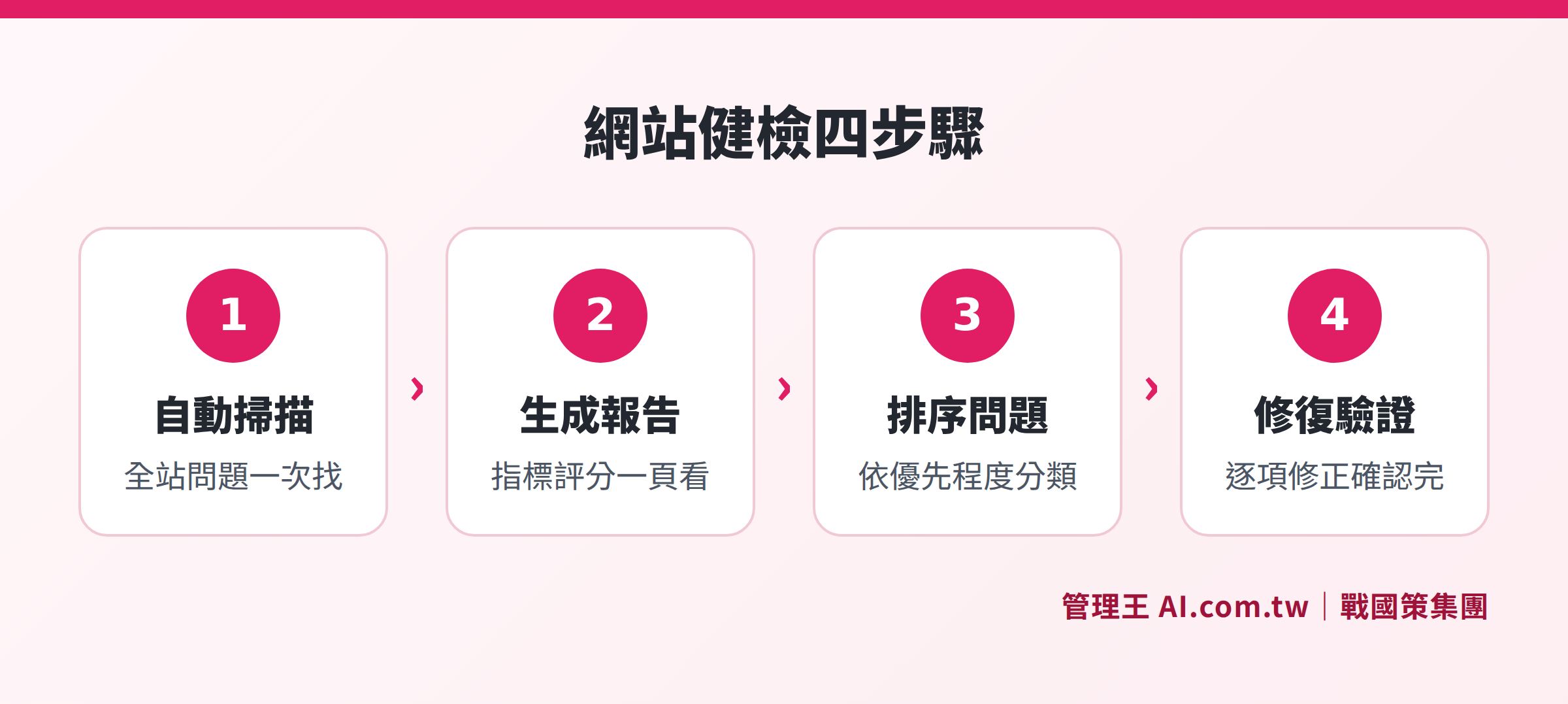
From tool scanning to report output, the complete process of a website health check in four steps
Complete SEO Health Check Checklist
The purpose of an SEO health check is to ensure that Google can correctly find, understand, and index every important page of the website.
Table: Core SEO Health Check Items
| Check Category | Specific Item | Description |
|---|---|---|
| Index Status | Are key pages indexed by Google? | Confirm using Search Console's "URL Inspection" |
| Title and Description | title within 60 characters, description within 160 characters | Exceeding length may result in automatic truncation by Google |
| URL Structure | Is it a semantic short URL? | Avoid dynamic URLs in the format ?id=123 |
| Duplicate Content | Are there multiple URLs pointing to the same content? | Set canonical tags to resolve |
| 404 Errors | Are there external links pointing to non-existent pages? | Set 301 redirects or fix pages |
| Internal Links | How many clicks can important pages reach from the homepage? | Core pages should be reachable within 3 clicks |
| Structured Data | Are there Schema marks (FAQ, Product, Article)? | Helps with rich snippets and AI search citations |
| Mobile Compatibility | Does the Google Mobile-Friendly Test pass? | Starting in 2024, Google will prioritize mobile indexing |
| sitemap.xml | Is it valid and submitted to Search Console? | Ensures new pages can be crawled quickly |
| robots.txt | Are important pages inadvertently blocked? | One of the common mistakes in checks |
In addition, E-E-A-T (Experience, Expertise, Authoritativeness, Trustworthiness) has become the core framework for Google’s evaluation of content quality. Corporate websites should ensure that the "About Us" page clearly explains the company's background, provides complete author information, and includes endorsements from external media or government agencies.
Security Health Check: 5 Critical Items
Failure to address website security issues promptly can lead to decreased rankings (Google will flag hacked websites) or, at worst, personal data leaks and legal liabilities.
1. SSL Certificate Validity
Check that the SSL certificate has not expired, that the certificate chain is complete, and that the protocol version is TLS 1.2 or higher (preferably TLS 1.3). Use SSL Labs (Qualys) for free testing; the rating should be A or above.
2. Malware and Blacklist Scanning
Use Google Safe Browsing or Sucuri SiteCheck to scan for confirmation that the website is not listed on blacklists from Google, McAfee, PhishTank, and other security organizations. Websites listed on blacklists will display red warnings in Chrome, making it almost impossible for visitors to continue browsing.
3. Software and Plugin Update Status
Check if the CMS core version, plugins, and themes are up to date. Unupdated WordPress plugins are one of the most common reasons why Taiwanese corporate websites get hacked.
4. Login and Account Security
Is two-factor authentication (2FA) enabled for back-office logins? Is the admin account avoiding default names like "admin"? Is there a limit on failed login attempts?
5. Backup Mechanism
Is there a regular automatic backup? Are backups stored offsite (in a separate location from the main server)? It is recommended to perform at least one full backup weekly and to actually test if the restore process works.
Regulatory Background for Security Health Checks
In Taiwan, if a corporate website has security vulnerabilities leading to personal data leaks, according to Article 29 of the Personal Data Protection Act, non-public agencies must be liable for damages to the affected parties, with a maximum of NT$2 million per person and up to NT$200 million per event. Furthermore, according to the Electronic Commerce Consumer Protection Guidelines, e-commerce platforms have higher obligations to ensure consumer transaction safety. Regular security health checks are not only technical best practices but also necessary measures to reduce legal risks. Enterprises are advised to keep security health check records for at least three years as self-protective documents when security incidents occur.
GEO Health Check: New Metrics for the AI Search Era
GEO (Generative Engine Optimization) focuses on optimizing visibility for AI search tools like ChatGPT, Gemini, Perplexity, and Microsoft Copilot. 管理王's website health check module specifically includes GEO assessments, which is quite rare among the health check tools on the market.
GEO health checks mainly examine:
- Structured Data: Are there Schema marks such as FAQ, HowTo, Product, to make it easier for AI searches to reference?
- Content Density: Does the key issue have a clear "one-sentence answer" paragraph (the part most frequently extracted by AI)?
- Source Citations: Are trusted external authoritative sources referenced to enhance AI citation credibility?
- Website Speed: AI crawlers have speed requirements similar to Google, and LCP exceeding 4 seconds will reduce crawl frequency.
- Brand Consistency: Consistency of the company name, address, and phone number (NAP) across the web affects the establishment of AI knowledge bases.
How to Enhance GEO Visibility?
The core of GEO optimization is to enable AI to "understand and trust" your website. Specific practices include: directly providing a definition or conclusion in the first paragraph of the page (AI prefers complete answers it can directly quote); using a "Frequently Asked Questions" paragraph structure, pairing each question with a clear answer paragraph; ensuring the "About Us" page lists the company name, founding year, main business, and contact information to aid AI in establishing brand identity; and appropriately citing data from government agencies, academic research, or reputable media to let AI recognize your content as credible sources.
It is noteworthy that, although GEO and SEO target different audiences, their underlying logic is highly overlapping: high-quality, clearly structured content with external endorsements benefits both Google and AI search tools. When conducting a website health check, it is most efficient for enterprises to combine GEO and SEO health checks.
Complete Comparison of Website Health Check Tools
There are multiple free and paid tools available on the market, each excelling in different aspects:
Table: Comparison of Mainstream Website Health Check Tools (2026)
| Tool Name | Specialization | Cost | Suitable For |
|---|---|---|---|
| Google PageSpeed Insights | Core Web Vitals Speed | Free | All website owners |
| Google Search Console | SEO Index Status | Free (ownership verification required) | Those with management permissions |
| Screaming Frog SEO Spider | Complete SEO Crawling | Free (500 pages), paid unlimited | SEO professionals |
| Sucuri SiteCheck | Malware and Blacklist | Free basic version | Those with high security awareness |
| SSL Labs (Qualys) | SSL Certificate Security Rating | Free | All website owners |
| GTmetrix | Speed Waterfall Analysis | Free basic version | Developers |
| Ahrefs Site Audit | Comprehensive SEO Health Check | Paid | Marketing teams |
| 管理王 AI.com.tw | Security + SEO + GEO All-in-One | Free plan permanently available | Small and medium enterprises for integrated management |
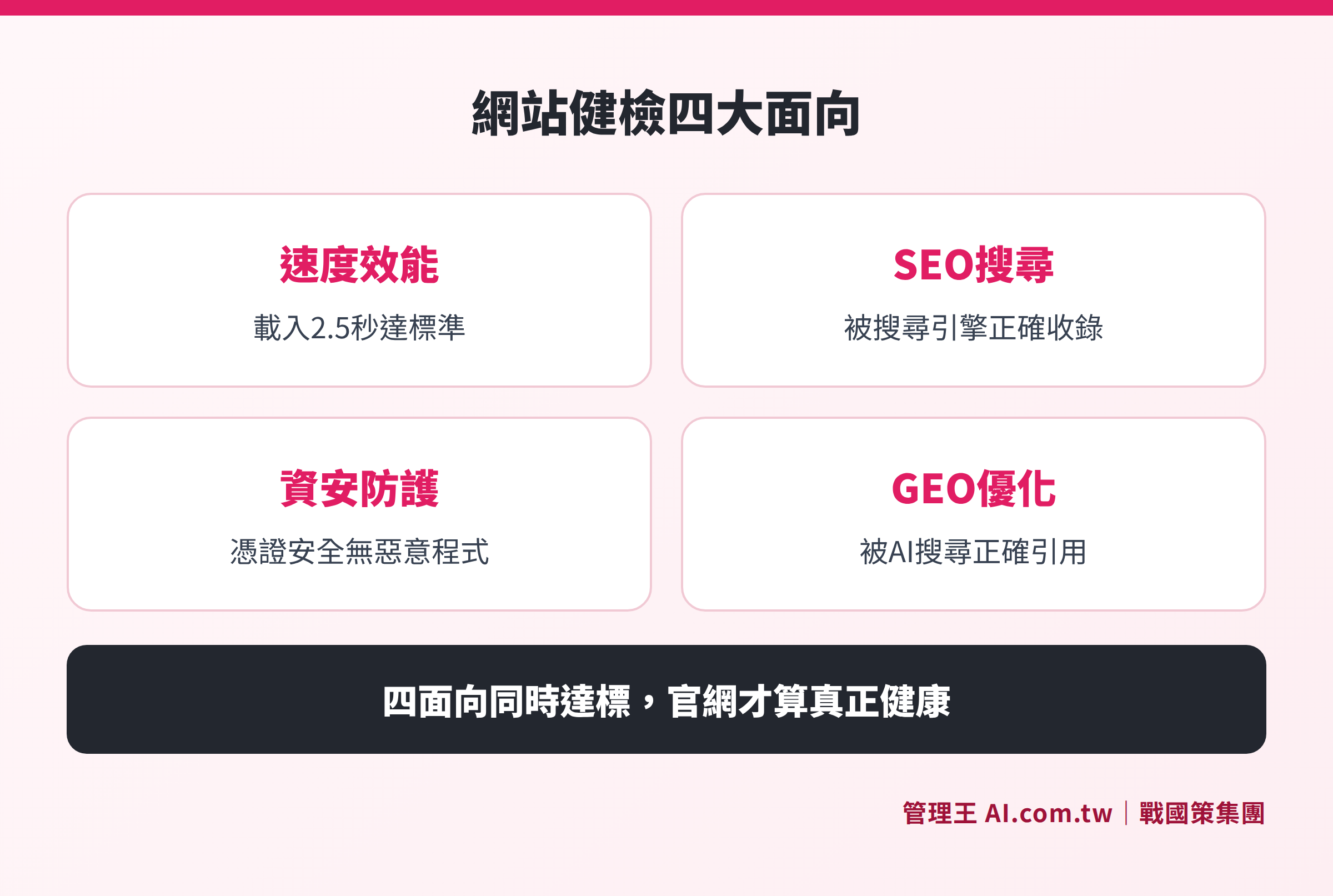
Key explanations of the four health check aspects: Speed, SEO, Security, GEO
How Often Should You Do a Website Health Check?
The recommended frequency for health checks varies by item:
- Daily Automated Monitoring: SSL certificate validity, server uptime (Uptime monitoring), Core Web Vitals anomalies
- Weekly: Confirming automatic backups, security scanning (malware)
- Monthly: SEO health checks (index status of new pages, 404 errors, external link quality), rechecking speed performance
- Quarterly: Complete technical SEO review, GEO visibility assessment, E-E-A-T content quality review
- Whenever There are Major Changes: Conduct a comprehensive health check immediately after a redesign, server migration, or CMS/plugin updates
The above frequencies are primarily suitable for corporate websites with stable content updates. E-commerce sites, given the volume of pages and high transaction security requirements, are advised to conduct a complete security scan weekly.
How to Prioritize Tasks After a Health Check?
After receiving the health check report, it is recommended to prioritize based on "impact scope × repair difficulty" dimensions. Issues with a large impact scope that are easy to fix (e.g., robots.txt erroneously blocking the entire site from being indexed, expired SSL certificates) should be addressed first; next, tackle problems with a large impact but are more complex to fix (e.g., significantly lagging Core Web Vitals LCP requiring hosting upgrades or code refactoring); lastly, focus on issues that are localized and difficult to fix (e.g., specific pages lacking Schema markup).
Enterprises are advised to create a trackable to-do list of health check issues, re-run Google PageSpeed Insights or Search Console after each fix, and verify that the data has indeed improved. The entire repair cycle should be completed before the next full health check, forming a continuous improvement loop of "health check → repair → verification → re-check."
Use 管理王 AI.com.tw for Website Health Checks
管理王 AI.com.tw's website health check feature employs a "Security / SEO / GEO All-in-One Automatic Health Check" framework, producing a health check report that can be embedded in the official website, transforming it into an "online health check assistant" for potential customers to experience with one click.
Core Features Explained:
IT Control Tower Dashboard
Consolidates the company's internal IP devices (printers, POS systems, Wi-Fi APs, servers) and SaaS account subscriptions into a unified monitoring dashboard. If a device goes offline for 30 seconds, it pushes notifications through LINE to MIS, significantly shortening the average repair time.
SaaS Subscription Management
Integrates with over 30 popular SaaS platforms such as Google Workspace, Microsoft 365, Slack, Notion, automatically showing the last usage date and per capita cost of each subscription, with automatic suggestions to deactivate idle accounts, helping businesses clean up unnecessary software expenditures.
Automatic Fault Dispatch
The website health check integrates with 管理王's task management, automatically creating tasks and assigning them to relevant IT personnel when alerts are triggered, with MTTR (Mean Time to Repair) statistics collected afterward.
Centralized Management for Multiple Branches
Supports hierarchical management from "Headquarters → Regional → Branch", enabling headquarters IT to view all stores' equipment and service status on one page, while regional IT sees only their responsible range.
How to Get Started:
- Sign up for a free 管理王 account (the free plan is permanently available, no credit card required)
- Go to "Information Systems" > "Website Health Check" module
- Add IPs of devices or SaaS accounts to monitor
- Set alert rules (LINE notification, alert grading, silence periods)
- View the complete diagnosis results from the "Health Check Report" after one week
Combined with high-speed hosting services (SSD storage, CDN acceleration, SSL certificates), data backups (weekly auto backups), and network management tools (IP monitoring, device management), it can create a complete safety protection loop for corporate IT. Additionally, if companies need to enhance SEO performance, 管理王's AI SEO function can assist in optimizing content structure automatically.
View complete plan pricing|Learn more about 管理王's security explanations
Experience Website Health Check Features for Free Now
管理王 offers a security, SEO, and GEO all-in-one automatic check, generating reports that can be embedded on the official website, with a free plan available for permanent use.
Free consultation hotline: 0800-003-191
LINE official account: @119m
Official website: app.AI.com.tw
Free trial: Apply for 管理王 now
Frequently Asked Questions
Do You Have to Hire Professionals for a Website Health Check?
Not necessarily. Tools like Google PageSpeed Insights, Google Search Console, SSL Labs, etc., are free and can be used without programming background; business owners or administrative personnel can complete basic health checks in 1-2 hours. If technical issues needing improvement (such as server settings, code optimization) are discovered, then professional assistance is necessary. 管理王's website health check is designed for MIS or administrative personnel familiar with computers to set up basic monitoring, while more complex custom monitoring can be assisted by 管理王 consultants.
What Are Common Reasons for Slow Website Speed?
Common reasons include: (1) Images not compressed or not converted to WebP/AVIF format; (2) Browser caching or CDN not enabled; (3) Insufficient host specifications (SSD hosts are recommended); (4) Too many unused JavaScript/CSS files; (5) Third-party embedded scripts (like chatbots, ad tracking codes) slowing down the main execution thread. Using Google PageSpeed Insights’ "Optimization Suggestions" can provide itemized explanations.
What Should be Fixed First After an SEO Health Check?
It is recommended to prioritize SEO health check issues as follows: first address "indexing issues" (such as robots.txt incorrect blocking, noindex misconfiguration), as being unindexed means there are no ranking opportunities; second, address "severe 404 errors" (especially for pages with external links pointing to them); then fix pages with poor Core Web Vitals scores; finally, tackle content and keyword optimization. Since each issue has varying repair difficulty, they can be prioritized for batch processing according to their impact scope.
What to Do if the Website is Hacked?
Immediately take the following steps: (1) Have the host or IT staff temporarily take the website offline to prevent further infection for visitors; (2) Restore from the most recent clean backup; (3) Change all account passwords (including FTP, backend management, host console); (4) Update all plugins and themes to the latest versions; (5) Submit a "Security Issue" review request in Google Search Console for Google to reevaluate and remove security warnings. If no regular backups exist, it's advisable to contact the host immediately.
What is GEO, and How is it Different from SEO?
SEO (Search Engine Optimization) targets traditional search engines like Google and Bing, bringing traffic through keyword rankings. GEO (Generative Engine Optimization) specifically targets AI search tools like ChatGPT, Gemini, and Perplexity, aiming for the website content to be accurately referenced and recommended to users by AI. GEO places a higher emphasis on the level of structuralization of content (Schema markup), directness of answers (a sentence that can answer the question), and the credibility of sources (having external citations). The two are not mutually exclusive; good SEO usually benefits GEO as well.
Data Sources
- Google Core Web Vitals — web.dev — Definitions and threshold values of the three key indicators LCP, INP, and CLS (official Google technical documentation)
- Google Core Web Vitals Tools — web.dev — User guides for PageSpeed Insights, Search Console, Lighthouse (official Google)
- Google Search Console Explanation — Core Web Vitals — Explanation of Core Web Vitals reports in Search Console
- SSL Server Test — Qualys SSL Labs — SSL certificate security rating tool (Qualys official)
- Google Safe Browsing — Check website security status (official Google)