How to Calculate CRM System Costs? Seats, Modules, and Hidden Costs|CRM System Recommendations
CRM costs consist of subscription fees, setup fees, integration fees, and training costs, with actual expenditures in the first year often exceeding retail prices by 20% to 40%. This article organizes three mainstream pricing methods: per-seat billing, module subscriptions, and one-time buyouts, compares the cost ranges of major international CRMs, and explains how to enable complete CRM functionality within a reasonable budget using 管理王 AI.com.tw.
The cost of a CRM system depends on the billing method, number of users, and range of functionalities, with mainstream CRMs in the Taiwan market ranging from free to tens of thousands of NT dollars per month. The most common billing methods are: per seat (monthly per user), module-based subscriptions, and one-time purchases with annual maintenance fees. Understanding the differences among these three models allows for precise calculations of expenses in the first, third, and fifth years without being misled by advertised prices, and helps avoid discovering that "hidden costs are higher than subscription fees" after implementation. This article organizes the main billing structures available in the market, the components of actual costs, and recommendations for small and medium enterprises in Taiwan during their selection process.
What Are the Components of CRM System Costs?
Many businesses only look at the "monthly subscription fee" when evaluating a CRM, forgetting that the subscription fee is just a part of the total cost of ownership (TCO).Complete CRM costs typically include the following levels:
1. Subscription Fees (Monthly or Annually)
This is the most visible figure, usually presented as "per seat per month" or "the entire suite per month".
2. Setup and Implementation Fees
This includes data migration, process configuration, and interface customization. The larger the scale and the more complex the processes, the higher the setup costs.
3. Education and Training Fees
Employee training, supervisor report setup, and onboarding costs for new employees; some vendors offer these for free while others charge separately.
4. Custom Development Fees
If standard functionalities cannot meet specific needs, additional payment is needed for development, usually billed hourly.
5. Integration Fees
When the CRM needs to connect with existing ERP, accounting systems, e-commerce platforms, LINE, or other tools, API integration fees are often required.
6. Annual Maintenance and Renewal Fees
Software updates, technical support, and server hosting fees vary by vendor.
In a Nutshell
The actual CRM costs = Subscription fees + Setup fees + Training fees + Integration fees, with the total expenditure in the first year typically exceeding advertised prices by 20% to 40%.
Comparison of Three Mainstream CRM Billing Methods
Table: Overview of Three CRM Billing Methods
| Billing Method | Description | Suitable For | Notes |
|---|---|---|---|
| Per Seat Billing | Pay per user per month, with costs increasing linearly as the number of users increases | Teams with a clear number of sales personnel and flexible budget planning | Costs directly rise when personnel expands, requiring prior assessment of growth rate |
| Module Subscription | Subscribe separately by functional modules, only purchasing the features needed | Small to medium enterprises with clear needs and single functionalities | The total cost after subscribing to multiple modules often exceeds the cost of a complete package |
| One-Time Buyout | Pay a license fee to use permanently, with additional annual maintenance fees | Businesses with IT resources that want to manage it themselves and do not want to pay monthly fees in the long term | High initial investment; upgrading requires additional payment |
Per seat billing is currently the mainstream model in the market, adopted by HubSpot, Salesforce, and Zoho CRM. The advantage is predictable costs, while the disadvantage is that rapid team expansion leads to a significant increase in monthly bills.
International Mainstream CRM Cost References (Based on Official Web Plans)
Below are the cost details publicly listed on each vendor's website, with exchange rates effective as of the inquiry date; actual costs should refer to the latest announcements on each vendor’s site.
Table: Public Costs of Mainstream CRM Models (Inquired 2026)
| Brand | Entry Plan (Per Seat Per Month) | Mid-Tier Plan | Enterprise Plan | Main Restrictions |
|---|---|---|---|---|
| Salesforce Sales Cloud | Approx. USD $25 | Approx. USD $100 | Approx. USD $175+ | Annual payment only, excess API usage charged separately |
| HubSpot Sales Hub | Approx. USD $20 | Approx. USD $100 | Approx. USD $150 | Advanced features have minimum seat requirements |
| Zoho CRM | Approx. USD $14 | Approx. USD $23 | Approx. USD $52 | Some features require purchase of other Zoho ecosystem products |
| Pipedrive | Approx. USD $14 | Approx. USD $39 | Approx. USD $79 | Automation features limited to advanced plans |
Converted to New Taiwan Dollars, for a 10-person sales team, the entry plan for Salesforce costs approximately NT$8,000 to NT$10,000 per month, while the mid-tier plan can reach NT$30,000 to NT$40,000, not including setup and customization costs.
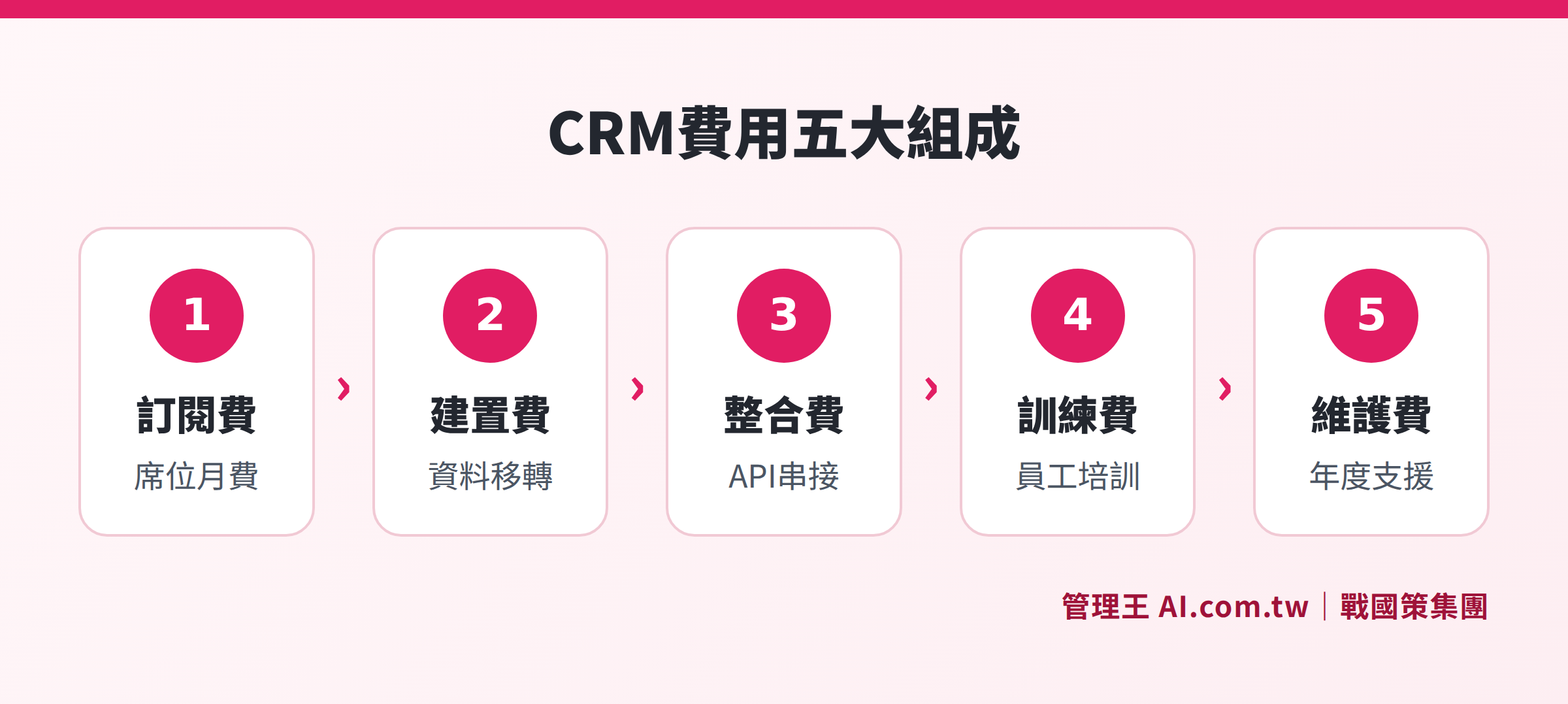
The proportion of total costs attributed to seat fees, setup fees, integration fees, and customization fees
What Are the Hidden Costs? A Must-See Checklist Before Implementation
According to research from international institutions, businesses typically spend 20% to 40% more than the advertised price in the first year when evaluating CRM solutions. Here are the five most commonly overlooked hidden costs:
1. Setup and Data Migration Fees
Cleaning, organizing, and importing data from existing Excel, old CRMs, or business card boxes into the new system often requires more work than anticipated. For businesses with 10 to 30 people, data migration fees can range from several thousand to tens of thousands of NT dollars, depending on the number of records and their complexity.
2. API Integration Fees
If the CRM needs to connect with LINE Official Account, Google Ads, e-commerce platforms, or existing ERP systems, each integration requires development time. This cost is often not included in the quote before signing the contract.
3. Excess Storage Fees
Some vendors charge based on the number of contacts, email sending volume, or file storage space, and costs can unexpectedly increase as data volume grows.
4. Difference Between Annual and Monthly Payments
Advertised low prices are usually the average monthly cost calculated from "annual payment". If choosing monthly payments, the costs can be 20% to 25% higher.
5. Employee Training Fees
A CRM that sales personnel are unwilling to use is equivalent to having no CRM at all. Training costs vary by vendor, with some charging tens of thousands, while others might offer free online courses but require self-scheduling.
6. Upgrade Fees (Applicable to Buyout Options)
If a one-time buyout option is chosen, additional fees are often required to upgrade when the vendor releases new versions after a few years, or users may remain on the old version without the new features.
Reasonable Budget Ranges for SMEs CRM Costs in Taiwan
For a sales team of 15 people, mainly requiring customer management, follow-up reminders, and performance reports, a reasonable first-year budget reference is as follows:
Using Free or Low-Cost SaaS Options
- Subscription Fee: NT$0 to NT$18,000/year (depends on the plan)
- Implementation and Setup: Self-handled, time cost can be high
- Suitable for: New startups with ample manpower, strong IT capabilities, and simple needs
Using Mid-Tier SaaS Options (e.g., HubSpot, Zoho)
- Subscription Fee: NT$36,000 to NT$120,000/year
- Consultant Fees for Implementation: NT$30,000 to NT$150,000 (depending on complexity)
- Training Fees: NT$0 to NT$30,000
- Total for the First Year: NT$70,000 to NT$300,000
Using Local Integrated Platforms (e.g., 管理王 AI.com.tw)
- Subscription Fee: NT$60,000 to NT$120,000/year (business model)
- CRM integrated with other functionalities (quotations, contracts, accounting, personnel) without additional API fees
- Implementation training included in the plan (8 hours for business model, 16 hours for flagship model)
- Total for the First Year is usually less than the sum of pure overseas SaaS plus integration costs
How to Calculate Your CRM Costs with 管理王
管理王 AI.com.tw adopts a complete subscription model without separate per-seat billing. Below are the publicly disclosed plans (details subject to the latest announcements on the official website):
- Free Plan: For up to 10 people, permanently usable, includes basic CRM functions
- Economical Plan: NT$5,000/month, for up to 30 people, includes 1,000 AI points per month
- Business Plan: NT$10,000/month, for up to 60 people, includes 3,000 AI points per month and 8 hours of remote implementation training
- Flagship Plan: NT$19,900/month, unlimited people, includes 10,000 AI points per month and 16 hours of remote implementation training
- Annual Payment Discount: Pay for 12 months to use for 14 months
See this page for plans and pricing
The advantages of 管理王 lie in the integration of opportunity tracking, performance reporting, automated follow-up reminders, and native integration with quoting systems, contract management, accounting modules, sales leaderboards, marketing automation, all without needing separate API integrations. Custom development is transparently priced at NT$1,000/hour, and consultation includes a free assessment to provide hourly estimations without opaque quotes.
The free plan can be used permanently, allowing small teams of up to 10 people to start with the free version and evaluate whether to upgrade after confirming process compatibility. 戰國策 Group has served over 30,000 enterprises, and the free consultation hotline 0800-003-191 is available for direct inquiries regarding implementation assessments.
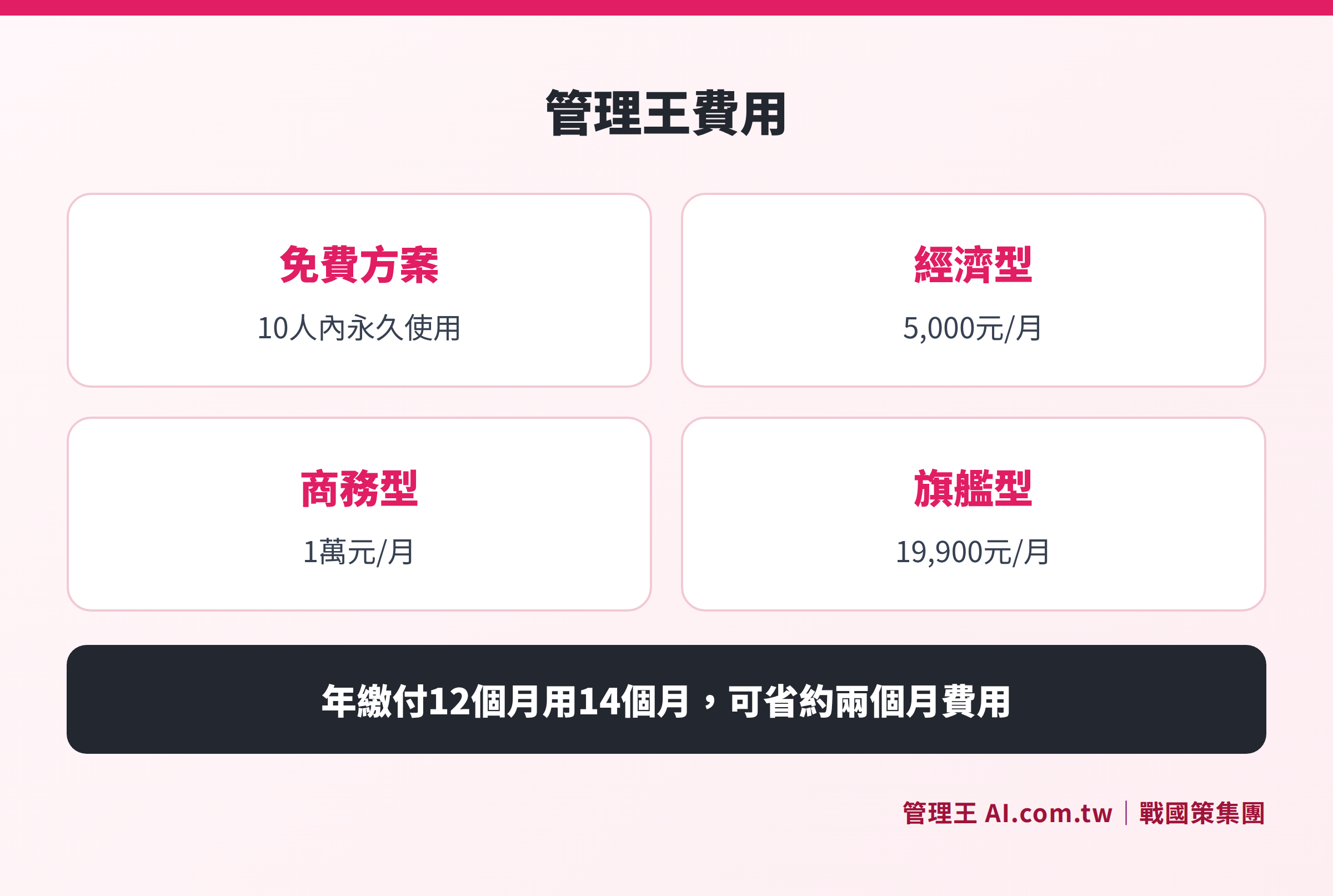
Core differences among the four plans: Free, Economical, Business, and Flagship
Common Five Cost Traps During Selection
Trap 1: Comparing Only Subscription Fees Without Considering Integration Costs
Many businesses only compare the monthly fees between Vendor A and Vendor B without calculating the development hours needed to integrate the CRM with existing ERP, LINE Official Account, or e-commerce backend. Integration costs often exceed subscription fees by more than double.
Trap 2: Estimating Using Advertised Prices Without Understanding the "Annual Payment" Conditions
Advertisements like “NT$1,500 per month starting” are typically the average monthly cost based on "annual payment" meaning if you choose monthly payments, costs will be 20% to 25% higher. If you do not meet the minimum seat requirement, the actual unit price will be even higher.
Trap 3: Not Accounting for Employee Turnover and Transition Costs
Employee turnover and training for new hires is a long-term hidden cost. Choosing an interface that is intuitive and quick to learn can significantly reduce these costs.
Trap 4: Underestimating Data Cleaning Hours
Importing data from Excel or old CRMs often requires cleaning formats, removing duplicates, and filling out fields beforehand. Many businesses underestimate the time required for this step, leading to longer-than-expected implementation periods.
Trap 5: Failing to Confirm Data Handling After Contract Expiry
Some vendors retain data for only 30 days post-contract termination, deleting it afterward without refunds. It’s crucial to confirm the data export format (CSV, Excel, or JSON) and retention period before signing.
How to Evaluate the Total Cost of Ownership of a CRM?
Before making a selection, it is advisable to use the following framework to calculate the three-year total cost of ownership (TCO):
Annual Subscription Fee × 3
+ One-Time Setup Fee (Data Migration, Process Configuration)
+ Integration Fees (API Development, System Connections)
+ Training Fees × 1 (typically applicable only in the implementation year)
+ Annual Maintenance Fees × 2 (for the second and third years)
If a comprehensive platform is selected (integrating CRM with ERP, accounting, personnel in a single subscription), integration fees can usually be reduced to zero, making the three-year TCO lower than that of a "collection of multiple SaaS plus integration fees" option.
Before signing a contract after receiving vendor quotes, confirm the following points:
- What is the upgrade cost when the number of seats exceeds the plan limit?
- Is data export free? Can you take it with you if you switch systems later?
- Are there limits on API calls, and how are excess calls charged?
- How many days will data be retained after contract expiry if not renewed?
- How many hours of training are included, and is there a recording for employees to review later?
For more information on CRM selection, refer to What is a CRM System? Comprehensive Management from Leads to Transactions, Comparison of Free CRM Systems: What Are the Limitations and When Should You Pay?, and Zoho CRM Review: Features, Pricing, and Chinese Support.
Calculate Your CRM Costs for Free
管理王 consultants can assist you in calculating the total first-year costs of implementing CRM and finding the most budget-friendly plan, with free consultations that do not require a forced purchase.
Free consultation hotline: 0800-003-191
LINE Official Account: @119m
Official Website: app.AI.com.tw
Free Trial: Apply for 管理王 Now
Frequently Asked Questions
How much does a CRM system cost per month?
The CRM costs on the market range from NT$0 (free plan) to tens of thousands per month. For a sales team of 15 people, the monthly subscription fee for international mainstream SaaS (like HubSpot, Zoho) is approximately NT$6,000 to NT$30,000, with higher actual expenditures after integrating fees. With integrated local platforms such as 管理王, a complete plan containing CRM and multiple functionalities costs between NT$5,000 and NT$19,900 per month, with no additional API costs. Actual costs depend on the number of users, functional needs, and degree of customization.
Which is more cost-effective, per-seat billing or whole-package subscription?
It depends on the number of users and the breadth of required functionalities. If only CRM is needed and team size is stable, per-seat billing can help accurately control costs. However, if functionalities such as quoting, contracts, accounting, and personnel are needed simultaneously, adopting an entire package subscription is typically more cost-effective, as the cumulative costs of multiple SaaS plus integration hours often exceed the subscription fee of a complete package.
What are the hidden costs of CRM?
Common hidden costs include: data migration fees, API integration development fees, employee training costs, excess storage fees, and the price difference between annual and monthly payments (monthly payments generally cost 20% to 25% more). It is advisable to ask the vendor for a complete quote listing all costs for the first year before signing a contract, and to inquire about how data will be handled post-contract.
Does 管理王 offer a free plan?
Yes. 管理王 AI.com.tw offers a free plan for teams up to 10 people, allowing permanent use of basic CRM functions (customer management, follow-up reminders, opportunity tracking) along with a one-time allocation of AI points. For additional users or advanced AI functions, users can upgrade to the Economical plan (NT$5,000/month) or higher. More details can be found on the plans and pricing page.
Does implementing a CRM have to be expensive?
Not necessarily. The cost mainly depends on the complexity of the system, data volume, and degree of customization. If using a local platform that offers standard processes and has a simple interface, teams of fewer than 10 can start with the free version and complete basic setups in 1 to 3 days. Higher costs usually arise when significant API integrations are needed, business processes are very complex, or specific reports and forms require custom development. It is best to test processes with the free version before assessing the necessity for upgrades and customizations.
Data Sources
- Vedain: CRM Software Pricing Costs, Plans and Hidden Fees 2026 (Inquiry date November 2026)
- 管理王 AI.com.tw Plans and Pricing (Inquiry date November 2026)
- 管理王 AI.com.tw CRM System Features Page (Inquiry date November 2026)
- Salesforce: What is CRM? (Inquiry date November 2026)
- HubSpot Sales Hub Official Pricing Page (Inquiry date November 2026)
- Zoho CRM Official Pricing Page (Inquiry date November 2026)