EIP System Recommendation: Comparison of Cloud-Based and On-Premise Versions|EIP System Recommendation
Comparing the costs, cybersecurity, customization, and maintenance differences between cloud-based and on-premise EIP systems, explaining their applicable scenarios to help Taiwan's small and medium enterprises choose the most suitable EIP deployment method.
The core difference between cloud-based EIP and on-premise EIP lies in: where the data is stored and who maintains it. The cloud version (SaaS) is managed by the vendor, which is responsible for servers, updates, and backups. Companies can subscribe monthly and can be online within a few days to a few weeks; the on-premise version (On-Premise) requires the company to purchase servers and install them independently, with all data stored in the company’s data center, but requires dedicated IT personnel for daily maintenance and version upgrades. For most small and medium enterprises in Taiwan, without a dedicated IT team, the cloud version of EIP is a pragmatic first choice to reduce implementation risks and achieve quick results; the on-premise version is suitable for medium to large enterprises or special industries with strict requirements on data sovereignty or developed IT infrastructures. There is no absolute superiority between the two; the key is to evaluate one's IT capabilities, budget structure, and data compliance needs before making the most suitable choice.
What is Cloud-Based EIP?
Cloud-based EIP (Software as a Service, SaaS) is a corporate information portal set up by software vendors on cloud servers, allowing companies to connect via browser or mobile app without needing to purchase servers or install programs on-site. The vendor is responsible for server maintenance, security patches, offsite backup, and feature upgrades, while the company only needs to manage accounts and process settings.
Main Features of Cloud-Based:
- Monthly subscription fees, low initial costs, no hardware procurement required
- Fast trial use after account activation, lowering the entry barrier
- Vendors automatically push updates, always using the latest version
- Accessible from any device and location, supporting remote work
- Expanding the number of users only requires adjusting the plan, no need to change equipment
- Data stored in the vendor’s data center (the location and ISO certification of the data center should be confirmed)
In the Taiwanese market, mainstream cloud EIPs charge monthly or annual fees, with costs adjusted flexibly based on the number of users and functional modules, suitable for businesses ranging from ten to hundreds of employees.
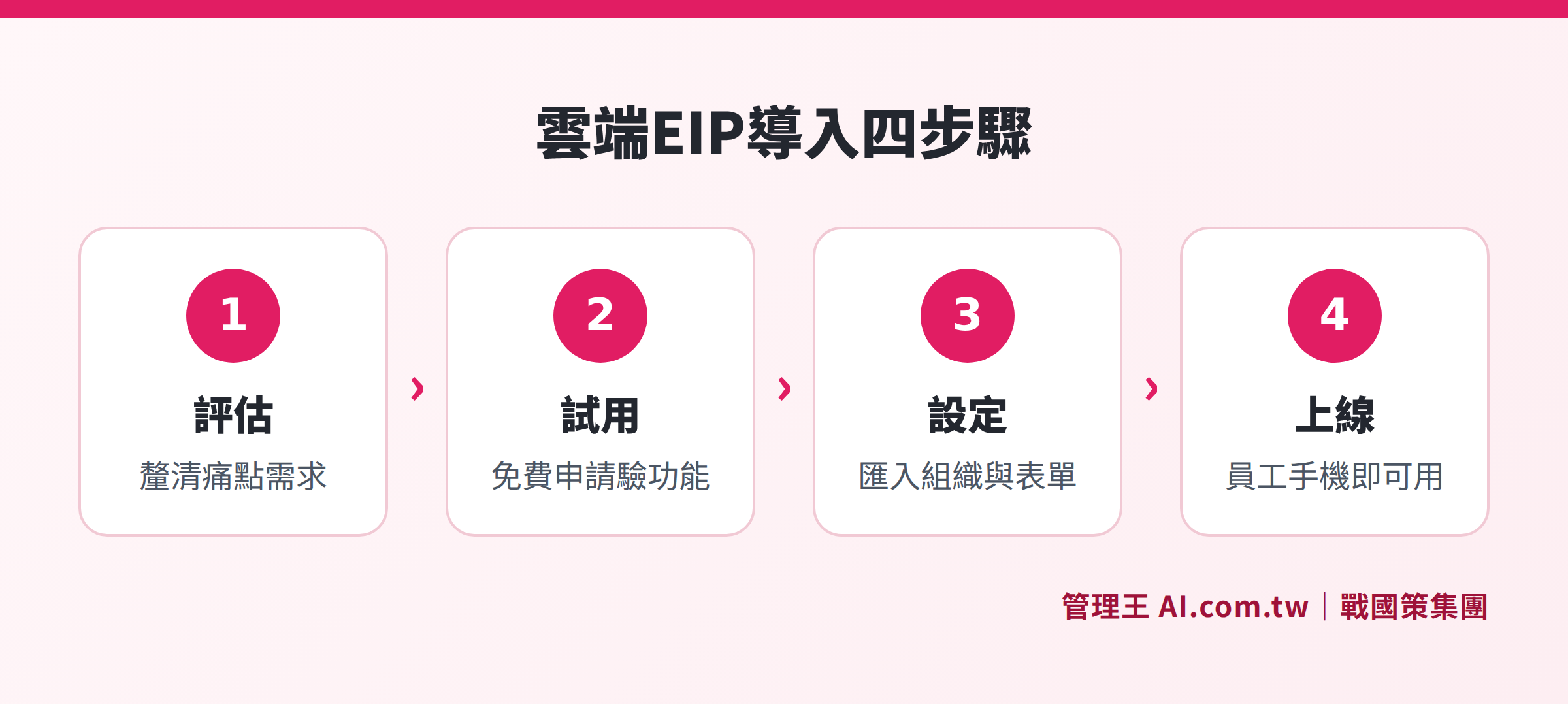
A diagram illustrating the four main steps for companies to implement a cloud-based EIP system, from demand assessment to full launch
What is On-Premise EIP? (On-Premise Deployment)
On-premise EIP (On-Premise) involves installing the EIP system on the company's own servers or private cloud, ensuring data does not leave the company’s data center. Companies have full control of the system and can deeply customize it according to internal processes, fully integrating with existing ERP or other IT infrastructures, but they must also bear all responsibilities for server procurement, IT maintenance, and system upgrades.
Main Features of On-Premise:
- Data is fully stored within the company’s data center, ensuring clear data sovereignty
- High customization level, allows modification of system architecture or deep integration with existing systems
- One-time licensing or outright purchase, no monthly fees for long-term use
- Can operate in offline environments, suitable for special fields with network restrictions
- Requires dedicated IT personnel for maintenance, backups, security, and version upgrades
- Higher initial hardware procurement and setup costs
On-premise versions are more common in the financial sector, healthcare institutions, government agencies, or large manufacturers, where there are strict regulatory requirements for data residency or complex integration needs with existing systems.
Cost Structure Comparison of Cloud-Based and On-Premise EIPs
The cost structure is the most critical difference between cloud-based and on-premise versions. The cloud version spreads costs through monthly subscriptions with low initial investment; the on-premise version requires a substantial one-time upfront investment, and the total cost of ownership (TCO) for long-term use needs to be evaluated based on actual number of users and usage years.
Table: Cost Structure Comparison of Cloud-Based vs. On-Premise EIP
| Cost Item | Cloud Version (SaaS) | On-Premise Version (On-Premise) |
|---|---|---|
| Initial Setup Cost | Low (can trial after account activation) | High (server procurement, installation, and configuration) |
| Monthly/Annual Fee | Yes (based on number of users and modules) | No (but maintenance and update fees are required) |
| IT Labor Costs | Low (vendor responsible for maintenance) | High (dedicated IT or outsourced maintenance required) |
| Customization Development Costs | Based on vendor quotes | Usually more flexible, can be outsourced for development |
| Upgrade Costs | Usually included in subscription fees | Licensing fees for version upgrades may apply |
| Data Backup Costs | Included in the plan (depending on vendor specifications) | Need to plan backup data centers and mechanisms |
In a Nutshell
Cloud version: “Monthly payments, eliminating IT burdens”; On-premise version: “High initial investment, completely self-managed data”.
Cybersecurity and Data Sovereignty: Which is Safer?
Cybersecurity considerations are a core factor in many enterprises' choice of deployment method, with both methods having their advantages, making it impossible to simply state which is "absolutely safer".
Cybersecurity Advantages of Cloud Version:
- Managed by professional cybersecurity teams from vendors, regular updates of security patches
- Automatically patches vulnerabilities, reducing exposure time due to delayed updates
- Usually has third-party cybersecurity certifications such as ISO 27001 or SOC 2
Cybersecurity Considerations for Cloud Version:
- Data is stored on third-party servers; confirm the location of the data center before purchasing
- If the data center is overseas, it may involve cross-border transmission issues of personal data
- Relies on internet connectivity; if the network is down, the service cannot be used
Cybersecurity Advantages of On-Premise Version:
- Data is completely in the company’s control domain, clear data sovereignty
- Network isolation can be set up to reduce the external attack surface
- Data retrieval during audits by regulatory agencies is more direct
Cybersecurity Considerations for On-Premise Version:
- Security updates must be planned and executed by the company, risk of delayed updates is self-borne
- If lacking dedicated cybersecurity personnel, cybersecurity risks may actually increase
- Internal access audits and controls need additional planning
According to the Ministry of Digital Affairs (MODA) regulations, enterprise information systems should implement basic cybersecurity requirements such as access controls and audit records, applicable to both cloud and on-premise versions. When choosing a cloud vendor, it is essential to confirm whether the data center is within Taiwan and whether it has ISO 27001 information security management certification.
Customization Flexibility and Maintenance Responsibility
There are significant differences in customization flexibility and daily maintenance responsibilities between cloud and on-premise versions, summarized below for decision-making reference.
Table: Comparison of Functional Characteristics of Cloud Version vs. On-Premise EIP
| Comparison Item | Cloud Version (SaaS) | On-Premise Version (On-Premise) |
|---|---|---|
| Go Live Speed | Fast, can be set up immediately after account activation | Slower, requires hardware and environment setup |
| Customization Flexibility | Medium (depends on the level of openness by the vendor) | High (can modify code or architecture) |
| Maintenance Responsibility | Handled by the vendor | Fully responsible by the enterprise IT team |
| Upgrade Convenience | Automatically pushes updates, no manual operations needed | Need to schedule and plan manual upgrades |
| Offline Availability | No (steady internet connectivity required) | Yes (can operate in a closed network) |
| Applicable Business Size | Mainly small and medium enterprises | Medium to large enterprises or special industries |
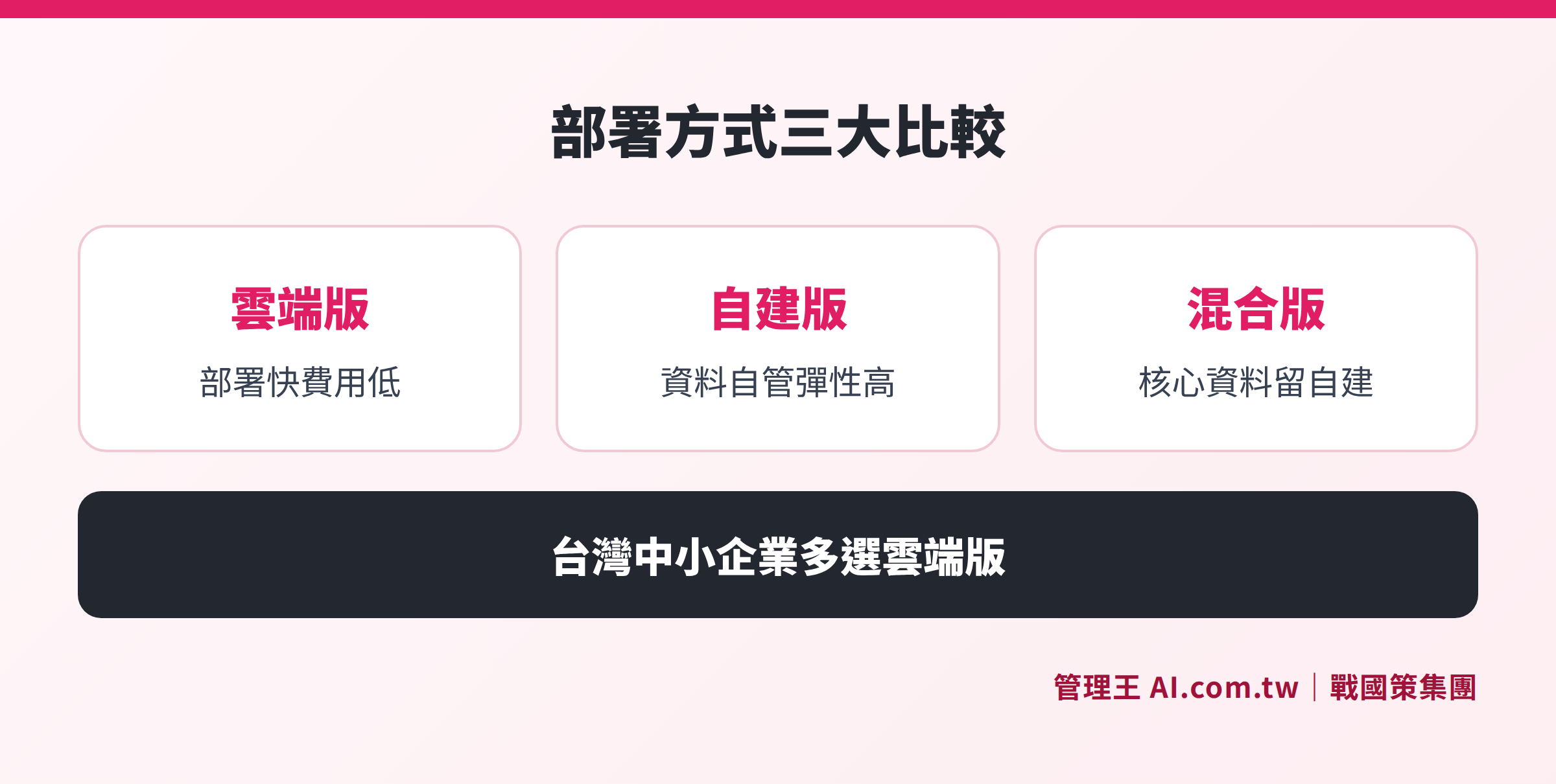
Comparison card diagram for the features of three EIP deployment methods (cloud version, on-premise version, hybrid version)
What Situations are Suitable for Choosing Cloud-Based EIP?
Companies in the following situations typically find more benefits in choosing cloud-based EIP:
- Limited IT Personnel: Small to medium enterprises without dedicated IT staff do not want to bear the responsibilities of server maintenance, backups, and security updates
- Need for Quick Deployment: Desire to enable employees to start using electronic signing, attendance punching, and other functionalities in a short time
- Flexible Budget Structure: Hope to spread costs in monthly or annual fees to avoid large one-time capital expenditures
- Decentralized Work or Multiple Locations: Employees working in different locations or frequently traveling require remote operation on any device
- Rapid Business Growth: Number of employees increasing from a few to several dozens, plans can be adjusted flexibly without needing to rebuild systems
- Prioritizing User Experience: Cloud vendors continuously update features; interfaces and mobile device support are usually more modern
Taking small and medium enterprises in Taiwan as an example, companies with ten to sixty employees without a dedicated IT team find cloud-based EIP to be the most pragmatic choice in terms of budget and maintenance costs.
What Situations are Suitable for Assessing On-Premise EIP?
The following circumstances may be more appropriate for an in-depth assessment of on-premise versions:
- Strict Data Sovereignty Requirements: Industries such as finance, healthcare institutions, government or publicly listed companies have regulatory requirements that specific data must not leave certain geographical boundaries
- Deep IT Integration Needs: Need for deep integration with existing ERP, MES, or factory automation systems, high requirements for API openness
- Special Network Environments: Intranet in factories, operational areas with high-security levels where systems cannot connect to external networks
- Extremely Large Scale for Long-Term Use: Very large number of users and expected usage duration exceeds ten years; long-term TCO of the on-premise version may be lower than continued subscriptions
- Well-Established IT Infrastructures: Existing data centers and mature IT maintenance teams capable of assuming full responsibility for system management
It is important to note that on-premise does not imply "no ongoing costs". In addition to hardware procurement costs, ongoing expenses such as IT staff salaries, cybersecurity maintenance fees, version upgrade licensing fees, etc., should not be underestimated. When comparing costs between the two, businesses should calculate the total cost of ownership for at least five years to make a more accurate assessment.
How to Use 管理王 AI.com.tw
管理王 AI.com.tw uses a cloud SaaS structure, with data stored in the Taiwan-based 戰國策 group data center, with dual data center redundancy, compliant with ISO 27001 standards, and data not transmitted overseas. Companies do not need to purchase any server hardware and can start trialing the complete functionality of the EIP Corporate Information Portal 30 seconds after free registration.
Main features include:
- Electronic Signing (Approval Center): Digital handling of leave, overtime, business trips, and payment requests, supporting custom multi-level processes, with approvals done via LINE
- Electronic Contracts and Signatures: Contracts can be signed online with a complete audit trail, legally valid according to the Electronic Signature Law
- Time Punch and Attendance: GPS and Wi-Fi punches automatically integrate with payroll modules, approved leave requests are automatically counted
- Employee Onboarding and Training: Automated employee onboarding processes, with all courses, tests, and certificates digitized
- AI Knowledge Base, Instant Messaging, Online Meetings: Collaboration tools integrated into one portal, with AI automatically generating meeting minutes
Plans range from free version (permanently free for ten users or fewer) to flagship versions without user limits, with annual payments enjoying discounts for fourteen months. When standard features are insufficient, customization development can be done transparently at NT$1,000/hour, following a free consultation for evaluation prior to work commencement. 戰國策 group has serviced over 30,000 enterprises and provides a local 0800 free customer service hotline in Taiwan.
For a deeper understanding of the overall structure and functions of EIP systems, you can refer to:
- What is an EIP System? Integrating Announcements, Forms, and Approvals in Corporate Portals
- Recommended Electronic Form Systems: When Google Forms Aren't Enough
- How Much Does an Electronic Signing System Cost? Buyouts, Monthly Subscriptions, and Hidden Costs
Free Consultation on EIP System Selection
Consultants assist in assessing which is better suited for your business between cloud-based and on-premise versions, providing customized suggestions and free trial options.
Free consultation hotline: 0800-003-191
LINE Official Account: @119m
Official Website: app.AI.com.tw
Free Trial: Apply for 管理王 now
Frequently Asked Questions
Where is the data of the cloud version EIP stored? Is Taiwanese company data secure?
The storage location of cloud EIP data is determined by the vendor; before purchasing, it should be confirmed whether the data center is in Taiwan and whether it holds ISO 27001 information security management certification. 管理王 AI.com.tw stores its data in 戰國策 group's Taiwan data center, with dual data center redundancy, compliant with ISO 27001 standards, and data not transmitted to overseas servers, ensuring that employee data, contract documents, and attendance records are protected under Taiwanese law.
Is the on-premise version of EIP necessarily safer than the cloud version?
Not necessarily. While the on-premise version does store data on the company's own servers, if the company lacks dedicated cybersecurity personnel to regularly patch vulnerabilities and control access permissions, it may actually pose a higher cybersecurity risk. The cloud version is maintained by the vendor, with regular automatic updates of security patches. For most small and medium enterprises, choosing a cloud provider with ISO 27001 certification and a data center in Taiwan does not have lower safety than on-premise versions.
Can cloud EIP customize forms and approval processes?
Yes. 管理王 AI.com.tw allows customization of form fields, set up multi-layer approval processes, and automatic routing based on application amounts or departments, allowing supervisors to designate proxies without the need for modifying any code for most process settings. For more complex customization needs, for example, deep integration with existing systems, it can be accomplished through NT$1,000/hour custom development services, with consultants conducting free interviews to assess required hours.
Is it better for small and medium enterprises to choose cloud-based or on-premise EIP?
For small and medium enterprises with ten to sixty employees and no dedicated IT team, the cloud version is usually the more pragmatic choice: low initial costs, fast deployment, and maintenance is taken care of by the vendor. The on-premise version is suitable for medium to large enterprises or special industries with strict data sovereignty regulation requirements (such as financial or healthcare institutions) or those needing deep integration with existing systems, but IT manpower and maintenance costs must also be evaluated in parallel.
How much preparation time is needed to implement a cloud EIP?
The preparation focus for cloud EIP is not on technical architecture but on internal process sorting: confirming the field requirements for various request forms, approval levels and proxy settings, and activating employee accounts. 管理王 AI.com.tw offers a free trial period allowing IT or administrative staff to become familiar with system settings. Preparation times vary based on company size and process complexity; it is advisable to trial first for assessment before determining the formal implementation schedule.
Data Sources
- Ministry of Digital Affairs Cybersecurity Regulations—Related Cybersecurity Regulations (Digital Ministry, MODA)
- EIP System Implementation Guide: Comparison of Cloud and On-Premise Solutions (Status Enterprise Management Platform)