Employee Reward System Design: A Complete Guide to Incentive Plans for SMEs|Recommended Employee Reward Systems

This article comprehensively explains the six types of employee reward system designs, critical differences in wage determination under the Labor Standards Act, mandatory regulations for year-end bonuses (Article 29), performance commission tier design methods, a five-step implementation framework, and the automated settlement operation of the management king reward system, suitable for reference by SME owners and HR in Taiwan to establish compliant and effective incentive systems.
Employee reward system design refers to how companies manage various incentive measures such as performance commissions, full attendance bonuses, year-end bonuses, and referral bonuses through clear rules and automated tools. The core purpose is to let employees clearly know "what to achieve and what to get," making the motivation tangible as a daily impetus rather than a one-time benefit at year-end. To design an effective employee reward system, it is essential first to understand the relevant provisions of Taiwan's Labor Standards Act — which bonuses belong to wages and which belong to profit distribution — and then select the appropriate reward types based on the company's scale and business characteristics, ultimately ensuring transparent calculations and compliant distributions through system tools so that the team genuinely feels motivated to achieve performance targets. This guide is suitable for SME owners, HR managers, and sales managers to refer to when establishing or optimizing existing reward systems from scratch.
What is an Employee Reward System? Definition and Regulatory Framework
An Employee Reward System is a management mechanism by which businesses link monetary or non-monetary rewards to employee performance, goal achievement, or specific behaviors. Broadly, it encompasses all incentive tools beyond just the salary structure; narrowly, it mainly refers to quantifiable monetary rewards like performance commissions, achievement bonuses, and full attendance bonuses.
In Taiwan, the design of employee reward systems must satisfy two legal frameworks:
Wage Determination (Labor Standards Act Article 2, Item 3): Any remuneration received by an employee for work, as long as it is "regular," regardless of its name (bonus, allowance), is considered wages and must be included in the average wage calculation, affecting severance pay, retirement pensions, and annual leave overtime calculations. The Ministry of Labor’s interpretation standard is that performance bonuses conditional upon "achieving work objectives" and disbursed on a monthly or quarterly basis are likely to be recognized as wages.
Profit Distribution (Labor Standards Act Article 29): At the end of an accounting year, if a business unit has surplus after paying taxes, covering losses, and allocating dividends and reserves, the employer "shall" give bonuses or dividends to employees who have worked the entire year without fault. This represents a legal obligation, not at the employer's discretion, and cannot be excluded in labor contracts.
In a nutshell
Year-end bonuses are a legal obligation that depends on "having profits"; performance bonuses that are regularly paid may be recognized as wages affecting severance pay calculations.
Six Major Types of Employee Reward Systems
The types of employee incentives commonly used by SMEs can be divided into six categories, each with applicable scenarios and regulatory considerations:
Table: Comparison of Six Types of Employee Reward Systems
| Type | Disbursement Conditions | Common Industries | Is it Wages (Reference) | Regulatory Notes |
|---|---|---|---|---|
| Performance Commission | Transaction Amount × Commission Rate | Sales, Insurance, Real Estate | Yes (Accumulative Monthly) | Must be included in average wages |
| Full Attendance Bonus | No sick leave or tardiness that month | Manufacturing, Service | Yes (Regular Disbursement) | Leave may affect compliance |
| Year-end Bonus | Distributed after annual profits | All industries | No (Discretionary Payment) | Mandatory under Labor Standards Act Article 29 |
| Achievement Reward | KPI reaches a certain percentage | Manufacturing, Sales | Depends on disbursement frequency | Goals must be documented |
| Referral Bonus | Successfully refer new clients or new hires | Retail Chains, Consulting | No (Irregular) | Payment conditions must be clearly stated |
| Performance Allowance | Based on performance evaluation results | Technology, Consulting | Yes (Included in Monthly Salary) | Implemented according to evaluation standards |
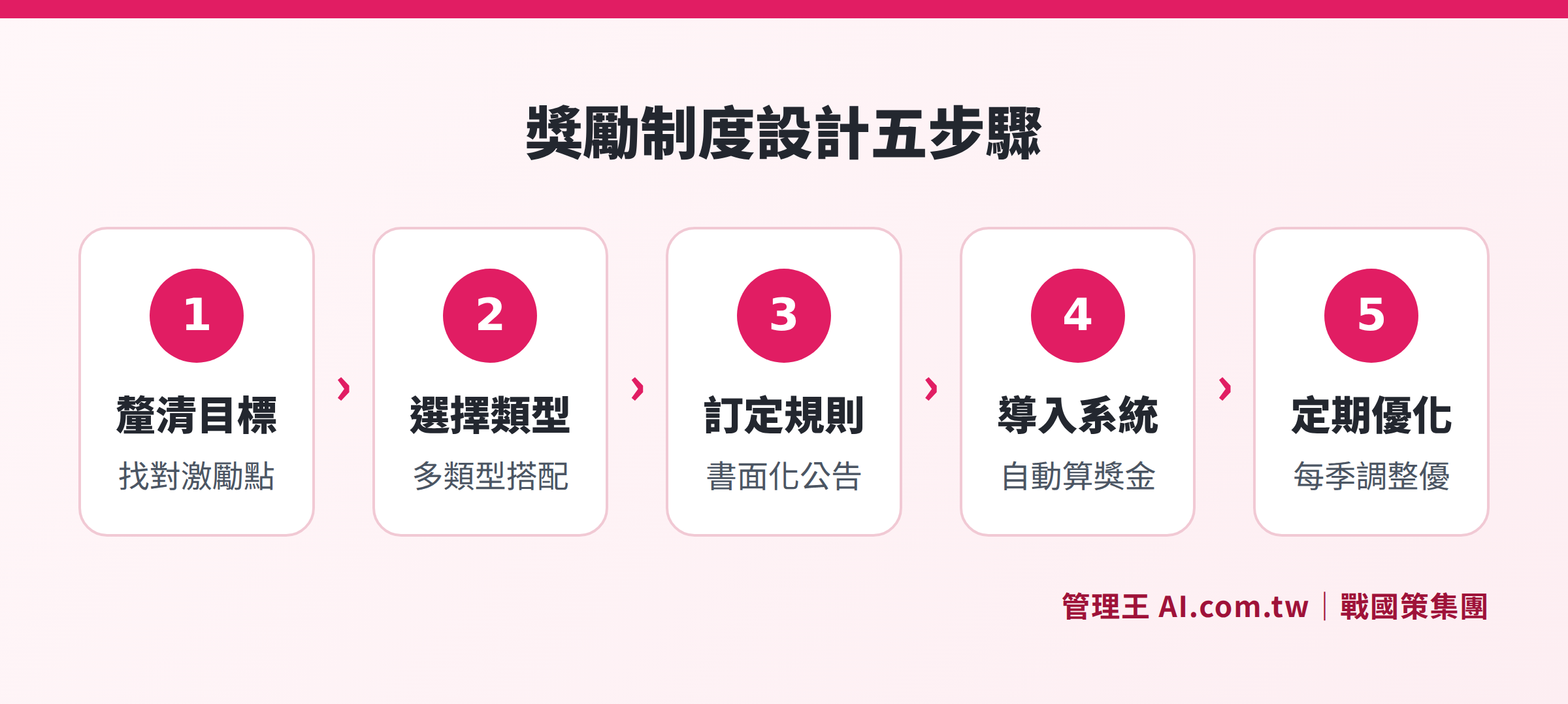
The five-step design framework from clarifying motivation goals, selecting reward types, defining calculation rules, implementing system tools to regular optimization
Full Attendance Bonus vs. Performance Allowance: Key Differences in Wage Determination
The full attendance bonus is one of the most common employee incentive tools for SMEs, but poor design can easily lead to labor disputes. According to the Ministry of Labor interpretation, whether a full attendance bonus is considered wages hinges on "whether it is regular":
- Cases included as wages: Fixed disbursement every month, paid upon meeting attendance conditions, essentially falls under "fixed remuneration obtained through work," should be counted as part of the average wages.
- Less likely to be included as wages: Irregular, variable amount, designed as extra rewards.
In practice, the Ministry of Labor and courts tend to recognize fixed monthly disbursement full attendance bonuses as wages. SMEs should clearly state the bonus nature and calculation method in employment contracts or work rules, and have written confirmation with employees in advance to reduce disputes.
Performance allowances (adjusted part of the monthly salary based on performance evaluations) typically belong to wages, and the adjustment must follow the procedures outlined in the work rules or labor contract and cannot be arbitrarily reduced.
Year-End Bonus and Dividends: Mandatory Regulations Under Labor Standards Act Article 29
Article 29 of the Labor Standards Act stipulates that if a business unit has surplus at the end of the year, it should provide employees with bonuses or dividends. The major points of this regulation are three:
- Distributed only when there are profits: The triggering condition is the company's annual accounting shows "remaining surplus after deducting taxes, covering losses, and allocating dividends and reserves"; it does not apply in loss years.
- Mandatory obligation: The word "shall" indicates legal obligation, and it cannot be excluded by labor contracts or work rules. Violating this may constitute a breach of the Labor Standards Act.
- Only employees who are on duty throughout the year and without fault are protected: Employees who leave during the year or have faults are not covered.
The "amount of year-end bonuses" is not specified by the Labor Standards Act and is determined through negotiations between labor and management. Companies can define the calculation method in work rules (for example, based on multiples of monthly salary or profit distribution ratios).
Tax Reminder (Ministry of Finance Regulations): Employee bonuses are considered salary income. If the single payment amount exceeds NT$90,501, the employer must withhold 5% on the excess amount, and remit to the treasury by the 10th of the following month; the annual withholding statement must be filed before January 31 of the following year.
Performance Commission System Design: Tier Rules and Calculation Examples
Performance commissions are the most powerful incentive tool for sales-oriented businesses, and the key lies in the design of tier rules. A well-designed tier allows salespeople to clearly see the real-time motivation of "one more sale to reach the next level".
For example, a B2B software company:
Table: Performance Commission Tier Rule Example
| Monthly Sales Range | Commission Rate | Amount for 1 Million in Sales |
|---|---|---|
| Below 500,000 | 3% | 15,000 |
| 500,000 to 1,000,000 (inclusive) | 5% | 50,000 |
| 1,000,000 to 2,000,000 (inclusive) | 8% | 160,000 |
| Above 2,000,000 | 12% | 240,000 or more |
Four key considerations when designing a performance commission system:
- Clearly define "performance": Should it be based on order amount, collection amount, or gross profit? Should returns or cancellations be deducted? This should be clearly stated in the rules.
- Set reasonable basic thresholds: If setting "no commission below X amount," confirm this design does not violate wage protection regulations.
- Inter-departmental profit sharing must be documented: The profit-sharing ratio for leads brought by marketing and transactions made by sales should ideally be included in the profit-sharing method and confirmed by both parties.
- Avoid retroactive adjustments of the rules: For ongoing performance periods, the commission rules cannot be altered unilaterally, as this may constitute a reduction in salary.
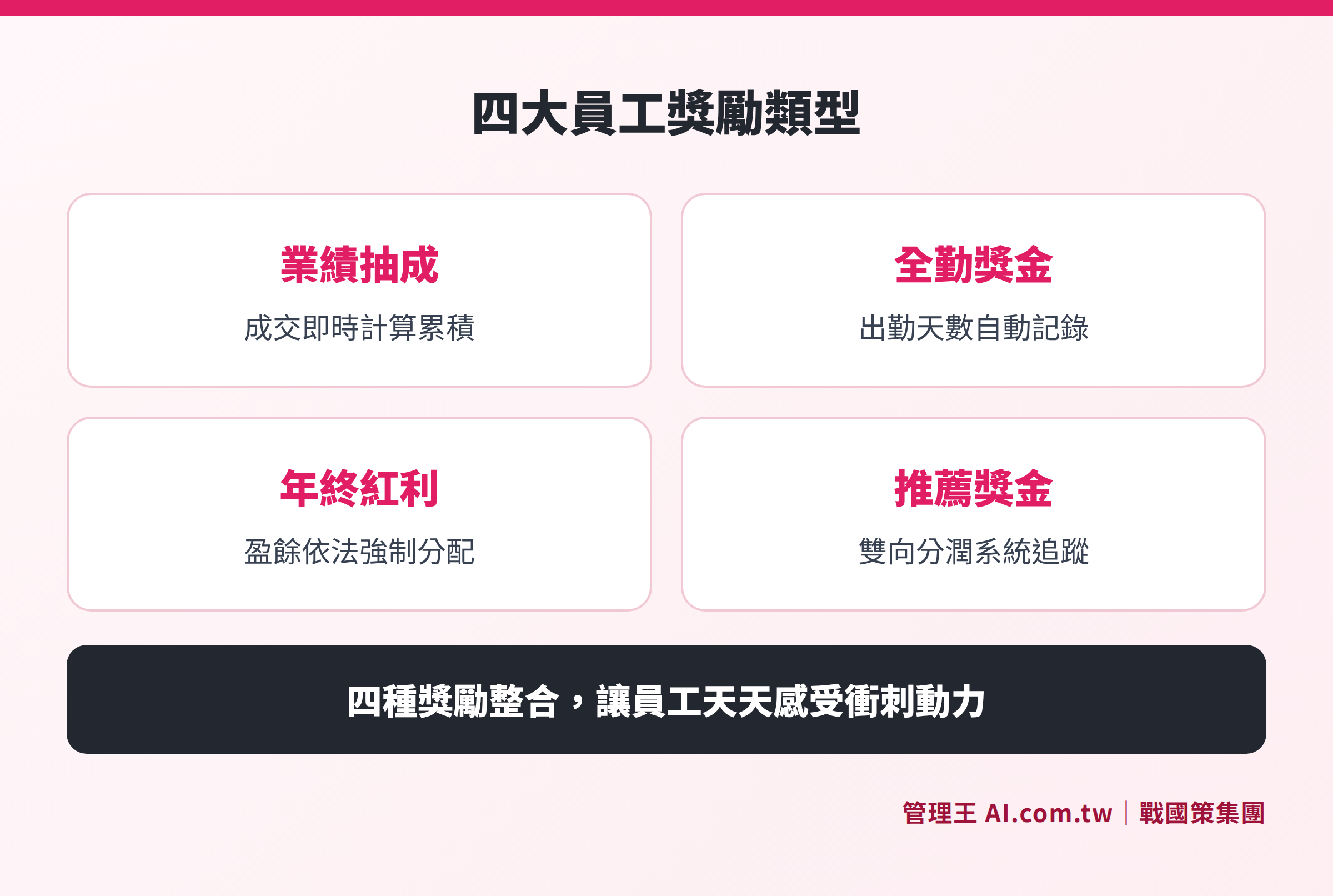
Design key points and applicable scenarios for four major types: performance commissions, full attendance bonuses, year-end bonuses, and referral bonuses
Five Steps to Designing an Employee Reward System for SMEs
An effective employee reward system is not just about clarifying the exchange of performance for money; it requires a complete closed loop that encompasses motivation goal setting, rule design, system support, and regular optimization.
Step One: Clarify Motivation Goals and Targets
Different staff roles require different incentive logic:
- Sales Roles: Centered on performance results, emphasizing timeliness and transparency
- Service Roles (Customer Service, Service Industry): Customer satisfaction, NPS scores, full attendance performance
- Administrative/Logistics Roles: Project completion quality, improvement proposals, full attendance
- Management Roles: Department KPI achievement rates, talent development results
Using a single reward rule across all functions often leads to poor outcomes. It is advisable to design by function groups and make sure employees clearly understand their reward structure upon hiring or at the beginning of the year. When clarifying goals, also consider: What behavior does the company need to motivate most at the moment? Is it increasing sales, improving service quality, or reducing employee turnover? Different core objectives require different emphasis in reward design.
Step Two: Select Reward Types and Calculation Basis
Based on motivation goals, choose suitable reward types (referencing the aforementioned table of six types) and clearly define the calculation bases:
- "Achievement Rate" Type: Bonuses are awarded only if achieving 80% or more, or calculated proportionally
- "Overachievement Reward" Type: Additional bonuses are awarded on the portion exceeding the baseline
- "Achievement Threshold" Type: Fixed amounts are awarded upon reaching a specific target
Step Three: Establish Rules and Ensure Regulatory Compliance
After completing the rule design, it is advisable to confirm the following points:
- Have fixed bonuses been included in the average wage calculations?
- Have work rules or labor contracts stated the bonus conditions, calculation of amounts, and disbursement times?
- Does the year-end bonus comply with Labor Standards Act Article 29 (only distributed if there are profits)?
- If adjusting the bonus system, have work rule revisions been conducted in accordance with Labor Standards Act procedures?
If there are doubts, it is recommended to consult the labor bureau in the area where the company is located or a consultant familiar with Taiwanese labor laws.
Step Four: Implement an Automated Calculation System
The main risks of manually calculating bonuses with Excel include:
- Formula errors leading to calculation disputes
- Multiple versions of spreadsheets causing communication confusion
- Inability for employees to check their accumulated status in real time
- Lack of complete audit records for settling bonuses for departed employees
Utilizing a reward system allows performance to automatically accumulate upon each transaction, with tier rules being automatically determined by the system; at month-end, dual approvals ensure that calculating bonuses transitions from a high-pressure task of two days to a daily automated update of figures.
Step Five: Regular Review and Optimization
It is advisable to review the actual effects of the reward system each quarter:
- Is the achievement rate reasonable? (Too high indicates goals are too low, while too low indicates thresholds are too high)
- Do employees have a consistent understanding of the rules?
- Are there any unexpected behaviors (e.g., sacrificing service quality for performance)?
After the annual accounting, the incentive structure for the next year can be adjusted according to the company’s business direction, with formal announcements made to inform employees. Continuous updates to the system are more crucial than aiming for perfection initially — launching it first and then optimizing based on practical feedback is a pragmatic path for SMEs to introduce reward systems.
Key Considerations When Purchasing an Employee Reward System: Six Essential Questions for SMEs
When selecting an employee reward system, SMEs should focus on evaluating:
- Can it support multiple types of rewards: Can performance commissions, full attendance, referral bonuses, and achievement rewards all be configured within the same system?
- Are tier rules customizable: Can dynamic calculations such as "5% for sales under 1 million, 8% for exceeding 1 million" be set?
- Is it integrated with CRM and task management: Can sales data be automatically retrieved from CRM or order systems without manual data transfer?
- Does it have a dual approval process: Are there supervisor approvals and financial review functions for bonus settlements to ensure traceability?
- Can employees self-check: Can employees view their accumulated bonuses and historical records at any time to reduce communication costs?
- Does it support multiple types of rewards and profit sharing: Can it handle complex structures like individual commissions with inter-departmental profit sharing and team leader allocations?
How to Do It with Management King: Automation of Employee Rewards
Management King AI.com.tw Reward System is designed for the automated settlement of bonuses, commissions, and incentives for employees in Taiwanese SMEs, integrated within the Management King all-in-one management system, linking natively with CRM System, Task Management, Payroll System, and Performance Management.
Actual operation methods:
Set Tier Rules: Set commission rules for each salesperson in the backend (e.g., 5% commission for monthly sales below 1 million, 8% for sales between 1 to 2 million), rules established once allow the system to automatically determine each transaction's classification.
Real-time Accumulation Check: After each order or task completion, the system updates the employee’s monthly bonus accumulation instantly, allowing salespersons to check on their mobile devices how much they have accumulated this month and how much remains to reach the next commission tier.
Multi-Layer Profit Sharing Setup: Supports two-way disbursement of referral bonuses (A refers B who completes a sale, A receives a share), team leader profit-sharing (leader 20%, team member 80%), inter-departmental profit sharing (marketing generates leads, sales finalize transactions in mutual calculations), with complex structures calculated seamlessly.
Dual Approval Settlement: At month-end or quarter-end, the system automatically generates bonus details for each employee, proceeding through a supervisor’s approval → financial review → disbursement process, ensuring amounts are verified and disbursements traceable, minimizing the scope for disputes.
Integrate with HR Payroll: After calculating bonuses, the results connect directly to the HR System, automatically incorporated into the payroll, eliminating manual transfers.
The Management King free plan is permanently available, suitable for SMEs with fewer than 10 people for a trial. For businesses with more than 10 staff or those needing AI points, they can upgrade to the Economic (NT$5,000/month) or Business (NT$10,000/month) plans. The 戰國策 Group has serviced over 30,000 enterprises, ensuring the reward system design fully complies with Taiwanese business practices and Labor Standards Act regulations.
For more comprehensive knowledge on employee incentive structures, refer to the Complete Performance Management Guide, Complete Payroll Calculation Tutorial, and Referral Reward System in Practice.
Let the reward system calculate automatically, no more month-end reconciliation stress
Management King's consultants assist you in designing performance commission tier rules, full attendance and year-end bonus systems, and integrating payroll systems for automatic settlement. Free consultation 0800-003-191
Free consultation hotline: 0800-003-191
LINE Official Account: @119m
Official Website: app.AI.com.tw
Free Trial: Apply for Management King now
Frequently Asked Questions
Is it mandatory to distribute year-end bonuses to employees?
According to Article 29 of the Labor Standards Act, if a business unit has a surplus at the end of the year (after deducting taxes, covering losses, and allocating dividends and reserves), the employer "shall" give bonuses or dividends to employees who have worked throughout the year without fault. This is a legal obligation and cannot be excluded by labor contracts. If the company incurs losses or does not have surplus that year, this regulation does not apply.
Does performance commission count as wages? Will it affect severance pay calculations?
According to the Ministry of Labor's interpretation, performance commissions that are "regularly fixed and conditioned on work achievement" tend to be recognized as wages and must be included in average wage calculations, affecting severance pay, retirement pensions, and overtime wages. It is advisable to clearly document the nature of commissions in labor contracts and consult a professional advisor to confirm the classification aligns with the latest interpretations.
Do employee bonuses need to be taxed?
Employee bonuses are considered salary income and must be reported for tax. If a single payment amount exceeds NT$90,501, the employer must withhold 5% tax on the excess amount, and remit it to the treasury by the 10th of the following month. The annual withholding statement should be filed by January 31 of the following year. If the amount is below the threshold, no withholding is required, but it must still be reported annually. (According to current Ministry of Finance regulations, based upon the latest announcements from regulatory authorities)
How should referral bonuses be designed to be legal and compliant?
Referral bonuses are typically considered "non-recurring payments" and are generally not recognized as wages. Key design points are to clearly state the "disbursement conditions" (e.g., upon successful completion of the trial period for the referred person or successful transactions) and the "amount" in written regulations, ensuring the bonuses are paid directly from the business to the employee (rather than being forwarded through the employee) to comply with individual income tax reporting obligations.
Should accumulated performance commissions for the month be paid if an employee resigns?
If the performance commission is recognized as wages, upon resignation, the employer must settle all wages according to Article 22 of the Labor Standards Act, including the portion of the commission earned up to the resignation date. It is advisable to pre-specify the calculation method for commissions in labor rules or contracts for the resignation month (e.g., based on completed orders, excluding not yet accounted earnings) to reduce disputes.
Sources
- Labor Standards Act Article 29 — Ministry of Labor Legal Query System
- Wage Recognition and Payment — Ministry of Labor
- Various Income Tax Withholding Rate Standards — Ministry of Finance Regulations System
- How Much Year-End Bonus Should be Withheld for Tax — Ministry of Finance
- Management King Reward System Features Page
This article is for general information and does not constitute legal or tax advice; please refer to the latest announcements by regulatory authorities for actual matters.