Payroll System Recommendations: 8 Key Checkpoints for Small and Medium Enterprises|Payroll System Recommendations

Here’s an 8-point checklist for small and medium enterprises to consider when selecting a payroll system, covering essential features such as overtime calculation per labor standards, automatic updates for labor and health insurance, detection of additional health insurance premiums, clock-in integration, and multi-branch management. It includes the latest payroll regulations in Taiwan for 2026 to help you confirm system compliance before a trial.
Choosing a payroll system is not just selecting a "tool for calculating salaries." Taiwan's Labor Standards Act stipulates that overtime pay must be accurately calculated to the hour, that paid leave days must automatically accumulate according to seniority, and that additional health insurance premiums must be detected based on bonuses—any miscalculation could result in fines during labor inspections or trigger disputes over employee salaries. This article compiles the 8 most frequently asked questions by HR in small and medium enterprises regarding payroll system selection to help you confirm essential functionality before the official trial, saving costs and time associated with switching systems repeatedly. This checklist is also suitable for bosses who are implementing a payroll system for the first time, quickly grasping the core criteria for selection.
Common Pain Points in Payroll System Selection for Small and Medium Enterprises
Many small and medium enterprises initially rely on Excel to estimate salaries, only to realize as employee numbers increase that misapplying the overtime rate can lead to whole batches of payroll being incorrect; labor and health insurance tiers are adjusted every year and forms need to be updated manually; the logic for detecting additional health insurance premiums is complex, leaving HR to rely on manual comparisons. The three most common pain points are as follows:
- Incorrect regulatory calculations: Overtime pay, paid leave days, and secondary health insurance calculations are incorrect, leading to dilemmas of back pay and fines during labor inspections.
- Redundant data entry across various forms: Attendance records, payroll trials, bank transfers, and withholding receipts are scattered across different tools, requiring HR to spend a lot of time each month copying, pasting, and verifying figures.
- Slow notification of regulatory changes: After revisions to labor laws or rates, spreadsheets used by businesses do not automatically update; HR must watch government announcements to keep up.
Selecting a suitable payroll system aims primarily to resolve the above three issues, allowing HR to shift from being a "firefighter" to a strategic partner focused on talent management.
8-Point Payroll System Selection Checklist
We recommend confirming the following 8 questions one by one during trials of each system. Only if all answers are "yes" does it clear the basic threshold.
1. Does the system automatically calculate overtime pay rates in accordance with the Labor Standards Act?
The calculation of overtime pay has clear stipulations in Taiwanese regulations: The first 2 hours of overtime on weekdays are calculated at 1.34 times the regular hourly wage, with the 3rd and 4th hours changing to 1.67 times; overtime on rest days is set at 1.67 times for the first 2 hours and 2.67 times thereafter; working on public holidays is calculated at 2 times the wage (according to Article 24 of the Labor Standards Act and Article 39). Whether the system can automatically apply the correct rates based on attendance records is a fundamental compliance requirement.
Confirmation Question: "If an employee works 6 hours of overtime on a rest day, will the system calculate the first 4 hours at 1.67 times and the last 2 hours at 2.67 times?"
2. Does the system provide proactive reminders for changes in labor and health insurance tiers?
Labor insurance insured salaries and the amounts for national health insurance have fixed tiers that must be updated in sync with any adjustments to employee salaries, or else there could be issues with non-compliance. Each year’s minimum wage increases affect the lower limit of insurance tiers—by 2026, the basic wage will rise to a monthly salary of NT$29,500 and an hourly wage of NT$196 (according to the Ministry of Labor’s announcement for Year 115, effective January 1, 2026). A good system should proactively prompt adjustments to insured amounts when employee salaries change.
Confirmation Question: "After an employee's salary increase, will the system remind me to update the insured salary for labor and health insurance?"
3. Is the system capable of automatically detecting additional health insurance premiums?
The rate for additional health insurance premiums (currently 2.11%, as per the latest announcement by the Ministry of Health and Welfare) is charged based on six kinds of income, commonly including: bonuses exceeding four times the insured salary, wages for part-time workers, and high-income salaries. These calculations require comparing monthly salaries with insured amounts; the logic is complex and manual calculations can lead to missed deductions, putting the business at risk of underpayment of taxes.
Confirmation Question: "When disbursing year-end bonuses, will the system automatically calculate the additional health insurance premiums to be withheld?"
4. Are attendance records from clock-ins directly linked to payroll calculations?
Many companies use separate systems for attendance and payroll, requiring HR to export attendance data and then import it into the payroll system each month. This manual step is not only time-consuming but also prone to errors during data transfer such as missing entries or incompatible formats. When selecting, confirm whether clock-in records can be directly integrated into payroll calculations to achieve a streamlined process where attendance confirmation also serves as payroll confirmation.
Confirmation Question: "Can employee clock-in data directly reflect in the payroll trials without needing manual imports?"
5. Does the system support management of employees across multiple branches or locations?
In the catering, retail, and service industries, it is common for employees to shift between stores and clock in at different locations. The payroll system should support multiple shift configurations, consolidate calculations for inter-store attendance, and accommodate different rules for employee bonuses at various locations to meet the practical needs of chain operations. If the business only has a single location, this can be postponed, but companies planning to expand should confirm it in advance.
Confirmation Question: "If an employee clocks in for 4 hours at Store A and 4 hours at Store B, can the system aggregate and calculate the total wages for that day?"
6. Can employees self-query their pay slips and paid leave balances?
HR spends a considerable amount of time each month answering questions from employees such as "Where is my pay slip?" and "How many days of paid leave do I have left this year?" If employees can access their pay details, request paid leave, and view attendance records through a mobile app or webpage, the administrative burden on HR can be significantly reduced, allowing more time to focus on high-value talent work.
Confirmation Question: "Can employees check their pay slips and request leave using their mobile phones? HR doesn’t need to send PDFs individually?"
7. Does the payroll format and bank transfer support commonly used formats in Taiwan?
Employees must be provided with pay slips according to the Labor Standards Act, and the transfer files must meet each bank's ACH format for batch payments. Common banks in Taiwan such as E.SUN, Cathay, and Mega have their unique transfer formats. If the system cannot directly export these, HR would still need to organize the data manually, which is particularly time-consuming for larger businesses.
Confirmation Question: "Can the system export ACH transfer files for major banks like E.SUN and Cathay? Can pay slips be automatically emailed as PDFs to employees?"
8. Is the data stored in Taiwan and compliant with personal data protection regulations?
Payroll data includes sensitive personal information such as employee ID numbers, salary amounts, and personal bank accounts, which are protected under the Personal Data Protection Act. When choosing a cloud payroll system, verify whether the data is stored in domestic data centers, whether it meets ISO 27001 security standards, and whether data can be fully exported when services are terminated to ensure data sovereignty is maintained.
Confirmation Question: "Where is my employees' payroll data stored? Can it be exported fully?"
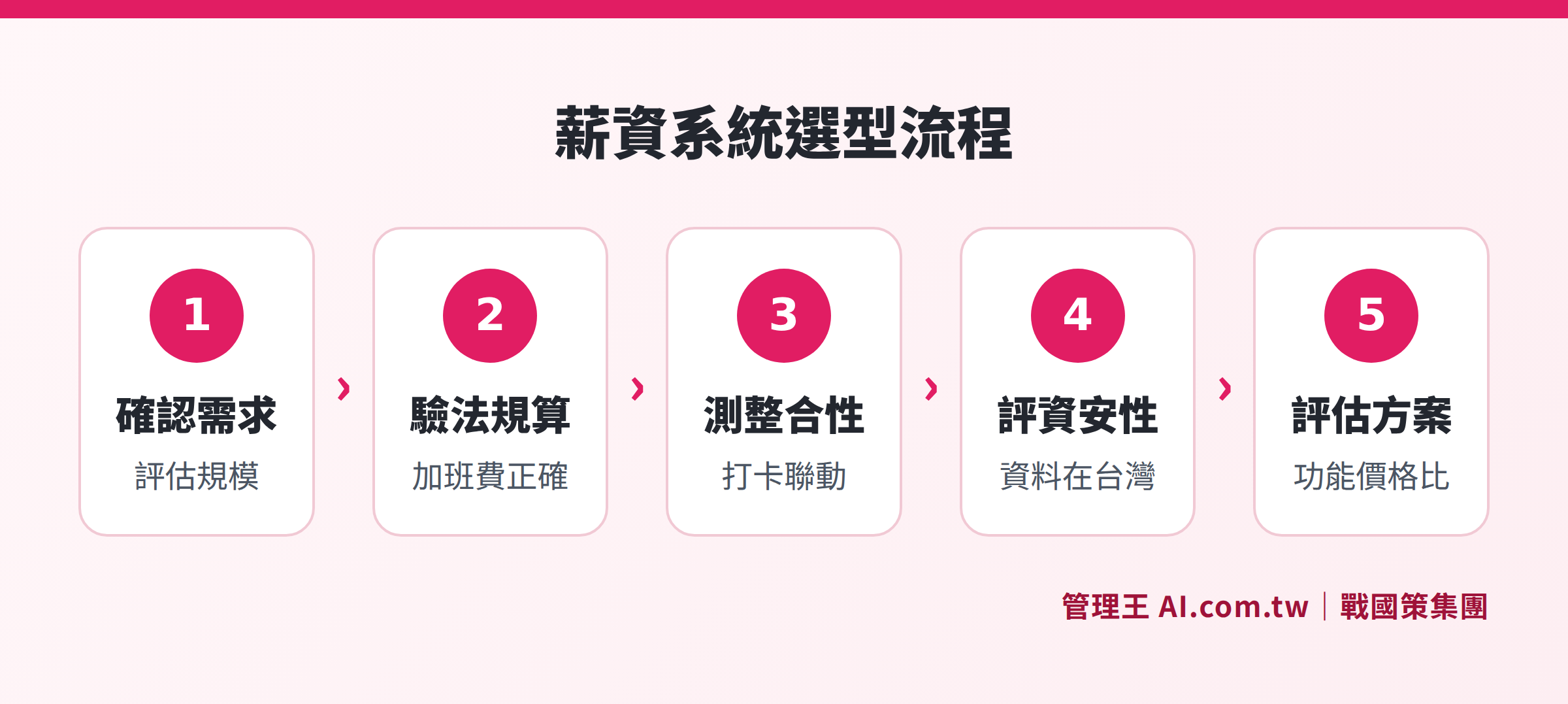
From confirming requirements, verifying regulatory calculations, testing integration, evaluating security, to comparing option costs—this is a selection process flowchart.
Comparison of Four Types of Payroll Management Tools
Table: Comparison of Advantages and Disadvantages of Four Payroll Management Methods
| Management Method | Initial Cost | Automated Regulatory Updates | Attendance Integration | Employee Self-Service | Recommended Scale |
|---|---|---|---|---|---|
| Excel Spreadsheet | None | No (manual updates) | No | No | 1–5 People |
| Outsourced Payroll Service | Monthly Fee | Depends on service provider | No | No | Under 10 People |
| Free Cloud Payroll System | None | Partial | Partial | Partial | 5–20 People |
| Integrated Paid System | Monthly Fee | Yes (automatic updates) | Yes | Yes | Over 10 People |
In a Nutshell
The core issues in selecting a payroll system boil down to three questions: Is overtime pay calculated automatically and correctly? Will regulations automatically update if they change? Can employees check their own pay slips? Only if all three answers are "yes" is it worth considering further.
Key Figures of Taiwan's 2026 Payroll Regulations
When selecting a payroll system, it is advisable to cross-check with the following latest regulatory figures for 2026 to confirm that the system has built-in calculation rules:
Table: Key Figures of the 2026 Payroll Calculation Regulations in Taiwan
| Item | 2026 Figures | Source of Data |
|---|---|---|
| Monthly Minimum Wage | NT$29,500 | Ministry of Labor (effective from January 115) |
| Hourly Minimum Wage | NT$196 | Ministry of Labor (effective from January 115) |
| Weekday Overtime Rate for the First 2 Hours | 1.34 times | Article 24 of the Labor Standards Act |
| Weekday Overtime Rate for the 3rd and 4th Hours | 1.67 times | Article 24 of the Labor Standards Act |
| Rest Day Overtime Rate for the First 2 Hours | 1.67 times | Article 24 of the Labor Standards Act |
| Rest Day Overtime Rate for Over 2 Hours | 2.67 times | Article 24 of the Labor Standards Act |
| Public Holiday Work Wage Rate | 2 times | Article 39 of the Labor Standards Act |
| Secondary Health Insurance Additional Premium Rate | 2.11% | Ministry of Health and Welfare |
| Health Insurance Rate (General Employees) | 5.17% | Ministry of Health and Welfare |
The actual rates are based on the latest announcements from the Ministry of Labor, the Ministry of Health and Welfare, and the Labor Insurance Bureau.
Using the Management Wang Payroll System
Management Wang's payroll calculation system is equipped with the calculation rules from Taiwan’s Labor Standards Act, Labor Retirement Pension Act, and National Health Insurance Act, covering all eight items listed above regarding regulatory calculations, tier reminders, additional premium detection, and clock-in integration. When regulations are revised each year, the system automatically updates calculation formulas, eliminating the need for companies to keep track of announcements themselves.
The specific operational process allows employees to clock in via LINE Bot or a webpage, automatically bringing attendance data into payroll trials; at the end of the month, HR can verify the payroll details (including complete calculations for base salary, overtime pay, allowances, and deductions) in the backend and generate pay slip PDFs to send to employees in one click, while also exporting ACH transfer files for the bank. The entire process is completed within the same system, avoiding the need to switch to Excel or integrate third-party tools.
The Management Wang Payroll Calculation System offers a free plan for permanent use. Businesses with fewer than 10 employees can use all core salary calculation functions for free, including automatic overtime calculations, leave accumulation, and pay slip PDF generation. Advanced features such as multi-branch management and AI payroll analysis are available in paid plans; for details, please see the pricing page.
Combined with the HR system to manage the full process of onboarding and offboarding, attendance analysis for tracking attendance anomalies that automatically integrates into payroll, scheduling system for managing multiple shifts and inter-store scheduling, and electronic contracts for sending employment contracts online and electronic signing, integrated with approval center to complete electronic HR processes such as leave requests and overtime approvals.
The 戰國策 group serves over 30,000 businesses, and Management Wang AI.com.tw is designed for small and medium enterprises in Taiwan, with a 100% Traditional Chinese interface and dual-site backup data centers complying with ISO 27001 standards. To understand the fundamentals of payroll calculation, refer to the complete payroll calculation guide; businesses evaluating whether to upgrade from Excel or free tools can refer to the is free payroll software sufficient?.
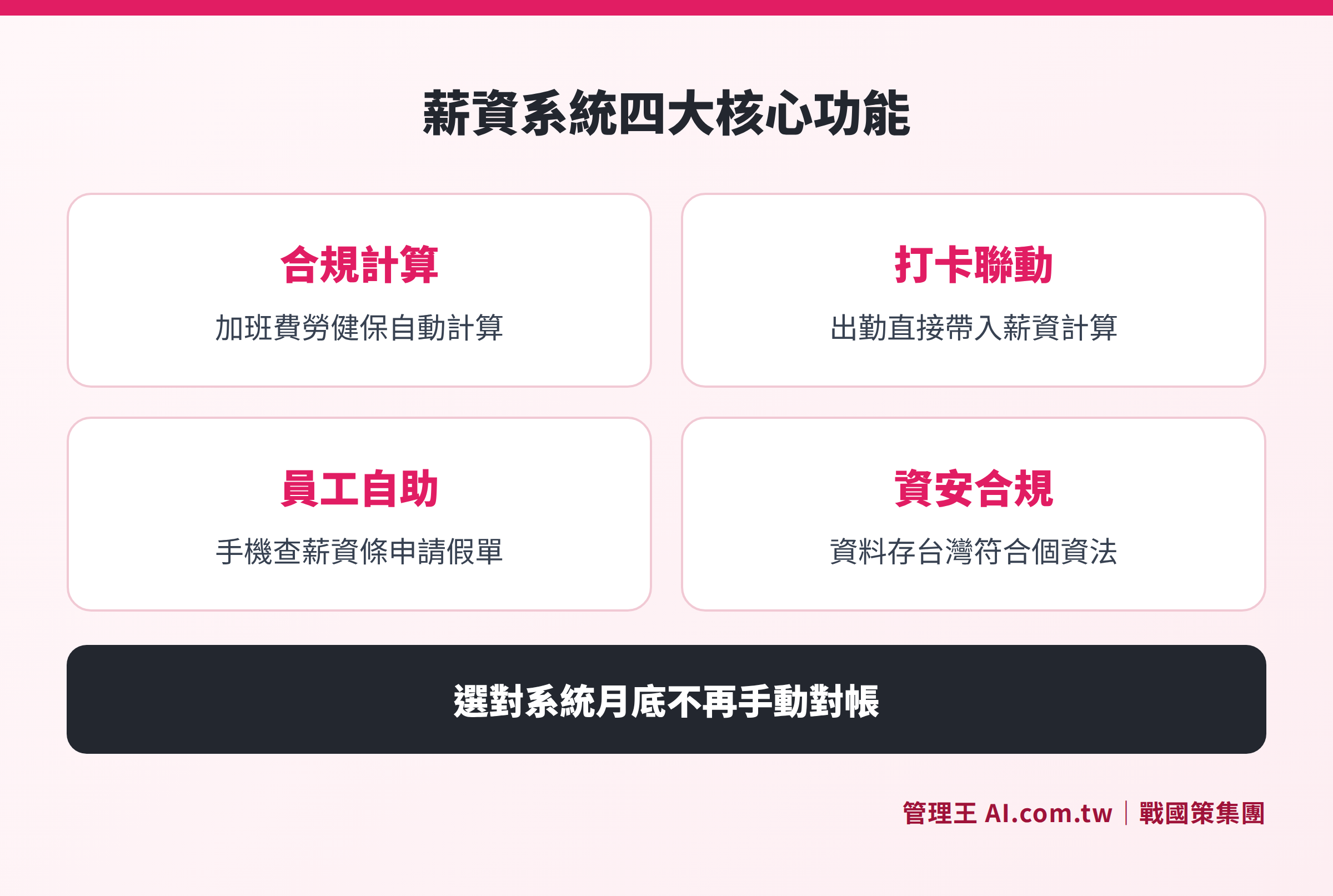
The Management Wang payroll system features four core capabilities: compliance calculations, clock-in integration, employee self-service, and security compliance.
Questions about Payroll Selection? Free Consultation with Our Advisors
The 戰國策 consultants assist in confirming whether the payroll system complies with Taiwan's Labor Standards Act and provide suggestions for optimizing HR processes; 30 minutes of free consultation is available.
Free consultation hotline: 0800-003-191
Official LINE Account: @119m
Official Website: app.AI.com.tw
Free trial: Apply for Management Wang now
Frequently Asked Questions
Does the payroll system have to comply with the Taiwan Labor Standards Act?
Yes. The Labor Standards Act in Taiwan clearly stipulates regulations for payroll calculations, including overtime pay rates, paid leave days, parental leave, and maternity leave. If the system calculations are incorrect, businesses may face legal risks of back pay or fines during labor inspections. When selecting, it is advisable to directly ask the vendor, "Does your overtime pay calculation comply with Article 24 of the Labor Standards Act? How do you handle annual regulatory updates?"
Do small and medium enterprises with less than 10 employees need a payroll system?
This depends on complexity. If all employees have fixed shifts, no overtime, and no multiple branches, Excel combined with manual calculations may suffice. However, as soon as there are rotating shifts, overtime payments, various types of leave, and additional health insurance premiums, or if the number of employees exceeds 5, the benefits of using a payroll system will outweigh the costs. The Management Wang free plan is available for permanent use for businesses with fewer than 10 employees and can be trialed to assess whether it meets their needs.
How long does it take to implement a payroll system?
This depends on the system's complexity and the company size. The Management Wang payroll calculation system is designed to be operational within one day; paid plans include remote implementation training (8 hours for business plans, 16 hours for flagship plans). If historical payroll data needs to be imported, typically an additional 1–2 weeks are required to organize data formats.
Is a cloud payroll system data secure?
When selecting a cloud payroll system, it is advisable to verify: (1) whether data is stored within Taiwan; (2) whether it meets ISO 27001 security certification; (3) whether complete data export is possible when services are terminated. Management Wang’s data is stored in dual-site backup data centers in Taiwan, compliant with ISO 27001 standards, and supports full exports in CSV, Excel, and PDF formats.
Can the payroll system integrate with existing ERP or accounting systems?
Most enterprise-level payroll systems provide API or import/export functions for integration with ERP and accounting systems. The Management Wang payroll calculation system integrates natively with the same account’s ERP system and approval center, with payroll changes directly reflecting in accounting entries without additional integration fees or API connections.
Source of Information
- Ministry of Labor 2026 Labor Reform Highlights (2026 basic monthly wage NT$29,500, hourly wage NT$196, effective from January 115)
- Article 24 of the Labor Standards Act|National Legislative Database (Overtime pay rate calculation basis: 1.34/1.67 times on weekdays, 1.67/2.67 times on rest days)
- Article 39 of the Labor Standards Act|National Legislative Database (Public Holiday work wage rate of 2 times)
- Ministry of Health and Welfare Central Health Insurance Agency (Health insurance rate 5.17%, additional health insurance premium rate 2.11%, based on the agency's latest announcements)