How to Choose a Performance Management System? Upgrade from Excel Assessment to 7 Indicators|Performance Management System Recommendations

Before choosing a performance management system, diagnose your pain points and compare with 7 key indicators: support for goal frameworks (KPI/OKR), 360-degree peer evaluation mechanism, calibration meeting tools, system integration depth, localization compliance, AI analysis capabilities, and mobility degree. This article provides a scoring table for selection and prioritization suggestions for different-sized enterprises, helping Taiwanese SMEs upgrade from Excel assessment to institutionalized performance management.
How to choose a performance management system? The answer depends on where you are currently stuck: is there no consensus on goal setting, is the evaluation process too subjective, are employees unhappy with the evaluations, or is there a disconnect between evaluation results and salary adjustments? A Performance Management System integrates the four elements of goal setting, continuous tracking, multi-source evaluation, and linking results to compensation into one software tool. Compared to Excel assessment forms, the core advantage of systematic management is not "more features," but transforming the evaluation logic that previously existed only in the boss's memory and spreadsheet cells into a repeatable, traceable, and understandable system for employees. Clarifying the 7 key indicators before selection can save you a year of detours: this article details the judging methods for support of goal framework, 360-degree peer review mechanism, calibration meeting tools, depth of system integration, localization compliance, AI analysis capability, and mobility degree, along with the prioritization for various sizes of businesses.
Why Can't Excel Assessments Keep Up?
The performance management situation for many small and medium-sized enterprises in Taiwan is as follows: HR prepares an assessment form at the end of each quarter, sends it to the supervisors to fill out, and supervisors score based on their recollections, resulting in HR compiling the report and telling the boss, "the average score is B+", after which year-end salary adjustments are made based on intuition.
The issue with this process is not a lack of effort, but rather a structural flaw:
- Employees do not know what goals they need to achieve or what standards will be used for measurement at the start of the cycle.
- Supervisors score based on memory, which can be heavily influenced by recency bias (recent performance overshadowing the entire year).
- Different supervisors use different standards for scoring, leading to inequity in salary adjustments during year-end.
- Excel cannot facilitate 360-degree peer assessments, leaving peer and subordinate observations completely absent.
- Evaluation results and salary calculations each exist in separate records, making it difficult to trace discrepancies.
According to the Workforce Development Agency of the Ministry of Labor's Human Resource Management Guidelines, the core of performance management is "making sure employees clearly understand the measurement criteria beforehand and have verifiable records afterwards," which is difficult to achieve systematically using Excel sheets.
In One Sentence
Upgrading from Excel to a performance management system fundamentally shifts from "evaluations based on memory" to "evaluations based on systems," placing employees, supervisors, HR, and the boss on the same objective standard.
Before Upgrading, Ask: At Which Stage is Your Enterprise's Performance Management Stuck?
Self-diagnosing before selecting a system can significantly shorten the selection time. The following four common pain points correspond to different selection priorities:
Table: Common Pain Points in Performance Management and Corresponding Selection Focus
| Symptom of Pain Point | Root Cause | Priority Selection Indicators |
|---|---|---|
| Year-end assessment results that leave employees feeling dissatisfied | Lack of multi-source cross-validation in scoring | 360-degree peer evaluation, calibration mechanism |
| Supervisors are unsure of what scores to give | Unclear goal standards | KPI goal setting, SMART framework |
| Evaluation results do not connect to salary | Personnel systems are isolated from each other | Depth of integration (payroll, attendance) |
| Post-implementation, employees do not use the system | The operation is too complex | Mobility, LINE notifications, ease of use |
| HR spends 3 days just compiling at the end of the month | Lack of automation | Automated processes, AI analysis, reporting |
After identifying your main pain point, you can quickly filter out unsuitable systems by comparing against the following 7 indicators.
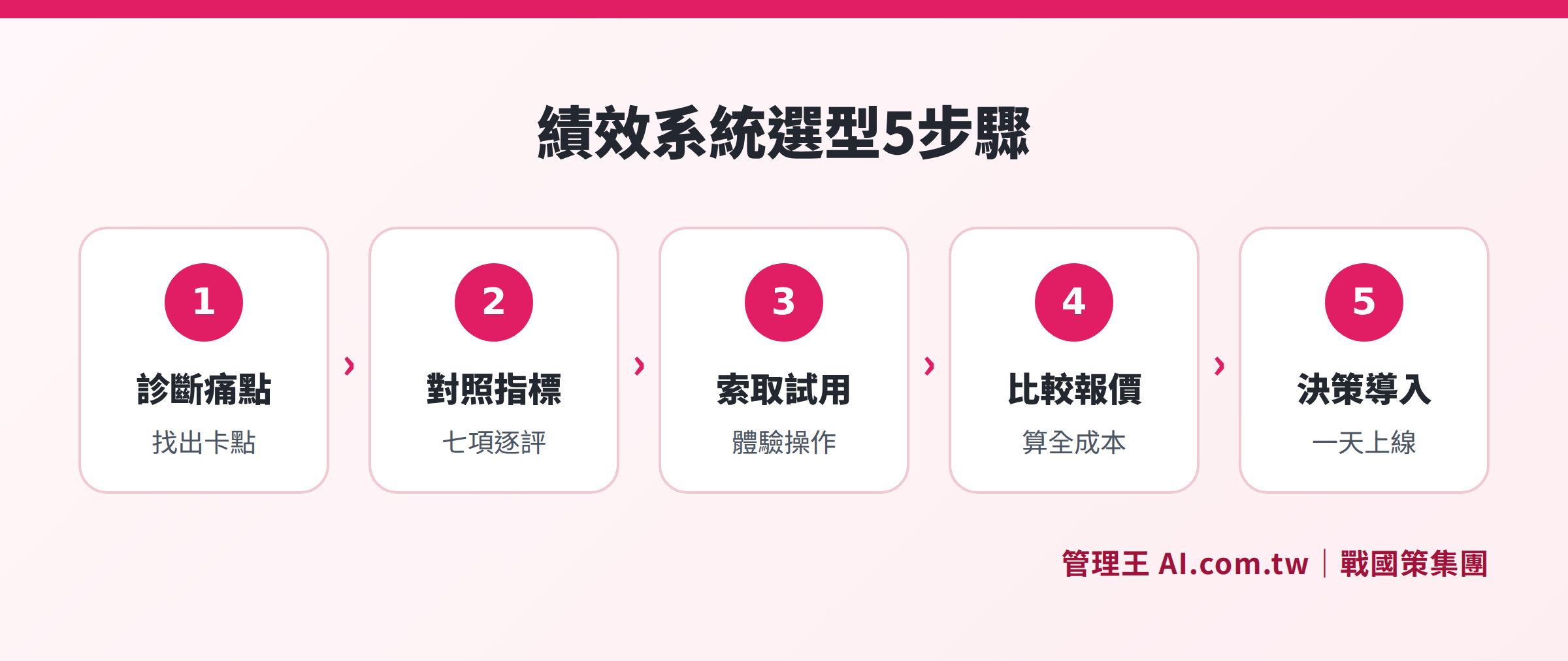
From pain point diagnosis, indicator assessment, trial to implementation: a 5-step selection process
Full Analysis of 7 Key Selection Indicators
Indicator 1: Support for Goal Framework—Can KPI and OKR Coexist?
Before selecting a system, clarify whether your company wants to use KPI, OKR, or both. KPI measures the performance of existing processes (monthly sales, customer service response times) and is suitable for departments with stable processes; OKR drives breakthrough goals (new product expansion) and is intentionally designed to be decoupled from salary, suitable for R&D and strategic functions. A mature practice is to use KPI for sales and OKR for R&D, so the system must support both.
Judging Criteria: Can the system set KPI and OKR in the same interface and automatically break down company goals to departments and individuals?
Indicator 2: Diversity of Evaluation Methods—Is 360-Degree Evaluation Feasible?
Single supervisor scoring has structural blind spots; a 360-degree assessment (supervisor, peers, subordinates, self-assessment) can cross-verify and reduce subjective biases. However, for 360-degree evaluations to be effective, the system must control the number of evaluators (recommended 5 to 8 people), design an anonymous mechanism, and allow employees to view the consolidated results afterwards.
Judging Criteria: Does it support multi-source evaluation, anonymous options, and adjustable evaluation cycles (monthly/quarterly)?
Indicator 3: Calibration Meeting Tools—Can Cross-Department Scoring Standards Align?
Calibration meetings are the key mechanism for addressing inconsistencies in scoring across departments: department heads gather to compare their employees' scores, confirm consistent evaluation standards, and then decide on promotions and bonuses. Without a calibration mechanism, the same "B+" can have completely different meanings in different departments, making year-end bonus allocations controversial.
Judging Criteria: Does the system provide a calibration view (simultaneously showing multi-department employee score distributions), and can supervisors leave calibration feedback in the system?
Indicator 4: Depth of System Integration—Can Evaluation Results Directly Link to Salaries?
Isolated performance systems ultimately force HR to maintain two sets of work: one for evaluation results and another for payroll calculation, with month-end reconciling still reliant on manual processes. The right system should automatically integrate performance scoring into the payroll calculation module, applying adjustment ratios or performance bonus formulas directly.
Judging Criteria: Does it natively integrate payroll calculations, attendance punch-ins, and leave approvals? Are integration costs additional or included in the subscription plan?
Indicator 5: Localization Compliance—Does it Comply with Taiwan's Labor Standards Act?
This is often overlooked when Taiwanese enterprises choose systems, resulting in discovering incorrect overtime pay calculations post-implementation or interfaces entirely in English leading employees to give up. Systems compliant with Taiwan’s regulations should include: Labor Standards Act overtime pay (1.34 times/1.67 times), vacation days calculation, second-generation health insurance supplement premiums, and a fully Traditional Chinese interface.
Judging Criteria: Is the interface 100% Traditional Chinese? Does the system automatically update calculation formulas in line with changes to labor laws?
Indicator 6: AI Analysis Capabilities—Can the System Tell You Why?
Traditional systems give you numbers; AI-enhanced performance systems can help interpret those numbers: "What was the main reason for this employee's Q2 KPI decline?" or "Which department made the most progress compared to the same period last year?" If HR runs reports manually, this could take half a day, but when systematized, it can be completed within seconds.
Judging Criteria: Is the AI functionality included in the subscription plan or is it an extra fee? Can performance data be queried using natural language?
Indicator 7: Mobility and Employee Self-Service Level—Will Employees Use It?
No matter how powerful a system's functions are, if employees don’t use it, it is worthless. The best design for increasing employee acceptance is enabling completion of tasks on their mobile phone: viewing their KPI achievement rates, filling out self-assessments, responding to 360-degree surveys, and checking performance history. Additionally, LINE notifications can significantly reduce instances of "forgetting to fill in".
Judging Criteria: Is there a mobile version or PWA? Does it integrate LINE notifications? Do employees need to log into a separate new system?
Quick Scoring Table for 7 Key Indicators
Before proceeding to trial, you can quickly score candidate systems using the following table (0: not supported, 1: partially supported, 2: fully supported). The higher the total score, the more suitable the system is for enterprises with high requirements for systematization:
Table: Scoring Table for 7 Key Indicators in Performance Management System Selection
| Selection Indicator | Assessment Question | Priority for SMEs |
|---|---|---|
| Support for Goal Framework | Does it support both KPI and OKR? | ★★★ |
| 360-Degree Peer Evaluation Mechanism | Does it support multiple sources and can it be anonymous? | ★★★ |
| Calibration Meeting Tools | Is there a cross-department score comparison view? | ★★ |
| Depth of System Integration | Is payroll and attendance natively integrated? | ★★★ |
| Localization Compliance | Is the interface 100% Traditional Chinese complying with labor laws? | ★★★ |
| AI Analysis Capabilities | Is AI integrated and not charged separately? | ★★ |
| Degree of Mobility | Can employees complete all operations via mobile? | ★★★ |
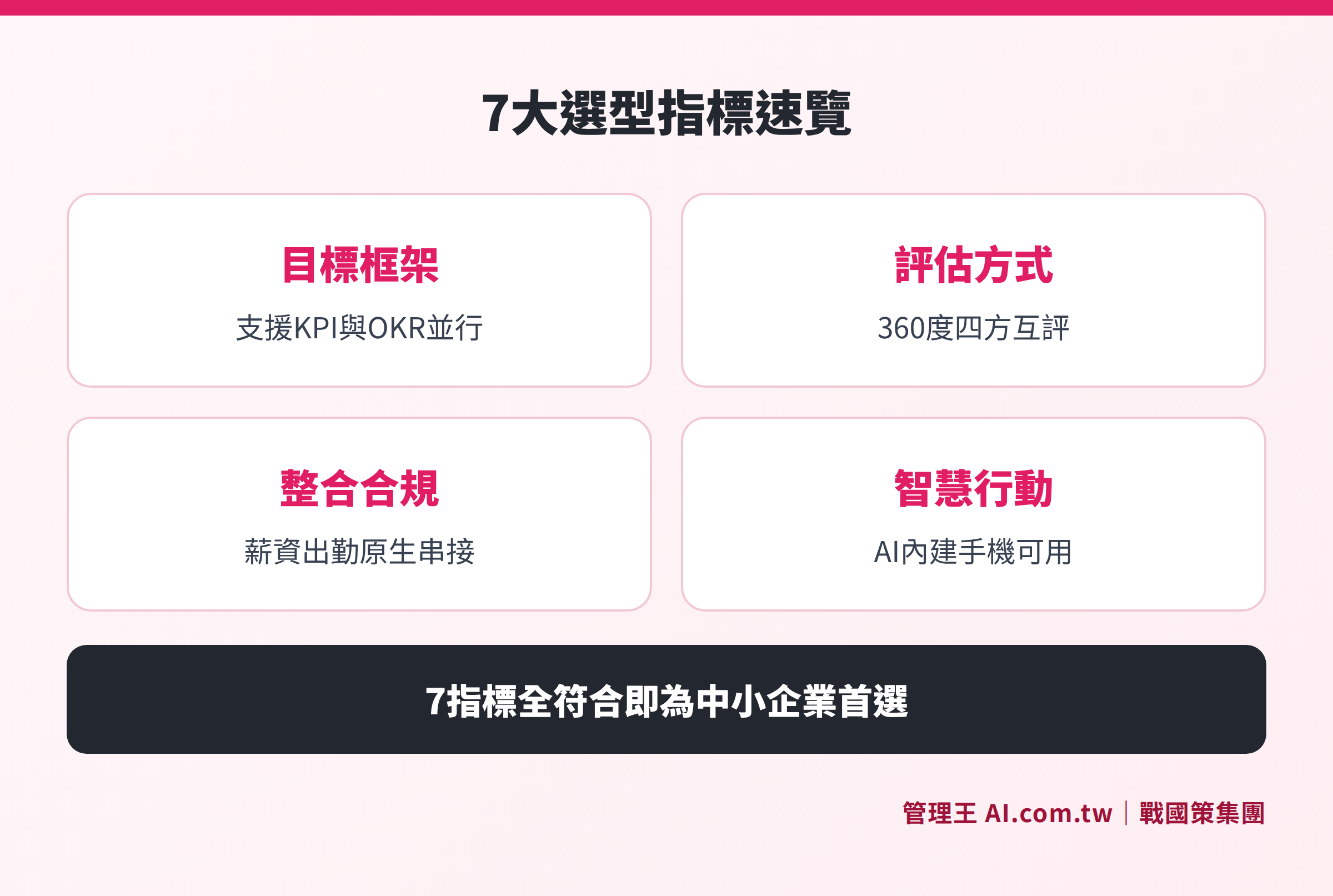
Overview of the 7 Key Performance Management System Selection Indicators and Assessment Focus for Each
Different Priority Selection Strategies by Enterprise Size
Different enterprise sizes require different selection priorities:
Fewer than 10 Employees (Startups)
The goal is to transition from "no system" to "basic system." Prioritize: whether KPI goal setting is intuitive enough, can supervisors quickly fill out evaluations, and is there a connection to salary? 360-degree peer evaluations and calibration mechanisms can wait until the system stabilizes before being introduced. Try out free plans first and upgrade to the paid version once employee acceptance is confirmed.
11 to 50 Employees (Establishing Systems)
With cross-department collaboration issues emerging, inconsistent scoring creates disputes. Focus on calibration mechanisms and 360-degree peer evaluations, as well as integration with attendance and leave systems to prevent HR from being overwhelmed at month-end. When selecting a system, check how many members are included in the plan to avoid needing to upgrade with increased personnel.
More than 50 Employees (Scaling Phase)
With a large volume of performance data, AI analysis capabilities begin to add value. The focus of selection shifts to: whether APIs are open for linking BI tools, whether data remains in Taiwan, and whether quotes for custom development are transparent.
How to Use 管理王
管理王 AI.com.tw Performance Management is designed with Taiwanese SMEs in mind, with six key functions covering the essential needs of the aforementioned 7 selection indicators:
KPI and OKR Dual Frameworks Running Concurrently: Each quarter, supervisors set 5 to 8 KPIs, supporting OKR mode to set qualitative goals, with company targets automatically broken down to departments and individuals.
Monthly Review + Four-Way 360-Degree Peer Evaluation: Supervisors fill in their evaluations at the end of the month, and employees respond in real-time; quarterly, assessments are conducted among supervisors, peers, subordinates, and self-assessments, with results compiled for employee viewing.
Calibration Meetings: Departments align evaluation standards through a calibration view, ensuring scores are comparable across teams and providing basis for promotions and bonus distributions.
Natively Integrated Payroll and Attendance: After completion of performance scoring, it can directly link to salary calculation system, automatically bringing in salary increase references; accounts for attendance punch-ins and approval center are unified without needing additional API.
AI Performance Analysis: Input "Why did this employee's Q2 performance decline?" The AI automatically summarizes the reasons from KPI achievement rates and peer evaluation data, with all AI features included in the subscription plan at no extra charge.
LINE Notifications + Mobile Self-Service: Employees can complete KPI queries, self-assessments, and leave applications via LINE Bot or mobile browser (integrated with HR system), reducing the time HR spends chasing employees for forms.
The free plan is permanently available, allowing companies with fewer than 10 employees to test all functions before evaluating an upgrade after confirming employee acceptance. Paid plans start at NT$5,000/month; for details, see pricing plans.
By pairing with onboarding training systems and department daily reports, a complete talent management cycle can be established from onboarding to daily tracking to annual performance evaluation.
Further reading: Performance Management is More than Just Scoring: The Cycle from KPI and OKR to Interviews, What’s the Difference between KPI and OKR? Which One to Choose, Can They Coexist?, How to Distribute Performance Bonuses? Calculation Methods, Ratios, and Distribution Rules.
Try 管理王 Performance Management System for Free
Our consultants will assist you in establishing a complete performance management system with KPI goal setting, 360-degree peer evaluations, and payroll integration, offering unlimited free consultations.
Free consultation hotline: 0800-003-191
LINE official account: @119m
Official website: app.AI.com.tw
Free trial: Apply for 管理王 now
Frequently Asked Questions
What is the Difference between a Performance Management System and HR System?
HR System (HRMS) typically focuses on payroll calculations, attendance records, labor and health insurance declarations, and other administrative processes; performance management systems emphasize goal setting, ongoing tracking, evaluations, and linking results to outcomes. The functions of both complement each other, and integrating them into the same platform (such as 管理王) can avoid data discrepancies without needing separate bridging processes.
Do SMEs need to use OKR when implementing a performance management system?
Not necessarily. OKR is suitable for departments that require rapid iteration and creativity, but for stable process sectors like manufacturing, restaurants, and retail chains, KPIs are often more intuitive and executable. The two are not mutually exclusive; many companies choose to use KPIs for sales and operations while deploying OKRs for R&D and strategic functions. During selection, just confirm that the system can support both.
What are the Most Common Mistakes in Selecting a Performance Management System?
The most common mistake is "selecting a system first, then thinking about the process." The system is just a tool; the true determinants of success are the goal-setting process, supervisor scoring discipline, and how evaluation results are linked to salaries. It’s recommended to first write a standard operating procedure (SOP) for how performance management will work (who sets goals, how often evaluations occur, how many people are included in 360-degree evaluations), and then find a system that can support that SOP.
How Soon Can You See Results After Implementing a Performance Management System?
The effects of a system usually begin to show during the first complete evaluation cycle (usually the first quarter). Technical implementation (account activation, goal input) can be completed in a day; however, changing employee habits and management behaviors requires two to three months. If a highly localized system with an easy employee interface is chosen, the acceptance curve will be shorter.
Is the Free Plan Sufficient? When Should You Upgrade to a Paid Plan?
The free plan is suitable for enterprises with fewer than 10 employees that are just starting to establish their systems, allowing them to permanently use basic performance functionalities. When membership exceeds 10, needs for more AI points arise, or remote implementation of training services is required, they can upgrade to the Economy (NT$5,000/month) or Business (NT$10,000/month) plans.
Data Sources
- Ministry of Labor Workforce Development Agency—Enterprise Human Resource Management Manual: Performance Management (Taiwan's official HR management guidelines)
- Yuqiqi Digital Technology—Performance Management System Comparison Recommendations: 2026 Enterprise Implementation Guide (Query date: November 2026)
- 104 Job Bank Workplace Power—How to Choose Between KPI and OKR? Comparison of Performance Tools and Compensation Components (Query date: November 2026)