How to Create a Sales Leaderboard? A Complete Guide to Sales Team Incentive Mechanisms|Recommended Sales Management Systems

The sales leaderboard provides real-time rankings that allow salespeople to see their position, combining behavioral and outcome indicators, independent tracks for newcomers, and reward mechanisms, effectively motivating the sales team to strive proactively. This article fully explains the principles of leaderboard design, comparisons of four types of competition systems, and a five-step implementation method.
The sales leaderboard is a core management tool that publicly visualizes the competitive dynamics of the sales team—using real-time updated rankings to let each salesperson see their position within the team. Through public recognition and healthy competition, overall performance can be driven upward. For managers of small and medium enterprises in Taiwan, the value of the leaderboard lies not just in "knowing who is first," but in helping every salesperson clearly understand "what actions can advance their ranking." A field experiment study on gamification in sales training (Gamification in virtual sales training, 2024) shows that after implementing a gamified ranking mechanism, salespeople saw an average 16% improvement in knowledge related to closing deals, with a significantly better target achievement rate than the control group. This article fully explains the principles of sales leaderboard design, comparisons of four competition systems, a five-step implementation method, common design pitfalls, and how to use systematic tools to automate the linkage between the leaderboard and rewards, suitable for reference by sales managers, HR, and business owners.
What is a Sales Leaderboard?
A sales leaderboard is a management tool that presents the sales figures of salespeople or teams in real-time rankings visible to all members. Traditional sales reports are only seen by supervisors, resulting in a lack of transparency and delayed feedback; a leaderboard lays out "who did what" in the open, allowing each salesperson to compare their performance with others at any time, creating self-driven motivation.
The core value of the sales leaderboard is not just "competition," but transforming the goal-setting theory in management (Goal-Setting Theory) into a real-time visible feedback loop: salespeople set goals → execute actions → see changes in rankings → adjust strategies → reset higher goals. This cycle is more effective in maintaining continuous effort than traditional methods where results are only reviewed at the end of the month.
In the practical scenarios of small and medium enterprises in Taiwan, sales leaderboards commonly track the following dimensions simultaneously:
- Transaction Amount: The most direct performance indicator, reflecting actual revenue generated.
- Number of Quotations: Measuring the frequency of proactive sales activities.
- Conversion Rate: The ratio of quotations to transactions, reflecting the quality of sales.
- Number of New Customers: The ability to develop the market, ensuring salespeople do not only focus on existing customers.
- Number of Visits: The volume of field activities, ensuring actions are taken rather than just outcomes monitored.
- Average Transaction Value: The ability to upsell by the salesperson.
In a Nutshell
The essence of the sales leaderboard is "transforming results seen only at the end of the month into behavior indicators that can be followed up daily," allowing sales managers to upgrade from managing results to managing behaviors.
Why Can Sales Leaderboards Effectively Motivate Sales Teams?
The motivational effect of sales leaderboards is rooted in psychology and behavioral science, not just "peer pressure".
Goal-Setting Theory
The goal-setting theory proposed by American management scholars Edwin Locke and Gary Latham points out that specific, challenging, and visible goals are more effective in enhancing performance than vague goals like "just do your best." The leaderboard transforms the abstract goal of "achieving this month's targets" into a clear action direction: "currently 4th place, capturing 2 more customers will bring me up to 2nd place."
The Power of Real-Time Feedback
Research shows that real-time feedback (daily updates) has a much stronger motivational effect than delayed feedback (weekly reports). Each time a salesperson closes a deal, the ranking is immediately re-sorted; this immediate positive reinforcement clarifies the connection between effort and reward, thus maintaining motivation for ongoing execution.
Public Recognition and a Sense of Honor
Behavioral science research (Gamified HR study, PMC 2025) confirms that gamified ranking mechanisms enhance work engagement through two pathways: "competence" (feeling capable of achieving) and "belonging" (being recognized within the team), allowing external incentives (bonuses) to gradually transform into intrinsic motivation (a sense of achievement).
The Face Culture Considerations in Taiwanese Workplaces
Taiwanese workplace culture values "face" (the honor or embarrassment brought by public rankings), which differs from Western workplaces. Studies indicate that named leaderboards (showing names rather than being anonymous) enhance target achievement rates while also reducing turnover rates; however, if an anonymous leaderboard is introduced, short-term performance may improve, but turnover rates may also rise. Thus, when designing leaderboards in Taiwanese enterprises, special attention is needed to adhere to the principle of "making good performance visible while also respecting the dignity of those with lower rankings."
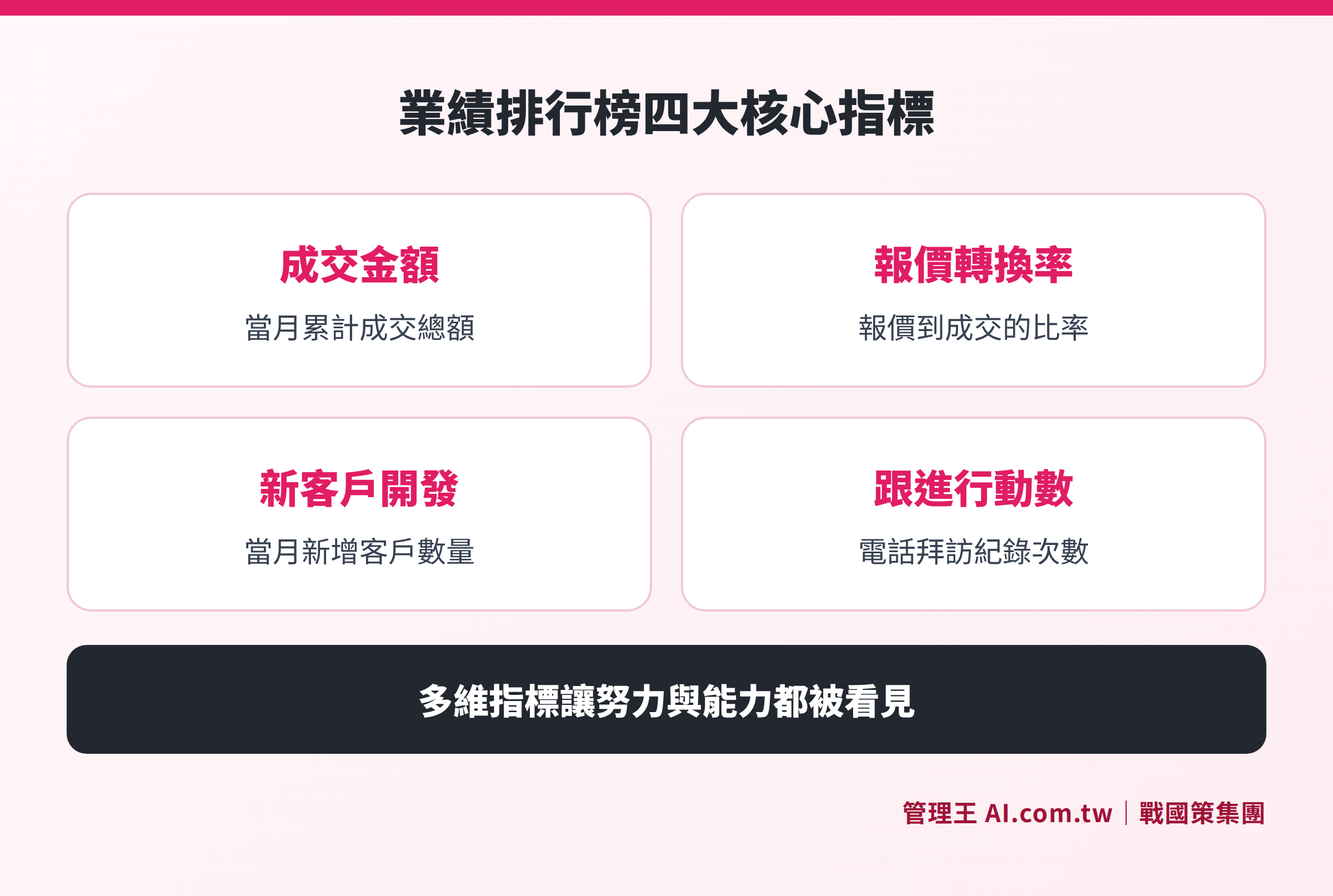
The sales leaderboard should simultaneously track four dimensions: transaction amount, quotation conversion rate, new customer development, and follow-up action count, ensuring performance is built from behavior.
Designing Sales Leaderboard Indicators: Choose Wisely
The most common reason for failure with sales leaderboards is not technical issues but rather poor indicator design. Here are three common principles for indicator design:
Principle 1: Balance Behavioral and Outcome Indicators
Focusing solely on transaction amounts can lead salespeople to prioritize big deals while neglecting smaller clients; meanwhile, only considering visit counts might create behaviors where visits are made just to boost ranks without actual progress in business opportunities. An ideal leaderboard design emphasizes "outcome indicators (transaction amount) × behavioral indicators (number of visits, number of quotations) × quality indicators (conversion rate, customer fulfillment)" in three dimensions equally.
Principle 2: Use Short, Medium, and Long Competition Periods
- Daily Rankings: Track the number of visits, calls, and quotations for the day, maintaining daily execution motivation.
- Weekly Rankings: Monitor accumulated business opportunities for the week, suitable for B2B sales with longer sales cycles.
- Monthly Rankings: Calculate final transaction amounts, serving as the basis for bonus distribution.
- Quarterly / Annual Rankings: Record honor awards, establishing a long-term "winning team" brand.
Principle 3: Avoid Solely Comparing Absolute Values and Include Relative Achievement Rates
Veteran salespeople may have high starting bases, making it difficult for new salespeople to surpass them, which can demoralize newcomers. Incorporating a "target achievement rate" (actual performance ÷ personal goal × 100%) allows new and mid-level salespeople to also appear on the leaderboard, fostering a healthy culture of competition where "effort has a stage."
Table: Comparison of Outcome Indicators and Behavioral Indicators
| Indicator Type | Example Indicators | Advantages | Cautions |
|---|---|---|---|
| Outcome Indicators | Transaction Amount, Number of Deals | Directly reflects revenue contribution | May ignore process quality |
| Behavioral Indicators | Number of Quotations, Number of Visits, Number of Calls | Manage controllable behaviors | Avoid doing ineffective actions just for numbers |
| Quality Indicators | Conversion Rate, Average Transaction Value, Customer Fulfillment | Reflects depth of sales ability | May fluctuate significantly with small sample sizes |
| Relative Indicators | Target Achievement Rate, Growth Rate | Facilitates fair competition among sales with different experience levels | Requires setting reasonable personal goals |
Comparison of Four Common Competition Systems
Depending on the size of the enterprise and the structure of the sales team, there are four main competition systems for sales leaderboards:
Table: Comparison of Four Sales Leaderboard Competition Systems
| Competition Type | Applicable Situations | Advantages | Potential Risks |
|---|---|---|---|
| Individual PK Leaderboard | More than 3 salespeople, each independently responsible for clients | Clear responsibilities, direct competition | May reduce willingness to collaborate in teams |
| Team PK Leaderboard | Sales team with divisions or zones | Promotes internal collaboration | May lead to social loafing issues |
| Branch / Zone PK | Retail outlets or multi-location sales | Gives regional managers competitive motivation | Resource conditions differ by region and need calibration |
| Newcomer Independent Track | Salespeople within 3 months of hiring | Avoids new employees being overshadowed by high-performing veterans | Must set transition timing to avoid dependence |
Individual PK Leaderboard is the most common format, suitable for a structure where each salesperson is independently responsible for a group of clients. Each order, visit, or quotation counts towards a personal score, and rankings update in real-time.
Team PK Leaderboard suits structures where sales are led by team leaders; the performance of team members is summed and compared with other teams. This design facilitates intra-team cooperation, and team leaders will proactively mentor weaker members.
Branch / Zone PK is appropriate for chain retail or multi-location service industries, where branch managers compete based on “branch performance ÷ branch goals,” eliminating feelings of unfairness caused by different regional conditions.
Newcomer Independent Track is a design particularly needed in small and medium enterprises in Taiwan. New salespeople compete solely against each other during their first three months, preventing them from being disheartened by high-performing veterans at the bottom of the rankings. This design can effectively reduce early turnover rates of new sales personnel.
Five Steps to Implement a Sales Leaderboard
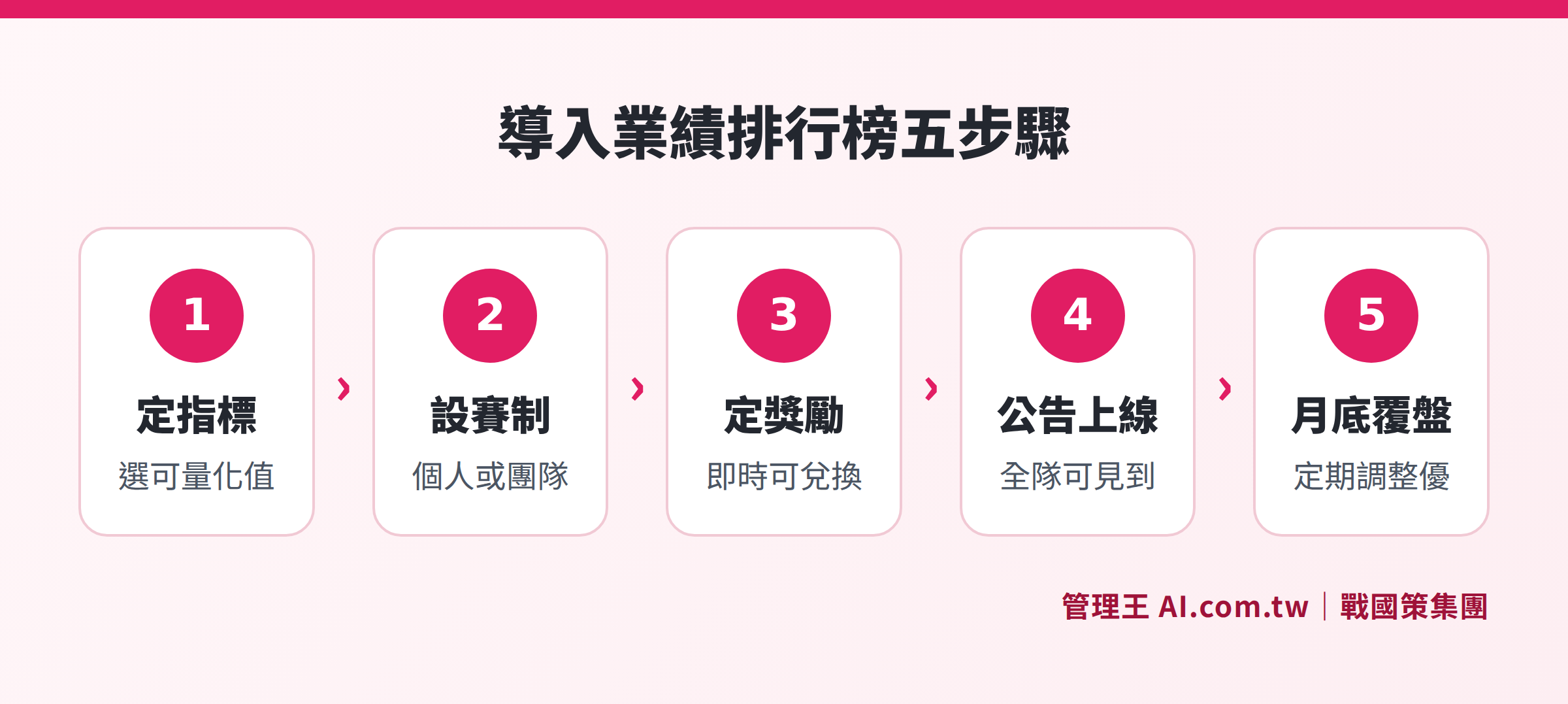
From defining indicators to regular reviews, five steps to establish a sustainable sales incentive ranking system.
Successfully implementing a sales leaderboard requires systematic planning rather than just "putting up the rankings." Here are five key steps:
Step 1: Confirm Core Indicators (Week 1)
First, discuss with sales managers, the boss, and senior sales representatives: what behavior do we want to drive this month? Is it acquiring new customers? Improving conversion rates? Or increasing average transaction values? Once confirmed, select 3 to 5 core indicators to avoid overwhelming salespeople with too many metrics and confusion about where to focus their efforts.
Step 2: Design the Competition System and Duration (Weeks 1 to 2)
Decide on the competition type (individual/team/branch) and the duration (daily/weekly/monthly). For first-time implementation, it is recommended to start with a "monthly individual leaderboard" and refine it to a weekly or multiple competition formats once the acceptance level among sales staff is confirmed.
Step 3: Design Reward and Honor Mechanisms (Week 2)
The leaderboard needs to be linked with rewards to have a sustained effect. It is advisable that the reward design follows the principles of "timeliness" (immediate point or bonus triggers upon order closure) and "publicity" (announcing the champion's list in groups or systems). Honor designs can include: monthly champion medals, quarterly best salespeople, annual honor lists, etc., allowing long-term accumulation of a sense of achievement.
Step 4: Implement the System, Making It Visible to the Whole Team (Week 3)
The effectiveness of the sales leaderboard relies heavily on "timeliness" and "accessibility"—salespeople must be able to view current rankings anytime on their smartphones. This step requires implementing a business management system that integrates automatically with CRM, quotations, and contracts, ensuring that each order closure and quotation submission is automatically counted in rankings without manual updates; otherwise, lack of real-time data can undermine credibility.
Step 5: Regular Review and Adjustments (Monthly)
Hold a 15-30 minute leaderboard review meeting at the end of each month, allowing salespeople to understand the reasons behind their ranking changes, with supervisors providing targeted guidance. Additionally, evaluate whether any indicator designs need adjustments: if a particular indicator is consistently ignored by all salespeople, it could mean there is an issue with its design or that it is disconnected from actual work.
Common Errors in Sales Leaderboard Design
Error 1: Ranking Only by Transaction Amount, Ignoring Behavioral Indicators
Ranking purely by monetary value leads salespeople to chase large clients, neglecting smaller or long-term potential clients, resulting in a decline in overall business development capability.
Error 2: Slow Updates to the Leaderboard, Losing the Sense of Real-Time Feedback
A leaderboard that updates only weekly has little motivational impact. If salespeople must wait a week to see their ranking changes, the connection between behavior and feedback becomes too weak.
Error 3: Newcomers Competing with Veteran Salespeople, Discouraging New Hires
Having no distinct track for newcomers results in them always being at the bottom of the rankings, creating a learned helplessness of "I'll never win anyway" and accelerating early turnover.
Error 4: Including Quota Comparison Publicly
Research indicates that displaying both "salesperson's actual performance vs quota targets" on the leaderboard is less motivating than a pure ranking leaderboard—salespeople do not like having their "performance gaps" made public. It is recommended to address quota management in one-on-one discussions, with the leaderboard only highlighting positive performance achievements.
Error 5: Leaderboard Not Linked to Rewards
If "making the leaderboard" only results in a title without tangible returns, the long-term motivational effect will rapidly diminish. At least one meaningful reward mechanism should be designed—whether cash bonuses, gift cards, extra vacation days, or prioritizing customer selections.
How to Establish a Sales Leaderboard Using 管理王
管理王 AI.com.tw Sales Leaderboard System is an integrated sales incentive tool designed for small and medium enterprises in Taiwan, deeply integrated with CRM, quotations, and contracts, requiring no additional API integration.
Multi-Dimensional Real-Time Ranking: Simultaneously display six major indicators: monthly transaction amount, number of quotations, number of clients quoted, conversion rates, average transaction values, and number of new customers; rankings are immediately re-sorted after each transaction closure, allowing salespeople to check their ranking on their phones at any time.
Newcomer Protection Mechanism: Sales employees within three months of hiring automatically enter an independent ranking track, avoiding suppression by high-performing veterans, effectively maintaining newcomer morale.
Automated Reward Linkage: The leaderboard is natively integrated with the reward system, automatically triggering bonus points and performance calculations upon ranking; the performance assessment system can also directly utilize leaderboard data, saving time on manual report sorting.
Daily Sales Reports and GPS Field Integration: The Sales Daily Report System automatically compiles the number of calls and visits each day, and field visit check-ins ensure that behavioral indicators can be referenced, allowing the leaderboard to track not just closing results but also the sales process.
AI-Assisted Analysis: The AI Call Coach can analyze sales call content and provide improvement suggestions; the CRM system's AI opportunity scoring helps salespeople focus on high-value customers, improving overall conversion rates.
Free Plan Available Permanently: 管理王 offers a free plan allowing small and medium enterprises to try core functions such as the sales leaderboard, CRM, and quotations at no cost. Upgrading to a paid plan (NT$5,000 to NT$19,900/month) unlocks advanced AI analysis and unlimited member numbers. For more details, see the pricing page.
戰國策集團 serves over 30,000 enterprises, with every feature of the 管理王 sales leaderboard designed to meet the real needs of small and medium enterprises in Taiwan, with a 100% Traditional Chinese interface, complying with Taiwan's business practices and labor regulations.
Establish Your Sales Leaderboard Today and Make Performance Competition Transparent
Management consultants from 管理王 assist you in designing a sales leaderboard and reward system suitable for your team size. Free trial of the full-featured system, no credit card required.
Free consultation hotline: 0800-003-191
LINE Official Account: @119m
Official website: app.AI.com.tw
Free trial: Apply for 管理王 now
Frequently Asked Questions
Do Sales Leaderboards Need to Be Publicly Visible to Everyone?
They do not necessarily have to be publicly visible to everyone, but research shows that named leaderboards (where salespeople can see their and their colleagues' names) enhance target achievement rates while also reducing turnover rates more than anonymous leaderboards. It is recommended that at least the internal sales team sees everything, though supervisors can set it so that leaderboards are only visible to salespeople and supervisors, adjusting flexibly based on company culture.
How Can New Hires Compete with Veterans Without Being Suppressed?
Creating an independent track for newcomers is the most straightforward solution—salespeople within three months of hiring automatically enter the newcomer leaderboard, competing against their peers and seeing their own growth rather than focusing on the gap with veterans. Additionally, incorporating a "target achievement rate" indicator (personal performance ÷ personal goals) allows those with different goals to compete fairly on the same basis, eliminating the unfairness caused by absolute values.
How Often Should the Sales Leaderboard Be Updated?
It is recommended that behavioral indicators (number of visits, number of quotations) update automatically every day, and transaction amounts should update in real time (each time an order is closed). Avoid updating only weekly—the more immediate the feedback, the clearer the link between behavior and outcome, and the stronger the motivational effect. Having a systematic CRM and business management tool that can automatically integrate orders saves the hassle of manual updates.
How Should the Sales Leaderboard Link to Year-End Bonuses or Commission?
Establish clear rules: for example, "the monthly champion receives an additional 10% of one month's commissions as an honor bonus" or "the quarterly champion can prioritize the selection of key customers for the next quarter." The rules should be announced to all salespeople before the leaderboard implementation so that they understand from the beginning what the rewards for their efforts will be, enhancing the predictability of motivation.
Is the Sales Leaderboard Suitable for Small Companies with Only 3 to 5 Salespeople?
It is entirely suitable. With fewer people, the effects of the leaderboard are even more noticeable—the changes in each person's rank are easier to see, making competition more direct. Small sales teams are recommended to start with a simple design of "individual monthly rankings + daily behavior points," without needing complex competition designs; the main focus should be on ensuring numerical updates are automatic, and rankings are always accessible.
Sources
- Gamification in virtual sales training: evidence from a field experiment (Taylor & Francis, 2024)
- Gamified human resource management as a driver of employee engagement through intrinsic motivation (PubMed Central, 2025)
- Gamification of task performance with leaderboards: A goal setting experiment (Computers in Human Behavior, 2015)
- 管理王 AI.com.tw Sales Leaderboard Feature Page (Checked November 2026)
- Designing an Employee Reward System: A Complete Guide for Small and Medium Enterprises (管理王 Blog)